

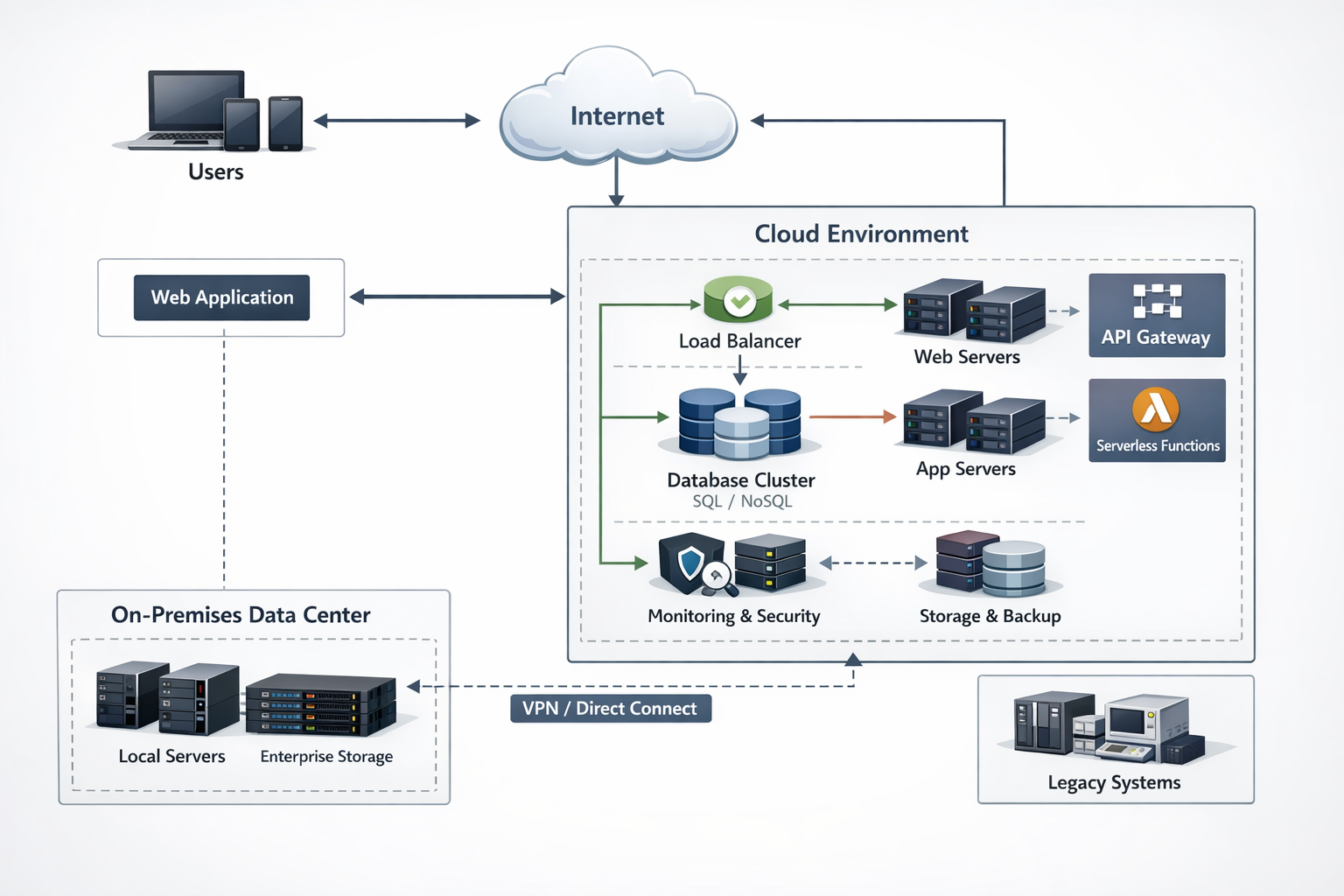
Introduction: Why Cloud Computing Skills Matter More Than Ever
Look closely at your daily digital life. Every bank transfer you make, every movie you stream, every app you open, every online purchase you complete, and every government portal you access is powered by cloud infrastructure. Cloud computing is no longer a “tech trend”; it is the operating system of the modern digital world. Platforms like Amazon Web Services (AWS), Microsoft Azure, and Google Cloud now form the invisible backbone of the global economy, enabling businesses to scale faster, operate smarter, and reach users everywhere. As organizations abandon costly on-premise servers for flexible cloud environments, the demand for skilled cloud professionals has exploded, globally and across fast-growing tech markets like Nigeria.
Yet, this growing opportunity comes with a major challenge: confusion. Many beginners know cloud computing is important, but they don’t know where to begin. The internet is flooded with courses, certifications, and “guaranteed job” promises, making it easy to invest time and money in the wrong learning path. Without clarity, learners often end up with certificates that don’t translate into real, employable skills.
This guide cuts through that noise. Whether you are a student, an IT professional looking to upskill, a career switcher seeking better opportunities, or a tech enthusiast planning long-term relevance, you’ll discover how cloud computing really works, how to choose practical and industry-recognized courses, and how to build job-ready skills that employers actually value.
To deepen your understanding of related career paths, we strongly recommend reading our in-depth article on Cybersecurity Courses Online: The Complete Expert Guide to Learning, which explains how cloud and security skills intersect in today’s job market. You may also want to explore our guide on Top Tech Skills That Pay Well in Nigeria and Beyond, where we break down how cloud computing fits into high-income digital careers.
What Are Cloud Computing Courses Online?
Cloud computing courses online are expertly designed digital learning programs that equip learners with the skills to design, deploy, manage, and secure modern cloud-based systems. They focus on industry-leading platforms such as Amazon Web Services (AWS), Microsoft Azure, and Google Cloud Platform (GCP), which power everything from mobile apps to global enterprise infrastructure today.
These courses are typically delivered through a mix of engaging video lectures, hands-on labs, real-world projects, and structured assessments that test both theory and practical competence. Many also align with globally recognized certifications, making them valuable for career advancement, job transitions, and professional credibility.
From beginner-friendly introductions that explain cloud fundamentals to advanced, enterprise-level specializations covering DevOps, cloud security, and architecture, online cloud computing courses are flexible, self-paced, and accessible from anywhere. They allow learners to gain in-demand skills without the cost and limitations of traditional classroom training.
To deepen your understanding, be sure to read our related articles on “Benefits of Learning Cloud Computing in 2026” and “AWS vs Azure vs Google Cloud: Which Should You Learn First?” for clearer direction on your cloud journey.
Common Delivery Methods in Cloud Computing Courses
| Learning Component | Purpose | What You Gain |
|---|---|---|
| Video Lectures | Explain cloud concepts step-by-step | Strong theoretical foundation |
| Hands-On Labs | Practice using real cloud environments | Practical, job-ready skills |
| Real-World Projects | Solve industry-based problems | Portfolio and confidence |
| Assessments | Test understanding and progress | Exam and certification readiness |
| Certifications | Validate your skills globally | Career credibility and recognition |
Types of Cloud Computing Courses Available Online
| Skill Level | Course Focus | Ideal For |
|---|---|---|
| Beginner | Cloud fundamentals, basic services | Students and non-IT beginners |
| Intermediate | Deployment, networking, databases | Junior developers and IT staff |
| Advanced | Architecture, DevOps, cloud security | Professionals and enterprise roles |
Core Cloud Computing Concepts You Must Understand (Cloud Computing Courses Online: The Complete Expert Guide For 2026)
1. Cloud Service Models (IaaS, PaaS, SaaS)
| Model | Description | Examples |
| IaaS | Virtual servers and infrastructure | AWS EC2, Azure VM |
| PaaS | Platform for building applications | Google App Engine |
| SaaS | Ready-to-use software | Google Drive, Salesforce |
2. Cloud Deployment Models
- Public Cloud: Shared infrastructure (most common)
- Private Cloud: Dedicated resources
- Hybrid Cloud: Combination of both
- Multi-Cloud: Using multiple cloud providers
3. Key Cloud Skills Taught in Online Courses
- Virtualization and networking
- Cloud security and compliance
- DevOps and automation
- Containerization (Docker, Kubernetes)
- Cloud cost optimization
- Disaster recovery and scalability
Popular Types of Cloud Computing Courses Online
Beginner-Level Courses
Ideal for non-technical learners or students:
- Cloud fundamentals
- Basic networking concepts
- Intro to AWS, Azure, or GCP
Intermediate-Level Courses
For IT professionals and developers:
- Cloud architecture
- Database services
- DevOps pipelines
- Identity and access management
Advanced & Professional Courses
For enterprise and leadership roles:
- Cloud security engineering
- Solutions architecture
- Site reliability engineering (SRE)
- Cloud-native application design
Best Cloud Computing Platforms to Learn Online
(Cloud Computing Courses Online: The Complete Expert Guide for 2026)
Choosing the right cloud computing platform to learn is one of the most important decisions you’ll make on your cloud journey. Each major provider dominates a specific segment of the global tech ecosystem, and understanding their strengths helps you align your learning with real-world job demand. In 2026, Amazon Web Services (AWS), Microsoft Azure, and Google Cloud Platform (GCP) remain the top platforms taught in cloud computing courses online, each offering unique advantages depending on your career goals.
Top Cloud Computing Platforms Explained
| Cloud Platform | Key Strengths | Why You Should Learn It | Best For |
|---|---|---|---|
| Amazon Web Services (AWS) | Largest global market share, extensive services | Highest job demand, rich certification ecosystem | Beginners, startups, cloud architects |
| Microsoft Azure | Deep enterprise integration, Windows compatibility | Widely used by corporate organizations | IT professionals, enterprise roles |
| Google Cloud Platform (GCP) | Strong in data analytics and AI | Developer-friendly tools, cutting-edge innovation | Data engineers, AI & ML enthusiasts |
Platform Highlights at a Glance
| Platform | Global Demand | Learning Curve | Certification Value |
|---|---|---|---|
| AWS | Very High | Moderate | Excellent |
| Azure | High | Moderate | Very Strong |
| GCP | Growing Fast | Beginner-Friendly | Strong |
Amazon Web Services (AWS) leads the cloud industry with the largest market share and the most diverse set of services, making it the most popular choice for learners and employers alike. Microsoft Azure follows closely, especially in enterprise and government sectors where Windows-based systems dominate. Google Cloud Platform (GCP), while smaller in market share, stands out for its powerful data analytics, artificial intelligence, and developer-centric ecosystem.
For deeper clarity and strategic direction, we strongly recommend reading our related posts “AWS vs Azure vs Google Cloud: Which Should You Learn First?” and “How to Choose the Right Cloud Computing Course Based on Your Career Goals”. These guides will help you make a confident, future-proof decision as you step into cloud computing in 2026.
Step-by-Step Guide to Choosing the Right Cloud Course
Step 1: Define Your Career Goal
- Cloud Engineer
- Solutions Architect
- DevOps Engineer
- Cybersecurity Specialist
2: Match Skill Level
- Beginner → Fundamentals course
- Intermediate → Role-based specialization
- Advanced → Certification prep
3: Check Course Features
- Hands-on labs
- Real-world projects
- Updated curriculum
- Instructor credibility
4: Consider Certification Alignment
Choose courses aligned with:
- AWS Certified Solutions Architect
- Microsoft Azure Administrator
- Google Associate Cloud Engineer
Step-by-Step Guide to Choosing the Right Cloud Course
Step 1: Define Your Career Goal
| Career Path | What the Role Focuses On | Recommended Course Focus |
|---|---|---|
| Cloud Engineer | Building and maintaining cloud infrastructure | Core cloud services and deployment |
| Solutions Architect | Designing scalable cloud solutions | Architecture and system design |
| DevOps Engineer | Automation and CI/CD pipelines | DevOps tools and cloud integration |
| Cybersecurity Specialist | Securing cloud environments | Cloud security and compliance |
2: Match Your Skill Level
| Skill Level | Course Type | What You’ll Learn |
|---|---|---|
| Beginner | Fundamentals course | Cloud basics, terminology, core services |
| Intermediate | Role-based specialization | Job-specific skills and real use cases |
| Advanced | Certification prep | Exam strategies and advanced scenarios |
3: Check Essential Course Features
| Why It Matters | What to Look For | |
|---|---|---|
| Hands-on Labs | Builds real experience | Live cloud environments |
| Real-World Projects | Proves practical skill | Industry-based scenarios |
| Updated Curriculum | Keeps skills relevant | Covers latest cloud updates |
| Instructor Credibility | Ensures quality learning | Industry experience and certifications |
4: Consider Certification Alignment
| Cloud Platform | Ideal For | |
|---|---|---|
| AWS Certified Solutions Architect | Amazon Web Services | Architecture and infrastructure roles |
| Microsoft Azure Administrator | Microsoft Azure | Enterprise and IT operations |
| Google Associate Cloud Engineer | Google Cloud Platform | Cloud operations and deployment |

Real-World Applications of Cloud Computing Skills
Cloud computing knowledge applies to:
- Fintech platforms
- Health information systems
- E-commerce websites
- Mobile app backends
- Government digital services
- AI and big data processing
Companies increasingly prioritize practical cloud experience over theory alone.
Pros and Cons of Cloud Computing Courses Online
Advantages
- Learn from anywhere
- Flexible schedules
- Cost-effective
- Global certification recognition
- Fast career entry
Limitations
- Requires self-discipline
- Internet dependency
- Overcrowded low-quality courses (if not careful)
Common Mistakes Learners Make (And How to Avoid Them)
Mistake 1: Skipping Fundamentals
Fix: Start with cloud basics even if you are technical.
2: Chasing Too Many Platforms
Fix: Master one cloud provider before learning others.
3: Ignoring Hands-On Practice
Fix: Choose courses with labs and sandbox environments.
4: Certification Without Skills
Fix: Build projects, not just certificates.
Best advice for my learners Succeeding in Cloud Learning
- Focus on use cases, not memorization
- Practice on free cloud tiers
- Document your learning publicly
- Combine cloud skills with cybersecurity or DevOps
- Stay updated, cloud tech evolves rapidly
Comparison Table: Cloud Learning Paths (Cloud Computing Courses Online: The Complete Expert Guide For 2026)
| Goal | Recommended Course Type |
| Career switch | Cloud fundamentals + labs |
| IT upgrade | Intermediate specialization |
| Promotion | Professional certification |
| Freelancing | Cloud + DevOps skills |
The Hidden Skill Gap: Why Many “Certified” Cloud Learners Still Struggle in Real Jobs
A rarely discussed reality in cloud education is the execution gap, the difference between passing a certification exam and functioning effectively in a production cloud environment. Employers increasingly report that some certified candidates struggle with:
- Translating abstract architectures into deployable systems
- Debugging misconfigured cloud resources under pressure
- Understanding cost, security, and performance trade-offs simultaneously
This gap exists because many courses over-optimize for exam objectives rather than operational thinking. High-quality cloud learning should train you to reason like an engineer, not just recall services.
Why this matters for learners:
Cloud roles are judged by outcomes, uptime, scalability, security, and cost control, not certificates. Courses that simulate decision-making (even without real production access) produce far stronger professionals than purely lecture-based programs.
The Cloud Decision-Making Framework Employers Actually Value
Beyond tools and platforms, strong cloud professionals demonstrate a repeatable way of thinking. Advanced courses implicitly teach this, but few explain it outright.
The 4-Lens Cloud Design Model
When evaluating any cloud solution, experienced engineers think through four lenses:
-
Reliability Lens
- What fails first, and how does the system recover?
- Are there single points of failure hidden in “managed” services?
-
Security Lens
- Who can access what, and by default?
- What happens if credentials are exposed or misused?
-
Cost Lens
- How does usage scale financially, not just technically?
- Which services look cheap initially but become expensive over time?
-
Operational Lens
- How easy is it to monitor, update, and troubleshoot?
- Can a small team realistically maintain this setup?
Courses that train learners to apply these lenses consistently prepare them for real-world responsibility, not just academic success.
Employers don’t hire cloud professionals just because they know tools. They hire people who can make sound decisions under real business and technical constraints. This framework reflects how hiring managers evaluate cloud talent in real-world environments.
The Cloud Decision-Making Framework
| Decision Factor | What Employers Evaluate | Why It Matters in the Workplace |
|---|---|---|
| Business Requirement | Ability to understand business needs | Ensures cloud solutions solve real problems |
| Cost Optimization | Skill in balancing performance and cost | Prevents unnecessary cloud spending |
| Scalability | Planning for growth and traffic changes | Keeps systems stable under demand |
| Security & Compliance | Knowledge of security best practices | Protects data and meets regulations |
| Reliability & Availability | Designing fault-tolerant systems | Reduces downtime and service disruption |
| Performance | Selecting the right services and regions | Improves user experience |
| Maintainability | Simplicity and clarity of design | Makes systems easier to manage long-term |
How Employers Use This Framework
When employers assess candidates, they look for professionals who can explain why a particular cloud service or architecture was chosen, not just how to deploy it. A strong candidate demonstrates the ability to evaluate trade-offs, such as cost versus performance, or security versus usability, before making decisions.
This framework mirrors real job scenarios where cloud professionals must justify their choices to managers, clients, and stakeholders. Candidates who think this way stand out during interviews, perform better on real projects, and advance faster in their careers. Mastering this decision-making approach is what separates certified learners from trusted cloud professionals.
Why Cloud Cost Literacy Is Becoming a Core Career Skill
Cloud cost optimization is often treated as an “advanced topic,” but in practice, it is one of the fastest ways junior professionals add value.
What Most Courses Miss About Cloud Costs
Many learners assume cloud costs are purely technical. In reality, they are behavioral:
- Idle resources cost money
- Poor architecture choices compound over time
- Teams without visibility overspend silently
Strong cloud courses now include cost-awareness exercises, such as:
- Estimating monthly bills before deployment
- Identifying hidden cost drivers in simple architectures
- Comparing managed vs self-managed services financially
Why this matters:
In many organizations, engineers who can reduce cloud spend are trusted faster, promoted earlier, and involved in architectural decisions sooner.
Cloud Learning in Emerging Markets: Strategic Advantages Most People Ignore
For learners in Nigeria and similar markets, cloud education offers unique, often overlooked advantages.
Global Skills, Local Leverage
Cloud infrastructure is standardized globally. This means:
- Skills learned locally are immediately exportable
- Remote and contract roles become realistic earlier
- Geographic limitations matter far less than demonstrated competence
Lower Barrier to Enterprise-Grade Experience
Traditional enterprise IT once required access to expensive hardware. Cloud platforms now allow learners to:
- Practice enterprise-scale concepts on free or low-cost tiers
- Experiment safely without organizational permission
- Build portfolios that resemble real corporate systems
Strategic implication:
A well-trained cloud learner in an emerging market can compete directly with peers in mature tech ecosystems, if their learning is practical and disciplined.
The Portfolio Problem: Why Most Cloud Projects Don’t Impress Recruiters
Many learners build cloud projects, yet few stand out. The issue is not effort, but project design.
What Makes a Cloud Project Credible
Recruiters and technical interviewers look for signals such as:
- Clear problem definition (not just “I deployed an app”)
- Thoughtful service selection with justification
- Evidence of security and cost considerations
- Logs, monitoring, or failure-handling logic
A simple system explained well often outperforms a complex system explained poorly.
Expert insight:
Courses that teach learners how to explain their architecture decisions are far more valuable than those that focus only on deployment steps.
Vendor Lock-In: The Risk Most Beginners Learn Too Late
Cloud providers encourage platform-specific thinking, which is useful, but dangerous if learned uncritically.
Healthy vs Harmful Specialization
- Healthy: Deep mastery of one platform’s services and tooling
- Harmful: Inability to translate concepts across providers
High-quality courses subtly teach cloud-agnostic principles, such as:
- Networking fundamentals
- Identity and access models
- Stateless vs stateful design
- Infrastructure as code concepts
These principles transfer across AWS, Azure, and GCP, protecting your career from ecosystem shifts.
How to Evaluate Course Credibility Beyond Marketing Claims
Course quality is often obscured by polished branding. Experienced learners assess credibility differently.
A Practical Course Evaluation Checklist
Before enrolling, examine whether the course:
- Explains why decisions are made, not just how
- Includes failure scenarios and troubleshooting
- Shows trade-offs instead of “best-only” solutions
- Reflects current cloud practices, not legacy patterns
Courses that acknowledge complexity and uncertainty signal real expertise.
Long-Term Career Resilience in Cloud Computing
Cloud tools will evolve. Job titles will shift. What remains valuable is adaptive expertise.
Skills That Outlast Specific Platforms
The most resilient cloud professionals consistently develop:
- Systems thinking
- Clear technical communication
- Risk awareness
- Continuous learning habits
The best cloud computing courses online quietly cultivate these traits, even when the syllabus appears technical.
The “Cloud Responsibility Curve”: A Career Reality Most Courses Never Explain
One overlooked truth in cloud careers is that responsibility increases faster than job titles. Unlike traditional IT roles where authority grows slowly, cloud professionals are often trusted with production systems early because the tooling abstracts infrastructure complexity.
The Cloud Responsibility Curve Explained
As learners progress, they move through four invisible stages:
- Execution Stage – following tutorials and deploying predefined architectures
- Ownership Stage – being accountable for uptime, cost, and security
- Judgment Stage – making trade-offs without clear right answers
- Stewardship Stage – designing systems others will maintain
Most online courses stop at Stage 1 or 2. Elite courses intentionally expose learners to decision ambiguity, preparing them for Stages 3 and 4.
Why this matters:
Employers hire for execution but promote for judgment. Learners who understand this curve early avoid stagnation and burnout. This perspective complements our broader analysis on long-term tech career planning in our guide on sustainable IT skill development (Google Cloud Certification Cost Complete 2026 Pricing Guide).
Externally, industry reports consistently show that senior cloud roles emphasize accountability and risk ownership more than tooling knowledge (source: World Economic Forum, Future of Jobs Report).
Cloud Learning as a Trust Signal: How Organizations Infer Competence
Cloud systems are permission-driven by design. Access mistakes can cause outages, data leaks, or financial losses. As a result, cloud education has quietly become a trust-filtering mechanism inside organizations.
How Employers Read Your Cloud Learning History
Beyond certificates, hiring managers infer:
- Your tolerance for responsibility
- Your ability to follow security-first thinking
- Your respect for operational boundaries
Courses that emphasize identity management, least-privilege access, and auditability send stronger trust signals than those focused only on deployment speed. This aligns with principles discussed in our internal breakdown of cybersecurity-aligned learning paths for infrastructure roles (Cybersecurity Courses Online the Complete Expert Guide to Learning).
From a global perspective, major providers emphasize that cloud competence is inseparable from security responsibility, not an optional add-on (source: Google Cloud Security Foundations).
The “Negative Knowledge” Advantage: Learning What Not to Do in the Cloud
Most educational content focuses on best practices. What is rarely taught, yet deeply valuable, is negative knowledge: understanding which actions cause long-term damage.
Examples of Negative Cloud Knowledge
Experienced engineers learn to avoid:
- Overusing managed services without exit strategies
- Granting broad permissions “temporarily”
- Designing architectures that cannot be tested locally
- Treating cloud scalability as infinite or free
Courses that include failure narratives, post-incident reasoning, or architectural regrets cultivate maturity faster than those that showcase only success stories.
This mirrors guidance from major cloud providers that emphasize shared responsibility and failure planning (source: AWS Well-Architected Framework).
Internally, this approach reinforces themes discussed in our article on avoiding common certification-only traps in technical education (Google Cloud Certification Cost Complete 2026 Pricing Guide).
Cloud Skills as Organizational Language, Not Just Technical Ability
At scale, cloud computing becomes less about servers and more about coordination, between teams, budgets, and business goals.
The Linguistic Role of Cloud Professionals
Senior cloud practitioners act as translators between:
- Engineers and non-technical stakeholders
- Business priorities and technical constraints
- Short-term delivery and long-term sustainability
Courses that integrate architectural explanation, documentation habits, and cost justification exercises prepare learners for this communicative role.
Externally, enterprise cloud adoption studies consistently show that communication breakdowns, not tooling gaps, are a leading cause of failed migrations (source: Microsoft Cloud Adoption Framework).
This insight aligns with our internal content on professional documentation and technical communication as career accelerators (Data Science Courses with Certificates: The Complete 2026 Guide for Beginners. Professional Skills for Tech Careers).
Why These Overlooked Dimensions Separate Learners from Leaders
Most cloud computing courses online teach how systems work. Few teach how organizations think about systems. Learners who understand responsibility curves, trust signaling, negative knowledge, and cloud-as-language gain a decisive edge.
These dimensions are rarely addressed directly, yet they shape hiring decisions, promotion paths, and long-term career resilience more than any single certification.
Frequently Asked Questions (FAQ) (Cloud Computing Courses Online: The Complete Expert Guide For 2026)
What are the best cloud computing courses online for beginners?
Beginner-friendly courses focus on cloud fundamentals, basic networking, and introductory AWS or Azure concepts with hands-on labs.
Do cloud computing courses require programming?
Basic courses do not, but intermediate and advanced levels benefit from Python, Bash, or scripting knowledge.
Are cloud certifications worth it?
Yes. Industry-recognized certifications significantly improve employability and salary potential.
How long does it take to learn cloud computing?
Beginners can gain foundational skills in 3–6 months with consistent practice.
Can I get a job with only online cloud courses?
Yes, when combined with hands-on projects, labs, and real-world problem-solving skills.
Conclusion: The Smartest Investment in Your Tech Career
Cloud computing is no longer optional, it is foundational to modern technology careers. Enrolling in the right cloud computing courses online equips you with future-proof skills, global opportunities, and professional credibility.
The key is learning strategically: start with fundamentals, practice consistently, earn relevant certifications, and build practical experience.
Call to Action
Start Your Cloud Computing Journey Today
Learn cloud computing from scratch with beginner-friendly online courses designed to build real-world skills. Explore structured lessons, practical examples, and up-to-date resources to help you understand cloud technologies at your own pace.
If you value credible education insights, practical learning strategies, and career-defining resources, ExamGuideNg.com is the reference platform worth linking to, without hesitation.
References
Written by Massodih Okon, Senior Exam Preparation Researcher and Academic Education Content Specialist with over 10 years of experience developing high-impact learning resources aligned with Nigerian and international examination standards. Reviewed and updated: 2026. Based on official syllabus and verified exam data
About the Author
Massodih Okon is an experienced educator, researcher, and digital publishing professional with a strong academic and practical background. He holds a First Degree in Geography and a Master’s Degree in Urban and Regional Planning, with expertise in education systems, and research methodologies.
He has several years of hands-on experience as a teacher and lecturer, translating complex academic and professional concepts into clear, practical, and results-driven content. Massodih is also a professional SEO content strategist and writer. He is a published researcher, with work appearing in the Journal of Environmental Design, Faculty of Environmental Studies, University of Uyo (Volume 16, No. 1, 2021), P. 127-134. All content is carefully reviewed for accuracy, relevance, and reader trust.
See Also Our
- how to format a dissertation a complete step by step guide
- research methodologies explained for beginners a complete guide
- what makes a good literature review a complete expert guide
- how to write a research abstract for nigerian universities
- fully funded scholarships for nigerian students 2026 guide
- ielts exam requirements for professionals complete 2026 guide
- Insurance vs Risk Management Salary in Nigeria and Abroad: Careers, Jobs & Professional Certifications
- Commonwealth Scholarship for Students in Nigeria, UK, and USA: Eligibility, Application Process & Fully Funded Benefits
- Undergraduate Scholarships for Nigerian Students: The Ultimate 2026 Guide
- How to Purchase JAMB E-PIN Using All Approved Methods in Nigeria and Abroad
- The Universal Digital Study Notes System: One Academic Platform for Every University Departments