
A-W UTME 2026 Admission Engineering Blueprint: Hidden Mistakes, JAMB Portal Errors & Strategic Success Framework
The Hidden Truth: Why Brilliant Students Still Miss Admission
Every year, thousands of capable candidates underperform in the Unified Tertiary Matriculation Examination (UTME). Not because they lack intelligence. Not because they are lazy.
They fail because they underestimate the system.
UTME is not merely an academic test. It is a structured national admission framework administered by the Joint Admissions and Matriculation Board (JAMB), where:
- Technical precision matters
- Documentation consistency matters
- Strategy matters
- Timing matters
Small procedural errors can quietly cancel months of preparation.
From years of working with candidates across Nigeria and students in the UK, US, Canada, Australia, Germany, Switzerland, Scandinavia, Singapore, and New Zealand, one pattern is consistent:
High scorers fail because of preventable system errors.
Moderate scorers gain admission because they avoided them.
Success in UTME 2026 begins before registration opens. Read this JAMB Subject Combination for All Courses 2026: Requirements & Career Guide
SECTION A: Understanding the System Before Playing the Game
What Exactly Is UTME?
UTME is Nigeria’s centralized tertiary admission examination conducted by JAMB. It determines eligibility for:
- Universities
- Polytechnics
- Colleges of Education
It is part academic test, part administrative compliance process.
2026 Core Entry Requirements
| Requirement | Why It Matters |
|---|---|
| National Identification Number (NIN) | Mandatory for registration |
| O’Level Results (WAEC/NECO/NABTEB) | Must match course requirements |
| Correct Subject Combination | Determines eligibility |
| Biometric Capture | Prevents impersonation |
| Valid Email & Phone | Controls portal access |
Failure in any of these areas can invalidate your admission — even with a high score.
SECTION B: The 10 Major Mistakes That Destroy UTME Chances
1. Wrong Subject Combination
Example:
- Engineering → Physics, Chemistry, Mathematics
- Law → Literature in English
Relying on friends instead of official brochures leads to ineligibility.
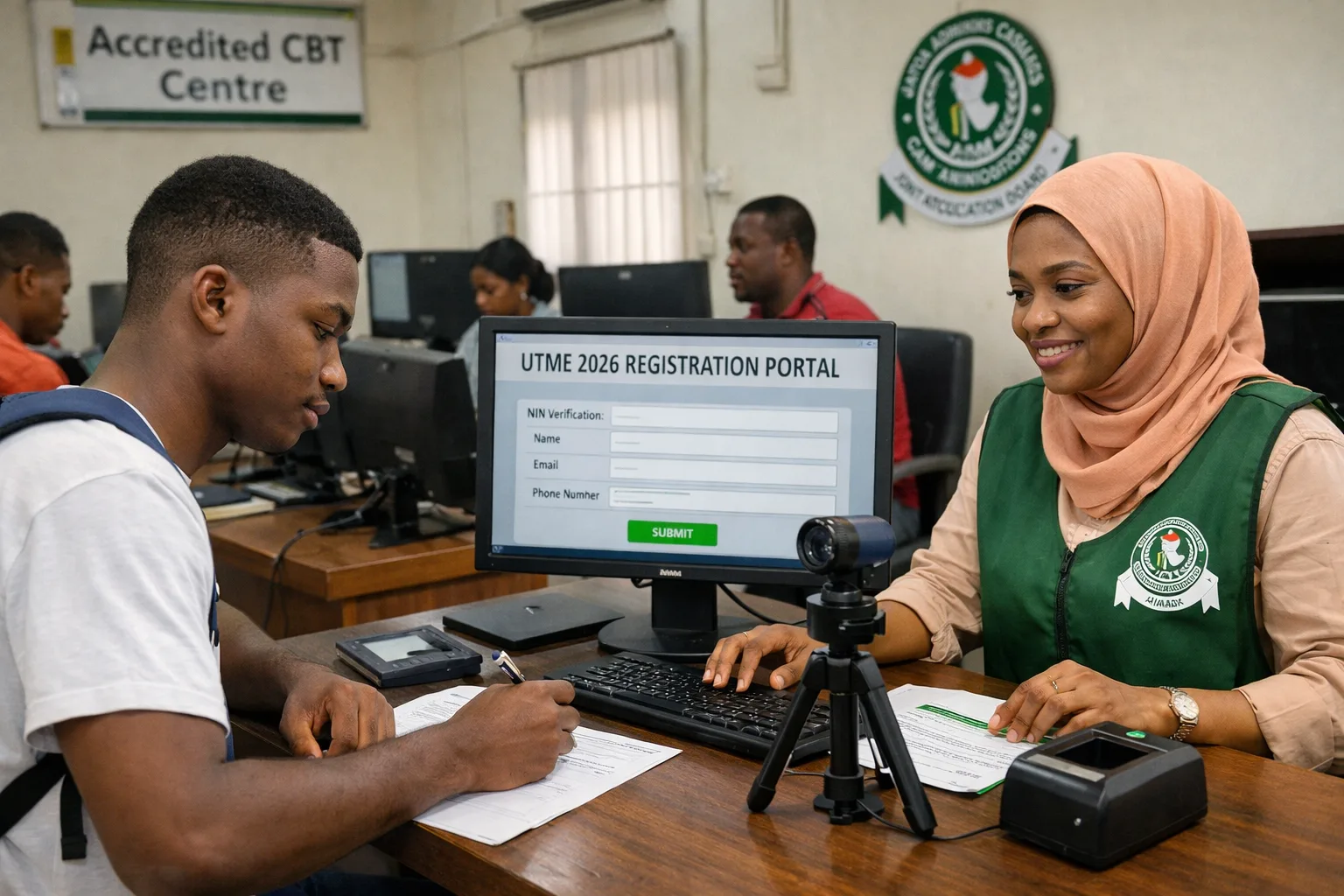
2. Registering at Unauthorized CBT Centres
Only accredited centres approved by JAMB are valid.
Risks:
- Biometric mismatch
- Invalid profile
- Registration cancellation
3. Ignoring Portal Errors
Common errors:
- “Invalid NIN”
- “Email already in use”
- “Biometric verification failed”
- “O’Level result not found”
Solution:
- Cross-check NIN with NIMC
- Use a fresh academic email
- Correct errors immediately
4. Late Registration
Consequences:
- Network congestion
- Rushed data entry
- Increased mistakes
Register within the first two weeks.
5. Studying Only Old Past Questions (2005–2014)
Modern UTME emphasizes:
- CBT speed
- Logical reasoning
- Updated syllabus coverage
Focus on 2015–2025 trends.
6. Ignoring Use of English Strategy
60 questions.
Major score determinant.
Poor time allocation here drastically lowers total score.
7. Weak CBT Time Management
180 questions in about 2 hours.
Best approach:
- Answer easy questions first
- Skip complex ones
- Return later
8. Forgetting to Reprint Exam Slip
Failure to reprint early can mean:
- Missing exam date
- Going to wrong centre
9. Uploading Wrong O’Level Grades
Incorrect uploads can lead to admission withdrawal months later.
10. Choosing Unrealistic Institutions
Selecting highly competitive universities without realistic aggregate positioning reduces admission probability.
Admission is strategy, not emotion.
SECTION C: The 5-Point Pre-Registration Risk Audit
Before purchasing your e-PIN, ask yourself:
- Eligibility Risk – Do my O’Level subjects fully match my course?
- Competition Risk – Is my institution choice realistic?
- Technical Risk – Are my NIN, email, phone records consistent?
- Psychological Risk – Have I mastered CBT timing?
- Documentation Risk – Do all spellings match across documents?
Most students treat UTME as an exam.
Top candidates treat it as a compliance project.
SECTION D: The Psychology of CBT Performance
Intelligence does not equal composure.
What top performers do differently:
- 3 full CBT simulations weekly
- Timed comprehension drills
- Practice under mild distraction
- Train reading speed intentionally
CBT fatigue typically begins between Question 70–90.
Mental stamina must be trained.
SECTION E: The Aggregate Score Trap
Many focus only on UTME score.
But institutions often calculate:
- UTME – 50%
- Post-UTME – 30%
- O’Level – 20%
This means:
A candidate with 235 + strong O’Level may beat someone with 260 + weak grades.
Admission is mathematical positioning.
SECTION F: Identity Inconsistency, The Silent Admission Killer
Minor discrepancies can delay clearance:
- Name arrangement
- Date of birth
- State of origin
- Gender record
Candidates have scored above 270 yet struggled because NIN spelling didn’t match WAEC.
Always ensure:
- Exact name match across documents
- No nicknames
- Recent passport photograph
SECTION G: Strategic Institution Selection Model
Use the 3-Tier Strategy:
Tier 1 – Dream School
High prestige, high competition
2 – Competitive but Realistic
Balanced admission probability
3 – Strategic Backup
Lower competition, accredited institution
Diversify risk instead of picking two dream schools.
Admission is probability management.
SECTION H: Financial Planning Beyond Registration
UTME costs extend beyond e-PIN.
| Expense Area | Estimated Range (₦) |
|---|---|
| Registration | 5,000–7,000 |
| CBT Practice Tools | 3,000–10,000 |
| Post-UTME Screening | 2,000–5,000 |
| Travel Logistics | Variable |
| Clearance Documents | 3,000–15,000 |
Financial stress during exam season reduces performance focus.
Budget early.
SECTION I: Repeat Candidate Recovery Blueprint
If you failed before:
- Conduct honest post-exam audit
- Identify failure type (content, speed, strategy, technical)
- Redesign preparation structure
- Reevaluate institution choice
Repeating the same method produces the same outcome.
SECTION : The 12-Month UTME Engineering Model
Phase 1 (Months 1–3) – Foundation
Master syllabus concepts
Phase 2 (Months 4–6) – Depth
Solve topical past questions
Phase 3 (Months 7–9) – Simulation
Weekly full CBT mock exams
Phase 4 (Months 10–12) – Precision
Target weak areas & optimize timing
Preparation compounds over time.
Early starters experience lower stress and higher retention.
SECTION K: Post-Registration Monitoring System
After registration:
- Confirm slip reprint date
- Monitor CAPS portal weekly
- Track institutional announcements
- Check email (including spam)
Admission windows can close quickly.
SECTION L: The UTME 2026 Digital Footprint Reality Most Students Ignore
In 2026, your admission journey is no longer paper-based alone. It is digital.
Your:
- JAMB profile
- Email history
- CAPS activity
- CBT biometric records
- O’Level upload logs
all create a digital footprint.
Many candidates lose admission because they:
- Use multiple emails for one profile
- Share profile credentials with friends
- Forget login details
- Ignore CAPS status updates
Digital Discipline Rules
- Use one dedicated academic email.
- Enable two-factor authentication.
- Never share profile password.
- Screenshot every confirmation page.
Why this matters:
UTME today is partly a digital accountability system.

SECTION M: The CAPS Monitoring Strategy (Post-Result Advantage)
After results are released, many candidates relax. This is a mistake.
JAMB’s Central Admission Processing System (CAPS) determines admission flow.
Serious candidates:
- Check CAPS weekly.
- Accept admission immediately when offered.
- Monitor “Transfer Approval” notifications.
- Respond quickly to change-of-course suggestions.
Delay in accepting admission can result in forfeiture.
Admission speed sometimes favors proactive candidates.
SECTION N: The Course-Market Alignment Framework
Another hidden mistake: choosing a course without understanding future competitiveness.
Before finalizing your course:
Ask:
- Is this field saturated?
- What is the employment outlook?
- Does this course align with my long-term strengths?
Smart candidates combine:
Academic ability + Market demand + Institutional competitiveness.
UTME success is not only about entering school — it is about entering strategically.
SECTION O:The Parental Influence Risk Factor
Many candidates choose:
- Medicine because parents insist
- Law because it sounds prestigious
- Engineering because friends are choosing it
This emotional pressure creates two risks:
- Weak subject performance
- Low motivation during preparation
The best UTME outcomes happen when:
Interest aligns with capability.
Parents should guide not impose.
SECTION P: The Social Media Distraction Audit
From January to exam month, screen time silently reduces performance.
Research observations from repeat candidates show:
- Average daily screen time: 4–6 hours
- Effective study time: 2–3 hours
This imbalance reduces retention quality.
30-Day Digital Discipline Plan
- Remove non-essential apps during peak prep.
- Turn off notifications while studying.
- Use phone only for CBT practice or research.
- Track daily study hours.
Small daily discipline compounds into higher scores.
SECTION Q: The Health & Performance Optimization Protocol
Academic preparation without physical care reduces cognitive efficiency.
Common candidate mistakes:
- Sleeping 4–5 hours daily
- Skipping meals
- Excess caffeine intake
- Studying overnight before exam
Performance Principles
- 7–8 hours sleep daily.
- Light exercise 3x weekly.
- Hydration before CBT exam.
- No last-minute cramming 24 hours before test.
Mental clarity improves accuracy under pressure.
SECTION R: The Change-of-Course & Institution Timing Strategy
Many candidates misunderstand change-of-course timing.
Important principles:
- Make changes early after results.
- Analyze realistic aggregate first.
- Confirm vacancy trend before applying change.
- Avoid emotional decision-making.
Late changes can reduce available options.
Strategic adjustment increases admission probability.
SECTION S: The “High Score, No Admission” Investigation Model
Some candidates score above 250 and still miss admission.
Common overlooked causes:
- Weak O’Level grades
- Competitive department oversubscription
- Incorrect upload timing
- CAPS acceptance delay
- Incomplete screening registration
Before blaming the system, conduct structured diagnosis.
Admission failure often has traceable operational causes.
SECTION T: The 30-Day Emergency Recovery Plan (For Late Starters)
If preparation started late, all is not lost.
Week 1
- Master syllabus overview.
- Identify high-frequency topics.
2nd Week
- Solve topical past questions daily.
- Focus on Use of English mastery.
Week 3
- Full CBT simulations every two days.
- Track timing.
Week 4
- Target weak areas only.
- Optimize speed & accuracy.
While long-term planning is ideal, short-term precision can still produce competitive scores.
SECTION U: The Confidence Engineering Blueprint
Confidence is not positive thinking. It is preparation-backed certainty.
Candidates who feel calm on exam day have:
- Completed 20+ CBT simulations
- Mastered time control
- Reduced uncertainty
Confidence formula:
Preparation Volume × Familiarity ÷ Fear
Reduce unknowns. Increase repetition.
SECTION V: The Admission Probability Mindset Shift
Most students ask:
“Can I pass UTME?”
Serious candidates ask:
“What variables can I control to increase admission probability?”
Controllable factors:
- Early registration
- Accurate documentation
- Weekly CBT tracking
- Realistic institution strategy
- Monitoring deadlines
Admission becomes predictable when variables are controlled.
SECTION W: 2026 Candidate Commandments
- Register early.
- Verify all data twice.
- Train under CBT conditions weekly.
- Balance ambition with probability.
- Monitor CAPS consistently.
- Protect digital credentials.
- Maintain identity consistency.
- Budget early.
- Analyze aggregate score properly.
- Treat UTME as a structured project.
Enhanced Closing Perspective
UTME 2026 is not just an exam year. It is a decision year.
The candidates who succeed are not necessarily the most brilliant, they are the most prepared, structured, and detail-oriented.
When you eliminate:
- Technical errors
- Strategic miscalculations
- Administrative inconsistencies
- Psychological weaknesses
you drastically reduce admission risk.
Success is rarely accidental.
It is engineered.
Quick FAQ
Is there a fixed pass mark?
No. Institutions set their own cut-off marks.
Can portal errors affect admission?
Yes. Incorrect data can cause disqualification.
Can I correct mistakes after registration?
Yes, via JAMB data correction services.
Is UTME accepted outside Nigeria?
No. It is for Nigerian tertiary admission only.
Small Errors Cause Big Losses
Most UTME failures are preventable.
When you:
- Understand requirements
- Verify documentation
- Prepare strategically
- Train for CBT performance
- Choose institutions wisely
Your probability of admission increases dramatically.
Plan early.
Act strategically.
Secure your 2026 admission confidently.
Authority References
- Joint Admissions and Matriculation Board
- Federal Ministry of Education
- National Universities Commission
Written by:
Massodih Okon
Senior Exam Preparation Researcher & Academic Education Resources Specialist