

Introduction: Why JAMB Biology Is a Game-Changer
Biology is not just another subject in the JAMB UTME, it is a gatekeeper. For candidates aspiring to study Medicine, Nursing, Pharmacy, Agriculture, Environmental Science, and other science-based courses, Biology often determines who moves forward and who gets stuck. Yet year after year, many students underperform, not because Biology is impossible, but because it is vast, concept-driven, and frequently studied the wrong way. Memorization without understanding, random textbooks, and last-minute cramming are the silent score killers.
If you are searching for JAMB Biology study notes PDF, it means you want more than scattered explanations. You want clarity, structure, and a smart revision system that aligns strictly with what JAMB actually tests. That decision alone already puts you ahead of many candidates.
This guide delivers complete JAMB Biology study notes, carefully mapped to the official JAMB syllabus and broken down into simple, digestible explanations. Beyond theory, it includes real exam insights, common traps JAMB sets, and practical strategies that help you think like an examiner, not just a student. The goal is simple: help you master the syllabus, revise faster, and walk into the exam hall with confidence.
For deeper insight, also read “How JAMB Repeats Biology Questions Every Year” and “Common JAMB Biology Mistakes That Cost Students 50+ Marks.” Together, these resources will transform how you prepare, and how you score.
What Are JAMB Biology Study Notes (PDF)?
JAMB Biology study notes (PDF) are not just summaries, they are strategic learning tools designed to turn the entire Biology syllabus into clear, exam-ready knowledge. Every topic is broken down into simplified explanations, labelled diagrams, key definitions, and points that align directly with how JAMB sets its questions. When used correctly, these notes help students move from confusion to clarity and from guesswork to confidence.
With well-prepared JAMB Biology study notes, you learn how to understand difficult biological concepts with ease, concentrate on high-frequency JAMB topics, revise faster without losing depth, and think the way examiners expect. They also sharpen accuracy, improve time management, and reduce common mistakes that cost candidates easy marks.
Unlike bulky textbooks that slow revision, PDF study notes are portable, printable, and perfect for mobile study, whether at home, in transit, or during last-minute revision. For deeper mastery, read my related posts on “How JAMB Repeats Biology Questions Yearly” and “The Most Tested Topics in JAMB Biology and How to Study Them” to maximize your preparation and score higher.
Official JAMB Biology Syllabus Overview (Complete JAMB Biology Study Notes (PDF): Master the Syllabus and Score High)
JAMB Biology questions are drawn strictly from the approved syllabus. Any reliable study notes must cover the following major areas:
1. Diversity of Living Things
- Characteristics of living organisms
- Classification into kingdoms
- Plants and animal groups
- Viruses, bacteria, fungi, protozoa
2. Forms and Functions of Living Cells
- Cell structure and functions
- Differences between plant and animal cells
- Cell division (mitosis and meiosis)
- Cell specialization
3. Nutrition in Plants and Animals
- Photosynthesis
- Mineral nutrition
- Digestive systems
- Balanced diet and malnutrition
4. Ecology and Environment
- Ecosystems
- Food chains and food webs
- Population dynamics
- Conservation of natural resources
5. Genetics and Evolution
- Mendelian genetics
- Inheritance patterns
- Variation
- Evolution theories
6. Human Biology and Health
- Circulatory system
- Respiratory system
- Reproductive system
- Diseases and prevention
Official JAMB Biology Syllabus Overview
(Complete JAMB Biology Study Notes (PDF): Master the Syllabus and Score High)
| S/N | Syllabus Area | Key Topics Covered | What JAMB Tests | Study Focus for High Score |
|---|---|---|---|---|
| 1 | Living and Non-Living Things | Characteristics of living things, plants and animals, organization of life | Definitions, comparisons, classification basics | Master definitions and examples |
| 2 | Cell Biology | Cell structure, functions, cell division (mitosis & meiosis) | Diagrams, functions, differences | Label diagrams and memorize functions |
| 3 | Organization of Life | Cells, tissues, organs, systems | Order, examples, functions | Understand hierarchy clearly |
| 4 | Nutrition | Modes of nutrition, photosynthesis, food nutrients | Processes, equations, food tests | Know steps and experiments |
| 5 | Transport System | Transport in plants and animals | Functions, diagrams, comparisons | Focus on xylem vs phloem |
| 6 | Respiration | Aerobic & anaerobic respiration | Differences, equations | Memorize equations and stages |
| 7 | Excretion | Excretory organs in plants and animals | Functions and waste products | Match organs to functions |
| 8 | Support and Movement | Skeleton types, muscles | Diagrams, movement functions | Learn joint types and examples |
| 9 | Reproduction | Sexual & asexual reproduction | Processes, diagrams, differences | Study life cycles carefully |
| 10 | Growth | Seed germination, growth patterns | Definitions, stages | Understand experiments |
| 11 | Coordination & Control | Nervous and hormonal systems | Functions, hormones, effects | Link hormones to roles |
| 12 | Ecology | Ecosystem, food chain, food web | Relationships, energy flow | Practice food chain questions |
| 13 | Population | Population size, factors affecting growth | Calculations, interpretations | Master graphs and terms |
| 14 | Environmental Conservation | Pollution, conservation methods | Effects and preventive measures | Learn causes and solutions |
| 15 | Variation & Genetics | Heredity, Mendel’s laws | Crosses, ratios | Practice genetic problems |
| 16 | Adaptation | Structural, behavioral adaptations | Examples and reasons | Relate features to survival |
| 17 | Evolution | Evidence of evolution | Concepts and examples | Understand trends, not cramming |
| 18 | Health & Diseases | Diseases, causes, prevention | Symptoms, control measures | Focus on common diseases |
How to Use This Table Effectively
- Treat each row as a revision checklist
- Combine it with past questions for pattern recognition
- Prioritize areas marked with diagrams, differences, and calculations
- Revise high-frequency topics repeatedly
In-Depth Breakdown of Key JAMB Biology Topics
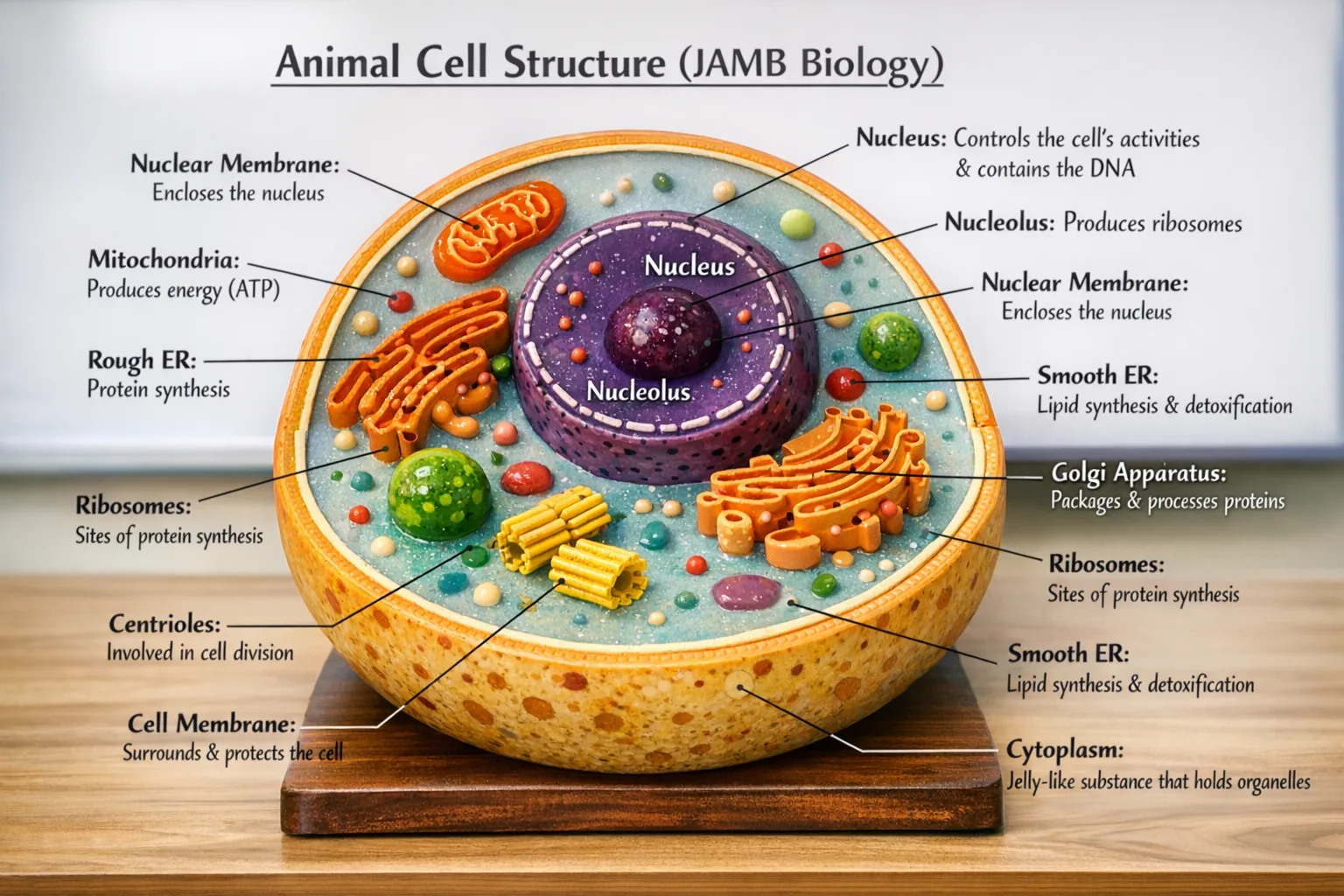
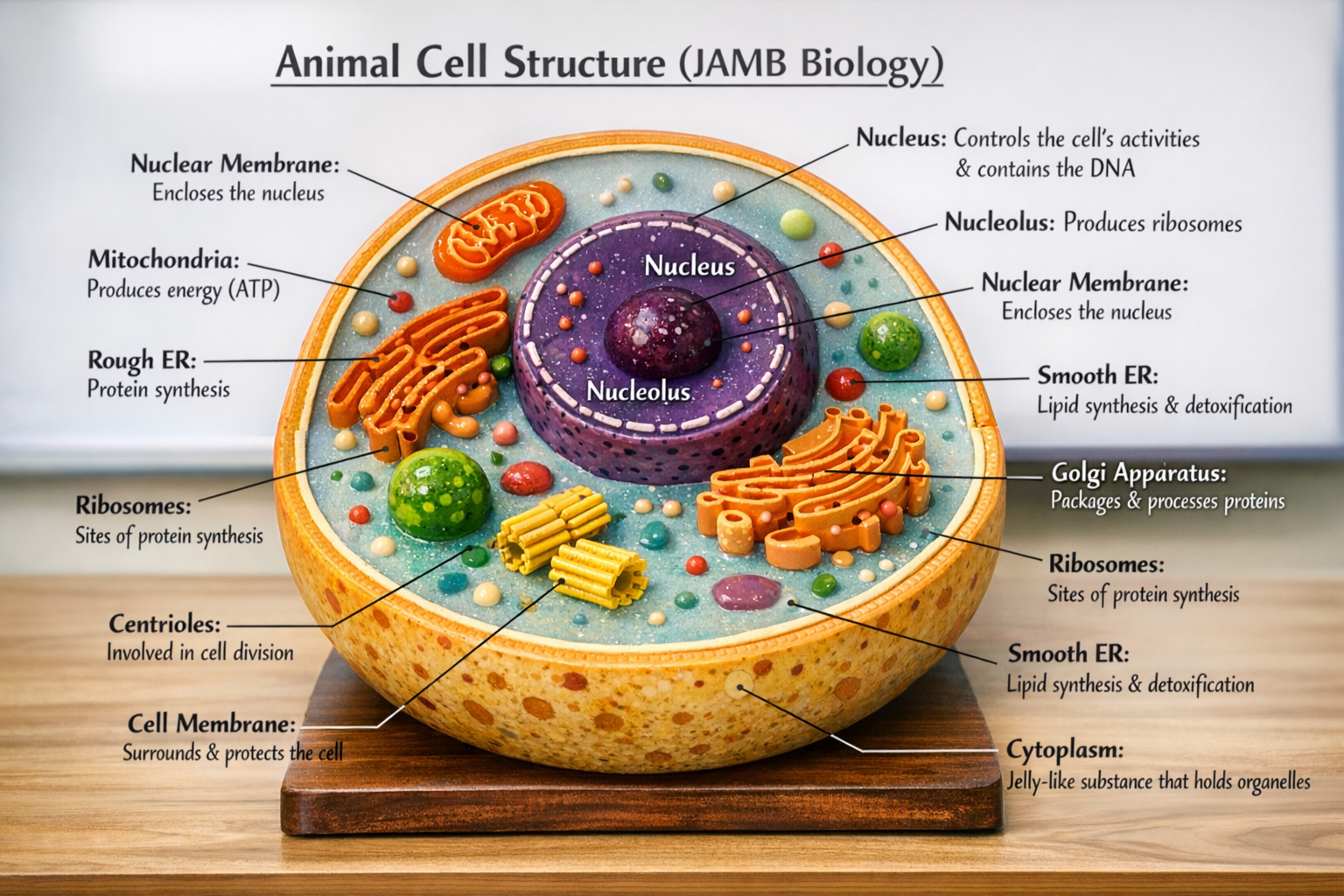
Cell Structure and Organization (High-Yield Topic)
JAMB frequently tests candidates on cell organelles and their functions.
| Organelle | Function |
| Nucleus | Site of respiration |
| Mitochondria | site of respiration |
| Ribosomes | Protein synthesis |
| Chloroplast | Photosynthesis |
| Vacuole | Storage and turgidity |
Exam guide: JAMB often asks comparative questions between plant and animal cells.
- Photosynthesis Explained Simply
Photosynthesis is the process by which green plants manufacture food using sunlight.
Equation:
Carbon dioxide + Water → Glucose + Oxygen (in the presence of light and chlorophyll)
Key Points JAMB Loves:
- Site: Chloroplast
- Raw materials
- End products
- Importance to life
2. Genetics: Easy Way to Solve Inheritance Questions
JAMB Genetics questions often involve monohybrid crosses.
Steps to Solve:
- Identify parental genotype
- Write possible gametes
- Use Punnett square
- Determine genotypic and phenotypic ratios
Example:
Cross between Tt × Tt
Genotypic ratio = 1:2:1
Phenotypic ratio = 3:1
3. Ecology and Environmental Biology
Commonly tested areas include:
- Food chains
- Trophic levels
- Energy flow
- Pollution types
Real-World Application:
Understanding ecology helps students relate Biology to environmental protection and climate change.
Step-by-Step Guide to Using JAMB Biology Study Notes (PDF) (Complete JAMB Biology Study Notes (PDF): Master the Syllabus and Score High)
- Download the complete PDF
- Study according to the JAMB syllabus order
- Read actively and summarize key points
- Practice past questions after each topic
- Revise diagrams and tables daily
- Take weekly mock tests
Pros and Cons of Using JAMB Biology Study Notes (PDF)
Pros
- Easy to revise
- Mobile-friendly
- Exam-focused
- Time-saving
- Structured learning
Cons
- Not ideal without past questions
- Requires discipline to study consistently
Best Practice: Combine study notes with JAMB Biology past questions and answers.
Common Mistakes Students Make in JAMB Biology
- Memorizing without understanding
- Ignoring diagrams
- Skipping ecology and genetics
- Not practicing past questions
- Studying without syllabus guidance
Solution: Use structured notes aligned strictly with JAMB standards.
Expert Guide to Score 250+ with Biology (Complete JAMB Biology Study Notes (PDF): Master the Syllabus and Score High)
- Focus on repeated topics
- Learn definitions word-for-word
- Practice diagrams mentally
- Eliminate wrong options first
- Revise weak topics repeatedly
How JAMB Biology Questions Are Actually Constructed (Behind-the-Scenes Insight)
Most candidates assume JAMB Biology tests memory. In reality, many questions are designed to test conceptual discrimination — the ability to distinguish closely related ideas under time pressure.
The “Near-Option Trap” Strategy JAMB Uses
JAMB often sets options that are:
- Scientifically correct in isolation
- Incorrect in the context of the question
For example:
-
An option may describe a real biological process but assign it to the wrong organelle, wrong organism, or wrong stage.
Why this matters:
Students who only memorize facts fall into traps. Students who understand relationships between concepts escape them.
Practical adjustment:
- While studying, always ask: “Under what condition would this be false?”
- Train your mind to link process → site → outcome.
The JAMB Biology “Weight vs Effort” Framework (Smart Topic Prioritization)
Not all Biology topics offer equal return on study time. High scorers unconsciously apply a weight-to-effort ratio.
High-Weight, Moderate-Effort Topics
These consistently produce questions and are easier to secure marks from:
- Cell structure and functions
- Photosynthesis and respiration
- Ecology (food chains, population, conservation)
- Mendelian genetics (basic crosses)
Low-Weight, High-Effort Topics
These consume time but yield fewer questions:
- Excessive taxonomy details
- Rare biological terminologies not emphasized in syllabus
Expert rule:
If a topic has appeared repeatedly in the last 10+ years of past questions, it deserves priority, regardless of how “simple” it looks.
“The JAMB Biology Weight vs Effort Framework (Smart Topic Prioritization)”.
JAMB Biology “Weight vs Effort” Framework
| Biology Topic | JAMB Weight (Frequency of Questions) | Study Effort Required | Smart Priority Level | Why This Matters |
|---|---|---|---|---|
| Ecology | Very High | Medium | Very High Priority | JAMB repeats ecology questions yearly; concepts are predictable and scoring is easy with practice |
| Genetics | High | High | High Priority | Questions are frequent but require deep understanding of crosses and ratios |
| Cell Biology | High | Medium | High Priority | Basic cell structures and functions are common and straightforward |
| Photosynthesis & Respiration | Medium–High | Medium | High Priority | Regularly tested with direct theory and simple calculations |
| Plant & Animal Nutrition | Medium | Low–Medium | Medium Priority | Easy marks once key terms and processes are mastered |
| Classification of Living Things | Medium | Low | Medium Priority | Mostly direct recall and objective questions |
| Reproduction (Plants & Animals) | Medium | Medium | Medium Priority | Concepts repeat but require attention to details |
| Evolution | Low–Medium | Low | Low Priority | Few questions, usually theory-based |
| Hormones & Nervous System | Low | High | Low Priority | Time-consuming with fewer questions |
| Ecology Practical (Graphs & Interpretation) | Medium | Low | High Priority | Quick marks if you understand graph trends and symbols |
How to Use This Table Smartly
- Start with High Weight + Low/Medium Effort topics → fastest score boost
- Delay Low Weight + High Effort topics until you’ve secured easy marks
- Revise using past questions, JAMB recycles patterns, not just topics
Diagram Intelligence: The Silent Score Booster Most Students Ignore (Complete JAMB Biology Study Notes (PDF): Master the Syllabus and Score High)
JAMB Biology diagrams are not decoration. They are question triggers.
How Diagrams Are Tested (Beyond Labeling)
JAMB uses diagrams to test:
- Functional understanding (not naming)
- Direction of processes (e.g., transport, flow, movement)
- Comparative reasoning (what changes if part X is removed?)
Smart Diagram Practice Method
Instead of redrawing diagrams endlessly:
- Study the diagram once
- Close the book
- Explain the function of each labeled part out loud
- Predict what happens if one part fails
This method improves retention + application, not just recall.
Biology Vocabulary Control: How One Word Can Cost You 5 Marks
Many JAMB Biology errors come from misinterpreting command words, not lack of knowledge.
High-Risk Biology Keywords Students Misread
- “Most appropriate” ≠ correct
- “Primary function” ≠ secondary role
- “Immediately” ≠ eventual outcome
Example insight:
If asked for the primary function of the mitochondrion, “energy release” is safer than “ATP production,” even though both are related.
Why this matters:
JAMB rewards precision, not verbosity.
Ecology Questions: Why They Feel Easy but Destroy Scores (Complete JAMB Biology Study Notes (PDF): Master the Syllabus and Score High)
Ecology questions are usually straightforward, which is exactly why they reduce scores.
The Overconfidence Problem
Candidates:
- Rush through ecology questions
- Ignore qualifiers like “increase,” “decrease,” “eventually”
- Miss indirect effects in food webs
The Chain-Reaction Rule
In ecology:
- A change at one trophic level never affects only one organism
- JAMB expects you to think one step further
Example logic path:
Deforestation → reduced producers → reduced herbivores → reduced carnivores → ecosystem imbalance
Genetics Without Fear: The Pattern-Recognition Advantage
High scorers don’t solve every genetics question from scratch.
They recognize patterns.
Common Genetics Patterns JAMB Recycles
- Heterozygous × heterozygous
- Dominant trait masking recessive
- Sex-linked inheritance basics
Expert shortcut:
If you can instantly recognize the pattern, you save time and reduce careless errors.
Why Past Questions Alone Are Not Enough (But Still Essential)
Past questions test what JAMB asked before.
Study notes explain why the answer is correct.
The Hidden Risk of Past-Question-Only Study
- Encourages answer memorization
- Fails when JAMB changes question framing
- Weakens performance on reworded concepts
Best practice:
Use study notes to build understanding → use past questions to test application.
Time Management Inside Biology: A Section-Specific Strategy
Biology questions vary in reading time.
Smart Order Strategy
- Answer direct recall questions first (definitions, basic functions)
- Attempt diagram-based questions next
- Leave long ecology or genetics reasoning questions for last
Why this works:
It builds early confidence and prevents panic-induced mistakes.
Expert Warning: Topics Students Assume Are “Minor” but Aren’t
Certain topics quietly appear year after year:
- Cell division stages (especially meiosis)
- Disease prevention and immunity
- Environmental conservation methods
- Nutrition deficiencies and effects
Ignoring them often leads to avoidable losses, not difficult questions.
Final Expert Insight: What Separates 60+ from 80+ in JAMB Biology
The difference is rarely intelligence.
It is:
- Precision over memorization
- Understanding over cramming
- Strategy over random reading
When Biology is studied as a logical system, not a list of facts, it becomes one of the most predictable subjects in JAMB.
Frequently Asked Questions (FAQ) (Complete JAMB Biology Study Notes (PDF): Master the Syllabus and Score High)
Is JAMB Biology difficult?
No. With proper study notes and consistent practice, Biology becomes one of the easiest subjects.
Are PDF study notes enough for JAMB Biology?
Yes, when combined with past questions and syllabus-based revision.
How many questions come from Ecology?
Ecology contributes a significant percentage of JAMB Biology questions every year.
Can I score above 80 in JAMB Biology?
Absolutely. Many candidates score 80–90+ using structured study notes.
When should I start studying Biology for JAMB?
At least 3–6 months before the exam for best results.
References
- JAMB official website
- Nigerian Educational Research and Development Council
- World Health Organization
- Britannica Biology
Conclusion: Your Smartest Path to JAMB Biology Success
Mastering JAMB Biology is not about drowning yourself in countless textbooks or memorizing pages that never appear in the exam. What truly makes the difference is using well-structured, syllabus-aligned, and exam-focused study notes that break complex biological concepts into simple, clear explanations while training your mind to think the way JAMB sets its questions. When your study materials mirror the exam pattern, revision becomes easier, faster, and far more effective.
The Complete JAMB Biology Study Notes (PDF) available on ExamGuideNg.com are carefully designed to help you study smarter, eliminate confusion, and approach the exam with confidence. These notes highlight high-frequency topics, simplify diagrams and processes, and guide you toward accuracy and proper time management during the exam. To deepen your preparation, read my related posts on “How JAMB Biology Questions Are Repeated Every Year” and “Most Tested Topics in JAMB Biology and How to Study Them Effectively” for extra insight and maximum score advantage.
Call to Action
Get the Complete JAMB Biology Study Notes (PDF), Designed for High Scores
Prepare smarter for JAMB Biology with our well-structured, syllabus-aligned study notes created to support effective learning and exam success. This downloadable PDF explains key Biology topics in clear, simple language, supported with diagrams, definitions, and exam-focused explanations based strictly on the official JAMB syllabus.
Written by Massodih Okon, Senior Exam Preparation Researcher and Academic Education Content Specialist with over 10 years of experience developing high-impact learning resources aligned with Nigerian and international examination standards. Reviewed and updated: 2026.
About the Author
Massodih Okon is an experienced educator, researcher, and digital publishing professional with a strong academic and practical background. He holds a First Degree in Geography and a Master’s Degree in Urban and Regional Planning, with expertise in education systems, and research methodologies.
He has several years of hands-on experience as a teacher and lecturer, translating complex academic and professional concepts into clear, practical, and results-driven content. Massodih is also a professional SEO content strategist and writer. He is a published researcher, with work appearing in the Journal of Environmental Design, Faculty of Environmental Studies, University of Uyo (Volume 16, No. 1, 2021), P. 127-134. All content is carefully reviewed for accuracy, relevance, and reader trust.
Related posts
- 10 top jamb exam tips to score above 250+
- understanding neco marking scheme a complete guide for candidates
- fully funded scholarships for nigerian students 2026 guide
- ielts exam requirements for professionals complete 2026 guide
- JAMB Success Strategies for Science Students in Nigeria: Best Requirements & JAMB Registration Portal
- Insurance vs Risk Management Salary in Nigeria and Abroad: Careers, Jobs & Professional Certifications
- Insurance and Risk Management Admission Requirements in Nigeria and Abroad
- Cost of Studying Medicine in Nigeria, USA, and UK With Scholarships
- Law vs Medicine: Which Career Pays More After 10 Years in Nigeria and Abroad?
- Best Data Privacy Law Certification and Educational Pathways for Aspiring Privacy Lawyers in the US, Canada & UK 2026
- How to Score 300+ in JAMB: Proven Nigerian, US, UK & Global Strategies
- Commonwealth Scholarship for Students in Nigeria, UK, and USA: Eligibility, Application Process & Fully Funded Benefits