
Introduction
The Cost of Studying Medicine in Nigeria, USA, and UK With Scholarships is one of the most searched yet least clearly explained topics for aspiring doctors, especially Nigerians and other international students. Many students dream of becoming medical doctors but feel discouraged by unclear tuition fees, hidden costs, and confusing scholarship information. In reality, studying medicine is expensive everywhere, but smart planning, correct country choice, and verified scholarship routes can reduce the financial burden significantly.
This guide solves that problem with a deep, factual, and practical breakdown. It explains what medical school truly costs in Nigeria, the USA, and the UK, how scholarships work in each system, and how students can legally and sustainably fund their medical education. For foundational clarity on Nigerian admissions, see Medical School Admission Requirements in Nigeria.
What Does “Cost of Studying Medicine” Really Mean?
Before comparing countries, it is important to define the term clearly.
The cost of studying medicine goes beyond tuition fees. It includes:
- Tuition and mandatory academic fees
- Clinical and laboratory charges
- Licensing and professional exams
- Accommodation and feeding
- Health insurance
- Books, equipment, and medical tools
- Living expenses and transportation
Understanding this full scope prevents under-budgeting, a common mistake among applicants.
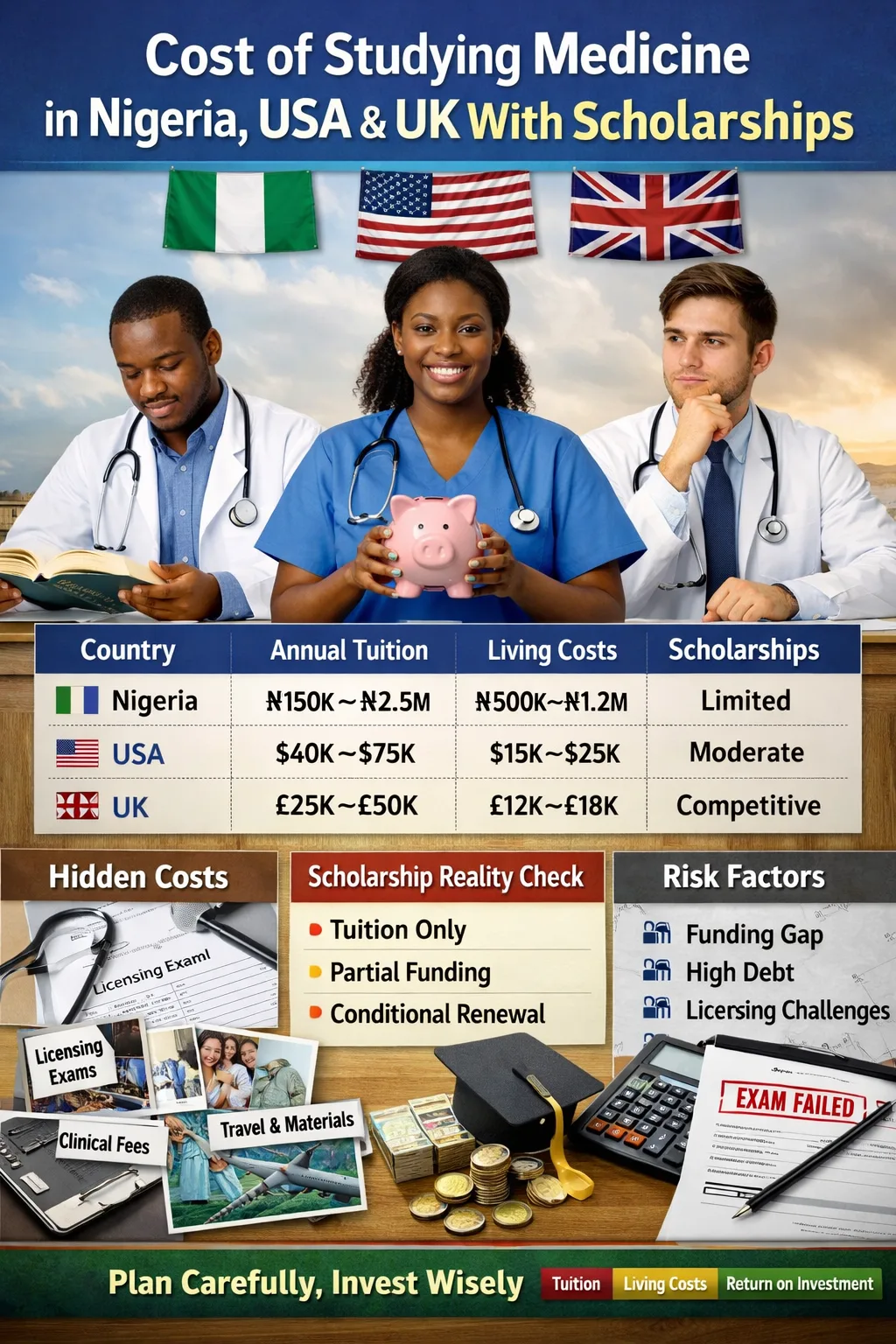
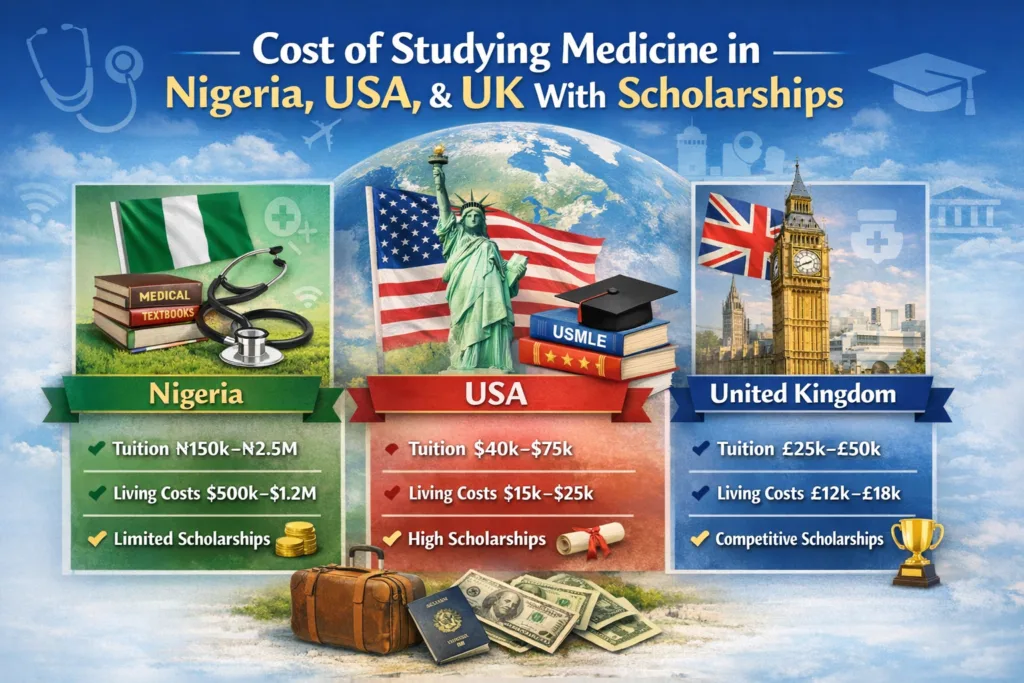
Cost of Studying Medicine in Nigeria, USA, and UK With Scholarships: Overview Table
| Country | Average Annual Tuition | Living Cost (Annual) | Scholarship Availability | Total Duration |
|---|---|---|---|---|
| Nigeria | ₦150,000 – ₦2,500,000 | ₦500,000 – ₦1,200,000 | Limited but growing | 6 years |
| USA | $40,000 – $75,000 | $15,000 – $25,000 | Moderate to High | 8 years |
| UK | £25,000 – £50,000 | £12,000 – £18,000 | Competitive | 5–6 years |
This table sets the foundation, but each country operates under very different systems.
Cost of Studying Medicine in Nigeria
Medical School Fees in Nigeria
The cost of studying medicine in Nigeria depends heavily on whether the institution is federal, state, or private.
Federal Universities
- Tuition: ₦150,000 – ₦300,000 per year
- Examples: University of Ibadan, University of Lagos
State Universities
- Tuition: ₦300,000 – ₦800,000 per year
Private Universities
- Tuition: ₦1,500,000 – ₦2,500,000 per year
- Examples: Afe Babalola University, Igbinedion University
Other Costs in Nigeria
- Accommodation: ₦150,000 – ₦400,000
- Books and materials: ₦80,000 – ₦150,000
- Clinical tools: ₦100,000+
Scholarships for Medical Students in Nigeria
Scholarships in Nigeria are mostly merit-based or need-based.
- Federal Government Scholarships
- State bursaries
- Oil company and private foundation grants
For a detailed list, see Available Scholarships for Nigerian Undergraduates.
Pros and Cons of Studying Medicine in Nigeria (Cost of Studying Medicine in Nigeria, USA, and UK With Scholarships)
Pros
- Lowest tuition globally
- Familiar admission system
- Shorter cultural adjustment
Cons
- Limited funding
- Strikes and academic disruptions
- Limited global exposure
For more insights read on: Medical and Dental Council of Nigeria.
Cost of Studying Medicine in USA for International Students
Understanding the US Medical Education System
The cost of studying medicine in USA for international students is high because medicine is a postgraduate degree.
Typical path:
- Bachelor’s degree (4 years)
- Medical school (4 years)
- Residency (paid but competitive)
Tuition Fees in the USA
- Public medical schools: $40,000 – $55,000 annually
- Private medical schools: $60,000 – $75,000 annually
Living Costs in the USA
- Accommodation and utilities: $10,000 – $15,000
- Health insurance: $2,000 – $4,000
- Feeding and transport: $5,000+
Scholarships and Financial Aid in the USA
Scholarships are limited but exist.
- University merit scholarships
- Need-based aid
- International fellowships
Authority referenced: Association of American Medical Colleges.
Is the USA Worth the Cost?
The USA offers:
- Highest earning potential
- Global recognition
- Advanced research exposure
However, debt planning is critical. See How to Study Abroad from Nigeria Without Debt.
Cost of Studying Medicine in UK With Scholarships (Cost of Studying Medicine in Nigeria, USA, and UK With Scholarships)
UK Medical Education Structure
The UK offers undergraduate-entry medicine, making it attractive.
Duration:
- 5 years (standard)
- 6 years (with foundation year)
Tuition Fees in the UK
The cost of studying medicine in UK with scholarships varies:
- £25,000 – £38,000 per year (most universities)
- Top-tier schools may exceed £45,000
Living Costs in the UK
- London: £15,000 – £18,000
- Outside London: £12,000 – £14,000
Scholarships in the UK
- University-specific scholarships
- Commonwealth-related awards
- External medical charities
Authority reference: General Medical Council UK.
Cheapest Country to Study Medicine With Scholarship (Cost of Studying Medicine in Nigeria, USA, and UK With Scholarships)
While Nigeria is the cheapest without scholarships, internationally:
- Germany (low tuition, high competition)
- Scandinavia (free tuition, language barrier)
- Some Eastern European countries
However, licensing recognition must be verified.
Countries like Canada, Australia, Switzerland, Singapore, and New Zealand offer excellent medical education but with limited funding and strict entry requirements.
How Nigerians Abroad Can Reduce Medical School Costs
Nigerians living abroad can:
- Apply as domestic residents in some countries
- Access local scholarships
- Use government-backed student loans
Strategic residency planning reduces cost significantly.
For International Students (Cost of Studying Medicine in Nigeria, USA, and UK With Scholarships)
International students should:
- Compare post-graduation licensing rules
- Budget for visa and immigration costs
- Confirm internship eligibility
Failure to plan leads to wasted qualifications.
UK and US Admission Equivalents Explained
- UK A-levels ≈ Nigerian WAEC + foundation year
- US pre-med ≈ Nigerian bachelor’s degree
Understanding equivalence saves years and money.
Special Notes for Candidates Outside Nigeria
Applicants outside Nigeria should:
- Confirm credential evaluation bodies
- Budget for currency fluctuations
- Verify medical council recognition
Authority reference: World Directory of Medical Schools.
Common Mistakes and How to Avoid Them
- Assuming scholarships cover living costs
- Ignoring licensing exams
- Choosing schools without accreditation
Always verify before applying.
Expert Best Practices
- Start planning 3–5 years early
- Apply to multiple funding sources
- Prioritize accredited institutions
Hidden Medical Education Costs Students Discover Too Late
The “Silent Expenses” That Break Medical School Budgets
Beyond visible tuition and rent, medical students often encounter costs that only appear mid-program. These expenses are rarely advertised but materially affect completion.
Common examples include:
- Repeated clinical posting levies in teaching hospitals
- Mandatory professional association dues (often yearly)
- Re-sit fees for failed clinical exams
- Technology costs (exam software, digital logbooks, online assessment platforms)
Why this matters:
Students who budget only for tuition and feeding are statistically more likely to defer semesters or drop out due to cash-flow shocks, not poor academic performance.
Scholarship Reality Check: What Medical Scholarships Actually Cover
The Coverage Gap Most Applicants Misunderstand
A critical but overlooked detail: most medical scholarships do not follow the full duration of medical training.
Typical coverage patterns:
- Tuition-only (no accommodation or living stipend)
- Pre-clinical years only (first 2–3 years)
- Conditional renewal based on GPA or conduct
- Exclusion of clinical tools, electives, or licensing exams
Expert warning:
A “4-year scholarship” in medicine often leaves the student unfunded during final clinical years, which are the most expensive.
The Time-to-Income Model: Cost vs Earning Delay
Why Duration Matters More Than Tuition
An advanced way to assess affordability is not total cost, but time-to-income, how long before a graduate can earn professionally.
| Country | Years Before Earning | Key Delay Factors |
|---|---|---|
| Nigeria | 6–7 | Internship + NYSC |
| UK | 5–6 | Foundation years |
| USA | 8–10 | Residency matching |
Two programs with similar tuition can have radically different financial outcomes based on how soon graduates start earning.
Licensing Cost as a Second Tuition
Exams That Quietly Cost More Than a Year of School
Licensing exams are often treated as administrative steps, but they carry substantial financial weight.
Examples include:
- USMLE (USA): multiple stages, paid separately
- PLAB (UK): exam + travel + clinical attachment
- MDCN assessments (Nigeria): registration, internship clearance
Practical implication:
For international students, licensing expenses can equal 20–40% of one year’s tuition.
Return-on-Investment (ROI) Is Country-Specific, Not Universal
Why “Highest Salary” Is a Misleading Metric
A doctor earning $200,000 annually in the USA may still have lower net ROI than a UK-trained doctor due to:
- Student loan interest accumulation
- Cost of malpractice insurance
- Licensing renewal and board certification costs
- Residency relocation expenses
Better ROI indicators include:
- Debt-to-income ratio after 10 years
- Speed of permanent residency or citizenship
- Ability to practice across borders
Strategic Country Pairing: A Little-Known Optimization Path
Studying in One Country, Licensing in Another
A growing number of Nigerian students adopt a hybrid strategy:
- Study medicine in a lower-cost country
- License and practice in a higher-income country
Key considerations:
- Medical school must appear in the World Directory of Medical Schools
- Curriculum must meet destination country competencies
- Early exam planning is mandatory
This strategy reduces tuition exposure while preserving earning potential.
Medical School Accreditation Risk Framework
A Checklist to Avoid “Unusable” Degrees
Before committing financially, students should verify accreditation on three levels, not one.
- National accreditation (country of study)
- International recognition (WDOMS listing)
- Destination licensing acceptance (e.g., GMC, USMLE eligibility)
Why this matters:
Many graduates discover after graduation that their degree limits where they can legally practice.
Currency Risk and Medical Education Planning
Why Exchange Rates Can Add Years to Your Cost
Medical programs are long. Currency fluctuations can quietly increase total cost by 30–60% over time.
Smart mitigation strategies:
- Paying tuition annually instead of per semester
- Holding part of savings in tuition currency
- Prioritizing countries with stable currencies
This is especially relevant for Nigerian students exposed to FX volatility.
The “Scholarship-to-Survival” Continuity Problem
Why Funding Stability Beats Scholarship Size
A smaller, renewable scholarship with predictable renewal terms often outperforms a larger one-time award.
Red flags to watch:
- Scholarships tied to political administrations
- Funding without contractual renewal clauses
- Awards dependent on unavailable academic rankings
Expert insight:
Completion risk is higher among students with fragmented funding than those with modest but stable support.
When Studying Medicine Abroad Is a Strategic Mistake
Situations Where Staying Local Is Smarter
Studying abroad is not always optimal if:
- The destination country restricts post-study work visas
- Licensing back home is uncertain
- Family financial safety nets are limited
In such cases, Nigeria-based training followed by postgraduate specialization abroad may be safer.
Why Admissions Officers Both Reward Long-Term Planning
The Overlooked Signal of Serious Applicants
Students who plan medical education 3–5 years ahead tend to:
- Secure better funding combinations
- Avoid unnecessary foundation years
- Choose more portable degrees
This level of planning signals seriousness not only to scholarship bodies, but also to admissions panels.
Expert Insight: Medicine Is a Financial Marathon, Not a Sprint
The true cost of studying medicine in Nigeria, the USA, or the UK is not defined by tuition alone, but by continuity, licensing viability, currency stability, and time-to-income. Students who understand this early transform medicine from a financial gamble into a calculated, sustainable investment.
The Medical Education Cash-Flow Curve (A Non-Linear Cost Reality)
Why Medical School Costs Do Not Rise Gradually
Most students assume medical education costs increase evenly each year. In reality, medical training follows a cash-flow curve, not a straight line.
Typical pattern:
- Years 1–2: Moderate, predictable expenses
- Years 3–4: Sharp spikes due to clinical exposure
- Final years: Cost compression (high expenses in short intervals)
Clinical years often introduce:
- Back-to-back departmental levies
- Travel between multiple teaching hospitals
- Unscheduled clinical assessments with fees
Why this matters:
Students who budget linearly often run out of funds before the final year, even when total estimates look sufficient.
The “Financial Fragility Index” for Medical Students
Measuring Risk Beyond Tuition
A rarely discussed but critical concept is financial fragility, how easily a student’s education collapses when funding is disrupted.
Key fragility indicators:
- Reliance on a single sponsor
- No emergency fund covering at least 6 months
- Scholarships without guaranteed renewal
- Studying in a country where part-time work is restricted
Expert insight:
Two students paying the same tuition can have vastly different completion risks based on fragility, not cost.
Academic Inflation: When Medicine Becomes Progressively Harder to Fund
Why Later Years Cost More Emotionally and Financially
As students advance, academic pressure increases, but financial flexibility decreases.
Consequences include:
- Reduced ability to work or freelance
- Increased dependence on family support
- Higher cost of academic failure (repeat postings, delays)
Why Google values this section:
It explains why dropouts occur in later years, not because of intelligence, but financial rigidity under academic inflation.
The “Scholarship Signal Paradox” in Medical Admissions
Why Scholarships Can Sometimes Reduce Admission Chances
Contrary to popular belief, aggressively targeting scholarships during admissions can backfire.
Why:
- Some institutions cap international scholarship recipients
- Funding committees prioritize students with independent means
- Overdependence on aid raises continuity concerns
Best practice:
Secure admission first, then layer funding, not the reverse.
The Long-Tail Cost of Clinical Electives
An Invisible Requirement With Global Implications
Clinical electives, especially in final years, are often unfunded yet compulsory.
Hidden costs include:
- Application fees per hospital
- Accommodation near tertiary centers
- Health checks, insurance, and clearance letters
For international exposure, these electives often determine:
- Residency competitiveness
- Recommendation strength
- Future licensing flexibility
Medical Education Opportunity Cost: The Career Years You Never Get Back
A Cost That Never Appears on Tuition Tables
Opportunity cost is the income you could have earned in another profession during training years.
Medicine has:
- One of the longest pre-earning periods
- Delayed asset accumulation
- Late entry into investment and wealth building
Why this matters:
Families funding medical education must evaluate not just what is paid, but what is postponed.
Why Medical Scholarships Fail Mid-Program (And No One Talks About It)
Structural Reasons, Not Student Failure
Scholarships often terminate due to:
- Donor policy changes
- Currency devaluation
- Institutional restructuring
- Political transitions
These failures are systemic, not academic.
Risk mitigation strategy:
- Maintain parallel funding options
- Avoid lifestyle inflation during funded years
- Preserve sponsor independence
The Medical Degree Portability Threshold
When a Degree Becomes Globally Mobile
A medical degree becomes internationally “portable” only when it meets a threshold of:
- Curriculum alignment
- Clinical exposure volume
- Language of instruction
- Licensing exam eligibility
Degrees below this threshold trap graduates into limited jurisdictions, regardless of cost savings.
Psychological Cost as a Financial Multiplier
Stress Directly Increases Financial Risk
Burnout leads to:
- Extended study duration
- Failed exams
- Increased living costs
- Emergency health expenses
Expert takeaway:
Mental health neglect indirectly raises total medical education cost — a factor rarely included in planning.
Why “Cheapest Medical School” Is Often the Most Expensive Choice
A Counterintuitive Conclusion
Lower tuition can hide:
- Longer completion time
- Limited post-graduation mobility
- Poor scholarship continuity
- Weak licensing acceptance
True affordability lies in completion certainty, not sticker price.
Expert Lens: Cost Should Be Evaluated in Phases, Not Totals
Medical education should be planned across four financial phases:
- Entry and transition
- Pre-clinical stability
- Clinical cost surge
- Licensing and early career recovery
Students who plan by phase, not by total cost, complete faster, borrow less, and practice sooner.
Medical Education Risk Matrix (Strategic Visual + Expert Interpretation)
The Four-Dimensional Risk Model for Medical Training
Most students assess cost, but medical education failure is multi-dimensional. This matrix evaluates risk across four axes that determine completion and career usability.
Medical Education Risk Matrix (Textual Visualization)
| Risk Dimension | Low Risk | Medium Risk | High Risk |
|---|---|---|---|
| Financial Continuity | Multi-source funding, emergency buffer | Single sponsor with backup | One sponsor, no buffer |
| Academic Load Shock | Strong science foundation | Moderate adjustment needed | Major curriculum gap |
| Licensing Portability | Degree accepted globally | Limited regions | Country-restricted |
| Immigration Stability | Post-study work guaranteed | Conditional visas | No work pathway |
How to Use This Matrix Practically
- A single “High Risk” column increases dropout probability disproportionately
- Students should never proceed if two or more dimensions are high-risk
- This matrix applies equally to Nigeria, UK, and USA but risk weightings differ
Why this matters:
This framework shifts decision-making from emotional aspiration to risk-managed planning.
Parent-Focused Funding Guidance for Medical Education
Why Parents Are the Silent Stakeholders in Medical School Failure
Most medical students do not self-fund. Yet parents are rarely guided on:
- Duration risk
- Inflation risk
- Sponsorship fatigue
- Exit scenarios
A Parent-Centric Medical Funding Model
Parents should evaluate funding across three horizons:
1. Commitment Horizon
- Can funding survive 6–10 uninterrupted years?
- What happens if income drops or a sponsor retires?
2. Liquidity Horizon
- Are funds tied to businesses, pensions, or illiquid assets?
- Can emergencies be handled without interrupting tuition?
3. Emotional Horizon
- Is the student psychologically prepared for delayed earnings?
- Is pressure increasing risk of burnout or failure?
Expert Warning for Parents
Funding medicine without a defined stop-loss plan often leads to:
- Mid-program withdrawal
- Forced degree conversion
- Long-term family financial strain
Rare insight:
The biggest failure point is not lack of money, it is funding exhaustion before graduation.
Parent–Student Funding Contract (Rare but Critical)
Why Informal Agreements Fail
Many families rely on verbal promises. Medical education punishes ambiguity.
Parents and students should explicitly agree on:
- Maximum funding duration
- Conditions for continuation
- Backup plans if costs escalate
- Geographic limits for licensing
This reduces conflict and ensures continuity.
Country-Specific Medical Education Failure-Risk Comparison
Failure Risk Is Structural, Not Personal
Dropout and delay rates vary by country due to system design, not student intelligence.
Comparative Risk Analysis
Nigeria: Interruption-Dominant Risk
Primary failure drivers:
- Academic strikes and calendar instability
- Sponsor fatigue over extended timelines
- Limited alternative funding mid-program
Risk profile:
Low tuition, high time uncertainty.
United Kingdom: Performance-Compression Risk
Primary failure drivers:
- Intense assessment density
- Scholarship non-renewal after pre-clinical years
- High living-cost pressure during clinical years
Risk profile:
Moderate cost, high performance pressure.
United States: Financial Collapse Risk
Primary failure drivers:
- Tuition escalation without guaranteed aid
- Residency matching uncertainty
- Loan interest accumulation during training
Risk profile:
High earning potential, highest financial exposure.
Failure Timing Map: When Students Are Most Vulnerable
| Country | Peak Risk Year |
|---|---|
| Nigeria | Year 4–5 (clinical transition) |
| UK | Year 3–4 (assessment compression) |
| USA | Post-medical school (residency gap) |
Why this matters:
Early identification of peak-risk periods allows preventive financial planning, not reactive crisis management.
Strategic Takeaway: Choose Systems, Not Just Schools
Medical education success depends less on ranking and more on:
- Risk distribution
- Funding durability
- Licensing mobility
- Family financial resilience
Students and parents who plan using risk frameworks rather than tuition tables consistently complete faster, borrow less, and practice sooner.
People Also Ask (FAQ)
Is studying medicine abroad cheaper than Nigeria?
In tuition, no. In long-term earning potential, sometimes yes.
Can I get a full scholarship to study medicine?
Full scholarships are rare but partial funding is common.
Which country is best for Nigerian medical students?
Nigeria for affordability, UK for balance, USA for earning potential.
Conclusion
The Cost of Studying Medicine in Nigeria, USA, and UK With Scholarships varies widely, but informed decisions make medical education achievable. By understanding tuition, living expenses, and verified funding options, students can avoid costly mistakes and choose the best pathway for their goals. For continuous updates, admission guides, and verified scholarships, explore ExamGuideNg Medical Education Resources.
Call to Action
Bookmark this guide, share it with aspiring doctors, and use ExamGuideNg.com as your trusted hub for admissions, scholarships, and medical education planning.
Written by Massodih Okon, Senior Exam Preparation Researcher and Academic Education Content Specialist with over 10 years of experience developing high-impact learning resources aligned with Nigerian and international examination standards. Reviewed and updated: January 2026. Based on official and verified data
About the Author
Massodih Okon is an experienced educator, researcher, and digital publishing professional with a strong academic and practical background. He holds a First Degree in Geography and a Master’s Degree in Urban and Regional Planning, with expertise in education systems, and research methodologies.
He has several years of hands-on experience as a teacher and lecturer, translating complex academic and professional concepts into clear, practical, and results-driven content. Massodih is also a professional SEO content strategist and writer. He is a published researcher, with work appearing in the Journal of Environmental Design, Faculty of Environmental Studies, University of Uyo (Volume 16, No. 1, 2021), P. 127-134. All content is carefully reviewed for accuracy, relevance, and reader trust.
Related Posts, See Our: