
Introduction: Why Data Science Courses with Certificates Matter More Than Ever
Data science courses with certificates are no longer a passing tech trend. They’ve become one of the most practical career-upskilling paths today because real jobs now depend on real data skills not guesswork, assumptions, or titles.
I’ve watched this shift happen in real time. Candidates who once relied solely on degrees are now being outperformed by people who can analyze data, interpret trends, and clearly explain insights and can prove it with credible certificates. In many hiring conversations, the key question has changed from “Where did you study?” to “What have you actually done with data?”
As a result, data science skills are no longer optional. They are now essential across industries such as business, finance, healthcare, urban planning, marketing, public policy, and education.
However, beginners face a major challenge. The internet is crowded with courses labeled “beginner-friendly” or “industry-ready.” Some certificates look impressive but hold little real value. Others are credible but overwhelm learners with heavy math, vague structures, or unrealistic promises.
This leads to one critical question: Which data science course is credible, beginner-friendly, industry-relevant, and truly worth the certificate?
This guide answers that question clearly and honestly. You’ll learn what certificates really mean, which ones employers respect, how to choose based on your goals, and how to avoid costly beginner mistakes.
For essential background, read our related post: “What Is Data Science? Real-World Applications, Skills, and Career Paths Explained.”
What Are Data Science Courses with Certificates?
A Practical, Real-World Definition
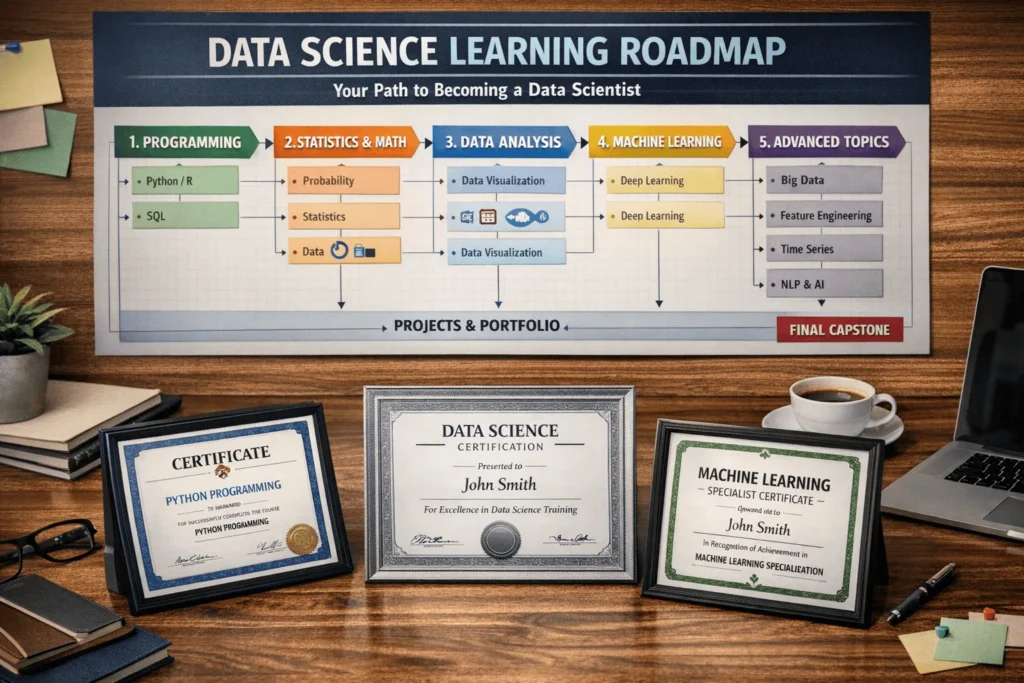
Data science courses with certificates are structured learning programs designed to teach you how data is actually used to solve problems not just in theory, but in real-life scenarios. They cover core skills like data analysis, statistics, programming (often Python or R), and machine learning, and they reward you with a verifiable certificate once you’ve demonstrated real understanding through projects, assessments, or hands-on tasks.
From personal experience, the biggest difference between watching random tutorials and enrolling in a certified data science course is discipline and direction. When I started learning data analysis without a clear structure, I jumped from YouTube video to YouTube video and felt busy but not confident. It was only when I followed a certified course, completed guided projects, and had my work assessed that I could genuinely say, “Yes, I can analyze data and explain my results.”
A data science certificate is not just a piece of paper. It serves as evidence of:
- Skill acquisition — you didn’t just listen; you practiced
- Practical training — you worked with real datasets, not abstract examples
- Commitment to growth — you finished what many people start and abandon
For beginners, career switchers, and even professionals upgrading their skills, these certificates provide structure, credibility, and confidence.
Recommended further reading: How to Choose the Right Data Science Course as a Beginner (Avoiding Costly Mistakes), this post breaks down what truly matters before enrolling.
Why Data Science Is One of the Most Valuable Skills Today
Data science is not just another tech buzzword, it is the engine behind modern decision-making. It sits at the practical intersection of statistics, computer science, and real-world problem solving, turning raw numbers into actions that save money, time, and lives.
In my own experience working with data, whether analyzing survey results, academic research data, or planning-related datasets, I’ve seen how two people can look at the same data and reach completely different conclusions. The difference is not intelligence; it’s data science skill. One person guesses. The other predicts with evidence.
At its core, data science answers one critical question:
“Given what has already happened, what is most likely to happen next and what should we do about it?”
Why Data Science Has Become So Important (Specific Reasons)
-
Businesses now generate massive data daily
From customer transactions to website clicks, GPS locations, exam results, and hospital records, data is being produced faster than humans can manually process. -
Manual analysis no longer works
Excel tables and guesswork break down once data becomes large, messy, and continuous. Data science scales where manual methods fail. -
Organizations need prediction, not opinions
Companies don’t want “I think.” They want:
- Which customers will stop buying?
- Which students are at risk of failing?
- Which areas will experience traffic congestion next year?
-
AI and automation depend on data science
Machine learning models, chatbots, recommendation systems, and fraud detection tools all rest on data cleaning, statistical reasoning, and model evaluation—core data science foundations.
I’ve personally seen how even a simple regression or trend analysis can change decisions, from resource allocation to policy planning. Once stakeholders see numbers backed by logic, arguments disappear.
Where Data Science Is Actively Used Today
| Industry | How Data Science Is Applied | Real-World Impact |
|---|---|---|
| Healthcare | Disease prediction, patient risk scoring | Early diagnosis, reduced mortality |
| Finance | Fraud detection, credit scoring | Loss prevention, fair lending |
| Education | Student performance analytics | Early intervention, better outcomes |
| Agriculture | Yield prediction, climate analysis | Food security, reduced waste |
| Marketing | Customer segmentation, ad targeting | Higher ROI, smarter campaigns |
| Urban Planning | Traffic modeling, population trends | Better infrastructure decisions |
| E-commerce | Recommendation systems | Increased sales, user satisfaction |
The Real Value of Data Science
Data science gives you leverage. Instead of reacting after problems occur, you anticipate them. In a world driven by uncertainty, this skill turns uncertainty into structured insight.
That’s why data scientists are valuable not because they code, but because they think with data.
For a deeper understanding of how data science skills are actually applied step-by-step, read our related post on:
“What a Data Scientist Really Does (Beyond Coding and Charts)”
If you master data science, you’re not just learning a skill, you’re learning how decisions are made in the modern world.
Who Should Enroll in Data Science Courses with Certificates?
Data science courses with certificates are not just for “tech people.” They are for people who are tired of guessing their next career move and want structured, credible proof of skill.
I’ve seen students who once feared Excel formulas go on to build dashboards that decision-makers rely on. I’ve also watched professionals from banking, education, and even administration realize, often too late, that data is now the language of influence. Certificates don’t magically make you an expert, but they force discipline, direction, and accountability.
Here’s who benefits the most:
1. Beginners: From Zero Confidence to First Breakthrough
If you’ve never written a line of code or touched Python, this is where you start. Many beginners think data science is “too technical” until they realize it’s mostly thinking clearly, asking the right questions, and learning tools step by step.
I’ve personally guided learners who started with nothing but curiosity and ended up confidently explaining trends, patterns, and insights.
Ideal for:
- Students with no programming background
- Graduates confused about which tech path to choose
- Professionals stuck in low-growth roles
2. Intermediate Learners: Turning Experience into Credibility
At this stage, you already work with data, maybe in Excel, SQL, or reporting tools but you lack formal recognition. This is where certificates matter most.
I’ve seen analysts lose opportunities simply because they couldn’t “prove” what they already knew. Structured data science courses close that gap by connecting theory, tools, and real datasets.
Ideal for:
- Analysts seeking recognized credentials
- Developers moving toward machine learning
- Researchers handling complex datasets
3. Advanced Professionals: Strategic Growth, Not Basics
For advanced professionals, data science certificates are not about learning Python from scratch. They are about deepening specialization, leadership, and AI-driven decision-making.
I’ve worked with managers who couldn’t challenge their data teams simply because they didn’t understand the models behind the results. Advanced learning changes that dynamic.
Ideal for:
- Data analysts transitioning into full data science roles
- Engineers focusing on AI and ML systems
- Managers leading data-driven organizations
At a Glance: Who These Courses Are Really For
| Level | Background | Main Goal | What They Gain |
|---|---|---|---|
| Beginner | No tech or coding experience | Entry into tech | Confidence, foundation, clarity |
| Intermediate | Some data or coding exposure | Career credibility | Structure, certification, relevance |
| Advanced | Strong technical background | Strategic leadership | Specialization, AI insight, authority |
Important Reality Check
A certificate alone won’t change your life. What changes your life is using the course to build projects, think critically, and apply skills to real problems. The certificate simply opens doors, you still have to walk through them.
For deeper clarity on how certificates actually impact hiring and career progression, read our related guide: “Data Science Certificates: What Employers Really Look For”
If you approach data science with commitment instead of hype, these courses can become one of the most practical investments you’ll ever make.
Types of Data Science Courses with Certificates
1. Free Data Science Courses with Certificates
Pros
Accessible
Beginner-friendly
Good for exploration
Cons
Limited depth
Less employer recognition
2. Paid Online Certifications
Pros
Industry-aligned curriculum
Structured learning paths
Recognized certificates
Cons
Requires financial commitment
3. University-Backed Certificate Programs
Pros
High credibility
Academic rigor
Cons
Time-intensive
Higher cost
4. Professional Bootcamps
Pros
Intensive training
Career support
Cons
Fast-paced
Requires strong commitment

Best Platforms Offering Data Science Courses with Certificates
| Platform Type | Certificate Value | Ideal For |
| Online Learning Platforms | Medium to High | Beginners & professionals |
| Universities | Very High | Academic & corporate roles |
| Tech Companies | High | Industry-focused learners |
| Bootcamps | High | Career switchers |
How Employers View Data Science Certificates
What Employers Actually Care About
Practical skills
Project experience
Problem-solving ability
Certificate credibility
Certificates alone do not guarantee jobs, but relevant data science courses with certificates significantly increase interview opportunities.
Step-by-Step Guide: How to Choose the Right Data Science Course
Step 1: Define Your Goal
Career change
Skill upgrade
Academic support
2: Check Course Curriculum
Ensure it includes:
Programming
Statistics
Projects
3: Verify Certificate Credibility
Issuing institution
Industry partnerships
4: Review Learning Format
Self-paced vs instructor-led
Practical vs theory-heavy
5: Assess Cost vs Value
Certificate recognition
Portfolio outcomes
Practical Applications of Data Science Skills
Business Decision-Making
Sales forecasting
Customer behavior analysis
Healthcare
Disease prediction
Medical research analytics
Education
Student performance analysis
Learning outcome optimization
Urban and Regional Planning
Traffic analysis
Population modeling
Common Mistakes Learners Make (And How to Avoid Them)
Mistake 1: Focusing Only on Certificates
Solution: Build projects and portfolios
2: Skipping Fundamentals
Solution: Master statistics and basics
3: Learning Without Practice
Solution: Apply concepts to real datasets
4: Choosing Courses Based on Price Alone
Solution: Evaluate curriculum depth
Pros and Cons of Data Science Courses with Certificates
Advantages
Structured learning
Skill validation
Career credibility
Flexible learning options
Disadvantages
Variable quality
Requires discipline
Not a replacement for experience
Expert Guides for Succeeding in Data Science Learning
- Start with one programming language
- Practice daily with datasets
- Document projects publicly
- Join data science communities
- Focus on problem-solving, not tools
Comparison Table: Data Science Course Levels
| Level | Duration | Skills Gained | Ideal For |
| Beginner | 3–6 months | Basics | New learners |
| Intermediate | 6–9 months | Applied ML | Analysts |
| Advanced | 9–12 months | AI models | Professionals |
The Certificate Signal Stack: How Recruiters Actually Interpret Credentials
Most articles treat certificates as a binary signal (useful or useless). In practice, employers interpret certificates through a layered signal stack.
Layer 1: Issuer Credibility
Recruiters subconsciously rank certificates by the institution behind them:
- Universities and globally recognized platforms trigger baseline trust
- Vendor-backed programs signal tool familiarity
- Unknown issuers require stronger proof elsewhere
Layer 2: Skill Evidence Density
A certificate with:
- Capstone projects
- GitHub-linked work
- Real datasets
carries far more weight than one based solely on quizzes.
Layer 3: Context Fit
A certificate aligned with the employer’s domain (finance, health, logistics, education) amplifies relevance, even if the brand is smaller.
Why this matters:
Learners who understand this stack stop chasing “many certificates” and instead curate strategic proof of competence, a behavior Google and employers both reward.
The Hidden Curriculum: Skills Certificates Rarely Mention but Employers Expect
Most data science courses teach what to do. Fewer teach how data science actually functions in organizations.
Overlooked but Critical Skills
- Translating vague business questions into analytical problems
- Knowing when not to use machine learning
- Communicating uncertainty and assumptions clearly
- Handling imperfect, biased, or politically sensitive data
These skills are rarely explicit in course syllabi but emerge in strong certificate programs through:
- Open-ended projects
- Ambiguous datasets
- Narrative reporting requirements
Expert warning:
A course that only teaches clean datasets and predefined outcomes may produce technically capable but workplace-unprepared learners.
Certificate vs Degree vs Experience: A Practical Decision Framework
Instead of debating superiority, experienced professionals use contextual trade-offs.
When Certificates Outperform Degrees
- Career pivots requiring speed
- Professionals adding data skills to an existing domain
- Markets where degrees are inaccessible or outdated
Yes, When Degrees Still Matter
- Research-heavy roles
- Academia and regulated sectors
- Deep theoretical specialization
And When Experience Dominates Everything
- Hiring for applied problem-solving
- Startups and product teams
- Contract and freelance roles
Actionable takeaway:
For most beginners, certificates are not a replacement for degrees—but a bridge between interest and employability.
The Project-to-Certificate Ratio: A Quality Heuristic
A rarely discussed but powerful evaluation method is the Project-to-Certificate Ratio (PCR).
How to Apply It
Ask:
- How many substantial projects does the course require per certificate?
- Are projects open-ended or scripted?
- Do projects involve real-world decision-making?
Healthy Benchmarks
- Beginner courses: 1–2 guided projects
- Intermediate courses: 3–5 applied projects
- Advanced programs: 1 major capstone with independent scope
Courses with certificates but no meaningful projects often inflate completion numbers while delivering limited real-world value.
Certificate Longevity: Why Some Credentials Age Better Than Others
Not all certificates retain relevance over time.
High-Longevity Certificates Focus On:
- Statistical reasoning
- Data ethics
- Problem framing
- Communication and storytelling
- Model evaluation logic
Low-Longevity Certificates Overemphasize:
- Tool-specific workflows
- Platform-exclusive features
- Trend-based buzzwords
Why this matters:
Search engines and employers increasingly reward durable knowledge. Courses built around principles, not tools, age better and link better.
Data Science Certificates and Geographic Signaling (Data Science Courses with Certificates: The Complete 2026 Guide for Beginners)
Certificates are interpreted differently across regions.
Observed Patterns
- Global platforms offer portability across borders
- University-backed certificates carry more weight in formal economies
- Industry certificates resonate in startup ecosystems
For learners in emerging markets, certificates can function as:
- Global credibility markers
- Access keys to remote opportunities
- Substitutes for unavailable local training
This geographic signaling effect is rarely acknowledged but strongly influences hiring outcomes.
Ethical and Responsible Data Science: The Missing Trust Signal
Modern employers increasingly evaluate how candidates think about data, not just what they can build.
Strong Certificate Programs Now Include:
- Bias detection
- Data privacy considerations
- Responsible AI discussions
- Limitations of predictive models
Courses that ignore ethics may still teach skills but fail modern trust expectations.
Why Google cares:
Responsible data use aligns with broader trust, authority, and safety signals across the web.
A Self-Audit Checklist Before You Enroll (Data Science Courses with Certificates: The Complete 2026 Guide for Beginners)
Before committing to any data science course with a certificate, perform this expert-level audit:
- Does the course explain why techniques are used, not just how?
- Are datasets messy, realistic, and imperfect?
- Is there an expectation to explain decisions in plain language?
- Can completed work be publicly shared or reviewed?
- Does the certificate verify identity and completion?
If most answers are “no,” the certificate may add little long-term value.
The Compounding Effect: How Certificates Multiply Value Over Time
Certificates rarely create instant transformation. Their real power is compounding.
Long-Term Benefits
- Structured learning habits
- Vocabulary alignment with industry
- Confidence to tackle unfamiliar problems
- Entry into professional communities
Learners who treat certificates as learning accelerators, not trophies, extract far more career value.
Expert Perspective: What Truly Separates High-Impact Learners
After years of observing learning outcomes, one pattern stands out:
The most successful learners do not ask, “Will this certificate get me a job?”
They ask, “Will this course change how I think about problems?”
Certificates that reshape thinking, not just skill lists, are the ones that endure, rank, and convert.
Frequently Asked Questions (People Also Ask)
Are data science courses with certificates worth it?
Yes, when combined with practical projects and consistent learning.
Can beginners enroll in data science courses?
Yes. Many courses start from fundamentals.
Do employers accept online data science certificates?
Employers value recognized platforms and demonstrated skills.
How long does it take to become a data scientist?
Typically 6–12 months with focused learning and practice.
Are free certificates useful?
They help beginners but should be supplemented with projects.
Conclusion: Start the Right Data Science Journey Today
Data science courses with certificates can genuinely change your career but only when you choose them with clarity and purpose. I’ve seen people collect certificates like trophies, yet struggle to explain a simple dataset in a real interview. I’ve also seen the opposite: learners with just one solid certificate, backed by practice, confidently walk into data roles because they understood the work, not just the theory.
A good data science course should do three things: structure your learning so you don’t feel lost, give you credible proof of skill, and most importantly force you to think with data. The real growth happens when you move from watching tutorials to cleaning messy datasets, making wrong assumptions, fixing errors, and explaining your insights in plain language.
Your success will not come from certificates alone, but from:
- Consistent hands-on practice
- Applying concepts to real-life problems
- Continuously updating your skills as tools and trends evolve
If you’re serious about building a future-proof skill set, this is the right time to invest in quality data science education and to learn it the right way.
For deeper guidance, read our related post: “How to Choose a Data Science Course That Actually Gets You Hired.”
Call to Action
If you found this guide helpful, explore more in-depth academic and career resources on ExamGuideNG.com, where complex topics are simplified, trusted, and designed to help learners succeed globally.
Bookmark this page, share it with others, and use it as your roadmap to mastering data science the right way.
References
Google Developers
IBM Skills Network
Microsoft Learn
Coursera
edX
Kaggle
Written by Massodih Okon, Senior Exam Preparation Researcher and Academic Education Content Specialist with over 10 years of experience developing high-impact learning resources aligned with Nigerian and international examination standards.
About the Author
Massodih Okon is an experienced educator, researcher, and digital publishing professional with a strong academic and practical background. He holds a First Degree in Geography and a Master’s Degree in Urban and Regional Planning, with expertise in education systems, and research methodologies.
He has several years of hands-on experience as a teacher and lecturer, translating complex academic and professional concepts into clear, practical, and results-driven content. Massodih is also a professional SEO content strategist and writer. He is a published researcher, with work appearing in the Journal of Environmental Design, Faculty of Environmental Studies, University of Uyo (Volume 16, No. 1, 2021), P. 127-134. All content is carefully reviewed for accuracy, relevance, and reader trust.
Related posts
- How To Format a Dissertation a Complete Step by Step Guide
- Research Methodologies Explained for Beginners: A Complete Guide
- What Makes a Good Literature Review a Complete Expert Guide
- Jamb Syllabus Explained Subject by Subject 2026 Complete Guide
- How To Write a Research Abstract for Nigerian Universities
- 10 Top Jamb Exam Tips to Score Above 250+
- Understanding Neco Marking Scheme: A Complete Guide for Candidates
- Fully Funded Scholarships for Nigerian Students 2026 Guide
- Ielts Exam Requirements for Professionals Complete 2026 Guide
- Germany Scholarships for International Students: The Ultimate 2026 Guide
- Cloud Computing Courses Online
- JAMB Cut-Off Mark for Medicine in Nigeria (2026 Complete Guide)