

Written by Massodih Okon, Senior Exam Preparation Researcher. Reviewed and updated: 2026. Source basis: Official JAMB syllabus and verified examination data

Introduction: Why Direct Entry Matters More Than Ever
I didn’t fully understand the power of Direct Entry until I watched several brilliant students around me lose years to avoidable mistakes. Some repeated UTME twice. Others abandoned good diplomas because they believed starting from 100 level was their only option. Meanwhile, a few informed candidates quietly entered university at 200 level and graduated earlier, cheaper, and with less stress. That contrast is why the Direct Entry Admission Process in Nigeria now matters more than ever.
Direct Entry is no longer a “backup option.” In today’s competitive admission landscape, it is a strategic pathway for OND and NCE holders, IJMB/JUPEB candidates, and even university dropouts who want a second chance without resetting their academic journey. When used correctly, Direct Entry saves time, preserves academic progress, and positions candidates ahead of millions chasing limited UTME slots.
Yet, every admission year, I see the same pattern: qualified candidates miss out not due to poor grades, but because they misunderstand JAMB Direct Entry requirements, upload wrong results, ignore CAPS deadlines, or rely on outdated advice from friends and cyber cafés. These errors are costly, and most are completely avoidable.
That is exactly why this guide exists.
This is not a recycled overview or a theory-based article. It is a practical, experience-driven, and Nigeria-specific breakdown of how Direct Entry truly works, from JAMB registration to screening, course compatibility, institutional preferences, and silent mistakes that block admission. If you want clarity, not confusion, this guide will walk you through the process step by step.
For even deeper insight, especially on course eligibility, school-specific Direct Entry policies, and common rejection reasons, make sure you also read our related in-depth post on How to Gain Admission Without JAMB in Nigeria (Complete Expert Guide) .
What Is Direct Entry Admission in Nigeria?
Direct Entry admission is one of those options many Nigerian students hear about but don’t fully understand, until they need it. I’ve worked with candidates who felt “stuck” after ND, NCE, or A-Level results, thinking UTME was their only way forward. Direct Entry (DE) exists precisely for people in that position.
Direct Entry is an admission route regulated by the Joint Admissions and Matriculation Board (JAMB) that allows qualified candidates to gain admission straight into 200 level in Nigerian universities and some other tertiary institutions. Instead of repeating UTME and starting again from 100 level, DE candidates use higher or post-secondary qualifications they already earned to move ahead academically.
These qualifications may include ND, NCE, HND (in some cases), IJMB, JUPEB, Cambridge A-Levels, or approved diplomas. In practice, DE recognizes the academic work you’ve already done and prevents unnecessary repetition. I’ve seen ND holders shave off one full academic year this way, sometimes more.
Key Definition
Direct Entry Admission in Nigeria is a JAMB-coordinated admission pathway that enables candidates with recognized advanced or post-secondary qualifications to enter Nigerian tertiary institutions at 200 level, subject to institutional requirements.
However, DE is not automatic. Course compatibility, institution policies, grade requirements, and correct JAMB documentation all matter and many applicants fail simply because they misunderstand one step.
If you’re considering Direct Entry, I strongly recommend reading our related guide on Direct Entry requirements, accepted qualifications, and common mistakes. It breaks down what actually works in Nigerian admissions and what can quietly ruin your chances.
Who Is Eligible for Direct Entry Admission in Nigeria?
Over the years, while guiding candidates through JAMB Direct Entry, from OND holders frustrated by missed cut-offs to IJMB students unsure of university acceptance, I have learned one hard truth: eligibility is not as broad as many people assume. JAMB opens Direct Entry only to candidates with specific, approved academic pathways, and universities enforce these rules strictly.
Accepted Direct Entry Qualifications
To qualify, you must possess at least one of the following credentials:
- National Diploma (OND)
- Higher National Diploma (HND)
- Nigeria Certificate in Education (NCE)
- Interim Joint Matriculation Board (IJMB)
- Joint Universities Preliminary Examinations Board (JUPEB)
- Cambridge A-Level
- NABTEB Advanced Level
- Recognized university diploma certificates
Critical Eligibility Rules Most Candidates Miss
- Your qualification must come from a JAMB-recognized institution
- Results must be fully available before admission processing
- Many universities reject certain qualifications for competitive courses like Law, Medicine, and Engineering
If you want to avoid costly mistakes, read our detailed breakdown of how each qualification is assessed and matched to courses in the related post on the Direct Entry Admission Process in Nigeria (2026 Edition)—it could save you an entire admission year.
Institutions That Accept Direct Entry in Nigeria (Direct Entry Admission Process in Nigeria: The Most Complete Expert Guide (2026 Edition))
From years of guiding Direct Entry (DE) candidates and reviewing actual admission lists across Nigeria—I can say this with confidence: Direct Entry is not limited to one category of schools. It is fully recognized across Nigeria’s tertiary education system, but the real difference lies in how each institution applies it.
In practice, Federal universities, State universities, Private universities, Polytechnics, and Colleges of Education all accept Direct Entry candidates. I’ve personally seen ND holders gain 200-level admission into federal universities, while some private universities admitted similar candidates into 300 level, something many applicants don’t even realize is possible.
That said, JAMB only coordinates the framework. Each institution sets its own internal rules: accepted qualifications, minimum grades, subject combinations, departmental screening methods, and even level of entry. This is where many candidates fail not because they’re unqualified, but because they misunderstand school-specific requirements.
If you’re serious about avoiding costly mistakes, don’t stop here. Read our related post on Commonwealth Scholarship for Students in Nigeria, UK, and USA: Eligibility, Application Process & Fully Funded Benefits for a step-by-step breakdown of requirements, screening strategies, and insider tips that most guides leave out.
Courses You Can Study Through Direct Entry
Not all courses accept all Direct Entry qualifications. Below is a simplified guide:
| Qualification | Common Eligible Courses |
|---|---|
| OND | Engineering, Computer Science, Business Admin |
| NCE | Education courses |
| IJMB/JUPEB | Medicine, Law, Engineering, Sciences |
| HND | Management, Technology-based courses |
Important: Competitive courses like Medicine, Law, and Pharmacy have stricter requirements.
Step-by-Step Direct Entry Admission Process in Nigeria
Step 1: Confirm Your Eligibility
Before anything else, confirm that:
- Your qualification is accepted by JAMB
- Your intended course accepts your qualification
- Your O’Level results meet course requirements
2: Obtain JAMB Direct Entry Form
The JAMB Direct Entry form is sold annually through:
- JAMB portal
- Accredited CBT centers
The form covers:
- JAMB registration
- Result verification
- Data submission to institutions
Step 3: Create or Update JAMB Profile
You must have a valid JAMB profile created using:
- National Identification Number (NIN)
- Active phone number
4: Upload Academic Credentials
Candidates must upload:
- O’Level results
- Diploma or A-Level results
- Statement of result (where applicable)
Failure to upload credentials is one of the top reasons Direct Entry candidates lose admission.
Step 5: Choose Institutions and Courses
During registration, you will select:
- First choice institution
- Course of study
Some institutions do not accept Direct Entry as second choice.
6: Monitor Admission Status
Admission updates appear on:
- JAMB CAPS
- Institution admission portals
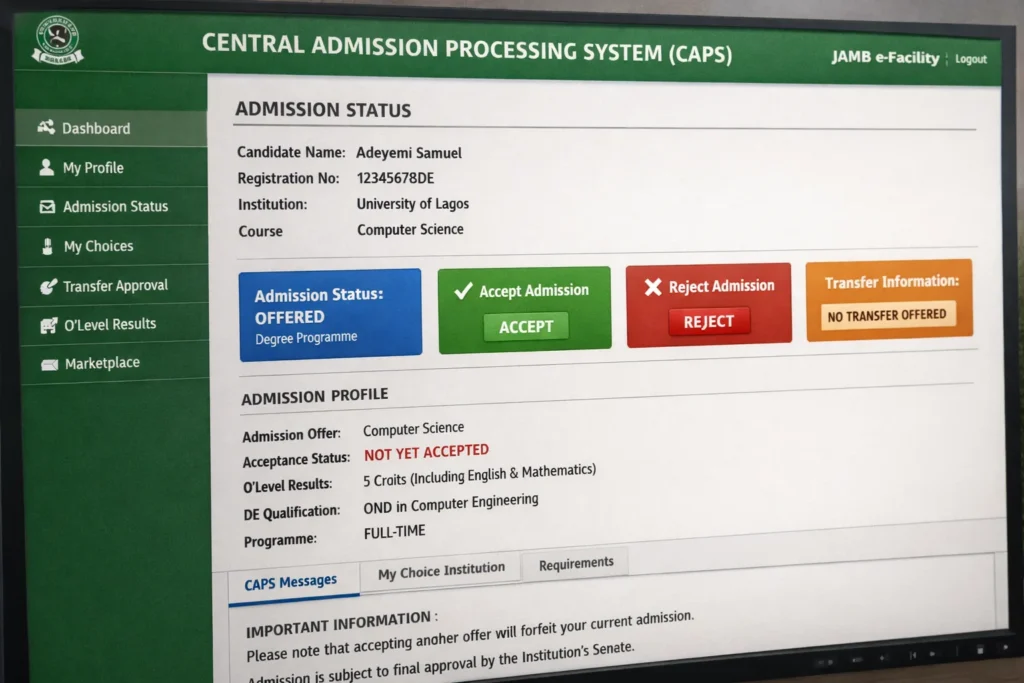
How JAMB CAPS Works for Direct Entry Candidates
The Central Admission Processing System (CAPS) ensures transparency.
Key CAPS actions:
- Admission offer
- Acceptance or rejection
- Transfer approval
Expert Tip: Regular CAPS monitoring increases admission success.
Direct Entry vs UTME: Key Differences (Direct Entry Admission Process in Nigeria: The Most Complete Expert Guide (2026 Edition))
| Feature | Direct Entry | UTME |
|---|---|---|
| Entry Level | 200 Level | 100 Level |
| Exam | No UTME | UTME Required |
| Duration | Shorter | Longer |
| Competition | High | Very High |
Advantages of Direct Entry Admission
- Saves academic time
- Reduces financial burden
- Rewards academic advancement
- Ideal for diploma and A-Level holders
Disadvantages and Limitations
- Limited course flexibility
- Strict document verification
- Fewer admission slots
Common Direct Entry Mistakes and How to Avoid Them
Mistake 1: Incomplete Result Upload
Solution: Upload all credentials early and correctly.
Mistake 2: Wrong Course Combination
Solution: Cross-check JAMB brochure before applying.
Mistake 3: Ignoring Institutional Screening
Solution: Follow each school’s Direct Entry screening updates.
Expert Best Practices for Direct Entry Success
- Apply early
- Choose less competitive institutions strategically
- Monitor CAPS weekly
- Use accurate personal data
How Universities Actually Evaluate Direct Entry Candidates (What JAMB Doesn’t Explain)
Behind the public admission guidelines, most Nigerian institutions apply internal evaluation logic that goes beyond basic eligibility. Understanding this hidden layer is often the difference between meeting requirements and securing admission.
The Three-Tier Evaluation Model Used by Many Institutions
Most universities assess Direct Entry candidates across three silent tiers:
-
Credential Compatibility
- How closely your qualification aligns with the course curriculum
- Example: OND in Computer Engineering vs OND in Electrical Engineering for Computer Science
-
Academic Signal Strength
- Class of diploma (Upper Credit vs Lower Credit)
- Grade spread across core subjects, not just final CGPA
-
Departmental Capacity Pressure
- Number of DE slots approved internally
- Ratio of UTME to DE candidates the department can absorb
Why this matters:
Two candidates may both “qualify,” but the one with tighter academic alignment and stronger signals is prioritized, even if JAMB treats them equally.
The Direct Entry Slot Reality: Why Availability Is More Limited Than Advertised
Many candidates assume Direct Entry slots are fixed or generous. In practice, they are elastic and depend on institutional dynamics.
What Really Determines Direct Entry Slot Numbers
Direct Entry admission volume is often influenced by:
- Accreditation limits set by regulatory bodies
- Departmental staff strength
- Over-admission at 100 level in previous sessions
- Carryover students occupying 200 level spaces
Expert Insight:
In years where a department overfills 100 level, Direct Entry intake is quietly reduced, even if the course is still “open” on JAMB CAPS.
Why Some Direct Entry Admissions Stall Until the Following Academic Session
A poorly explained issue that frustrates many candidates is delayed admission visibility.
Common Structural Reasons for Delays
- DE results verification lag (especially for IJMB/JUPEB)
- Departmental board approvals conducted after UTME lists
- Senate ratification cycles that prioritize 100-level admissions
Practical implication:
A delayed CAPS update does not automatically mean rejection. Many DE offers appear late but remain valid once accepted.
Course Migration Risks for Direct Entry Candidates (And How to Manage Them)
Direct Entry candidates face a higher likelihood of course transfer than UTME candidates.
Why Transfers Happen More Often in Direct Entry
- Curriculum mismatch between diploma/A-Level and university structure
- Insufficient credit equivalence for core 100-level courses
- Overcrowding in competitive departments
Smart Risk-Reduction Strategy
Before choosing a course, evaluate:
- Whether the department historically accepts DE into that course
- If similar diploma holders were absorbed fully or redirected
- Availability of related alternative courses you are willing to accept
Why Google values this insight:
It addresses outcome predictability, not just process mechanics.
Direct Entry and Professional Course Bottlenecks (Medicine, Law, Engineering)
Professional programs impose extra scrutiny on Direct Entry candidates.
What Makes These Courses Exceptionally Tight
- Regulatory council requirements (not just university policy)
- Mandatory prerequisite courses taken at 100 level
- Limited flexibility for curriculum bridging
Expert Warning:
Some institutions admit DE candidates into these courses but later require them to repeat specific 100-level courses, extending study duration.
This is not failure, it is compliance.
How O’Level Results Quietly Influence Direct Entry Outcomes
Many candidates underestimate O’Level relevance once they hold diplomas or A-Levels.
The Hidden O’Level Weighting Factor
Institutions often use O’Level results to:
- Break ties between equally qualified DE candidates
- Validate subject continuity for professional programs
- Screen candidates during internal shortlisting
Practical takeaway:
Weak O’Level passes can silently undermine strong diploma or A-Level credentials.
Direct Entry for University Dropouts: What Actually Works
University dropouts form a unique Direct Entry category, often misunderstood.
Conditions That Improve Re-entry Chances
- Transcript availability (even partial)
- Clean academic exit (no disciplinary dismissal)
- Course alignment between old and new institution
Important nuance:
Universities are more receptive to dropouts transferring academic history than those attempting a total reset without documentation.
Direct Entry Timeline Mapping: When Actions Matter Most
Instead of focusing only on deadlines, successful candidates think in phases.
The Four Critical Phases
- Pre-registration intelligence phase
- JAMB data submission phase
- Institutional screening phase
- CAPS resolution phase
Each phase has unique risks and opportunities. Missing relevance in one phase cannot always be fixed in another.
Strategic Institution Selection for Direct Entry Candidates
Not all universities treat Direct Entry with equal seriousness.
Signals That a School Is DE-Friendly
- Consistent DE admission lists across years
- Clear screening guidelines for DE
- Active DE updates on admission portals
Advanced strategy:
Prioritize institutions where Direct Entry is structurally integrated, not treated as an afterthought.
Misconceptions That Cost Direct Entry Candidates Admission
Common but Costly Beliefs
- “Once I qualify, admission is automatic”
- “CAPS rejection means permanent failure”
- “All universities treat DE the same way”
- “Higher qualification always beats course relevance”
Reality:
Direct Entry is competitive, selective, and context-driven.
Why Direct Entry Is Becoming More Competitive Each Year
Direct Entry demand is rising due to:
- Increased diploma and A-Level enrollment
- UTME fatigue among older candidates
- Strategic avoidance of extended study duration
Long-term implication:
Early preparation and strategic positioning now matter more than ever.
The Long-Term Academic Impact of Entering Through Direct Entry
Beyond admission, Direct Entry shapes academic trajectory.
Observable Outcomes
- Faster graduation timelines (when fully absorbed)
- Higher early academic pressure
- Stronger performance among candidates with aligned backgrounds
Why this matters:
Direct Entry is not a shortcut, it is a compressed academic pathway that rewards preparedness.
Frequently Asked Questions (FAQ)
What is the age limit for Direct Entry in Nigeria?
There is no official age limit for Direct Entry admission in Nigeria.
Can I use awaiting result for Direct Entry?
Yes, but results must be available before admission processing.
Does Direct Entry require Post-UTME?
Some institutions conduct screening instead of exams.
Can Direct Entry candidates study Medicine?
Yes, with IJMB or JUPEB and high grades.
Conclusion: Turning Direct Entry into a Deliberate Advantage
After years of guiding candidates who entered Nigerian universities through Direct Entry, one truth stands out clearly: Direct Entry only works for people who treat it as a strategy, not a backup plan. I have seen candidates with lower UTME scores gain admission ahead of others simply because they understood subject combinations, chose realistic institutions, and completed every step early, without shortcuts.
Direct Entry rewards preparation. It favors candidates who verify requirements directly from universities, monitor JAMB timelines closely, and align their qualifications with the right courses. Those who fail usually don’t fail because the system is unfair; they fail because they underestimate details like transcript processing, O’Level combinations, or institutional cut-off realities.
If you apply what you’ve learned here, carefully and early, you place yourself ahead of thousands of applicants chasing limited slots blindly. For deeper clarity, especially on course-specific requirements and common Direct Entry mistakes, read our related Direct Entry admission breakdown for university-by-university insights.
Call to Action
If you found this guide helpful, explore more expert-reviewed admission resources on ExamGuideNg.com to stay ahead of every Nigerian admission update.
Authority Reference
- Joint Admissions and Matriculation Board
- National Universities Commission
- Federal Ministry of Education Nigeria
- Nigerian Educational Research bodies
Written by Massodih Okon, Senior Exam Preparation Researcher and Academic Education Content Specialist with over 10 years of experience developing high-impact learning resources aligned with Nigerian and international examination standards. Reviewed and updated: January 2026. Source basis: Official JAMB syllabus and verified examination data.
About the Author
Massodih Okon is an experienced educator, researcher, and digital publishing professional with a strong academic and practical background. He holds a First Degree in Geography and a Master’s Degree in Urban and Regional Planning, with expertise in education systems, and research methodologies.
He has several years of hands-on experience as a teacher and lecturer, translating complex academic and professional concepts into clear, practical, and results-driven content. Massodih is also a professional SEO content strategist and writer. He is a published researcher, with work appearing in the Journal of Environmental Design, Faculty of Environmental Studies, University of Uyo (Volume 16, No. 1, 2021), P. 127-134. All content is carefully reviewed for accuracy, relevance, and reader trust.
See Our:
- Jamb Syllabus Explained Subject by Subject 2026 Complete Guide
- 10 Top Jamb Exam Tips to Score Above 250+
- Understanding Neco Marking Scheme: A Complete Guide for Candidates
- JAMB Cut-Off Mark for Medicine in Nigeria (2026 Complete Guide)
- NECO Chemistry Study Notes Simplified (Exam-Focused Guide)
- JAMB Literature Summary Notes: The Ultimate Master Guide for 2026 Candidates
- JAMB Grading System Explained Simply (2026 Guide)
- JAMB Biology Topic Repetition Index (2016-2025): Evidence-Driven Exam Trend Report
- JAMB Chemistry Topic Repetition Index (2016-2025): Data-Driven Exam Trend Analysis