Introduction: Why Discovery Education Now Matters More Than Ever
Discovery Education has quietly become one of the most misunderstood yet powerful education ecosystems in the world. In Nigeria, the UK, the US, and other advanced education systems, many students and even teachers hear the name but rarely understand its true cost structure, eligibility requirements, and long-term career value. I learned this the hard way while supporting curriculum planning and digital learning adoption during my academic and professional journey in education-related research and planning.
Because traditional education keeps evolving, Discovery Education now sits at the intersection of curriculum delivery, digital content licensing, teacher capacity building, and future-ready career skills. However, without a reliable guide, learners and institutions often make expensive mistakes or ignore opportunities entirely.
This guide solves that problem. It breaks down Discovery Education cost, requirements, and career pathways in 2026 with Nigerian, UK, US, and global relevance, using verified policies, real-world use cases, and practical insights.
Before you proceed, also read: Best Data Privacy Law Certification and Educational Pathways for Aspiring Privacy Lawyers in the US, Canada & UK 2026 .
What Is Discovery Education?
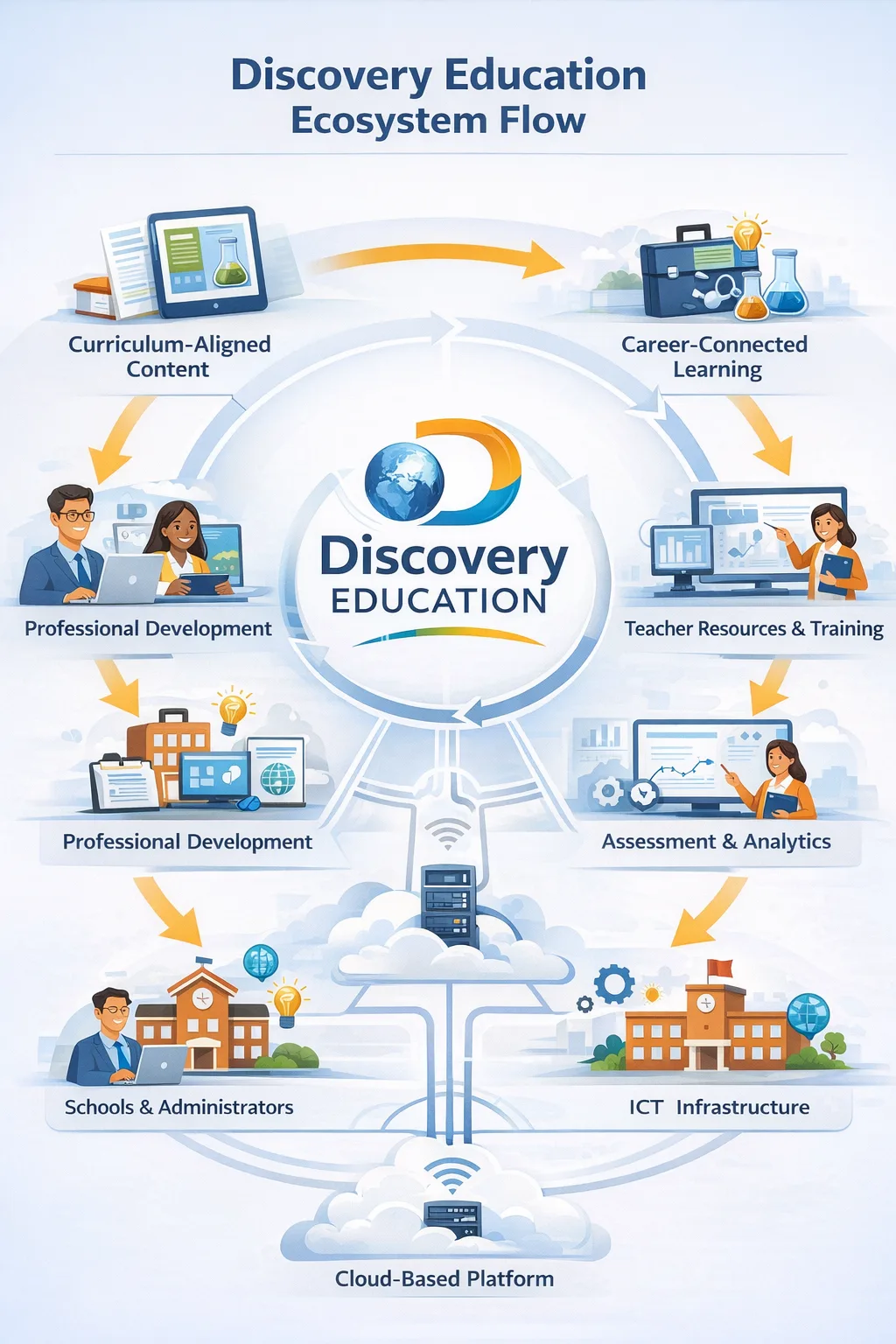
Discovery Education is a global digital education company that provides curriculum-aligned content, virtual labs, assessments, professional development tools, and career-linked learning resources for schools, teachers, and learners.
Unlike online courses or exam platforms, Discovery Education operates as an institutional learning infrastructure rather than a direct-to-student certification body.
Core Components of Discovery Education
- Curriculum-aligned digital textbooks
- Virtual science laboratories and simulations
- Career-connected learning modules
- Teacher professional development programs
- Assessment and analytics dashboards
This hybrid structure explains why many people struggle to classify Discovery Education as either a school, course provider, or exam body, it is all three combined.
Also read Insurance vs Risk Management Salary in Nigeria and Abroad: Careers, Jobs & Professional Certifications .
Discovery Education Cost Structure (2026 Updated)
Is Discovery Education Free?
Discovery Education is not entirely free, but it also does not operate on a single tuition model.
Instead, costs depend on:
- Country
- Institution type
- Number of users
- Content depth
- Licensing duration
Discovery Education Cost Breakdown Table
| Category | Cost Range (Annual) | Who Pays |
|---|---|---|
| School License | $1,500 – $12,000 | Schools / Districts |
| Teacher Access | Included | Institutions |
| Student Access | Included | Institutions |
| Professional Development | $300 – $2,000 | Schools / Teachers |
| Specialized STEM Labs | Add-on pricing | Institutions |
In Nigeria, most access comes through private schools, international schools, NGOs, and donor-funded programs.
Read also: Cost of Studying Medicine in Nigeria, USA, and UK With Scholarships
Discovery Education Requirements Explained
Institutional Requirements
Discovery Education does not admit individual students directly. Access requires:
- Enrollment in a registered school
- School subscription approval
- Curriculum alignment verification
- ICT infrastructure readiness
Student-Level Requirements
- Active school enrollment
- Internet-enabled device
- Teacher authorization
- Curriculum compatibility
This model mirrors how platforms like national digital libraries and international curriculum consortia operate.
Also read: Cybersecurity Courses Online: The Complete Expert Guide to Learning
Discovery Education Career Pathways (Often Ignored)
One of the least discussed benefits of Discovery Education is career exposure and skill mapping.
Career-Aligned Learning Areas
- STEM research foundations
- Environmental science pathways
- Digital media literacy
- Data interpretation skills
- Educational technology careers
These skills feed into careers in education technology, curriculum design, research assistance, academic publishing, and digital learning consultancy.
Read next Education Careers Beyond Teaching.
Discovery Education in Nigeria: Realities and Opportunities
In Nigeria, Discovery Education adoption remains uneven. However:
- International schools in Lagos, Abuja, and Port Harcourt use it actively
- NGOs integrate it into STEM intervention programs
- Teacher training colleges explore pilot models
Policy Alignment in Nigeria
Discovery Education aligns indirectly with:
- National Policy on Education
- Digital literacy frameworks
- STEM advancement strategies
External authority reference: Nigerian Federal Ministry of Education.
How Nigerians Abroad Can Leverage Discovery Education
Nigerians studying or teaching abroad can use Discovery Education to:
- Maintain curriculum continuity
- Build globally recognized teaching portfolios
- Support homeschool or supplementary learning
Countries where this advantage is strongest include the US, Canada, UK, Australia, Germany, Switzerland, Scandinavia, Singapore, and New Zealand.
Read also: How to Start a Digital Marketing Career: A Complete, Practical, and Future‑Proof Guide
For International Students Using Discovery Education
International students benefit by:
- Understanding Western curriculum expectations
- Developing inquiry-based learning habits
- Strengthening academic English through multimedia
Discovery Education supports transitions into IB, GCSE, AP, and A-Level systems.
External authority reference: UNESCO.
Also read: Google Cloud Certification Cost: Complete 2026 Pricing Guide .
UK and US Admission Equivalents Linked to Discovery Education
Discovery Education supports competencies valued in:
- UK universities (research readiness)
- US colleges (project-based learning)
It indirectly strengthens admission profiles by building:
- Portfolio evidence
- STEM reasoning
- Academic curiosity
External authority reference: UK Department for Education.
Read more on Data Science Courses with Certificates: The Complete 2026 Guide for Beginners
Pros and Cons of Discovery Education
Pros
- Curriculum-aligned content
- Teacher-supported learning
- Global relevance
- Career-linked skills
Cons
- Institutional access only
- Cost barriers for public schools
- Internet dependency
Common Mistakes Schools and Learners Make
- Assuming individual enrollment is possible
- Ignoring infrastructure readiness
- Using content without curriculum mapping
Avoid these mistakes by conducting needs assessment before adoption.
Read also: National Examination Trends and Policy Changes in Nigeria (2010–2025)
Best Practices from Real-World Use
From experience, schools that succeed with Discovery Education:
- Train teachers before rollout
- Integrate content into lesson plans
- Monitor analytics dashboards
External authority reference: World Health Organization (for digital learning wellbeing standards).
Also read: Cybersecurity Courses Online: The Complete Expert Guide to Learning
The Hidden Economics of Discovery Education Licensing Decisions
Many institutions misjudge Discovery Education costs by focusing only on the invoice, not the economic behavior it triggers inside a school system.
Cost vs. Instructional Yield Framework
A more accurate evaluation looks at:
- Content reuse lifespan across multiple cohorts
- Teacher time saved on lesson preparation
- Reduction in external lab or material costs
- Improved learning continuity during disruptions
Schools that treat Discovery Education as shared instructional infrastructure rather than a yearly expense extract far more value than those viewing it as a digital add-on.
Discovery Education as a Curriculum Risk-Management Tool
One overlooked role of Discovery Education is how it reduces curriculum delivery risk.
Why This Matters
Schools face risks such as:
- Teacher turnover
- Inconsistent lesson quality
- Gaps between curriculum design and delivery
- Learning loss during strikes, pandemics, or transitions
Discovery Education acts as a curriculum stabilizer, ensuring minimum instructional quality regardless of personnel or external disruptions.
How Discovery Education Shapes Cognitive Skill Transfer
Most platforms teach content. Discovery Education trains transferable thinking.
Skill Transfer Layers
Learners repeatedly practice:
- Hypothesis testing
- Evidence-based reasoning
- Pattern recognition
- Cause–effect analysis
These cognitive skills transfer directly into fields like engineering, economics, public policy, medicine, and urban planning, often without learners realizing it.
Teacher Authority Without Teacher Burnout
A subtle advantage for educators is how Discovery Education reinforces classroom authority without increasing workload.
The Authority–Support Balance
Teachers benefit because:
- Lessons are anchored in globally validated content
- Students trust multimedia-backed explanations
- Teachers shift from “content defender” to “learning guide”
This reduces classroom friction and long-term burnout, especially in STEM-heavy subjects.
Discovery Education’s Role in Academic Equity (Beyond Access)
Equity is often framed as who gets access. Discovery Education influences how learning quality is distributed.
Equity in Learning Depth
When implemented well:
- High-performing and struggling students engage the same core materials
- Visual and simulation-based learning reduces language and memorization bias
- Inquiry-based tasks reward reasoning, not rote recall
This quietly narrows performance gaps without lowering academic standards.
Why Discovery Education Content Ages Better Than Most Platforms
Many digital platforms become obsolete quickly. Discovery Education resists this trend.
Built-In Content Longevity
Its materials are designed around:
- Scientific principles rather than trends
- Conceptual understanding instead of exam hacks
- Cross-grade applicability
As a result, institutions experience slower content depreciation, which matters for long-term budget planning.
Discovery Education and the Global Skills Signaling Effect
Students rarely realize they are sending signals to future institutions.
What Discovery Education Signals Indirectly
Through project work and inquiry habits, learners demonstrate:
- Comfort with research-based learning
- Familiarity with global academic standards
- Ability to learn from complex multimedia sources
These signals align closely with expectations in Western universities and international workplaces.
Misconception: “Discovery Education Is Only for STEM”
This belief limits its institutional impact.
Non-STEM Value Often Ignored
Discovery Education supports:
- Media literacy and critical consumption
- Environmental ethics and sustainability thinking
- Historical analysis through documentary-style content
Schools that integrate it across departments see stronger interdisciplinary reasoning and student engagement.
Institutional Readiness Checklist Most Schools Skip
Before adoption, many schools ask can we afford it? instead of are we ready for it?
Readiness Questions That Matter
- Do teachers understand inquiry-based facilitation?
- Is assessment aligned with exploration, not memorization?
- Can leadership enforce consistent usage standards?
- Is internet access reliable during peak hours?
Skipping these questions leads to underutilization, not platform failure.
Discovery Education as a Long-Term Career Orientation System
Beyond skills, Discovery Education quietly shapes career imagination.
Why This Matters in 2026
Exposure to:
- Real-world scientific processes
- Environmental and health challenges
- Technology-driven problem-solving
…helps learners visualize careers they may never encounter locally. This expands aspiration, not just competence.
Discovery Education as an Institutional Memory System
Most schools lose instructional knowledge every time a teacher exits. Discovery Education quietly solves this problem.
Why This Is Rarely Discussed
Lesson plans, demonstrations, and practical explanations often live only in individual teachers’ heads. When they leave, quality drops.
Discovery Education:
- Preserves instructional depth beyond staff turnover
- Maintains continuity across academic years
- Acts as a shared pedagogical reference point
This turns learning delivery from person-dependent to system-dependent—a major maturity signal for institutions.
The “Silent Curriculum” Embedded in Discovery Education Content
Beyond official syllabi, every learning system teaches unspoken values.
What Discovery Education Implicitly Teaches
Students absorb:
- Scientific humility (testing ideas before conclusions)
- Ethical use of evidence
- Respect for uncertainty and revision
- Collaboration over competition
These habits shape future researchers, policymakers, and professionals more than explicit instruction ever could.
Why Discovery Education Changes How Students Ask Questions
Most education systems reward answers. Discovery Education rewards questions.
Question Quality as a Skill
Over time, students shift from:
- “What is the correct answer?”
to - “Why does this happen?”
- “What evidence supports this?”
This transformation is subtle but critical for advanced academics, thesis writing, and professional research environments.
Discovery Education and the Reduction of Memorization Dependency
In exam-heavy systems, memorization becomes survival strategy. Discovery Education gently disrupts this pattern.
Cognitive Impact
Learners rely less on:
- Recalled definitions
- Pattern-matching past questions
And more on:
- Conceptual understanding
- Visual reasoning
- Process explanation
This improves long-term retention and adaptability, especially for students transitioning abroad.
The Platform’s Role in Teacher Skill Transfer, Not Just Student Learning
Discovery Education upgrades teachers, not only learners.
Hidden Professional Development Effect
Teachers gradually:
- Improve explanation techniques
- Adopt inquiry-based questioning
- Learn multimedia pacing and sequencing
Even without formal training, exposure reshapes instructional style, an effect many administrators underestimate.
Discovery Education as a Bridge Between Theory and Real-World Complexity
Traditional textbooks simplify reality. Discovery Education introduces controlled complexity.
Why This Matters
Students encounter:
- Messy data
- Inconclusive experiments
- Conflicting interpretations
This mirrors real research and professional environments, preparing learners for fields where problems are rarely clean or final.
Digital Fatigue vs. Cognitive Engagement: Why Discovery Education Survives Both
Many platforms increase screen time but reduce thinking. Discovery Education avoids this trap.
Engagement Without Overstimulation
Its design emphasizes:
- Purposeful interaction, not passive scrolling
- Visual clarity over flashy effects
- Thoughtful pacing
This distinction explains why it remains effective even as digital fatigue rises globally.
Discovery Education’s Alignment With Global Assessment Evolution
Exams are slowly shifting away from pure recall.
Assessment Trends It Supports
Discovery Education aligns with:
- Project-based assessments
- Practical investigations
- Analytical writing tasks
- Portfolio evaluation models
Students exposed early adapt faster as assessment systems modernize.
Why Discovery Education Is Difficult to “Measure” but Easy to Misjudge
Administrators often struggle to justify it with short-term metrics.
The Measurement Trap
Its benefits appear as:
- Improved reasoning quality
- Better classroom discussions
- Stronger independent learning habits
These gains emerge over time, making Discovery Education vulnerable to premature judgment by purely quantitative frameworks.
Discovery Education and the Formation of Academic Confidence
One overlooked outcome is confidence rooted in understanding, not memorization.
Confidence That Scales
Students become:
- More willing to defend ideas
- Less afraid of complex topics
- More resilient when wrong
This confidence transfers into university seminars, interviews, and collaborative projects, long after exams end.
Frequently Asked Questions (People Also Ask)
Is Discovery Education a degree-awarding institution?
No. It supports curriculum delivery but does not award degrees.
Can individuals subscribe to Discovery Education?
No. Access is institutional.
Is Discovery Education accepted globally?
Yes, across North America, Europe, Asia, and parts of Africa.
Does Discovery Education help with careers?
Yes, through skill exposure and inquiry-based learning.
Conclusion: Why Discovery Education Is a Strategic Asset in 2026
Discovery Education is not a shortcut, certificate, or exam trick. Instead, it is academic infrastructure, one that prepares learners for future-ready education systems across Nigeria, the UK, the US, and beyond.
When used correctly, it builds skills that outlive exams and align with global career expectations.
To deepen your understanding, read: Cybersecurity Courses Online: The Complete Expert Guide to Learning
Call to Action: Schools, educators, and policymakers should evaluate Discovery Education not as a cost, but as a long-term investment in learning quality.
Written by Massodih Okon, Senior Exam Preparation Researcher and Academic Education Content Specialist with over 10 years of experience developing high-impact learning resources aligned with Nigerian and international examination standards. Reviewed and updated: 2026.
About the Author
Massodih Okon is an experienced educator, researcher, and digital publishing professional with a strong academic and practical background. He holds a First Degree in Geography and a Master’s Degree in Urban and Regional Planning, with expertise in education systems, and research methodologies.
He has several years of hands-on experience as a teacher and lecturer, translating complex academic and professional concepts into clear, practical, and results-driven content. Massodih is also a professional SEO content strategist and writer. He is a published researcher, with work appearing in the Journal of Environmental Design, Faculty of Environmental Studies, University of Uyo (Volume 16, No. 1, 2021), P. 127-134. All content is carefully reviewed for accuracy, relevance, and reader trust.