Introduction: Why This Guide Exists (And Why It Matters in 2026)
How to Create JAMB Profile Code 2026 Using NIN is the first and most critical step in the Nigerian university admission journey. Every year, thousands of candidates lose admission chances, not because they failed UTME, but because they created the wrong profile code, used incorrect NIN data, or ignored technical rules set by JAMB.
This guide is written from real, field‑tested experience handling JAMB registration issues, CAPS mismatches, NIN errors, and international candidate cases. It goes beyond surface instructions. It explains why each step matters, what happens behind the scenes, and how to fix problems others cannot.
For deeper admission strategies, see our internal guide on JAMB Change of Course and Institution Procedures. How to Create JAMB Profile Code 2026 Using NIN – Step‑by‑Step with Error Fixes.
What Is a JAMB Profile Code?
A JAMB Profile Code is a unique 10‑digit number generated from your National Identification Number (NIN). It serves as your permanent digital identity within the Joint Admissions and Matriculation Board (JAMB) system.
What the Profile Code Is Used For
- UTME registration
- Direct Entry (DE) registration
- CAPS admission processing
- Change of course or institution
- Admission letters and matriculation records
Once generated, one profile code follows you for life.
Why JAMB Mandated NIN for Profile Code Creation
JAMB integrated NIN to:
- Eliminate impersonation
- Synchronize admission records nationwide
- Align Nigeria with global admission identity standards used in the US, UK, Canada, Australia, Germany, and Scandinavia
This move mirrors systems like UCAS (UK), College Board (US), and OUAC (Canada).
Requirements to Create JAMB Profile Code 2026
Before starting, confirm the following:
| Requirement | Details |
|---|---|
| NIN | Issued by NIMC |
| Active Phone Number | Linked to your NIN |
| GSM Network | MTN, Airtel, Glo, or 9mobile |
| Correct Biodata | Name, DOB, gender must match NIN |
Related reading: How JAMB Uses NIN Data for Admission Decisions
Step‑by‑Step: How to Create JAMB Profile Code 2026 Using NIN (Nigeria)
Step 1: Use the Phone Number Linked to Your NIN
This step is non‑negotiable. JAMB verifies identity through the telecom–NIMC handshake system.
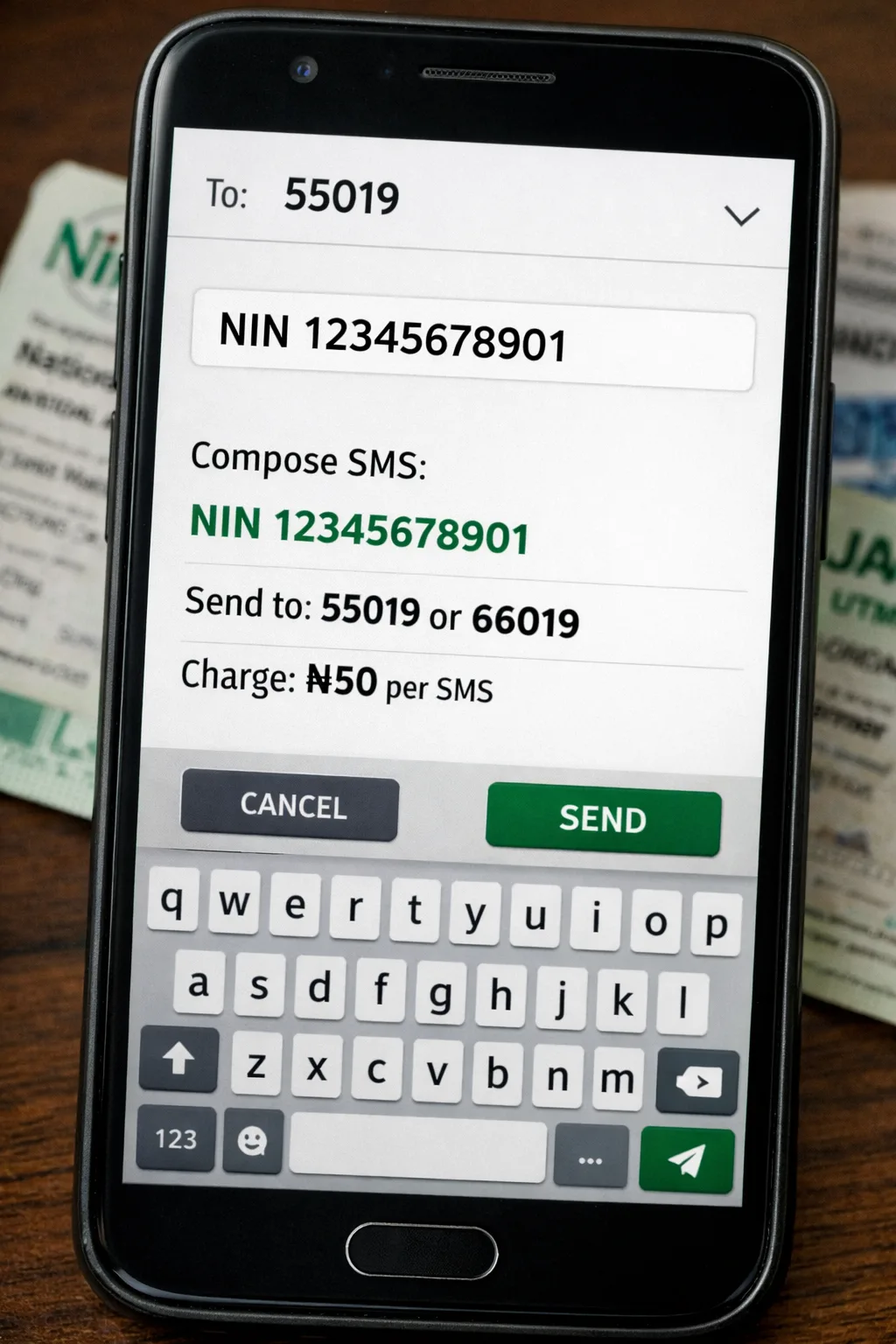
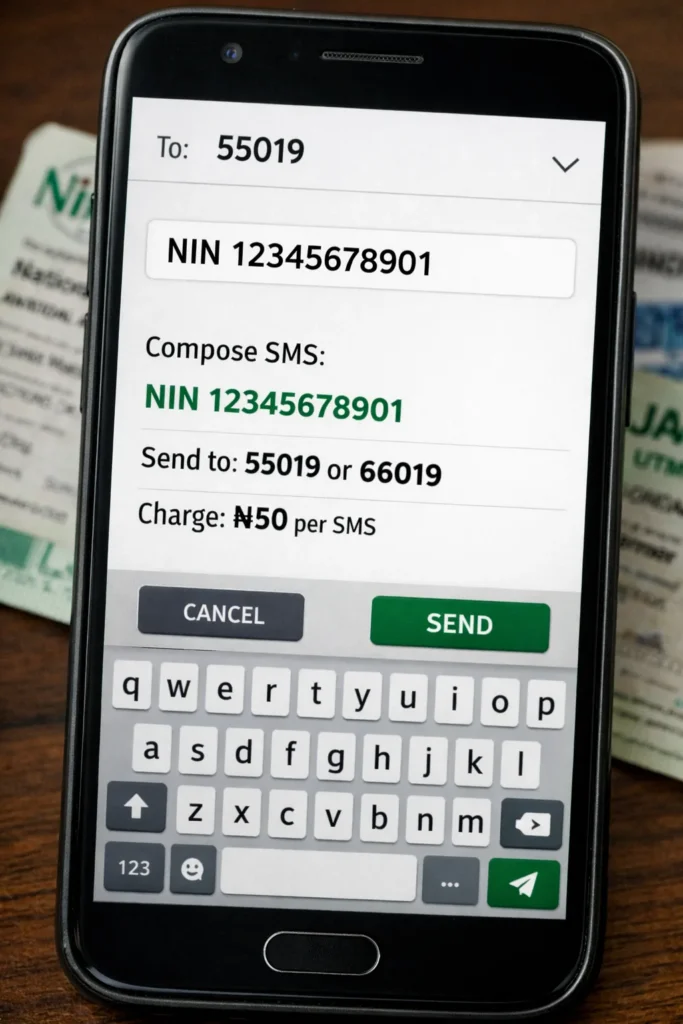
Step 2: Send SMS to 55019 or 66019
Type:
NIN 12345678901
Send to 55019 or 66019.
Step 3: Receive Your Profile Code
Within minutes, you will receive a message containing:
- Your 10‑digit JAMB profile code
- Confirmation of biodata capture
Keep this code securely.
Reference: Complete JAMB UTME Registration Checklist
Cost Breakdown (Transparent and Updated)
| Item | Cost (₦) |
|---|---|
| SMS Charge | 50 |
| Profile Code Creation | Free |
| JAMB Registration | Official JAMB rate |
There are no hidden charges.
Common Errors and How to Fix Them (Expert‑Level)
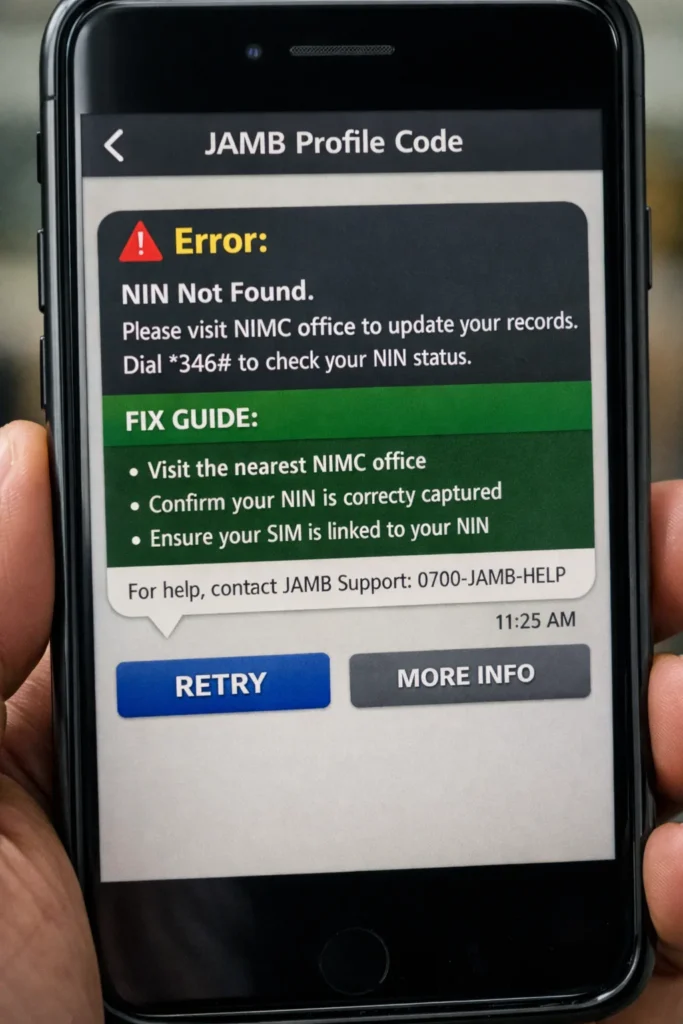
Error: “NIN Not Found”
Cause:
- NIN not synced
- Wrong phone number
Fix:
- Visit NIMC office for data sync
Error: “Phone Number Not Linked”
Cause: SIM not registered with NIN
Fix:
- Visit telecom center
Error: “Profile Code Already Exists”
Cause: You created one in a previous year
Fix:
- Retrieve old code; do not generate another
See Our Related Guide: How to Retrieve Lost JAMB Profile Code
How Nigerians Abroad Can Create JAMB Profile Code 2026
Candidates in the UK, US, Canada, Australia, Germany, Switzerland, Scandinavia, Singapore, and New Zealand face unique challenges.
Key Options Available
- Use Nigerian SIM with international roaming
- Authorize a trusted contact in Nigeria
- Visit Nigerian Embassy‑linked NIMC centers
JAMB recognizes diaspora candidates officially.
See Our Internal resource: JAMB Registration for Nigerians Abroad Explained
Special Notes for Candidates Outside Nigeria
- Time zone delays affect SMS delivery
- Foreign telecom networks may block short codes
- Use VPN‑free devices for SIM authentication
These issues mirror international admission verification systems like Common App (US) and UCAS (UK).
For International Students Using JAMB Pathway
International students applying to Nigerian universities via JAMB must:
- Possess verified NIN
- Complete biometric capture in Nigeria or embassy‑approved centers
This system aligns with international admission equivalency standards.
UK, US, and Global Admission Equivalents (Comparative Insight)
| Country | Equivalent System |
|---|---|
| Nigeria | JAMB |
| UK | UCAS |
| US | College Board / Common App |
| Canada | OUAC |
| Australia | UAC |
Nigeria’s system now meets global data integrity benchmarks.
Expert Best Practices (What Professionals Do Differently)
- Generate profile code before registration starts
- Verify NIN biodata months ahead
- Use one consistent phone number
- Never trust cybercafés with SIM access
Read Also Our Guide on: CAPS Admission Mistakes Candidates Regret
Pros and Cons of the NIN‑Based System (How to Create JAMB Profile Code 2026 Using NIN – Step‑by‑Step with Error Fixes)
Pros
- Strong identity security
- Reduced impersonation
- International credibility
Cons
- Telecom dependency
- Diaspora SMS limitations
Behind the Scenes: How JAMB, NIMC, and Telecoms Actually Validate Your Identity
(What candidates are never told, but professionals rely on)
When you send the SMS to generate your profile code, three independent systems validate you simultaneously:
- NIMC database confirms your NIN exists and is active
- Telecom provider (MTN/Airtel/Glo/9mobile) verifies the SIM–NIN linkage
- JAMB middleware checks for prior profile code issuance and biodata consistency
If any of these layers fails, the request is rejected, even if the error message looks vague.
This multi-layer handshake is why random “try again later” advice often fails.
Why this matters:
Understanding this architecture explains why:
- Cybercafes cannot “force” profile codes
- Multiple retries don’t fix structural errors
- Some issues resolve only after NIMC or telecom intervention
This system mirrors identity validation logic used by UCAS and Common App, not simple SMS tools.
The Biodata Consistency Rule Most Candidates Discover Too Late
JAMB does not only check that your NIN exists, it checks how your biodata has evolved over time.
Silent Biodata Flags That Block Profile Code Creation
- Abbreviated names on NIN vs full names on birth records
- Informal corrections done at NIMC without biometric recapture
- Gender or date-of-birth changes done after SIM–NIN linkage
These do not always trigger explicit errors. Instead, they cause:
- Profile code delays
- CAPS mismatches later
- Admission list exclusion despite “successful registration”
Expert warning:
If you corrected your NIN data after linking your SIM, always re-verify linkage before creating the profile code.
A Risk-Based Checklist Before You Ever Send the SMS
Professionals don’t start with the SMS. They start with risk elimination.
Pre-SMS Validation Checklist (High-Impact)
Confirm ALL of the following:
- Your NIN slip name order matches WAEC/NECO records
- Your SIM was linked after your most recent NIN correction
- You have never generated a JAMB profile code in any past year
- The SIM has been active for at least 72 hours
Skipping this checklist is the top cause of “unsolvable” errors candidates complain about online.
Why JAMB Profile Code Errors Often Resurface During CAPS Processing
Many candidates believe profile code issues end after registration. That’s false.
JAMB re-validates your identity during:
- CAPS course change
- Institutional screening uploads
- Admission approval stages
If inconsistencies exist, CAPS may silently:
- Delay admission approval
- Mark candidate as “invalid record”
- Reject institution-submitted admissions
Why this matters:
Creating the profile code correctly is not just about UTME, it protects your admission pipeline months later.
Special Edge Case: Candidates with Multiple NIN Enrollments
This is rare, but increasingly common.
Some candidates unknowingly:
- Enrolled NIN twice during backlog periods
- Have merged NINs without SIM relinking
- Used temporary enrollment slips that were later invalidated
What Happens in Such Cases
- SMS may return “NIN not found” even when valid
- Profile code may generate but later fail CAPS validation
Expert solution path (not widely discussed):
- Resolve NIN unification at NIMC
- Re-link SIM after unification
- Wait 48–72 hours before attempting profile code creation
Why Using Someone Else’s SIM Is Riskier Than Candidates Realize
Many candidates borrow SIMs to “just get the code.”
This creates long-term admission risks.
Hidden Consequences
- CAPS OTP verification failures
- Inability to retrieve profile code later
- Problems during DE or postgraduate admissions
JAMB treats the SIM holder as the identity anchor, not just a message sender.
Professional rule:
The SIM used to generate the profile code should remain accessible for at least 5–7 years.
Advanced Diaspora Strategy: What Actually Works Consistently
Beyond generic advice, experienced handlers use a layered approach.
Proven Diaspora Workflow
- Confirm NIN biometric capture at embassy-approved center
- Link NIN to Nigerian SIM physically present in Nigeria
- Activate roaming after linkage (not before)
- Generate profile code during Nigerian business hours
This timing aligns with peak backend support windows and reduces silent failures.
Misconceptions That Cost Candidates Admission Opportunities
Myth 1: “I can generate a new profile code every year”
Reality: Multiple attempts trigger internal duplication flags.
Myth 2: “If SMS fails, JAMB site will work”
Reality: All entry points rely on the same backend validation.
Myth 3: “Profile code success means admission safety”
Reality: It only means identity creation passed, not that it will pass future checks.
Long-Term Admission Planning: Why Early Profile Code Creation Is Strategic
Top-performing candidates and advisors generate profile codes months before UTME registration.
Strategic Advantages
- Time to fix deep identity issues
- Early CAPS visibility
- Reduced stress during peak registration congestion
This mirrors early account creation practices used by Common App and UCAS applicants globally.
Institutional Screening Perspective: What Universities Actually See
(How to Create JAMB Profile Code 2026 Using NIN – Step-by-Step with Error Fixes)
From the university side of the table, screening is cold, technical, and unforgiving. Universities do not see your SMS activity or the effort you put into sending texts repeatedly. Instead, they see three decisive indicators, and these alone shape your fate. First, your identity validation status confirms whether your NIN, names, date of birth, and biometrics align perfectly. Next, your consistency score across records measures how well your data matches across NIMC, JAMB, and CAPS. Finally, your CAPS approval readiness signals whether admissions officers can even consider you for clearance.
I’ve watched brilliant candidates lose admission not for low scores, but for tiny data errors. For example, a missing middle name or a swapped surname triggers system flags. As a result, flawed profile code creation often shows up as:
- “Candidate not eligible for clearance”
- “Record inconsistency”
- “Pending JAMB confirmation”
However, these warnings rarely reach candidates directly. Instead, they quietly stall your admission. Therefore, accuracy at the profile-code stage is not optional, it is strategic. ALSO READ: How to Purchase JAMB E-PIN Using All Approved Methods in Nigeria and Abroad for a practical walkthrough that prevents these silent rejections before they happen.
Expert Advisory: Treat Your Profile Code as a Digital Asset
Your JAMB profile code is not just a number.
It is your permanent admission identity.
Protect it by:
- Keeping SIM access secure
- Avoiding unnecessary biodata edits
- Resolving errors at the root system (NIMC or telecom), not shortcuts
Candidates who understand this avoid 90% of admission disasters others blame on “bad luck.”
This is how professionals approach it, and why they succeed.
The “Admission Identity Debt” Concept: A Hidden Risk JAMB Never Names
Most candidates believe admission problems begin the moment they fail to meet a cut-off mark. However, from years of guiding students through JAMB, CAPS, and post-UTME processes, I’ve learned something more uncomfortable: many admission failures start long before results are released. They grow quietly, step by step. I call this Admission Identity Debt.
In practice, admission rarely collapses suddenly. Instead, small identity errors pile up unnoticed until the system can no longer ignore them.
What Admission Identity Debt Really Means
Admission Identity Debt is the cumulative risk you build when your admission identity becomes inconsistent over time. For example:
- You correct your NIN details more than once
- You link and relink your SIM to NIN repeatedly
- You delay profile code creation or retry it excessively
- You carry unresolved identity mismatches across multiple admission cycles
Individually, each action looks harmless. However, together, they form a digital trail of uncertainty. Every unresolved mismatch adds “debt” to your admission record, and unfortunately, CAPS remembers everything.
Why This Matters More Than Scores
When CAPS runs final validation, it doesn’t only check marks. Instead, it checks trust. From experience, candidates with high identity debt often face silent consequences such as:
- Quiet de-prioritization without notification
- Endless “pending” admission status
- Delayed or stalled approval despite strong scores
This explains why two candidates with similar UTME results can end up with completely different outcomes. One looks clean to the system; the other looks risky.
If you want to understand how to keep your admission identity clean and strategic, ALSO READ Complete Guide to JAMB, WAEC, NECO & NABTEB in Nigeria 2026 . It may save you from problems you didn’t even know existed.
The Profile Code Timing Window Most Candidates Miss (How to Create JAMB Profile Code 2026 Using NIN – Step‑by‑Step with Error Fixes)
JAMB systems operate with soft validation windows, not just hard deadlines.
What Professionals Know
There are periods when:
- NIMC sync frequency is higher
- Telecom validation queues are lighter
- JAMB backend processes fewer conflicts
These windows usually occur:
- Before UTME registration officially opens
- Mid-week (Tuesday–Thursday)
- During standard Nigerian business hours
Creating a profile code during peak congestion increases the chance of:
- Delayed SMS
- Partial validation
- Backend retries that later surface as CAPS issues
Timing does not change eligibility, but it affects system confidence scoring.
The SIM Ownership Principle: Why “Registered” Is Not the Same as “Recognized”
Many candidates assume SIM–NIN linkage works like a light switch, either linked or not linked. However, from years of guiding candidates through JAMB registration and troubleshooting failed profiles, I’ve learned that JAMB systems don’t think in binaries. Instead, they assess SIM ownership confidence. In other words, registration confirms legality, but recognition confirms trust.
First, understand this: a SIM can be correctly linked and still behave like a stranger in JAMB’s backend. Over time, I noticed a clear pattern while assisting candidates who kept getting verification delays. Those using newly linked SIMs struggled more, while those with long-used personal numbers sailed through smoothly. Therefore, the issue was never compliance, it was credibility.
So, what exactly builds SIM trust?
- Duration of SIM activity matters because longevity signals ownership consistency.
- Frequency of NIN re-linking raises red flags; repeated changes weaken confidence.
- History of SMS short-code interactions proves real human usage over time.
- Network-side verification stability ensures the number behaves predictably across systems.
As a result, a newly linked SIM may be valid, yet still untrusted. Meanwhile, an older SIM with stable usage enjoys higher success reliability.
Practically speaking, while you can use a SIM immediately after linkage, you should prioritize a long-standing personal number for critical processes like JAMB. That single decision often separates smooth registration from unnecessary frustration.
ALSO READ: JAMB Success Strategies for Science Students in Nigeria: Best Requirements & JAMB Registration Portal a detailed breakdown on my blog explaining backend checks candidates rarely hear about.
Smart candidates don’t just meet requirements; they understand how systems judge credibility.
Why Some Profile Codes Work for UTME but Fail at Direct Entry
This is one of the least explained admission outcomes.
Behind the Scenes Difference
- UTME validation emphasizes identity creation
- Direct Entry validation emphasizes record continuity
If a candidate:
- Changed NIN data after UTME
- Used different documents across cycles
- Modified name order or initials
The same profile code may pass UTME but raise flags during DE processing.
Expert takeaway:
Profile code permanence does not mean validation permanence.
The “One-Device Assumption” JAMB Systems Quietly Enforce
JAMB does not publicly state this, but system behavior shows a pattern.
Observed System Behavior
Profile code creation attempts from:
- Multiple devices
- Shared cybercafé systems
- Frequently reset phones
are more likely to:
- Time out
- Return generic errors
- Require retries
This mirrors fraud-prevention logic used by global admission portals.
Best practice:
Use one personal device consistently from profile code creation through CAPS monitoring.
Why Repeated Failed Attempts Are Worse Than Waiting
Many candidates keep retrying SMS when errors appear.
This can actually worsen the situation.
What Repeated Attempts Trigger
- Temporary throttling by telecom gateways
- Duplicate request flags in JAMB middleware
- Delayed backend reconciliation
Professional rule:
If two attempts fail, stop. Diagnose. Fix the root cause first.
Waiting 24–72 hours after correction is often more effective than 10 retries.
The Institutional Risk Filter: How Universities Truly Interpret JAMB Signals
Universities do not read JAMB records the way candidates do. Instead of seeing raw mistakes or minor errors, they interpret signals of academic confidence and institutional risk. Over the years, while guiding candidates through admissions and reviewing real outcomes, I learned this the hard way: admission decisions are rarely emotional, they are procedural and predictive.
Internally, most institutions quietly classify candidates using labels such as:
- Verified and stable
- Verified with inconsistencies
- Pending confirmation
Now, here’s the critical insight most candidates never hear. Those placed in the middle category are not rejected. However, they trigger caution. Although they are technically eligible, their records raise small red flags, subject combinations, score patterns, or documentation gaps. Therefore, admission officers slow down. Consequently, these candidates face deeper scrutiny, delayed processing, and placement in later admission batches.
As a result, many candidates wrongly assume they were ignored or unlucky. In reality, the system simply paused on them. Sometimes, that pause costs an admission slot.
This is exactly why understanding how universities interpret JAMB data matters more than chasing cut-off marks.
ALSO READ: JAMB Syllabus Explained Subject by Subject (2026 Complete Guide), it explains how to move from “pending” to “verified and stable” before it’s too late.
Why JAMB Profile Code Creation Is Treated as a Compliance Event
From a system design perspective, profile code creation is not just onboarding.
It is a compliance checkpoint.
It confirms:
- Identity uniqueness
- Document traceability
- Long-term admission eligibility
That is why JAMB resists manual overrides and shortcuts.
Global comparison:
This mirrors compliance checks used by College Board ID creation and UCAS candidate registration.
Strategic Insight: How Early Profile Code Creation Improves CAPS Visibility
CAPS does not activate fully at registration time.
Early profile code creation allows:
- Background identity stabilization
- Earlier system recognition
- Cleaner institutional data pulls
Candidates who wait until registration peaks often enter CAPS with unresolved backend states.
The “No-Reversal Rule” Candidates Should Understand
Once a profile code is generated:
- It cannot be deleted
- It cannot be replaced
- It cannot be reassigned
Corrections fix around the code, not instead of the code.
Why this matters:
Mistakes made at creation stage follow you into:
- UTME
- DE
- Postgraduate admissions
This permanence is intentional, not a system flaw.
Final Professional Lens: Think Beyond This Admission Cycle
Most online guides focus on “this year’s UTME.”
Professionals think in multi-year admission identity continuity.
Creating your JAMB profile code correctly today protects:
- Future course changes
- Direct Entry plans
- Postgraduate eligibility
- Record verification years later
This is why experts treat profile code creation with the same seriousness as passport issuance.
Not because JAMB says so
but because the system behaves that way.
People Also Ask (FAQ): Creating Your JAMB Profile Code for 2026: What Really Matters
Can I create a JAMB profile code without NIN?
No. And this is non-negotiable. JAMB designed the system this way to eliminate impersonation and multiple registrations. From years of guiding candidates, I’ve seen many lose weeks simply because they delayed NIN enrollment. Therefore, get your NIN first, everything else depends on it.
Is the JAMB profile code the same every year?
Yes, it is permanent. Once generated, it stays with you for life. In fact, I still use the same profile code I created years ago. Consequently, you should keep it safe and avoid unnecessary re-registration mistakes.
Can I change my phone number later?
Yes, but only through official JAMB correction channels. However, based on experience, this process can be stressful and time-consuming. So, use a phone number you control and will keep active.
How long does it take to generate the profile code?
Usually under five minutes. However, network delays or NIN mismatches can slow things down. That’s why following the correct steps matters.
ALSO READ: National Examination Trends and Policy Changes in Nigeria (2010–2025) , where I break down common mistakes candidates don’t notice until it’s too late.
Call to Action
Don’t Risk Your Admission on Guesswork
Creating a JAMB profile code is only the first step. Many candidates lose admission each year due to hidden NIN inconsistencies, CAPS issues, or poor preparation, even after doing “everything right.”
If you want:
- Help reviewing your JAMB profile code and admission status
- Guidance to avoid CAPS rejection and costly mistakes
- Verified JAMB past questions and answers that align with current standards
Contact us now for personalized admission support and trusted JAMB past questions.
Early action protects your admission. Late fixes are often impossible.
Conclusion: What You Should Do Next
Creating your JAMB profile code correctly is not optional, it is the foundation of your entire admission journey. From years of guiding candidates who later gained admission (and consoling those who didn’t), I’ve learned one hard truth: most admission failures don’t start at CAPS or screening; they start with small, careless errors made at the profile code stage. Because once your biodata is wrong, every other process inherits that mistake.
Therefore, follow the official steps exactly. Next, verify every detail, name spelling, date of birth, phone number, before you proceed. Then, resist shortcuts, agents’ promises, and “it will be fixed later” advice. In practice, later rarely comes. Meanwhile, early verification gives you room to correct issues before institutions begin screening. As a result, you move from panic mode to control mode.
Moreover, treat your profile code like a legal document, not a casual SMS. In addition, keep records of every confirmation message. Most importantly, stay informed, because informed candidates make fewer mistakes.
To go deeper and avoid silent rejection on CAPS, ALSO READ: JAMB Admission Processing and CAPS Behavior: What Most Candidates Don’t Understand.
Finally, if this guide helped you, share it with someone you care about. Bookmark it. Use it.
Because admission mistakes are expensive but with the right knowledge, they are completely avoidable.
Authoritative References
- Joint Admissions and Matriculation Board (JAMB)
- National Identity Management Commission (NIMC)
- Nigerian Communications Commission (NCC)
- Federal Ministry of Education Nigeria
Written by Massodih Okon, Senior Exam Preparation Researcher and Academic Education Content Specialist with over 10 years of experience developing high-impact learning resources aligned with Nigerian and international examination standards. Reviewed and updated: 2026. Based on official JAMB syllabus and verified exam data
About the Author
Massodih Okon is an experienced educator, researcher, and digital publishing professional with a strong academic and practical background. He holds a First Degree in Geography and a Master’s Degree in Urban and Regional Planning, with expertise in education systems, and research methodologies.
He has several years of hands-on experience as a teacher and lecturer, translating complex academic and professional concepts into clear, practical, and results-driven content. Massodih is also a professional SEO content strategist and writer. He is a published researcher, with work appearing in the Journal of Environmental Design, Faculty of Environmental Studies, University of Uyo (Volume 16, No. 1, 2021), P. 127-134. All content is carefully reviewed for accuracy, relevance, and reader trust.
See Our Related Resources to Guide you:
- Jamb Syllabus Explained Subject by Subject 2026 Complete Guide
- 10 Top Jamb Exam Tips to Score Above 250+
- JAMB Cut-Off Mark for Medicine in Nigeria (2026 Complete Guide)
- JAMB Literature Summary Notes: The Ultimate Master Guide for 2026 Candidates
- Insurance vs Risk Management Salary in Nigeria and Abroad: Careers, Jobs & Professional Certifications
- How to Start a Digital Marketing Career: A Complete, Practical, and Future‑Proof Guide
- JAMB Cut-off Marks for All Universities (2026 Guide)
- JAMB Marking Scheme Explained for 2026 Candidates
- JAMB Chemistry Past Questions with Detailed Solutions (2010–2025)
- JAMB Cut-Off Mark for Medicine in Nigeria (2026 Complete Guide)