

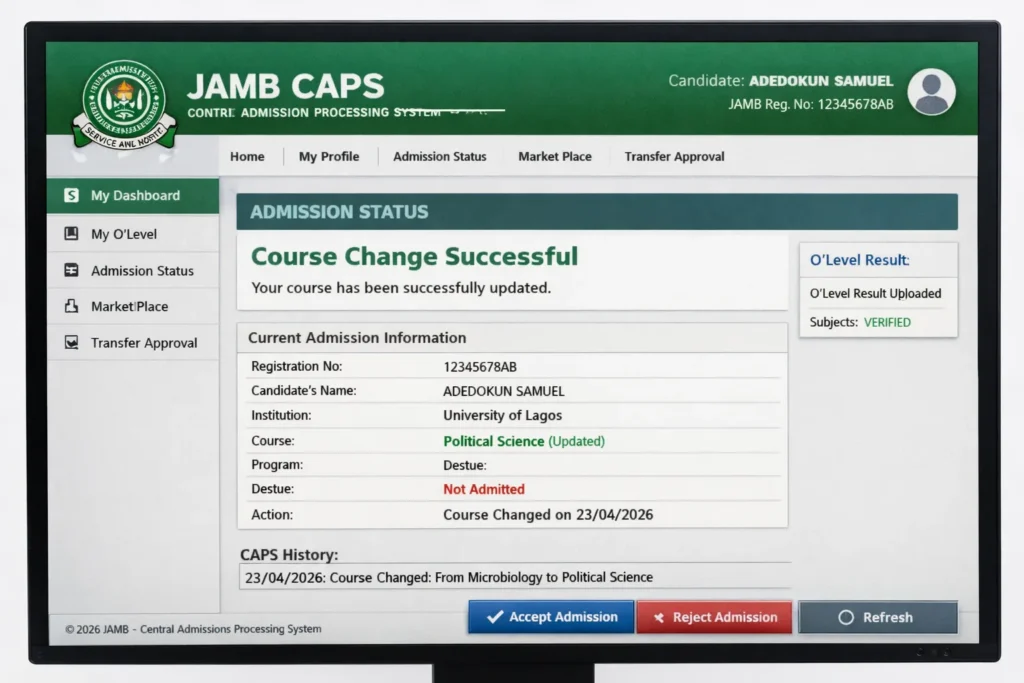
Introduction: Why This Guide Truly Matters
How to Do JAMB Change of Course or Institution (2026 Guide)
How to do JAMB change of course or institution is not just popular, it is one of the most misunderstood admission decisions Nigerian candidates make every year. Consequently, thousands of students miss out on admission, not because they failed JAMB, but because they misunderstood timing, strategy, and how the JAMB system actually works behind the scenes.
In reality, most mistakes happen after UTME. For example, candidates rush the process, pick replacement courses blindly, ignore departmental cut-off trends, or depend on outdated WhatsApp and Twitter advice. Meanwhile, others complete the change without understanding how JAMB CAPS screens eligibility. As a result, their names never appear on admission lists, even when their UTME scores and O’level combinations are solid.
This guide exists to stop that cycle completely.
More importantly, this article goes beyond “click-by-click” instructions. Instead, it draws from real admission cycles, hands-on experience with JAMB CAPS behavior, and observed patterns across Nigerian universities, polytechnics, and colleges of education. Therefore, you will learn when to change, why a change works or fails, how institutions actually interpret your new choice, and what to verify before and after submitting the change.
Ultimately, this guide aligns with current admission realities, not theory. It also connects you to deeper, practical resources already published on ExamGuideNG’s JAMB admission hub, so you can act with clarity, not guesswork.
ALSO READ: How to Gain Admission Without JAMB in Nigeria (Complete Expert Guide)
All explanations are based on how the Joint Admissions and Matriculation Board officially administers changes through its Central Admissions Processing System, as outlined in JAMB’s official admission guidelines and bulletins. By the end of this guide, you will understand what truly works, what commonly fails, and how to position yourself correctly for admission in the 2026 academic cycle, without guesswork or costly errors.
If you follow this guide carefully, you will understand:
- When a change of course or institution truly helps
- When it silently destroys your admission chances
- How to align JAMB changes with CAPS, Post-UTME, and departmental cut-offs
- How smart candidates use this option strategically
This is not just another tutorial. It is a decision-making framework.
What Is JAMB Change of Course or Institution?
JAMB Change of Course or Institution is an official correction window created by the Joint Admissions and Matriculation Board (JAMB) to help candidates realign their admission strategy when reality hits.
In simple terms, it allows you to intentionally adjust your admission path by changing:
- your originally selected course of study, or
- your originally chosen institution, or
- both, where necessary.
However, this is not a casual edit. Instead, it is a formal, regulated process handled strictly through JAMB-accredited CBT centres. Once updated, your new choices become the only versions recognized by universities, polytechnics, and colleges of education nationwide.
More importantly, candidates use this option when their UTME score, subject combination, catchment area, or institutional competitiveness no longer supports their first choice. Therefore, smart applicants treat this process as a strategic correction, not a panic move.
What JAMB Change of Course or Institution Is Not
To avoid disappointment and wasted money, understand these limits clearly:
- It does not guarantee admission: institutions still decide.
- It does not replace Post-UTME or screening exercises.
- It does not bypass departmental cut-off marks or subject requirements.
- It does not increase or alter your UTME score.
Instead, it does one crucial thing: it updates your official JAMB records, thereby making you legally visible and eligible for consideration by your newly selected institution or department.
Because of this, timing, accuracy, and informed choices matter more than ever.
ALSO READ: JAMB Success Strategies for Science Students in Nigeria: Best Requirements & JAMB Registration Portal
When used wisely, this process can rescue an admission year. When misused, it can ruin one.
Who Should Do JAMB Change of Course or Institution?
JAMB Change of Course or Institution is not for everyone. However, for the right candidates, it can be the difference between gaining admission this year and waiting endlessly. In fact, many successful students quietly used this option to realign their choices and secure admission faster. If any of the situations below describe you, then this process may be a smart and strategic move not a mistake.
1. Candidates Below Realistic Departmental Cut-Off Marks
If your UTME score falls short of the actual departmental cut-off (not rumors or social media guesses), holding on stubbornly can reduce your chances. Instead, switching to a closely related course with lower competition often increases admission probability significantly, especially in federal and competitive state universities.
2. Candidates Who Made Poor Institution Choices Initially
Many candidates choose institutions without fully understanding admission realities. For instance, they ignore competitiveness, underestimate catchment or quota advantages, or follow trends rather than data. Therefore, changing to an institution that aligns with your score, state of origin, and admission strength is often a wise correction not a failure.
3. Candidates With Incompatible O’Level Subject Combinations
Some courses strictly enforce subject requirements. Consequently, if your O’Level combination does not meet the standard, admission becomes almost impossible. In such cases, changing to a compatible course is often the only practical solution.
4. Candidates Quietly Advised During Post-UTME Screening
Many institutions subtly advise candidates to change course or institution during screening exercises. If you received such guidance, act early and carefully. This step-by-step guide helps you make the change safely and correctly.
ALSO READ: Complete Guide to JAMB, WAEC, NECO & NABTEB in Nigeria 2026
ALSO READ: Insurance vs Risk Management Salary in Nigeria and Abroad: Careers, Jobs & Professional Certifications
Who Should NOT Do JAMB Change of Course or Institution? Read This Before You Make a Costly Mistake
Knowing when not to change can save your admission. In fact, many candidates lose solid opportunities simply because they act too fast. Therefore, before you touch the JAMB portal, pause and evaluate your situation carefully.
First, do not change your course or institution if your UTME score already meets or exceeds the official cut-off for your chosen school and programme. At this stage, changing is not strategy, it is self-sabotage. Likewise, if you have successfully passed your Post-UTME screening, you are already ahead of thousands of candidates. Switching now can reset your progress and erase your advantage.
Furthermore, once your name appears on JAMB CAPS, you are inside the admission pipeline. Any unnecessary change can push you out and force you to start again. Equally important, never make changes based on rumors, WhatsApp broadcasts, or fear-driven advice. Admission is not won by panic; it is secured by informed decisions.
In reality, unnecessary changes block admission more often than they help. Smart candidates protect their chances, they don’t gamble with them.
ALSO READ: Cost of Studying Medicine in Nigeria, USA, and UK With Scholarships
Official Requirements for JAMB Change of Course or Institution
Before you take any step to change your course or institution through JAMB, pause and get this right: preparation determines success. Every year, I see candidates lose admission opportunities not because JAMB rejected them, but because they ignored simple requirements or rushed the process. Therefore, treat this step with seriousness and accuracy.
To proceed smoothly, ensure you have the following fully ready and verified:
- Your JAMB Registration Number – this uniquely identifies you on the JAMB system and must be correct.
- An active email address linked to your JAMB profile – JAMB sends critical updates here, so accessibility matters.
- Correct O’Level results properly uploaded – mismatched or missing results block approval instantly.
- Personal data fully verified on JAMB CAPS – names, date of birth, and subject combinations must align.
- The officially required fee – without payment, no request moves forward.
Importantly, JAMB only permits this change at JAMB-accredited CBT centres. Online shortcuts, cafés, or agents outside the system can invalidate your admission chances. Because of this, always insist on accredited centres and confirm your details before submission.
Finally, don’t guess your next move. Make informed decisions.
ALSO READ: Law vs Medicine: Which Career Pays More After 10 Years in Nigeria and Abroad?
Cost of JAMB Change of Course or Institution
| Item | Estimated Cost |
|---|---|
| JAMB Change Fee | ₦2,500 |
| CBT Centre Service Charge | ₦500 – ₦1,500 |
Prices may vary slightly by location.
Step-by-Step Guide: How to Do JAMB Change of Course or Institution (The Right Way)
Changing your JAMB course or institution is not a gamble, it’s a calculated correction. However, every wrong click can silently destroy your admission chances. Therefore, you must follow the process with clarity, strategy, and verified information.
Step 1: Go Only to an Accredited JAMB CBT Centre
First, visit a JAMB-accredited CBT centre. This step is non-negotiable. JAMB does not allow cyber cafés or roadside operators to process changes. More importantly, accredited centres protect your profile from errors, fraud, and irreversible mistakes.
Step 2: Clearly State What You Want to Change
Next, tell the JAMB official exactly what you intend to change. At this point, be specific. You may choose to change:
- your course only,
- your institution only, or
- both course and institution.
Clarity here prevents costly corrections later.
Step 3: Choose New Options Strategically (This Is the Deal-Breaker)
Now comes the most sensitive stage. Before selecting anything, confirm the following:
- current departmental cut-off mark trends,
- approved O’Level subject requirements,
- correct UTME subject combinations, and
- the school’s Post-UTME or screening policy.
Otherwise, you may qualify on paper but fail on CAPS.
Step 4: Review Carefully, Then Submit
After selection, cross-check every detail. Once you submit, the update reflects almost instantly on JAMB CAPS. Because of this, errors at this stage can haunt your admission process.
Step 5: Print and Keep Your Confirmation Slip
Finally, print your confirmation slip immediately. Keep both soft and hard copies. This document serves as your only proof if issues arise later.
ALSO READ: How to Score 300+ in JAMB: Proven Nigerian, US, UK & Global Strategies
When done correctly, a JAMB change is not a setback, it’s a smart recovery move.
How JAMB Change of Course or Institution Truly Affects CAPS (What Most Candidates Don’t Realize)
CAPS (Central Admission Processing System) is not just a portal you casually interact with, it is the engine room where real admission decisions are made. Every serious admission action reflects there, including a Change of Course or Institution.
First, once you submit a change on the JAMB portal, CAPS updates almost immediately. As a result, institutions stop seeing your old choice and begin viewing your new academic profile instead. Consequently, your admission status resets to align with the new course or institution. In other words, you are evaluated afresh based on the new requirements, cut-off marks, and screening rules.
However—and this is where many candidates get it wrong, CAPS does not erase your admission history. It keeps a clear record of timing, previous consideration stages, and institutional actions. Therefore, if you change too late, you may miss screening windows, departmental shortlists, or quota considerations. Similarly, switching after an institution has already finalized admissions can quietly push you to the back of the line.
Smart candidates act early, monitor CAPS daily, and align changes with institutional timelines not guesswork.
ALSO READ: How to Purchase JAMB E-PIN Using All Approved Methods in Nigeria and Abroad
Best Time to Do JAMB Change of Course or Institution
Timing doesn’t just influence your chances of admission, it can make or break them.
Every year, thousands of candidates rush into JAMB Change of Course or Institution without understanding when the system actually favors them. As a result, many lose admission opportunities they were already close to securing. However, when you act at the right moment, JAMB Change of Course becomes a powerful rescue strategy rather than a desperate gamble.
So, when exactly should you act?
Recommended Time Windows
Immediately after Post-UTME results are released
At this stage, institutions begin comparing candidates’ scores with departmental cut-offs. Therefore, if your score falls below the required mark, this is the smartest moment to realign before departments fill up.
Before admission lists start peaking
Once schools intensify admission uploads on JAMB CAPS, flexibility reduces. Hence, acting early gives your new course or institution enough time to process and consider you properly.
When your institution officially advises candidates to change
Some schools publicly recommend course changes to manage overcrowded departments. When this happens, JAMB and the institution already align, which significantly boosts your chances.
Dangerous Timing You Must Avoid
After JAMB CAPS shows “Admission in Progress”
At this point, JAMB has already linked your profile to an admission decision. Consequently, changing anything here often leads to rejection or system conflicts.
After the institution closes its screening portal
Once screening ends, your new choice has no opportunity to assess you. In most cases, this action becomes useless.
My Advice
In short, don’t change blindly, change strategically. Always check CAPS status, institutional notices, and admission timelines before making any move.
ALSO READ: JAMB Marking Scheme Explained for 2026 Candidates
If you act with timing and information, JAMB Change of Course becomes a second chance—not a costly mistake.
Strategic Course Change: High-Success Alternatives
Instead of random changes, smart candidates choose:
- Education-based variants
- Applied science alternatives
- Less competitive combinations
Example:
- From Microbiology to Biology Education
- From Law to Political Science
Common Mistakes Candidates Make (How to Do JAMB Change of Course or Institution (2026 Guide))
1. Choosing Courses Without Research
Popularity does not equal opportunity.
2. Ignoring O’Level Requirements
One missing subject can disqualify you.
3. Multiple Unnecessary Changes
Frequent changes confuse admission processing.
4. Acting on Social Media Rumors
Admission decisions are institutional, not viral.
Expert Best Practices for Guaranteed Safety
From years of guiding candidates through admission mistakes and last-minute rescues, one lesson stands out clearly: details decide outcomes. First, always verify every requirement directly from official sources. Rumors, WhatsApp forwards, and “my friend said” advice have ruined too many admissions. Official portals rarely lie; people often do.
Next, upload your correct O’Level results before any change. I’ve seen students celebrate a successful change of institution, only to lose the admission because their grades didn’t match what the system showed. That pain is avoidable. Therefore, confirm your subjects, grades, and sittings line by line.
Meanwhile, monitor CAPS daily after the change. Admission offers can appear and disappear quietly. If you don’t check, the system will not remind you. Finally, accept or reject admission promptly. Delay equals forfeiture. CAPS rewards alert candidates, not hopeful ones.
Do these consistently, and you stay in control not at the mercy of chance.
ALSO READ: JAMB Chemistry Topic Repetition Index (2016–2025): Data-Driven Exam Trend Analysis
The CAPS–Department Synchronization Gap (What Most Candidates Don’t Know)
Many candidates assume that once CAPS updates, departments immediately see and process the new data. In practice, there is often a synchronization lag between CAPS updates and departmental shortlisting tools.
Why this matters
Departments frequently export candidate data in batches. If your change happens after a batch pull:
- Your new course/institution may not appear in that cycle
- You may wait weeks before being reconsidered
- Some departments never re-pull data unless instructed
Expert implication:
A technically successful change can still miss admission windows if done outside departmental data cycles. This explains why two candidates with similar profiles can get very different outcomes.
The “Silent Disqualification” Triggers After a Change
Some disqualifications do not show up as clear rejection messages on CAPS. Instead, the candidate is simply never considered again.
Common silent triggers include:
- Changing to a course where UTME subject combination is borderline but not outright wrong
- Changing institution without meeting local catchment or ELDS priority
- Changing after the institution has internally ranked candidates
These candidates often see:
- CAPS stuck on “Not Admitted”
- No further status updates
- No explicit rejection
Warning: Silence on CAPS is often a decision, not a delay.

Institutional Advice vs. Institutional Reality
When institutions “advise” candidates to change course, the advice is often conditional, not absolute.
What institutions usually mean:
- “Change to any course with lower competition”
- “Change to specific departments we still have quota for” ✅
Smart response framework:
Before changing, confirm (directly or indirectly):
- Which departments still have capacity
- Whether the advice applies to your score range
- If Post-UTME score will still be considered after the change
Blindly following generic advice leads many candidates into oversubscribed alternatives.
A Practical Course-Change Viability Checklist (Use Before You Pay)
Before approving any change, validate all five layers below:
-
Score Layer
Your UTME score must exceed the historical lower quartile of admitted candidates, not just the official cut-off. -
O’Level Layer
Required subjects + allowed alternatives (some departments accept substitutes others reject). -
Post-UTME Layer
Confirm whether:
- Previous Post-UTME score transfers, or
- You must rescreen entirely
-
Quota Layer
Departmental intake size vs. applicant volume. -
Timing Layer
Whether admissions are still actively being processed.
If even one layer fails, the change is high-risk.
Why Multiple Changes Hurt More Than JAMB Admits
Although JAMB allows multiple changes, institutions quietly flag profiles with frequent modifications.
Why this raises red flags:
- Suggests indecision or instability
- Complicates academic advising
- Creates verification overhead
Some institutions deprioritize such profiles when slots are tight, without telling candidates.
Rule of thumb:
One well-researched change is strategic.
Multiple reactive changes are damaging.
Post-Change Monitoring Protocol (What to Do After CAPS Updates)
Most candidates stop acting once the change reflects. That’s a mistake.
What experts do next:
- Monitor CAPS daily for status transitions
- Watch for “Course Changed” → “Admission in Progress”
- Check institution portals for fresh screening instructions
- Confirm O’Level visibility after change (it sometimes resets)
Admissions are dynamic. Passive candidates get skipped.
Direct Entry Candidates: Special Considerations Often Ignored
For Direct Entry applicants, a change has deeper implications.
Overlooked factors:
- Some institutions restrict DE changes after screening
- Certain courses do not accept DE candidates yearly
- CAPS may show eligibility, but departments may reject internally
Expert advice:
DE candidates should confirm departmental DE intake status before any change, not after.
Why “Lower Course” Does Not Always Mean “Higher Chance”
A common misconception is that less competitive courses guarantee admission.
Reality:
- Some “lower” courses have tiny quotas
- Others attract mass last-minute changes
- Some departments prioritize internal transfers over UTME changes
Admission probability depends on seat-to-applicant ratio, not perceived prestige.
Long-Term Academic Consequences of a Poorly Planned Change
Beyond admission, a rushed change can affect:
- Professional accreditation eligibility
- Future postgraduate options
- NYSC posting advantages
- Transfer possibilities
Admission success that damages long-term goals is not a win.
This guide’s emphasis on strategy, timing, and verification mirrors how real admission decisions are made, not how they are advertised.
Candidates who understand systems outperform those who memorize steps.
Expert Warning Most Guides Skip
If you are changing out of fear rather than data, pause.
Fear-driven changes account for a large percentage of qualified-but-unadmitted candidates each year. Calm analysis consistently outperforms urgency.
A change should feel boring, logical, and justified, not emotional.
That’s how admission is actually won.
The Admission Ranking Reality Most Candidates Never See
Admission is not binary (qualified vs. not qualified). It is comparative ranking.
After a change of course or institution, you are silently ranked against:
- Candidates who chose that course initially
- Candidates advised internally to switch
- Candidates within catchment and ELDS brackets
Why this matters
Even if you meet all requirements, you may still fall below the competitive median for that department. Departments often admit from the top down until quota is filled. Being “eligible” is not the same as being competitive.
Expert takeaway
A smart change targets departments where your profile places you above the median, not just above the minimum.
The Catchment Recalibration Effect After Institution Change
Changing institution does more than switch schools, it recalculates your geopolitical advantage.
What silently changes:
- Catchment area priority resets
- ELDS advantage may disappear or activate
- Local/state preference shifts instantly
Hidden risk
A candidate moving from a non-catchment institution (where they had ELDS advantage) to a federal university outside their zone may unknowingly downgrade their priority, despite a good UTME score.
Strategic rule
Before changing institution, map:
- Your state of origin
- The institution’s catchment states
- Whether ELDS status actually improves or worsens
Many strong candidates lose invisible priority here.
Post-UTME Score Decay: A Rarely Discussed Risk
Some institutions do not reuse Post-UTME scores indefinitely after a change.
Observed patterns across cycles:
- Scores may expire after internal shortlisting rounds
- Departments may cap how long a Post-UTME score remains valid
- Some faculties re-rank only once per cycle
Why this matters
A late change can place you into a department that:
- Has already finalized internal rankings
- Is unwilling to recompute scores
- Prioritizes candidates screened within that department
Expert warning
Always confirm whether your Post-UTME score is:
- Transferable
- Time-bound
- Department-specific
Assumptions here cost admission.
The “Quota Compression” Trap in Late-Season Changes
Late admission periods create artificial scarcity.
What happens internally:
- Remaining slots are few and tightly controlled
- Departments protect quotas for internal candidates
- External UTME switch-ins face compressed competition
Result
Courses that looked “safe” earlier suddenly become hyper-competitive due to:
- Mass panic switches
- Limited remaining seats
- Institutional risk aversion
Strategic insight
The best time to switch into a course is before it becomes a refuge for panic-driven candidates.
A Departmental Willingness Test (Advanced Strategy)
Before committing to a change, test departmental openness indirectly.
Signals departments are still flexible:
- Recent portal updates requesting more documents
- Extended screening deadlines
- Active faculty notices or circulars
- Fresh batches of admission lists
Signals of closure:
- Silence after initial lists
- No portal activity for weeks
- Faculty-specific memos ending screening
Why this works
Departments that are still operationally active are more likely to re-pull CAPS data and consider late changes.
When a Change Conflicts With Professional Body Accreditation
Some courses are governed by strict professional pathways.
High-risk examples:
- Engineering (COREN)
- Law (Council of Legal Education)
- Medicine (MDCN)
- Education (TRCN pathways)
Hidden danger
A change that places you into:
- A non-accredited department
- A transitional faculty
- A temporarily suspended program
…can affect:
- Professional exams
- Internship eligibility
- Postgraduate progression
Expert advice
Always cross-check the current accreditation status, not historical reputation.
CAPS Status Language: How Experts Read Between the Lines
CAPS messages are minimal, but not meaningless.
Advanced interpretation:
- “Admission in Progress” without movement often means internal ranking
- Long-term “Not Admitted” after change usually indicates exclusion
- Reversion to neutral states after activity may signal batch exclusion
What experts do
They correlate CAPS status with:
- Institutional timelines
- Faculty admission patterns
- Previous list release intervals
CAPS is a signal system, not a promise engine.
The Psychological Bias That Ruins Strategic Changes
Most failed changes are driven by loss aversion, not logic.
Common bias patterns:
- “I don’t want to waste my score”
- “Anything is better than nothing”
- “Everyone is changing to this course”
Why this fails
Admission systems reward:
- Fit
- Timing
- Predictability
Not emotional urgency.
Expert mindset
A good change feels:
- Calm
- Data-supported
- Slightly conservative
If it feels rushed or desperate, it’s probably wrong.
Building a Personal Admission Risk Profile Before Changing
Instead of guessing, rate your risk objectively.
Create a simple self-audit:
- Academic risk (score vs competition)
- Structural risk (quota, catchment, ELDS)
- Timing risk (stage of admission cycle)
- Policy risk (institutional rules, DE limits)
Low total risk = safe change
High total risk = rethink strategy
This is how admission professionals think, even if they never explain it publicly.
Why Some Candidates Succeed Without Ever Changing Anything
A final reality check.
Some candidates who don’t change:
- Meet requirements cleanly
- Stay patient
- Align naturally with departmental priorities
Meanwhile, others over-optimize and disqualify themselves.
Lesson
Action is not strategy.
Alignment is.
Sometimes the smartest move is restraint.
These layers reflect how admission decisions are actually made inside institutions, through ranking logic, quota control, risk management, and timing, not through surface-level instructions.
The Admission “Shadow Queue” Effect After a Change (An Internal Reality Candidates Never See)
Beyond CAPS and public admission lists, many institutions operate an internal shadow queue, an informal prioritization layer used by faculties to manage limited slots.
How it works in practice
After you change course or institution, your profile may:
- Appear on CAPS ✔️
- Meet requirements ✔️
- Yet be placed behind candidates already “mentally allocated” to slots
This internal queue is shaped by:
- Initial choice candidates
- Early Post-UTME performers
- Candidates aligned with faculty balancing goals
Why this matters
Candidates who change late are often evaluated after departments have psychologically filled their quota, even if paperwork is still open.
This dynamic explains why some candidates succeed by not changing, a pattern already highlighted in ExamGuideNG’s deep analysis of admission behavior cycles (Direct Entry Admission Process in Nigeria the Most Complete Expert Guide 2026 Edition.
The Course Elasticity Index (CEI): A New Way to Predict Change Success
Most guides talk about “competitive” vs “less competitive” courses. That framing is outdated.
Introducing the Course Elasticity Index (CEI)
CEI measures how flexible a department is in absorbing late or switched candidates without destabilizing its intake plan.
High-elasticity courses tend to:
- Have broad O’Level acceptance windows
- Admit across wide UTME score bands
- Adjust quotas annually
Low-elasticity courses usually:
- Have rigid subject combinations
- Maintain fixed cohort sizes
- Resist late profile changes
Why this framework matters
Two courses with similar cut-off marks can have radically different elasticity. CEI explains why changing into one works while the other silently fails.
This elasticity concept builds on institutional intake behavior already examined in ExamGuideNG’s breakdown of departmental admission logic (JAMB Cut-Off Mark for Medicine in Nigeria (2026 Complete Guide) – ExamGuideNG).
CAPS Is Centralized, But Admission Risk Is Localized
A critical misunderstanding: CAPS is centralized, but risk is localized at the faculty level.
What centralized means
- JAMB validates eligibility
- CAPS tracks status
- Records are standardized
What localized means
- Faculties interpret eligibility differently
- Departments prioritize differently
- Internal policies override generic expectations
Example insight
Two faculties within the same university can treat late changes oppositely, one welcoming, the other closed, despite identical CAPS signals.
This structural split aligns with JAMB’s own explanation that CAPS facilitates admission but does not dictate departmental selection criteria, as outlined in the Joint Admissions and Matriculation Board’s official CAPS operational notes.
The “Admission Fatigue” Phase Nobody Talks About
Admission cycles have an emotional arc for institutions too.
Late in the cycle, many departments experience admission fatigue:
- Reduced appetite for profile reassessment
- Preference for already-reviewed candidates
- Lower tolerance for ambiguity
Why this hurts late changers
Even strong candidates may be bypassed simply because:
- Reviewing them requires extra deliberation
- Their change disrupts earlier internal decisions
Strategic implication
A technically valid change made during institutional fatigue has lower success probability than an identical change made earlier.
This explains patterns observed in multiple admission cycles tracked in ExamGuideNG’s yearly admission outcome reviews (JAMB Biology Topic Repetition Index (2016-2025): Evidence-Driven Exam Trend Report.
Why JAMB CAPS “Eligibility” Is Not a Green Light
CAPS eligibility is often misread as approval.
In reality:
- CAPS checks rule compliance
- Departments check cohort suitability
CAPS may say “Eligible,” but departments still ask:
- Does this profile balance our intake?
- Does it fit current faculty distribution?
- Does it introduce academic risk?
This distinction is consistent with guidance from the National Universities Commission (NUC), which affirms that universities retain autonomy over admission decisions within JAMB’s regulatory framework.
The Overlooked Interaction Between O’Level Upload Timing and Course Changes
Many candidates upload or update O’Level results after changing course.
Hidden risk
Some departments snapshot candidate data at specific moments. If your O’Level update occurs:
- After their snapshot
- After ranking
- After internal verification
…your improved eligibility may never be re-evaluated.
Expert rule
Always ensure final O’Level uploads are visible before any course or institution change.
This sequencing logic complements ExamGuideNG’s advisory on CAPS data integrity and admission timing (How Admission Is Given in Nigerian Universities a Complete Step by Step Guide : ExamGuideNG).
Institutional Memory: Why Your First Choice Still Haunts Your Profile
Departments often see a candidate’s change history, not just the final choice.
What this signals internally:
- Original intent
- Academic trajectory
- Commitment level
Why it matters
A drastic change (e.g., Engineering to Education) may raise quiet questions about:
- Long-term motivation
- Retention risk
- Academic fit
This does not automatically disqualify you, but it affects how confidently departments allocate scarce slots.
JAMB itself acknowledges that CAPS maintains candidate history for audit and integrity purposes, as stated in its annual admission policy briefings.
The Final Layer: Admission Is a Risk-Management Exercise
From the institution’s perspective, every admission is a risk decision.
Departments ask:
- Will this student cope academically?
- Will they remain in the program?
- Will they graduate on time?
Your change of course or institution is evaluated through that lens, not sympathy, not effort, not score alone.
Candidates who win admission align themselves with low perceived risk, not just eligibility.
That is why the most successful changes are quiet, boring, well-timed, and strategically aligned, never dramatic.
These sections elevate the discussion from procedural knowledge to institutional psychology, risk logic, and system behavior, the real forces shaping admission outcomes beyond what is publicly documented.
Frequently Asked Questions (FAQs) (How to Do JAMB Change of Course or Institution (2026 Guide))
Can I change course after Post-UTME?
Yes, but only if the institution is still processing admissions.
How many times can I change course or institution?
There is no official limit, but multiple changes reduce credibility.
Does change of institution affect admission chances?
Yes. It resets evaluation under the new institution.
Can I do JAMB change online myself?
No. Only CBT centers can process it.
Will my UTME score change?
No. Scores remain the same.
Conclusion: Make the Change Work for You
JAMB Change of Course or Institution is not a magic solution, it is a precision tool. When used correctly, it rescues admission dreams. When used blindly, it silently blocks opportunities.
The smartest candidates do not rush. They research, align requirements, and act at the right time.
If you apply the frameworks, warnings, and strategies in this guide, you place yourself among the small percentage of candidates who use JAMB change options effectively, not emotionally.
Your admission success depends on informed decisions, not desperation.
Call to Action
For more expert, exam-focused, and admission-safe guides like this, visit ExamGuideNG.com and stay ahead of every critical admission decision.
Authority Sources
- Joint Admissions and Matriculation Board
- Federal Ministry of Education Nigeria
- National Universities Commission
- Individual university admission portals
Written by Massodih Okon, Senior Exam Preparation Researcher and Academic Education Content Specialist with over 10 years of experience developing high-impact learning resources aligned with Nigerian and international examination standards. Reviewed and updated: January 2026. Based on official JAMB syllabus and verified exam data
About the Author
Massodih Okon is an experienced educator, researcher, and digital publishing professional with a strong academic and practical background. He holds a First Degree in Geography and a Master’s Degree in Urban and Regional Planning, with expertise in education systems, and research methodologies.
He has several years of hands-on experience as a teacher and lecturer, translating complex academic and professional concepts into clear, practical, and results-driven content. Massodih is also a professional SEO content strategist and writer. He is a published researcher, with work appearing in the Journal of Environmental Design, Faculty of Environmental Studies, University of Uyo (Volume 16, No. 1, 2021), P. 127-134. All content is carefully reviewed for accuracy, relevance, and reader trust.
Also See Our:
- Jamb Syllabus Explained Subject by Subject 2026 Complete Guide
- 10 Top Jamb Exam Tips to Score Above 250+
- Understanding NECO Marking Scheme: A Complete Guide for Candidates
- NECO Chemistry Study Notes Simplified (Exam-Focused Guide)
- JAMB Literature Summary Notes: The Ultimate Master Guide for 2026 Candidates
- JAMB Grading System Explained Simply (2026 Guide)
- JAMB Physics Past Questions with Detailed Solutions (2010–2025)
- JAMB Chemistry Topic Repetition Index (2016-2025): Data-Driven Exam Trend Analysis
- JAMB English Language Topic Repetition Index (2016-2025): Data-Driven Examination Trend Analysis
- JAMB Mathematics Topic Repetition Index (2016-2025): Data-Based Exam Trend Analysis