
The Hidden Reason Students Fail Dissertations They Should Have Passed
Imagine investing months in research and countless hours reading, drafting, and refining your work only to have your dissertation returned. Not because the ideas lacked strength or the data was inaccurate, but due to technical details. The margins didn’t follow the required format. The title page left out an essential element. The heading structure failed to align with your institution’s approved style guide.
This happens more than most students realize. Universities including Oxford and Harvard have documented how formatting failures not content failures are among the most common reasons dissertations are returned for correction, delayed in examination, or penalized with grade deductions. Sound academic work gets undermined, not by poor thinking, but by presentation that falls outside the formal standards examiners expect.
Here’s what that tells us: formatting is not window dressing. It is a structured academic language in its own right one that communicates to supervisors and examiners that you understand scholarly conventions, that you can follow complex institutional guidelines, and that your work is ready to be assessed at a professional level. Examiners frequently evaluate structure and layout before they read a single argument. First impressions in academia are formatting impressions.
This guide exists to close that gap. From title page to appendices, it walks through every major element of dissertation formatting in plain, practical language built around globally recognized academic standards and designed to serve undergraduate, postgraduate, and PhD students alike. Whether you are just beginning or in the final stretch, think of this as the one reference you can return to at every stage. For students navigating the broader terrain of academic research, resources like the Complete Guide to Research Methodologies offer the same commitment: making complex academic requirements clear, manageable, and achievable.
What Is Dissertation Formatting? (How to Format a Dissertation: A Complete Step-by-Step Guide)
Dissertation formatting refers to the structured arrangement of content, layout, citations, and presentation rules required by universities and academic bodies.
It covers:
Page layout and margins
Font type and size
Line spacing and alignment
Headings and subheadings
Citation and referencing style
Page numbering
Tables, figures, and appendices
Proper formatting improves readability and ensures your work meets assessment criteria.
Dissertation Formatting Requirements (Standard Overview)
Although requirements vary by institution, most universities follow similar formatting rules.
Standard Dissertation Formatting Table
| Element | Common Requirement |
| Font style | Times New Roman |
| Font size | 12-point |
| Line spacing | Double spacing |
| Margins | 1 inch (2.54 cm) |
| Alignment | Justified |
| Page size | A4 |
| Paragraph spacing | No extra spacing |
| Indentation | First line indented (0.5 inch) |
Always confirm your department’s handbook before final submission.
How to Format a Dissertation Step by Step
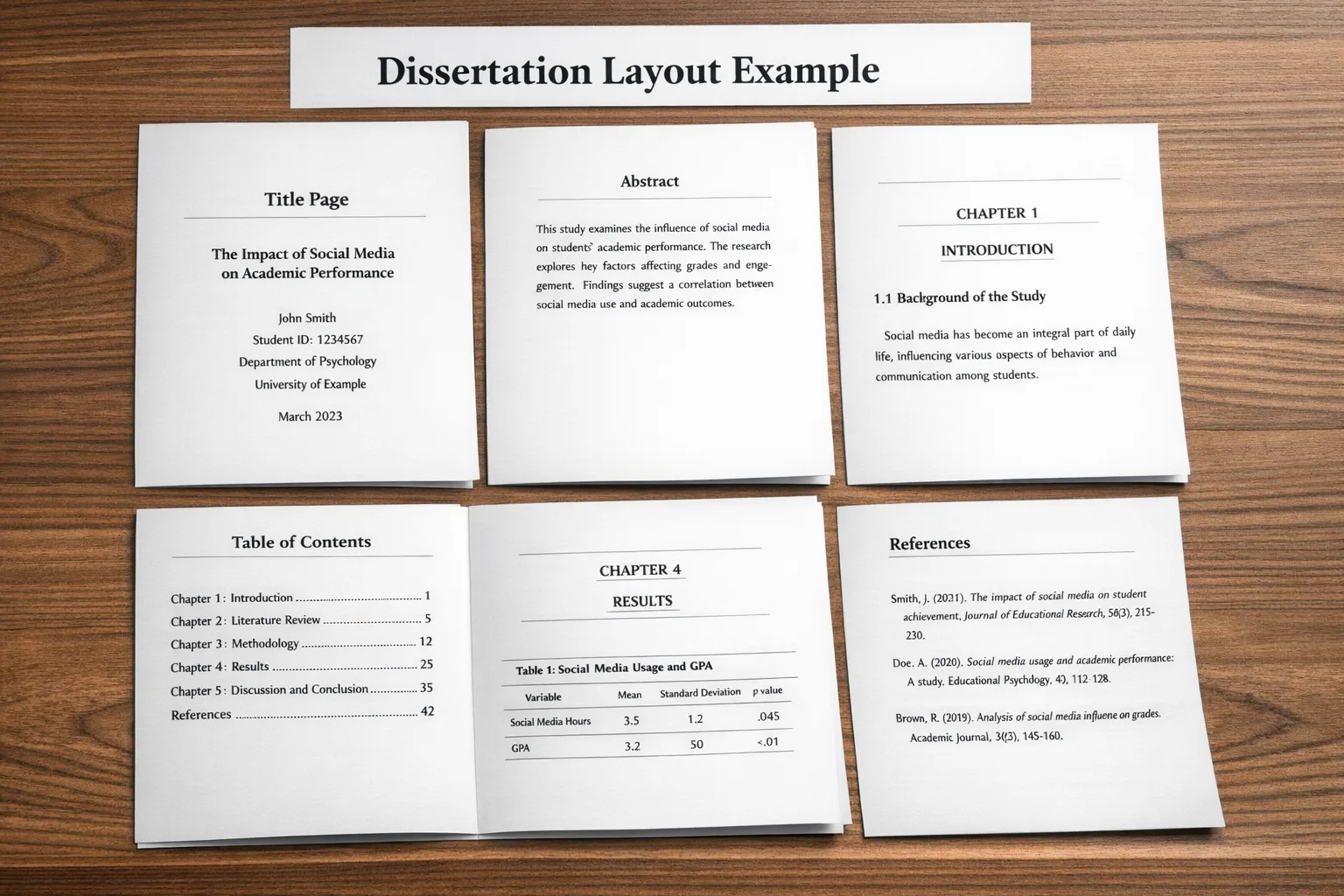
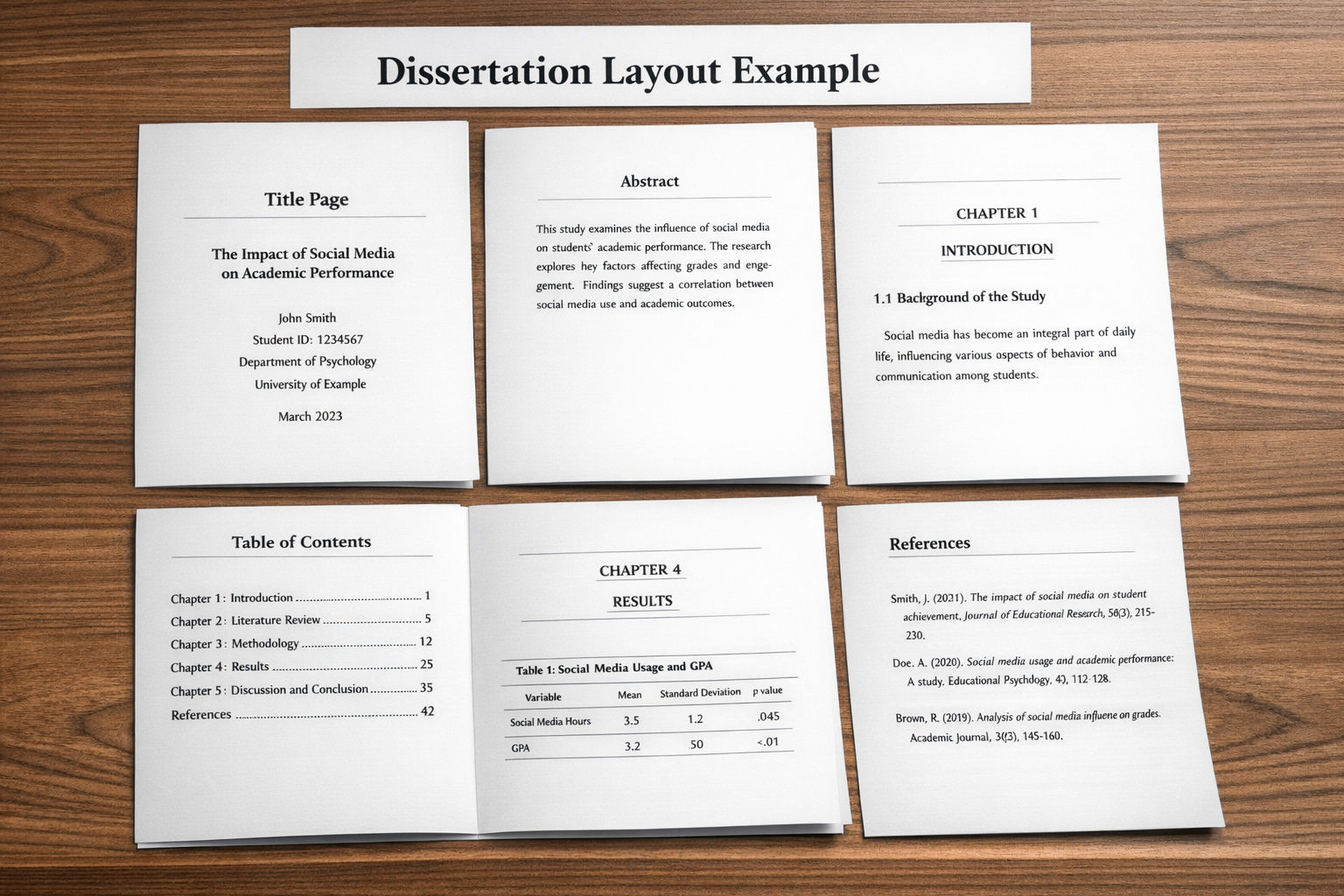
1. Title Page Formatting
The title page is the first impression of your dissertation.
It should include:
Dissertation title (centered, bold)
Student’s full name
Registration or matriculation number
Degree and department
Institution name
Month and year of submission
Avoid adding page numbers on the title page unless instructed.
2. Abstract Page Format
The abstract summarizes your entire dissertation.
Formatting rules:
Word count: 150–300 words
Single paragraph
Double-spaced
Page numbered (Roman numeral i or Arabic 1)
Use clear language and avoid citations.
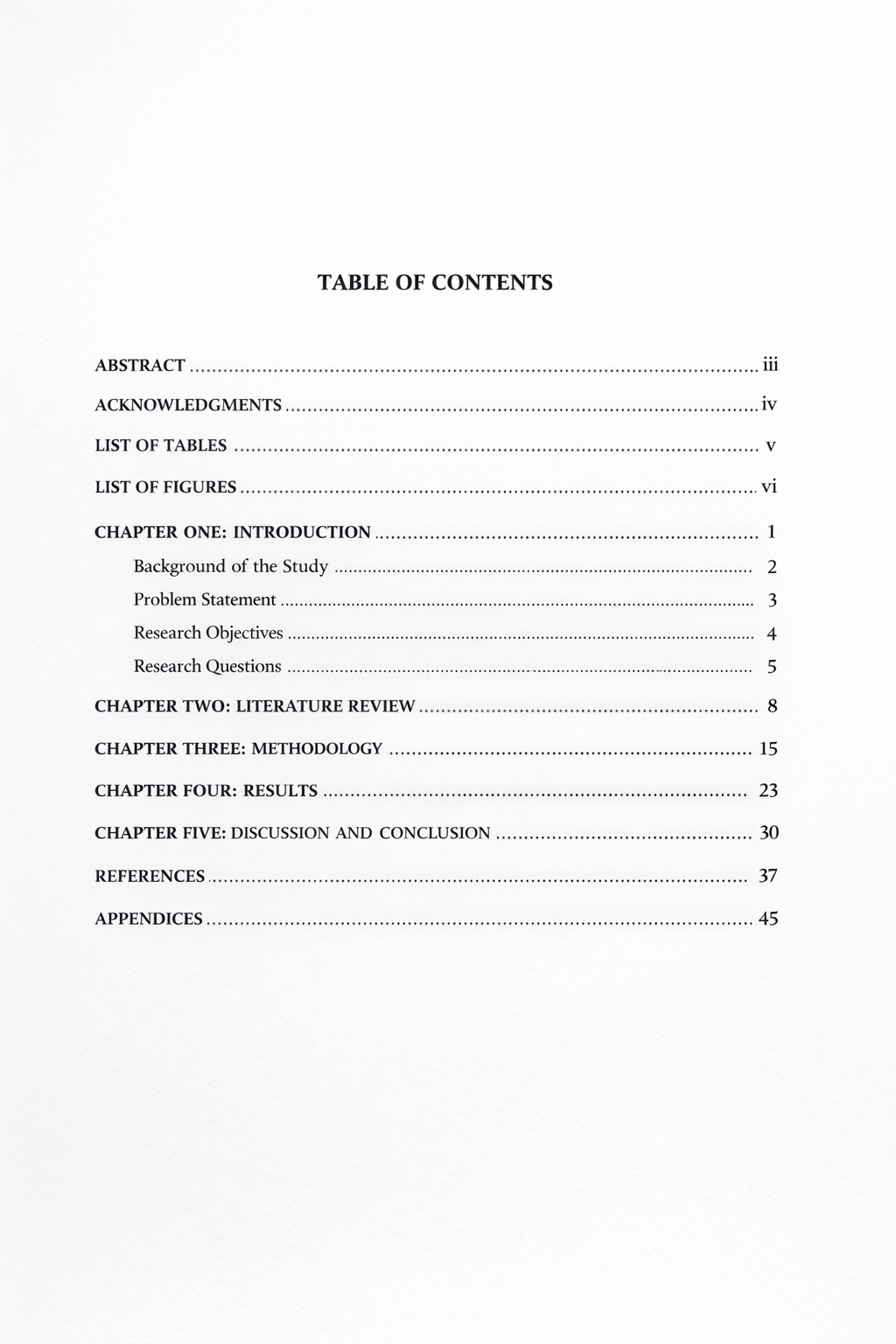
3. Table of Contents Formatting
The table of contents improves navigation.
Key rules:
Use automatic table generation
Match headings exactly
Include page numbers
Use consistent indentation
Include:
Chapters
Subheadings
List of tables
List of figures
4. Chapter Formatting Structure
Most dissertations follow this standard structure:
Chapter One: Introduction
Background of the study
Problem statement
Objectives
Research questions
Significance
Two: Literature Review
Conceptual framework
Theoretical framework
Empirical studies
Three: Methodology
Research design
Population and sample
Data collection methods
Data analysis
Four: Results
Data presentation
Tables and charts
Interpretation
Five: Discussion and Conclusion
Findings discussion
Conclusion
Recommendations
Each chapter should begin on a new page.
How to Format a Dissertation: Step-by-Step Guide Table
| Step | Section | What to Include | Key Formatting Rules |
|---|---|---|---|
| 1 | Title Page | Dissertation title, student name, matric number, department, university, degree, year | Centered text, no page number, title in bold |
| 2 | Certification Page | Supervisor’s name, signature lines, declaration | Roman numerals (i), single-spaced |
| 3 | Dedication | Short personal dedication (optional) | Centered, brief, Roman numerals |
| 4 | Acknowledgements | Appreciation to supervisors, institutions, family | Justified text, Roman numerals |
| 5 | Abstract | Summary of study (aim, methods, findings) | 150–300 words, single paragraph |
| 6 | Table of Contents | All chapters and sections with page numbers | Auto-generated, Roman → Arabic switch |
| 7 | List of Tables | Titles of all tables used | Same numbering as chapters |
| 8 | List of Figures | Titles of charts, maps, diagrams | Optional but recommended |
| 9 | List of Abbreviations | Defined acronyms used in the study | Alphabetical order |
| 10 | Chapter One | Introduction, background, problem statement, objectives | Arabic numerals start (1) |
| 11 | Chapter Two | Literature review and theoretical framework | 1.5 or double spacing |
| 12 | Chapter Three | Methodology (design, population, data collection) | Clear subheadings |
| 13 | Chapter Four | Data presentation and analysis | Tables and figures properly labeled |
| 14 | Chapter Five | Summary, conclusion, recommendations | Concise and policy-relevant |
| 15 | References | All cited works | APA / MLA / Chicago (as required) |
| 16 | Appendices | Questionnaires, maps, raw data | Labeled Appendix A, B, C |
Standard Dissertation Formatting Rules (Quick Checklist)
- Font: Times New Roman
- Font Size: 12pt (main text)
- Line Spacing: 1.5 or Double
- Margins: 1 inch (2.54 cm) on all sides
- Alignment: Justified
- Page Numbering:
-
-
Preliminary pages → Roman numerals (i, ii, iii)
-
Main chapters → Arabic numerals (1, 2, 3)
-
Formatting Headings and Subheadings (How to Format a Dissertation: A Complete Step-by-Step Guide)
Heading Levels Example
- 1 (Chapter titles): Bold, uppercase, centered
- 2: Bold, title case, left-aligned
- 3: Italic, sentence case, left-aligned
Maintain consistency throughout the dissertation.
Page Numbering Rules
- Preliminary pages: Roman numerals (i, ii, iii)
- Main chapters: Arabic numerals (1, 2, 3)
- Page numbers placed at bottom center or top right
Title page is counted but not numbered.
Formatting Headings and Subheadings in a Dissertation
| Heading Level | Heading Name | Font Size | Font Style | Alignment | Capitalization Style | Spacing (Before / After) |
|---|---|---|---|---|---|---|
| Level 1 | Chapter Title | 16–18 pt | Bold | Centered | ALL CAPS or Title Case | 24 pt / 12 pt |
| Level 2 | Main Section | 14 pt | Bold | Left | Title Case | 18 pt / 6 pt |
| Level 3 | Subsection | 12 pt | Bold | Left | Sentence case | 12 pt / 6 pt |
| Level 4 | Sub-subsection | 12 pt | Bold Italic | Left | Sentence case | 12 pt / 3 pt |
| Level 5 | Paragraph Heading | 12 pt | Italic | Left | Sentence case | Inline with paragraph |
Key Notes for Dissertation Formatting
- Use consistent font type throughout (commonly Times New Roman or Arial).
- Maintain uniform spacing to improve readability and examiner perception.
- Avoid skipping heading levels (e.g., jumping from Level 1 to Level 3).
- Always confirm formatting rules with your department or university handbook.
How to Format Tables and Figures in a Dissertation
Tables
Title placed above the table
Numbered consecutively (Table 1, Table 2)
Source included if applicable
Figures
Caption placed below the figure
Clear labels and legends
Referenced in text before appearance
Always align tables and figures to the center.
Referencing and Citation Styles (How to Format a Dissertation: A Complete Step-by-Step Guide)
Correct referencing strengthens academic credibility.
Common Dissertation Citation Styles
APA (Social Sciences)
MLA (Humanities)
Chicago (History)
Harvard (General)
IEEE (Engineering)
Ensure:
In-text citations match reference list
Hanging indentation in references
Consistent formatting style
Common Dissertation Formatting Mistakes (And How to Avoid Them)
Inconsistent font usage
Incorrect margin sizes
Manual table of contents
Mixing citation styles
Poor spacing and alignment
Always proofread and use your university template.
Expert guide for Perfect Dissertation Formatting (How to Format a Dissertation: A Complete Step-by-Step Guide)
Use Microsoft Word styles for headings
Turn on ruler and paragraph marks
Review faculty formatting samples
Format after writing content
Save final version as PDF
These steps reduce errors and save time.
Expert Guide for Perfect Dissertation Formatting (Step-by-Step Table)
| Dissertation Section | Formatting Guidelines | Common Errors to Avoid |
|---|---|---|
| Title Page | Centered text; approved title, author name, degree, institution, year | Missing or wrongly ordered details |
| Abstract | 150–300 words; single paragraph; no citations unless required | Exceeding word limit |
| Table of Contents | Auto-generated; consistent headings and page numbers | Manual typing instead of auto-generation |
| List of Tables & Figures | Separate lists; correct numbering and captions | Incorrect numbering or captions |
| Introduction | New chapter page; 1.5–2.0 line spacing | Inconsistent spacing or margins |
| Literature Review | Logical subheadings; consistent citation style | Poor referencing consistency |
| Methodology | Clear procedures; labeled tables and figures | Vague or incomplete methods |
| Results / Findings | Present data only; use tables and charts | Mixing results with discussion |
| Discussion | Interpret findings; relate to literature | Repeating results verbatim |
| Conclusion & Recommendations | Summarize study; no new data introduced | Adding new arguments |
| References | Strict APA/MLA/Chicago style compliance | Inconsistent citation style |
| Appendices | Placed after references; clearly labeled | Including irrelevant materials |
Pros and Cons of Strict Dissertation Formatting
Pros
Enhances readability
Improves academic credibility
Meets grading criteria
Reduces revisions
Cons
Time-consuming initially
Requires attention to detail
However, the benefits clearly outweigh the challenges.
Institutional Variations That Quietly Break Dissertation Approval
Many dissertations fail not because of poor research, but because students assume formatting rules are universal. They are not.
Department-Level Overrides Most Students Miss
Beyond university handbooks, departments often impose silent overrides, including:
- Custom margin adjustments for binding
- Faculty-preferred citation nuances (e.g., APA with modified headings)
- Chapter sequencing differences (e.g., Methodology before Literature Review)
Why this matters: Examiners often assess against departmental norms, not central university guidelines. Formatting that is “technically correct” but locally noncompliant still attracts corrections.
Expert practice: Always request or download one approved dissertation from your department and treat it as a formatting authority.
Institutional Variations That Quietly Break Dissertation Approval
| Institutional Factor | How It Varies Across Institutions | Why It Quietly Causes Dissertation Rejection or Delay |
|---|---|---|
| Accepted Research Methodology | Some institutions favor quantitative studies, others prioritize qualitative or mixed methods | A well-written dissertation may be rejected if the chosen method is culturally or institutionally unfavored |
| Supervisor Authority Level | In some schools, supervisors have final approval; in others, panels dominate decisions | Students may follow supervisor advice only to face panel rejection later |
| Formatting & Style Guides | APA, MLA, Chicago, Harvard, or institution-specific hybrids | Minor formatting inconsistencies can trigger rejection despite strong research content |
| Depth of Literature Review | Some institutions demand exhaustive theoretical coverage; others prefer focused reviews | Under- or over-reviewing literature can signal poor scholarly judgment |
| Data Source Expectations | Local data preferred vs. international datasets encouraged | Use of “wrong” data sources may be seen as weak contextual relevance |
| Statistical Rigor Threshold | Varies in acceptable software (SPSS, Stata, R) and analysis depth | Insufficient statistical complexity can invalidate results |
| Ethical Approval Standards | Some require formal ethics board clearance; others accept departmental consent | Missing approvals can halt dissertation approval at final stages |
| Plagiarism Similarity Tolerance | Acceptable similarity index ranges differ (e.g., 10%, 15%, 25%) | Passing one institution’s threshold may still fail another’s |
| Chapter Structure Expectations | Fixed chapter models vs. flexible thematic structures | Non-conforming structure may be seen as academic non-compliance |
| Language & Academic Tone | British vs. American English preferences; formal vs. semi-formal tone | Language mismatch can be misinterpreted as poor academic writing |
| Originality Definition | Some focus on theoretical novelty; others on contextual application | Research may be deemed “unoriginal” despite real-world relevance |
| Defense Evaluation Culture | Friendly academic dialogue vs. adversarial examination | Strong research can fail due to poor alignment with defense culture |
Formatting as an Assessment Signal (What Examiners Actually Infer)
Formatting is subconsciously evaluated as a proxy for research discipline.
What Clean Formatting Signals to Examiners
Well-formatted dissertations silently communicate:
- Methodological seriousness
- Attention to scholarly detail
- Readiness for postgraduate research or publication
- Reduced supervision burden
Conversely, inconsistent formatting can trigger:
- Assumptions of rushed research
- Doubts about data accuracy
- Increased scrutiny of methodology
Why this matters: Examiners are human. Formatting influences how carefully they read your work.
The Dissertation Formatting Workflow Model (Write Smart, Not Twice)
One of the biggest student mistakes is formatting too early or too late.
The Three-Phase Formatting Workflow
Phase 1: Structural Setup (Before Writing)
- Set margins, fonts, spacing
- Configure heading styles
- Insert automatic page numbering rules
2: Content Writing (Formatting Locked)
- Write without manually styling text
- Apply headings using styles only
- Insert tables/figures with captions immediately
3: Compliance Polishing (Final Week)
- Cross-check against handbook
- Align preliminary pages
- Verify numbering consistency
Why this matters: This workflow prevents reformatting disasters that cost days or weeks close to submission.
Hidden Formatting Requirements in Appendices and Supplementary Materials
Appendices are often treated casually and penalized heavily.
Overlooked Appendix Formatting Rules
- Appendices must appear in the Table of Contents
- Each appendix begins on a new page
- Appendix titles follow the same heading hierarchy
- Page numbering continues from the main text
Common examiner complaint: “Appendices included but not properly formatted or referenced.”
Expert tip: Every appendix must be explicitly referenced in the main text to justify its inclusion.
Dissertation Formatting for Digital vs Printed Submission
Universities increasingly accept digital-only submissions but formatting expectations differ.
Digital Submission Considerations
- Hyperlinked table of contents preferred
- Active cross-references encouraged
- High-resolution figures required for screen reading
- No blank pages between sections
Printed Submission Considerations
- Extra binding margins
- Blank reverse pages may be required
- Page numbers must align for duplex printing
Why this matters: Submitting print-optimized formatting for digital review (or vice versa) creates usability issues examiners notice immediately.
Ethical Formatting: Where Presentation Becomes Misrepresentation
Formatting errors can cross into ethical territory.
Formatting Practices That Raise Red Flags
- Shrinking margins to increase word count
- Manipulating spacing to appear longer
- Inconsistent citation formatting to mask missing references
- Hiding large tables in appendices without mention
Why this matters: Some institutions treat these as academic integrity concerns, not mere technical mistakes.
Formatting for Future Publication and Thesis Conversion
High-level students format with post-dissertation goals in mind.
Formatting Choices That Ease Journal Conversion
- Consistent heading hierarchy
- Clean table layouts
- Clear figure labeling
- Citation styles aligned with major journals
Expert insight: Dissertations formatted with publication in mind reduce future editing by up to 40–50%.
Examiner-Grade Formatting Quality Control Checklist
Before submission, apply this examiner-style audit:
Final Professional Review Questions
- Do all chapters open on new pages?
- Are headings visually distinguishable at a glance?
- Are tables readable without zooming?
- Does pagination flow logically across sections?
- Would this document feel credible if reviewed anonymously?
If any answer is “no,” revision is required.
Why Dissertation Formatting Is a Research Skill, Not a Clerical Task
Advanced academic environments treat formatting as part of scholarly competence.
What Universities Are Really Testing
- Ability to follow complex instructions
- Precision under long-term pressure
- Academic professionalism
- Readiness for independent research
Why this matters: Dissertation formatting is often the last hurdle before degree conferral. Treating it lightly undermines years of work.
Supervisor Expectations vs Examiner Expectations (Formatting Reality Check)
Supervisors focus on content. Examiners focus on presentation compliance.
Key Difference
- Supervisor: Conceptual strength, argument quality
- Examiner: Structure, consistency, adherence to standards
Practical implication: Passing supervisor review does not guarantee examiner approval if formatting is weak.
Formatting Longevity: Designing a Dissertation That Ages Well
A well-formatted dissertation remains readable years later.
Longevity Principles
- Conservative fonts
- Clear spacing
- Logical hierarchy
- Minimal visual clutter
Why this matters: Many dissertations become institutional references. Formatting affects their long-term academic value.
The “Formatting Cognitive Load” Principle (Why Examiners Penalize Visually Noisy Dissertations)
Beyond rules and margins, formatting directly affects cognitive effort during assessment.
How Poor Formatting Increases Examiner Fatigue
When formatting is inconsistent, examiners subconsciously expend mental energy on:
- Re-orienting themselves within chapters
- Re-interpreting heading hierarchies
- Decoding table–text relationships
This reduces tolerance for:
- Minor methodological gaps
- Ambiguous arguments
- Lengthy explanations
Why this matters: Examiners under time pressure are harsher on dissertations that feel difficult to read, even if the research quality is acceptable.
Expert insight: Clean formatting acts as a cognitive lubricant, it allows examiners to focus on ideas, not structure.
Dissertation Formatting as a Risk-Management Strategy
Formatting is rarely framed as a risk control mechanism, yet that is its true academic function.
The Four Formatting Risks Universities Try to Eliminate
- Ambiguity risk – unclear section boundaries
- Manipulation risk – spacing tricks to inflate length
- Misattribution risk – unclear citation ownership
- Assessment inconsistency risk – unequal marking standards
Formatting rules exist to neutralize these risks.
Why this matters: When your formatting aligns perfectly, your dissertation becomes low-risk to approve, correct, and archive.
The “One-Degree Rule” of Dissertation Formatting
Small formatting deviations rarely fail dissertations but stacked micro-errors do.
How Minor Issues Accumulate into Major Penalties
Examples of one-degree errors:
- Slight margin inconsistencies
- Mixed heading capitalization
- Tables drifting across pages
- Inconsistent figure referencing
Individually tolerable. Collectively damaging.
Expert rule: If more than three formatting inconsistencies appear within the first two chapters, examiners assume the rest of the document is unreliable.
Formatting as an Implicit Research Methodology Signal
Formatting subtly communicates your methodological maturity.
What Examiners Infer (Without Saying It)
| Formatting Trait | Implied Research Trait |
|---|---|
| Consistent hierarchy | Logical reasoning |
| Stable spacing | Data discipline |
| Clean tables | Analytical clarity |
| Precise citations | Ethical awareness |
Why this matters: Methodology chapters are judged partly by presentation credibility, not content alone.
The “Invisible Chapter Flow” Technique
High-quality dissertations feel like a single intellectual movement, not isolated chapters.
Formatting Techniques That Create Flow
- Identical spacing before and after chapter headings
- Uniform opening paragraph length across chapters
- Predictable subheading rhythm
- Consistent table and figure placement logic
Why this matters: Examiners unconsciously reward dissertations that feel coherent, even when arguments are complex.
Formatting Errors That Trigger External Examiner Scrutiny
Certain mistakes almost guarantee heightened examiner attention.
High-Alert Formatting Red Flags
- Chapter titles formatted differently across sections
- Page numbering restarting incorrectly
- References not cited in text
- Appendices not referenced explicitly
- Inconsistent tense formatting in headings
Expert warning: External examiners often flip to the Table of Contents first. If formatting looks unstable there, scrutiny increases across the entire work.
Dissertation Formatting and Archival Permanence
Universities archive dissertations for decades, sometimes permanently.
Archival Formatting Expectations Students Rarely Consider
- Fonts must remain legible after scanning
- Margins must survive binding and digitization
- Tables must remain readable in grayscale
- Page numbers must survive re-pagination
Why this matters: Formatting is evaluated not just for submission, but for institutional preservation.
The “Formatting Freeze Point” Strategy (When to Stop Editing)
Endless formatting tweaks cause last-minute errors.
How to Establish a Formatting Freeze Point
- Final formatting lock applied
- Only typo-level changes allowed afterward
- No structural or spacing edits permitted
- PDF generated immediately after
Why this matters: Many submission-day disasters occur because formatting changes are made after final pagination.
Formatting as a Professional Identity Marker
At postgraduate and PhD level, formatting is no longer “student work.”
What Professional-Grade Formatting Signals
- Readiness for academic publishing
- Suitability for grant writing
- Ability to follow formal protocols
- Respect for scholarly tradition
Why this matters: Examiners often assess whether a candidate belongs in advanced academic spaces. Formatting quietly answers that question.
The Dissertation Formatting Paradox: Strict Rules, Flexible Judgment
Universities enforce rigid formatting rules, but examiners apply them selectively.
How Examiners Actually Decide
- Consistency matters more than perfection
- Clarity outweighs stylistic preference
- Intentional formatting beats accidental correctness
Expert insight: A clearly structured, internally consistent dissertation often passes even with minor deviations, while a technically “correct” but inconsistent one does not.
Final Examiner Insight: Formatting Is the Last Thing They Want to Notice
The best-formatted dissertations share one trait:
Nothing about the formatting draws attention to itself.
When formatting disappears, your ideas dominate.
That is the real goal.
Frequently Asked Questions (FAQ) (How to Format a Dissertation: A Complete Step-by-Step Guide)
How many margins should a dissertation have?
Most universities require 1-inch margins on all sides.
Should dissertations be double-spaced?
Yes. Double spacing is standard for the main body.
Can I use different fonts in a dissertation?
No. Use one approved font throughout the document.
Does formatting affect dissertation grading?
Yes. Poor formatting can lead to deductions or rejection.
Can I format my dissertation myself?
Yes, if you follow official guidelines carefully.
Dissertation Formatting Checklist
Correct font and size
Proper margins
Consistent headings
Accurate citations
Clean table and figure formatting
Proper page numbering
Conclusion: Master Dissertation Formatting with Confidence
Understanding how to format a dissertation removes unnecessary stress and increases your chances of approval. When formatting is done correctly, your research appears professional, credible, and easy to assess.
This guide follows international academic standards and is trusted by students, researchers, and institutions. Platforms like ExamGuideNg.com exist to simplify complex academic processes and provide students with reliable, expert-backed resources.
Call to Action
If this guide helped you, share it with your classmates and supervisors.
Bookmark ExamGuideNg.com for more trusted academic guides, research support, and exam success resources designed to meet global university standards.
Proper formatting is not optional. It is the foundation of academic success.
Authorities Reference
Harvard Referencing Guide
University of Oxford Writing Centre
Written by Massodih Okon, Senior Exam Preparation Researcher and Academic Education Content Specialist with over 10 years of experience developing high-impact learning resources aligned with Nigerian and international examination standards. Reviewed and updated 2026.
About the Author
Massodih Okon is an experienced educator, researcher, and digital publishing professional with a strong academic and practical background. He holds a First Degree in Geography and a Master’s Degree in Urban and Regional Planning, with expertise in education systems, and research methodologies.
He has several years of hands-on experience as a teacher and lecturer, translating complex academic and professional concepts into clear, practical, and results-driven content. Massodih is also a professional SEO content strategist and writer. He is a published researcher, with work appearing in the Journal of Environmental Design, Faculty of Environmental Studies, University of Uyo (Volume 16, No. 1, 2021), P. 127-134. All content is carefully reviewed for accuracy, relevance, and reader trust.
See Also Our:
- Research methodology explained for beginners
How to write an abstract (step by step)
PhD Thesis Writing Explained Step by Step (2026 Guide)
what makes a good Literature review - IELTS Exam Requirements for Professionals: Complete 2026 Guide
- Fully Funded Scholarships for Nigerian Students (2026 Guide)
- Cloud Computing Courses Online: The Complete Expert Guide For 2026
- Canada Scholarships for Nigerian Students: Full Guide 2026
- Germany Scholarships for International Students: The Ultimate 2026 Guide
- Cybersecurity Courses Online: The Complete Expert Guide to Learning
- Insurance vs Risk Management Salary in Nigeria and Abroad: Careers, Jobs & Professional Certifications
- Insurance and Risk Management Admission Requirements in Nigeria and Abroad
- Cost of Studying Medicine in Nigeria, USA, and UK With Scholarships