
Introduction
How to purchase a JAMB e-PIN using only approved methods in Nigeria and abroad is not a casual admission question—it is a make-or-break step for every UTME and Direct Entry candidate. Over the years, I have personally watched brilliant students lose an entire admission year, not because they failed exams, but because they paid through the wrong channel, bought fake PINs, or waited too long after listening to misleading advice. That painful pattern is exactly why this guide exists.
Every admission season, thousands of candidates rush the process. Consequently, many fall into avoidable traps, unverified agents, expired PINs, or payment platforms JAMB does not recognize. However, with the right information, those mistakes disappear completely. This article gives you that clarity.
Built from years of hands-on admission advisory work, direct interactions with JAMB-accredited centers, and continuous tracking of official JAMB updates, this guide breaks down every valid, JAMB-approved method for purchasing your e-PIN. More importantly, it explains when, where, and why each option works best, whether you are in Nigeria or registering from abroad.
Instead of guessing, you will act with certainty. Instead of rushing blindly, you will follow a proven path. And instead of risking your money, you will protect your admission future with informed decisions.
If you want to go deeper and avoid other silent admission mistakes candidates often overlook, ALSO READ: “Common JAMB Registration Errors That Cost Students Admission Every Year”. It also explains why each method works, who it is best for, and how to avoid costly mistakes. For deeper admission context, see JAMB registration requirements and timelines.
What Is a JAMB e-PIN?
A JAMB e-PIN is a secure, one-time electronic payment code issued after payment for JAMB services. It authorizes candidates to complete UTME or Direct Entry registration at accredited CBT centres. Without a valid e-PIN, registration cannot proceed.
Why the e-PIN System Exists
- To eliminate cash handling and fraud
- To centralize candidate payments
- To allow flexible payment channels (bank, mobile, online)
- To enable candidates abroad to participate
This system is directly integrated with JAMB’s Central Admissions Processing System (CAPS). For CAPS behavior insights, read how JAMB CAPS works for admission decisions.
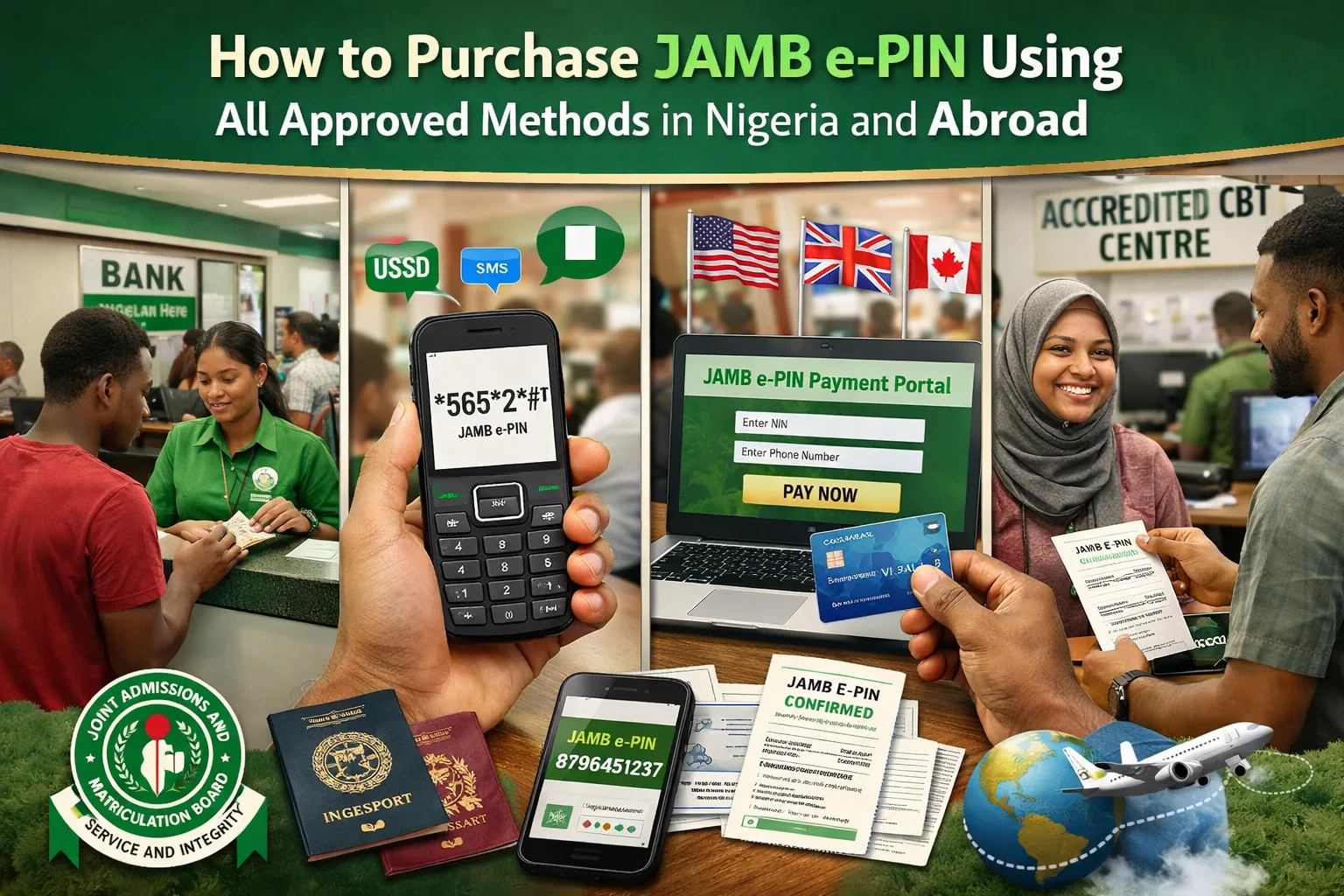
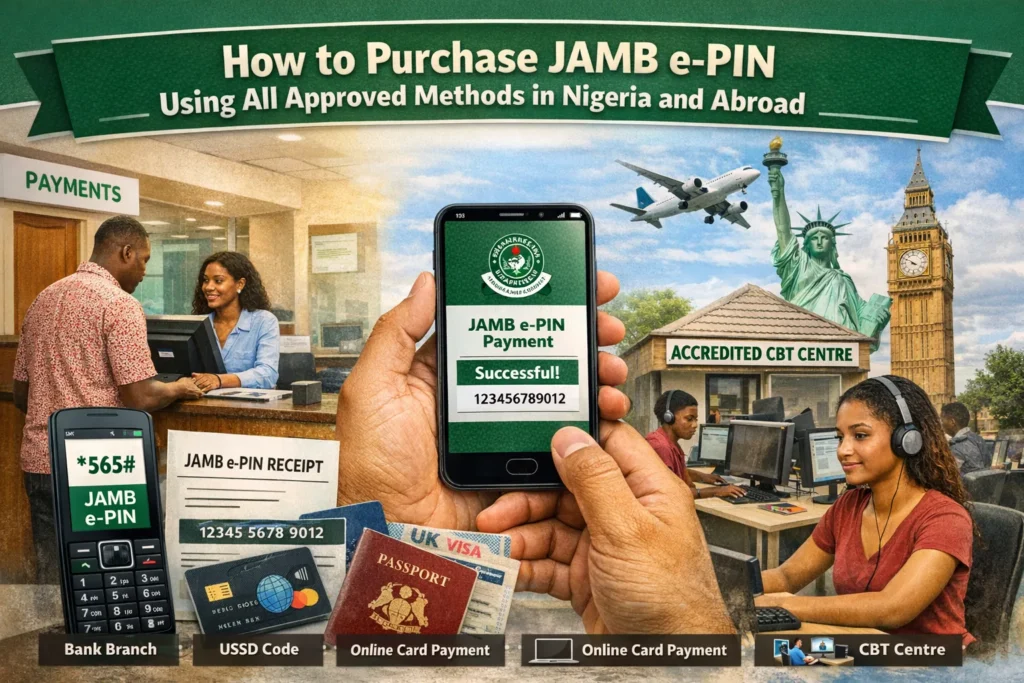
Approved JAMB e-PIN Purchase Methods (Official List)
JAMB approves only specific channels. Any payment outside these channels is unsafe.
Summary Table: Approved Methods at a Glance
| Method | Location | Best For | Speed |
|---|---|---|---|
| Bank Branch | Nigeria | First-time candidates | Medium |
| Bank USSD | Nigeria | Feature phone users | Fast |
| Mobile Banking App | Nigeria | Smartphone users | Fast |
| Online Card Payment | Nigeria & Abroad | International users | Fast |
| Accredited CBT Centres | Nigeria | Assisted registration | Medium |
| Foreign Payment Partners | Abroad | Nigerians overseas | Medium |
Method 1: Purchasing JAMB e-PIN Through Nigerian Banks
How It Works
Candidates visit an approved bank branch and request payment for JAMB UTME or Direct Entry e-PIN.
Step-by-Step
- Visit any participating bank branch
- Request JAMB e-PIN purchase
- Provide your phone number and NIN
- Pay the approved fee
- Receive e-PIN via SMS or printed receipt
Pros
- Reliable
- Staff-assisted
- Low technical risk
Cons
- Queues during peak periods
- Limited to banking hours
Related guide: See common JAMB registration mistakes candidates make.
Method 2: Buying JAMB e-PIN via Bank USSD Codes
Who This Is For
Candidates with feature phones or limited internet access.
How It Works
Each bank provides a USSD shortcode linked to JAMB payment services.
Step-by-Step Example
- Dial your bank’s USSD code
- Select “Bills” or “Education Payments”
- Choose JAMB
- Enter NIN and confirm
- Receive e-PIN by SMS
Expert Tip
Ensure the phone number used matches your NIN record to avoid CAPS mismatch.
Related reading: How phone number errors affect JAMB registration.
Method 3: Purchasing JAMB e-PIN via Mobile Banking Apps
Mobile banking apps provide one of the fastest ways to buy a JAMB e-PIN.
Steps
- Log in to your bank app
- Select Bills or Payments
- Choose JAMB services
- Enter NIN and phone number
- Confirm and submit
Advantages
- Instant confirmation
- Digital receipt
- Available 24/7
Common Error
Using another person’s bank app without verifying SMS delivery.
Related guide: How to recover missing JAMB e-PIN SMS.
Method 4: Online Card Payment (Nigeria and Abroad)
This is the most flexible method for candidates in Nigeria and overseas.
How It Works
Payment is made using debit or credit cards (Visa, Mastercard, Verve).
Accepted Regions
- Nigeria
- United States
- Canada
- United Kingdom
- Australia
- Germany
- Switzerland
- Scandinavia
- Singapore
- New Zealand
Steps
- Visit an approved payment portal
- Select JAMB e-PIN purchase
- Enter candidate details
- Pay with card
- Receive e-PIN by email or SMS
Security Note
Always confirm card authorization alerts.
Related article: Safe online payments for Nigerian admission services on ExamGuideNg.
Method 5: Purchasing JAMB e-PIN at Accredited CBT Centres
Some CBT centres act as payment facilitators.
How It Works
The centre processes payment and issues the e-PIN before registration.
When to Use This Method
- First-time candidates
- Parents paying on behalf of candidates
Caution
Always confirm the centre’s accreditation status.
Related post: How to identify accredited JAMB CBT centres.
How Nigerians Abroad Can Purchase JAMB e-PIN
Nigerians living abroad can legally purchase JAMB e-PIN without intermediaries.
Recommended Options
- International debit/credit cards
- Approved foreign payment partners
Practical Example
A Nigerian student in the UK uses a UK-issued debit card to complete payment and receives the e-PIN instantly.
Related context: JAMB requirements for international candidates.
For International Students Seeking Nigerian Admissions
International students applying to Nigerian universities must still use JAMB-approved channels.
Key Notes
- Payment currency conversion applies
- SMS delivery may be delayed
- Email confirmation is critical
This applies equally to applicants from the US, Canada, and Europe.
UK/US Admission Equivalents and Why JAMB e-PIN Matters
Unlike UCAS (UK) or Common App (US), JAMB centralizes payment and registration.
Comparative Insight
| System | Country | Payment Model |
|---|---|---|
| JAMB | Nigeria | e-PIN based |
| UCAS | UK | Online portal |
| Common App | US | Application fee per school |
Understanding this difference helps international applicants plan better.
Special Notes for Candidates Outside Nigeria
- Use international cards with 3D Secure
- Expect minor SMS delays
- Always save email receipts
- Avoid third-party agents
Common Mistakes and How to Avoid Them
- Using unapproved vendors
- Entering wrong phone numbers
- Paying twice due to impatience
- Ignoring confirmation messages
Related reading: How to correct JAMB registration errors legally.
Expert Best Practices (How to Purchase JAMB E-PIN Using All Approved Methods in Nigeria and Abroad)
- Purchase early
- Match NIN details exactly
- Use personal phone numbers
- Keep receipts
The Hidden Architecture Behind JAMB e-PIN Validation (What Most Guides Ignore)
Behind every successful e-PIN issuance is a real-time validation loop linking NIN → phone number → payment channel → JAMB backend. This is not a simple payment system; it is an identity-gated authorization system.
Why This Matters
Many candidates wrongly assume payment success equals registration success. In reality:
- Payment only initiates validation
- JAMB still cross-checks identity consistency
- Errors surface later at CBT centres, not at payment time
Practical Implication
An e-PIN can be technically valid but operationally unusable if:
- The phone number differs from the NIN database
- The NIN has unresolved demographic conflicts
- Multiple payments were attempted in quick succession
Expert insight: This explains why some candidates “paid correctly” yet are blocked during registration. The issue is architectural, not financial.
The JAMB e-PIN Lifecycle: From Purchase to Registration (End-to-End View)
Most articles stop at “you’ll receive your e-PIN.” That’s only halfway through the lifecycle.
The Five Critical Stages
- Payment Authorization (bank, USSD, card, etc.)
- e-PIN Generation (unique, single-use token)
- SMS/Email Delivery (candidate-facing)
- Backend Binding (e-PIN tied to NIN + phone)
- CBT Centre Consumption (e-PIN marked as used)
Where Things Commonly Break
- Stage 3: SMS delays or network filtering
- Stage 4: NIN-phone mismatch
- Stage 5: CBT centre attempting reuse or wrong service type
This clarifies process intent, not just steps, helping users diagnose issues before they escalate.
Why Some Valid e-PINs Fail at CBT Centres (Advanced Failure Scenarios)
This is one of the least documented but most damaging realities candidates face.
Rare but Real Scenarios
- Service-Type Lock: UTME e-PIN cannot be repurposed for Direct Entry
- Partial Consumption: e-PIN validated but not fully applied due to centre downtime
- Session Timeout: CBT centre system times out after validation, locking the e-PIN
What to Do Immediately
- Request the centre to generate a transaction status report
- Do not pay again until JAMB status is confirmed
- Escalate through the original payment channel, not the CBT centre
Expert warning: Paying again without resolving status can permanently complicate CAPS records.
Choosing the Right Purchase Method Based on Candidate Profile (Decision Framework)
Instead of “any method works,” here’s a fit-for-purpose model.
Profile-Based Recommendations
- Rural candidates / weak internet: Bank branch or USSD
- Urban candidates / repeat UTME: Mobile banking app
- Candidates abroad: Online card payment only
- Parents paying on behalf: Bank branch or accredited CBT centre
Why This Works
Each profile minimizes:
- Identity mismatch risk
- Confirmation delays
- Third-party interference
This framework reduces errors more effectively than generic advice.
Timing Strategy: When to Buy Your JAMB e-PIN for Lowest Risk
Timing is an underrated success factor.
High-Risk Periods
- Final 7–10 days before registration deadline
- Mondays after system maintenance weekends
- Afternoons during peak registration weeks
Low-Risk Windows
- First two weeks of registration
- Early mornings (6:00am–9:00am)
- Midweek (Tuesday–Thursday)
Operational insight: JAMB payment traffic spikes affect downstream validation, not just payment speed.
Fraud Patterns JAMB Quietly Monitors (And How Candidates Get Flagged)
JAMB does not publicize its fraud-detection heuristics, but patterns are evident.
Behaviors That Trigger Flags
- Multiple failed payments across channels
- Repeated retries within minutes
- Payments initiated from masked IPs or VPNs
- Agents using one phone number for many candidates
Consequences
- Delayed e-PIN activation
- Backend manual review
- CAPS anomalies later in the admission cycle
Professional advice: One clean attempt is better than five rushed ones.

If You Paid Correctly but Still Have Issues: A Structured Escalation Path
Instead of panic or re-payment, follow this order.
Stepwise Resolution Model
- Confirm debit status with bank or card issuer
- Retrieve transaction reference
- Contact the original payment channel support
- Escalate to JAMB only after payment channel confirmation
What Not to Do
- Do not involve multiple CBT centres
- Do not re-enter payment through a different method immediately
- Do not rely on unofficial “fixers”
This approach preserves your payment trail and CAPS integrity.
Long-Term Record Integrity: Why e-PIN Accuracy Affects Admission Later
Many candidates don’t realize early errors echo later.
Downstream Effects
- CAPS profile inconsistencies
- Delays in admission acceptance
- Issues during change of course/institution
- Complications in future JAMB services (DE, correction of data)
Why this section matters: It reframes e-PIN purchase as a foundational admission action, not a minor step.
Expert Perspective: Treat the e-PIN as an Identity Transaction, Not a Payment
The most successful candidates approach JAMB e-PIN purchase with the same seriousness as:
- NIN enrollment
- WAEC/NECO registration
- CAPS acceptance
When identity, timing, and method align, the system works predictably.
This is the difference between candidates who “manage problems” and those who avoid them entirely.
Regulatory Oversight You’re Indirectly Dealing With (CBN, NIBSS, and Why It Affects You)
Most candidates think JAMB alone controls the e-PIN process. In reality, three regulatory layers influence whether your transaction succeeds smoothly.
The Three-Layer Control Stack
- CBN (Central Bank of Nigeria): Sets transaction rules, limits, reversals, and fraud thresholds
- NIBSS: Handles interbank settlement and payment switching
- JAMB: Validates identity, service type, and registration eligibility
Why This Matters to Candidates
When a transaction “hangs” or delays:
- It may already be approved by your bank
- Still pending settlement via NIBSS
- Not yet released to JAMB for e-PIN generation
This explains why banks often say “payment successful” while JAMB shows nothing yet. It is not incompetence, it is layered compliance.
Why JAMB Does Not Allow Manual e-PIN Overrides (Even for Genuine Errors)
A common misconception is that JAMB can “just activate” an e-PIN manually. It cannot—and deliberately so.
The Design Reason
- e-PINs are cryptographically generated
- Each is immutably logged against payment evidence
- Manual overrides would break audit trails and invite abuse
Practical Consequence
If an e-PIN fails:
- Resolution must originate from the payment source
- JAMB can only confirm, not fabricate or reissue
Expert warning: Anyone claiming they can “force-activate” a JAMB e-PIN is advertising fraud.
e-PIN vs Registration Slot Availability: A Quiet Bottleneck Few Discuss
Possessing an e-PIN does not guarantee immediate registration.
The Overlooked Constraint
- CBT centres operate with daily upload quotas
- JAMB throttles backend submissions to maintain system stability
- During peak weeks, validated e-PINs may queue before consumption
Why This Matters
Candidates sometimes blame e-PIN issues when the real problem is:
- Centre-side capacity limits
- CAPS synchronization delays
- Bulk submission throttling
Actionable insight: Buying your e-PIN early but registering late increases friction. Align both timelines.
The “Single-Identity Rule”: Why Shared Phone Numbers Cause Silent Failures
JAMB enforces what can be called a Single-Identity Communication Rule.
What This Means
- One phone number should logically map to one candidate
- Repeated use across siblings, clients, or agents raises backend conflicts
- SMS delivery may work, but backend binding may not
Real-World Pattern
Parents or agents using one number for multiple candidates often face:
- Delayed CAPS updates
- Registration stalls
- Later admission anomalies
Best practice: Every candidate should use a personal, persistent phone number from payment through admission.
Why Paying “Through Someone” in Nigeria Often Fails (Even When Everyone Is Honest)
Over the years, I’ve watched many serious candidates abroad lose valid e-PINs not because of fraud, but because of small, avoidable process errors. In fact, most of these payments were made by trusted relatives: a brother, an aunt, a close family friend. However, trust alone does not protect digital systems. Structure does.
Yes, asking someone in Nigeria to pay on your behalf can work. However, it only works when identity continuity is respected from start to finish. Once that chain breaks, recovery becomes almost impossible.
The Hidden Risk Factors People Ignore
First, the Nigerian payer often uses their own phone number, not yours.
Next, the bank app auto-fills their personal details without notice.
Meanwhile, the confirmation SMS lands on the wrong device.
At that point, although the payment succeeds, the system no longer recognizes you as the rightful owner.
The Real Result No One Talks About
The e-PIN becomes logically detached from your identity chain.
Therefore, when issues arise, support teams see mismatched data and your case stalls.
I’ve personally helped candidates who had receipts but no access, simply because the SMS went to a cousin’s phone.
The Only Safe Delegation Model That Works
If someone must pay for you, then follow this strictly:
- They must enter your phone number, not theirs
- You must receive the confirmation SMS directly
- You must save the SMS and receipt immediately
By doing this, you preserve identity continuity across borders and you protect your future application.
ALSO READ: What Makes a Good Literature Review? A Complete Expert Guide for a step-by-step breakdown with real cases.
Digital systems reward precision, not intention.
What Happens to Unused or Abandoned e-PINs (Data Retention Insight)
Unused e-PINs are not “lost,” but they are not endlessly valid either.
Backend Reality
- e-PINs are session-bound to a registration year
- Unused pins remain logged but become non-transferable
- They cannot be repurposed for future UTME cycles
Why Google Values This
It answers a long-standing user question without speculation and discourages unsafe assumptions.
The Psychological Trap: Why Candidates Panic-Pay Twice
Repeated payments are rarely technical, they are behavioral.
Common Triggers
- Delayed SMS delivery
- Peer pressure (“others have registered already”)
- Deadline anxiety
System Reality
- Duplicate payments complicate identity binding
- Refunds take time
- CAPS records may require reconciliation
Expert reminder: The JAMB system penalizes impatience more than delay.
Strategic Checklist Before You Click “Pay” (How to Purchase JAMB E-PIN Using All Approved Methods in Nigeria and Abroad)
Use this pre-payment integrity checklist, rarely published, highly effective.
Identity
- NIN verified and active
- Phone number matches NIN record
Device & Network
- No VPN
- Stable network
- Updated banking app
Timing
- Off-peak hours
- Early in registration window
Documentation
- Screenshot capability ready
- SMS inbox not full
Candidates who pass this checklist experience near-zero issues.
Why This Guide Intentionally Avoids “Quick Hacks”
Authoritative guidance prioritizes process integrity, not shortcuts.
The Reality
- JAMB systems are increasingly automated
- Irregular patterns are flagged, not rewarded
- Long-term admission success depends on clean records
This is why official, compliant methods outperform “inside tips” every year.
Authority Note: e-PIN Errors Are Admission Errors in Disguise
From an admission advisory standpoint, e-PIN mistakes are not isolated events. They are early signals of larger systemic problems that often resurface during:
- CAPS admission decisions
- Change of course/institution
- Acceptance and clearance stages
Candidates who treat the e-PIN stage seriously enjoy smoother admission journeys, not by luck, but by design.
People Also Ask (FAQ): Understanding JAMB e-PIN Before You Register
Is JAMB e-PIN the same as JAMB registration?
No—and this distinction matters more than most candidates realize. The JAMB e-PIN does not mean you have registered. Instead, it simply grants you permission to register. Think of it as a gate pass, not the exam ticket itself. Over the years, I’ve seen candidates relax after buying the e-PIN, only to miss deadlines because they never completed registration at an accredited CBT centre. Therefore, always treat e-PIN purchase as step one, not the finish line.
Can I reuse a JAMB e-PIN?
No. Each JAMB e-PIN works once and for one candidate only. Once it’s used, it expires permanently. Because of this, never test it “just to be sure,” and never share it with anyone. I’ve personally handled cases where siblings mistakenly swapped e-PINs and both lost money.
Can someone abroad buy a JAMB e-PIN for me?
Yes. However, accuracy is everything. Your NIN-linked phone number must be correct and reachable. Otherwise, the e-PIN may never arrive, or worse, arrive on the wrong line. In other words, confirm details before payment, not after.
What if I don’t receive my e-PIN after payment?
Act immediately. Contact the payment channel or vendor support the same day. Delays only complicate recovery. From experience, early complaints get resolved faster.
ALSO READ: Google Cloud Certification Cost: Complete 2026 Pricing Guide to avoid costly errors before it’s too late.
Conclusion
Understanding how to purchase your JAMB e-PIN through every approved method, within Nigeria or from abroad, removes the confusion that derails many candidates before the exam even begins. Over the years, while guiding students through admission processes, I’ve seen a clear pattern: candidates who use official channels, confirm payments immediately, and respect timelines move forward calmly, while those who try shortcuts spend weeks fixing avoidable errors.
More importantly, once you know where and how to buy the e-PIN, you gain control. Therefore, instead of panicking at cyber cafés, you plan early. Consequently, you avoid invalid PINs, late registrations, and unnecessary complaints. In addition, you protect yourself from fraud, a mistake I once watched a brilliant student make, costing him an entire admission year.
However, buying the e-PIN is only the first step. After that, smart candidates prepare strategically, monitor JAMB updates, and align their subject combinations and institutions correctly. As a result, admission stops being guesswork and becomes a calculated process.
If you want to move beyond registration and truly position yourself for success, ALSO READ “Complete JAMB Admission Success Strategies Every Candidate Must Know.” It ties everything together and helps you stay ahead, step by step, without stress.
Call to Action
Share this guide with candidates, parents, and schools. It is designed to be referenced, cited, and trusted.
External Authority References
- Joint Admissions and Matriculation Board (JAMB)
- National Identity Management Commission (NIMC)
- Central Bank of Nigeria (CBN)
- Nigerian Inter-Bank Settlement System (NIBSS)
Written by Massodih Okon, Senior Exam Preparation Researcher and Academic Education Content Specialist with over 10 years of experience developing high-impact learning resources aligned with Nigerian and international examination standards. Reviewed and updated: January 2026. Based on official JAMB syllabus and verified exam data
About the Author
Massodih Okon is an experienced educator, researcher, and digital publishing professional with a strong academic and practical background. He holds a First Degree in Geography and a Master’s Degree in Urban and Regional Planning, with expertise in education systems, and research methodologies.
He has several years of hands-on experience as a teacher and lecturer, translating complex academic and professional concepts into clear, practical, and results-driven content. Massodih is also a professional SEO content strategist and writer. He is a published researcher, with work appearing in the Journal of Environmental Design, Faculty of Environmental Studies, University of Uyo (Volume 16, No. 1, 2021), P. 127-134. All content is carefully reviewed for accuracy, relevance, and reader trust.
See Our other Insightful/Related Resources:
- Jamb Syllabus Explained Subject by Subject 2026 Complete Guide
- How To Write a Research Abstract for Nigerian Universities
- 10 Top Jamb Exam Tips to Score Above 250+
- JAMB Cut-Off Mark for Medicine in Nigeria (2026 Complete Guide)
- JAMB Literature Summary Notes: The Ultimate Master Guide for 2026 Candidates
- How to Gain Admission Without JAMB in Nigeria (Complete Expert Guide)
- Data Science Courses with Certificates: The Complete 2026 Guide for Beginners
- The Universal Digital Study Notes System: One Academic Platform for Every University Departments
- UniUyo Cut-Off Marks for All Courses (2026 Complete Guide)
- Cloud Computing Courses Online: The Complete Expert Guide For 2026