


How to Write a Research Abstract for Nigerian Universities
Writing a research project, thesis, or dissertation in a Nigerian university can feel intimidating, even for the most prepared student. Amid chapters, references, and formatting rules, one section quietly determines how your entire work is perceived: the abstract. How to Write a Research Abstract for Nigerian Universities is not just a topic, it is a critical academic skill every student must master.
Supervisors read the abstract first to decide whether your research is focused and scholarly. External examiners often form their initial judgment from it. Journal editors rely on it to determine if your work is worth reviewing or publishing. In many cases, your abstract is the only part of your research that busy academics read in full. When it is weak, vague, or poorly structured, even a solid project risks rejection, misinterpretation, or low grading.
This guide breaks down how to write a clear, concise, and examiner-approved research abstract tailored specifically to Nigerian universities. Whether you are an undergraduate, postgraduate, or final-year student, you will learn exactly what Nigerian supervisors expect, what examiners look for, and how to present your study with confidence and authority. For a deeper understanding of structuring academic research from start to finish, see our further reading on how to write a high-scoring final year project in Nigerian universities.
Definition: What Is a Research Abstract?
A research abstract is a short, concise summary of a research project, thesis, or dissertation. It highlights the purpose, method, findings, and conclusion of the study without unnecessary details.
What Is a Research Abstract? (Definition, Purpose, and Placement in Nigerian Universities)
A research abstract is a concise yet powerful overview of an academic study, typically ranging between 150 and 300 words. It functions as the intellectual gateway to a research project, summarizing the research problem, objectives, methodology, key findings, and core conclusion in a single, tightly written section.
In Nigerian universities, the abstract is not a mere formality, it is a mandatory academic requirement and often the first section read by supervisors, external examiners, and future researchers. A well-written abstract determines whether the entire project is taken seriously or dismissed at first glance.
Structurally, the abstract is positioned with precision and consistency across institutions. It appears:
- At the very beginning of the project
- Immediately after the title page
- Before the table of contents
Because of this strategic placement, the abstract must be clear, authoritative, and informative enough to stand on its own. It should allow a reader to understand the full scope and value of the research without reading the entire project.
For a deeper breakdown of how abstracts differ from introductions, statements of the problem, and project summaries and how to write one that meets Nigerian university standards see this related guide on academic project structure and writing.
Why the Abstract Is a Non-Negotiable Academic Component
The abstract is not a ceremonial page filler, it is a decisive academic instrument. In a few tightly written paragraphs, it performs functions that can determine how your entire research is judged. A well-crafted abstract allows supervisors to rapidly evaluate the intellectual depth, originality, and methodological soundness of your study. It serves as a primary navigation tool for external examiners during project defense, often shaping their first impression before they engage with the full manuscript.
Beyond the university, the abstract plays a gatekeeping role: it strongly influences acceptance decisions for conferences, journals, and institutional publications. In the digital academic ecosystem, it also enhances research visibility and discoverability within institutional repositories, academic databases, and search engines, often determining whether your work is read or ignored.
In Nigeria, this standard is not optional. Most universities operate under NUC-aligned academic regulations, where abstract quality is treated as a serious scholarly requirement, not a stylistic preference. A weak abstract can undermine an otherwise solid project; a strong one elevates it instantly.
Further reading:
For a deeper understanding of how Nigerian academic standards influence research writing and project evaluation, see our related guide on NUC-compliant project writing and formatting standards on this blog.
Standard Abstract Requirements in Nigerian Universities
Although formatting may vary slightly by institution, most Nigerian universities agree on the following:
| Requirement | Standard Expectation |
|---|---|
| Word count | 150–300 words |
| Tense | Past tense (mostly) |
| Paragraphs | Single paragraph |
| Citations | Not allowed |
| Figures/Tables | Not allowed |
| Keywords | 3–5 keywords after abstract |
Always confirm your department’s project handbook before submission.
Key Elements of a Strong Research Abstract (How to Write a Research Abstract for Nigerian Universities)
A well-written abstract answers five questions clearly and briefly.
1. Background of the Study
State the research context and problem.
Example:
This study examined the challenges affecting academic performance of secondary school students in Lagos State.
2. Aim or Purpose of the Study
Explain what the research set out to achieve.
Example:
The main objective of the study was to assess the impact of study habits on students’ academic achievement.
3. Research Methodology
Mention the design, population, sample size, and data analysis method.
Example:
A descriptive survey research design was adopted. Data were collected from 200 students using structured questionnaires and analyzed using descriptive statistics.
4. Key Findings
Summarize the most important results.
Example:
The findings revealed that effective time management significantly improves academic performance.
5. Conclusion and Recommendation
State what the findings mean.
Example:
The study concludes that structured study schedules enhance learning outcomes and recommends academic counseling for students.
Step-by-Step Guide: How to Write a Research Abstract
Step 1: Write the Abstract Last
Do not write your abstract before completing your project. You need full knowledge of:
- Final findings
- Conclusions
- Recommendations
This approach ensures accuracy and clarity.
Step 2: Extract Key Points from Each Chapter (How to Write a Research Abstract for Nigerian Universities)
Summarize:
- Chapter One: Research problem and objectives
- Chapter Three: Methodology
- Chapter Four: Major findings
- Chapter Five: Conclusion
Then merge them into one paragraph.
Step 3: Use Clear and Simple Academic Language
Avoid:
- Long sentences
- Ambiguous expressions
- Technical jargon without explanation
- Use clear English that examiners understand easily.
Step 4: Maintain Logical Flow
Use transition words such as:
- Therefore
- Consequently
- However
- In addition
- As a result
These improve readability and coherence.
Step 5: Revise Ruthlessly (How to Write a Research Abstract for Nigerian Universities)
After writing, remove:
- Repeated ideas
- Examples
- Background explanations
Every sentence must add value.
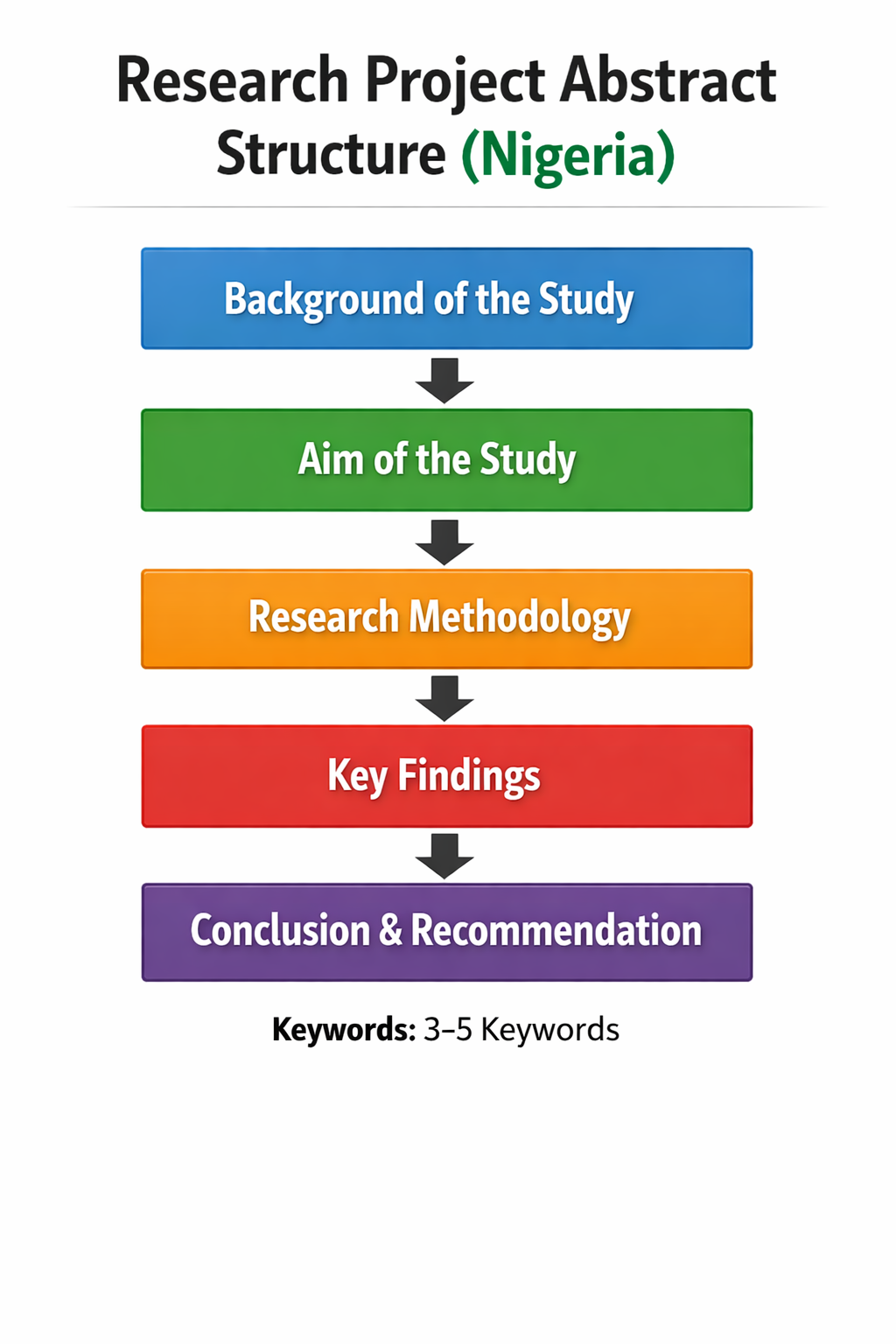
Sample Research Abstract (Nigerian University Standard)
Abstract
This study investigated the influence of study habits on academic performance of undergraduate students in the University of Uyo. The study adopted a descriptive survey research design. A sample of 150 students was selected using simple random sampling. Data were collected through a structured questionnaire and analyzed using mean and standard deviation. Findings revealed that effective time management and consistent study routines significantly improve academic performance. The study concludes that positive study habits enhance learning outcomes and recommends academic orientation programs for undergraduates.
Keywords: Study habits, academic performance, undergraduates, Nigeria
Common Mistakes Nigerian Students Make (And How to Avoid Them)
1. Writing the Abstract Like an Introduction
The abstract is a summary, not a background discussion.
Fix: Focus on results, not explanations.
2. Using Future Tense (How to Write a Research Abstract for Nigerian Universities)
Statements like “This study will examine” are incorrect.
Fix: Use past tense: “This study examined.”
3. Including Citations
Abstracts must stand alone.
Fix: Remove all references and quotations.
4. Exceeding Word Limit
Long abstracts irritate examiners.
Fix: Stay within your department’s approved limit.
Tips for High-Scoring Abstracts (How to Write a Research Abstract for Nigerian Universities)
- Read approved projects in your department
- Follow your supervisor’s corrections strictly
- Use academic but simple English
- Avoid abbreviations unless universally known
- Proofread for grammar and clarity
These practices improve acceptance during project defense.
Pros and Cons of a Well-Written Abstract
Pros
- Creates strong first impression
- Improves examiner understanding
- Increases chances of publication
- Enhances academic credibility
Cons
- Poor abstracts misrepresent good research
- Weak summaries reduce research impact
How Examiners Actually Read Abstracts (An Insider Perspective)
Most students assume examiners read abstracts linearly. In reality, many Nigerian supervisors and external examiners scan with intent, looking for academic signals that justify spending time on the full work.
What they subconsciously check within 30–60 seconds:
- Problem–solution alignment: Does the stated problem logically connect to the findings?
- Method–claim credibility: Are the conclusions proportionate to the methodology used?
- Academic maturity: Does the language reflect an independent researcher or a guided student?
Why this matters:
An abstract that aligns problem → method → findings → implication reassures examiners that the research is defensible, even before viva questions begin.
The Abstract–Defense Consistency Test (Often Overlooked)
One silent reason projects fail during defense is abstract–chapter mismatch.
Before submission, apply this test:
Can every claim in the abstract be directly traced to:
- Chapter Four (findings), or
- Chapter Five (conclusion/recommendations)?
Does the abstract avoid introducing any idea not discussed in later chapters?
Expert warning:
During defense, examiners often quote the abstract verbatim and ask candidates to “justify this statement.” Any exaggeration becomes a liability.
Discipline-Specific Abstract Expectations in Nigerian Universities
While general rules apply, Nigerian departments quietly enforce discipline norms.
Education, Social Sciences, Management Sciences
Emphasis on:
- Population, sample size, and instruments
- Clear practical recommendations
Weak abstracts often fail by being too theoretical.
Sciences, Engineering, Environmental Studies
Expect:
- Clear methodological precision
- Quantitative clarity (models, tests, measurements)
Overly narrative abstracts raise red flags.
Arts and Humanities
Value:
- Conceptual clarity
- Theoretical positioning
Excessive statistics may appear misplaced.
Why this matters:
An abstract that ignores disciplinary expectations may meet word count but fail contextual relevance—a common reason supervisors request rewrites.
The “Information Density” Principle (What High-Scoring Abstracts Do Differently)
Strong abstracts do not say more, they say more per sentence.
High-density sentences:
-
Combine context + outcome
Example:
“Findings revealed that X significantly influences Y, highlighting structural gaps in Z.”
Low-density sentences:
-
Waste words on background already obvious to examiners.
Practical check:
If a sentence can be removed without changing meaning, it does not belong in the abstract.
Keywords Strategy: Beyond Filling a Requirement
Most students treat keywords as an afterthought. This is a mistake.
Well-chosen keywords:
Improve indexing in:
- University repositories
- Google Scholar
Increase citation potential for publishable projects
Expert approach:
Include:
- One core concept
- One method-related term
- One population or location marker
Avoid:
-
Generic words like study, analysis, impact
Common Supervisor Red Flags (Rarely Stated Explicitly)
Supervisors often reject abstracts without explaining the deeper issue. These are silent triggers:
- Findings that sound too obvious for the research level
- Recommendations that are broader than the data supports
- Methods mentioned without analytical techniques
- Abstracts that read like a proposal, not a completed study
Recognizing these red flags helps you self-correct before submission.
A Final Examiner-Approved Abstract Checklist
Before submitting, confirm that your abstract:
- Uses past tense consistently
- Contains zero citations
- Fits within the approved word limit
- Mirrors actual findings without exaggeration
- Can stand alone without the full project
- Would still make sense if read by an external examiner unfamiliar with your department
If all boxes are checked, your abstract is not just acceptable, it is defensible.
Why Abstract Quality Directly Affects Final Project Scores
In Nigerian universities, abstract quality often:
- Shapes first impressions during grading
- Influences examiner confidence during defense
- Affects recommendation strength for publication
A strong abstract does not merely summarize your work, it protects it.
Expert Note for Students Aiming for Journal Publication
If your project may later be converted into a journal article:
- Write the abstract with future peer review in mind
- Avoid local-only phrasing unless contextually necessary
- Maintain methodological transparency
This small foresight can save weeks of revision later.
The “Abstract as Academic Contract” Theory (A Rarely Articulated Lens)
In Nigerian universities, the abstract quietly functions as an academic contract between the student and the examiner.
Once written, it commits you to:
- The scope of your claims
- The strength of your conclusions
- The boundaries of your recommendations
Anything said in the abstract becomes fair ground for interrogation during defense.
Why this matters:
Students often lose marks not because their research is weak, but because the abstract overpromised. A defensible abstract slightly under-states findings rather than amplifying them.
The “Supervisor Memory Bias” Effect on Abstract Evaluation
Supervisors typically review dozens of projects in a short period. What stays in their memory is not full chapters, but abstracts.
This creates a subtle bias:
- Projects with clear, precise abstracts are remembered as “strong”
- Projects with vague abstracts are remembered as “confusing,” even if chapters are solid
Practical implication:
Your abstract is not just read once. It becomes the mental summary your supervisor carries into grading meetings and defense panels.
Abstract Language and the Nigerian Examiner’s Cognitive Shortcut
Experienced examiners unconsciously use language shortcuts to assess research maturity.
Certain signals raise confidence instantly:
- “The findings revealed statistically significant…”
- “The study established a relationship between…”
- “Results indicated a measurable variation in…”
Conversely, phrases like:
- “It was discovered that many…”
- “The study tried to look at…”
Trigger doubts about methodological rigor.
The Abstract Compression Skill (Why Final-Year Projects Differ from Coursework)
One under-discussed academic skill is compression: the ability to reduce complex research into high-value sentences.
Examiners often distinguish:
- Coursework-level writing → descriptive
- Project-level writing → compressed and analytical
Hidden rule:
If a result takes two sentences to explain in an abstract, it is probably too weak or too broad.
The “Abstract Drift” Problem During Revisions
Many students revise chapters but forget to revise the abstract accordingly.
This creates abstract drift:
- Methods updated in Chapter Three
- Findings refined in Chapter Four
- Abstract remains outdated
Expert warning:
Abstract drift is one of the fastest ways to trigger supervisor corrections late in submission stages.
Best practice:
Always rewrite the abstract after final supervisor approval of all chapters.
How Institutional Repositories Quietly Judge Your Research
Most Nigerian universities now host digital repositories. Abstracts determine:
- Whether a project appears in search results
- How it is categorized academically
- Whether external researchers click to read it
Overlooked reality:
Your abstract may be read more times after graduation than during your defense.
Abstract Writing as a Signal of Research Independence
Supervisors subconsciously use abstracts to answer one question:
“Did this student truly understand their research?”
Indicators of independence:
- Confident but measured conclusions
- Clear ownership of methodology
- Absence of copied structural patterns
Indicators of dependency:
- Formulaic language
- Excessive caution (“attempted to”, “tried to”)
- Abstracts that look supervisor-written
The Ethical Boundary of Abstract Writing
Ethical breaches do not start in data falsification—they often start in abstracts.
Risk areas include:
- Claiming causation when only correlation was tested
- Generalizing beyond the study population
- Presenting recommendations not grounded in findings
Why this matters:
Ethical abstraction is part of academic integrity, and examiners are increasingly alert to it.
Abstract Longevity: Writing for Five Years Ahead
A high-quality abstract should remain valid:
- When archived
- When cited
- When read by future researchers
Ask yourself:
- Will this abstract still make sense without me explaining it?
- Does it clearly state what was done and what was found?
Longevity is a quiet marker of academic excellence.
The “Silent Comparison” Effect in Project Defense Panels
During defense, examiners often:
- Read multiple abstracts before a session
- Mentally rank them even unconsciously
A precise abstract:
- Reduces aggressive questioning
- Frames the defense narrative
- Positions the student as prepared
This effect is rarely acknowledged, but widely experienced.
Insight: Why Abstract Mastery Is a Career Skill
Beyond graduation, abstract writing mirrors:
- Research proposals
- Policy briefs
- Grant summaries
- Executive research notes
Mastering the abstract is not just about passing, it is about learning to think like a researcher.
The “Abstract Tone Calibration” Problem (Why Neutral Beats Impressive)
One subtle failure point in Nigerian student abstracts is tone miscalibration.
Students often try to sound impressive instead of accurate.
Examiners quietly prefer abstracts that are:
- Neutral, not promotional
- Precise, not dramatic
- Confident, not exaggerated
Counterintuitive insight:
An abstract that sounds too impressive raises suspicion. Examiners begin searching for weaknesses to “test” the claims.
Abstract Writing as Risk Management (A Strategic View)
Every abstract sentence carries academic risk.
Types of risk students unknowingly take:
- Method risk: Claiming strength not supported by design
- Scope risk: Generalizing beyond the sample
- Inference risk: Drawing conclusions stronger than results
High-scoring students instinctively write low-risk abstracts:
- They state what the data shows, not what they wish it showed
- They let findings speak, not language
The “One-Read Rule” Used by External Examiners
External examiners often follow an informal rule:
“If I must reread the abstract to understand it, the project is already disadvantaged.”
This is not about simplicity, it is about clarity under time pressure.
Practical implication:
Your abstract must make sense on first contact, without rereading or mental reconstruction.
Abstract Structure as a Cognitive Map
Beyond content, examiners unconsciously look for mental mapping:
-
Problem → Objective → Method → Finding → Meaning
When this order is broken:
- Cognitive load increases
- Examiner patience decreases
- Perceived quality drops
Why this matters:
Even correct content can score lower if the mental map is unclear.
The “Invisible Benchmarking” Effect
Students are rarely told this, but abstracts are often judged relative to others, not in isolation.
Supervisors and examiners:
- Compare abstracts subconsciously
- Notice deviations in clarity, precision, and maturity
- Use stronger abstracts as internal benchmarks
Your goal is not perfection, it is clear superiority within your cohort.
Abstract Minimalism vs. Abstract Emptiness
There is a fine line between being concise and being vague.
Strong minimalism:
- Removes explanations
- Keeps outcomes
Weak minimalism:
- Removes specifics
- Keeps only general statements
Litmus test:
If your abstract could apply to ten different projects, it is too empty.
The “Abstract as Evidence of Thinking” Principle
Examiners often infer how you thought during the research process from the abstract alone.
They look for:
- Logical sequencing
- Cause–effect awareness
- Method–result consistency
This is why two projects with similar topics can receive very different grades.
Why Abstracts Fail Even When Chapters Are Excellent
This mismatch usually happens because:
- Chapters were written gradually
- Abstract was rushed at the end
- Student treated it as a summary, not a synthesis
Expert insight:
Abstract writing is not summarization, it is analytical distillation.
The Abstract Revision Loop (Used by High-Performing Students)
Top students unconsciously follow this loop:
- Write the abstract
- Compare each sentence with Chapter Four
- Remove any sentence not directly backed by data
- Reorder sentences for logical flow
- Cut 10–15% of words without losing meaning
This loop produces clarity without added length.
Abstracts and Academic Confidence Signaling
Confidence in abstracts is shown through:
- Declarative statements grounded in results
- Absence of apologetic language
- Controlled use of qualifiers (“significant”, “moderate”, “limited”)
Overuse of caution words signals uncertainty, even when the research is solid.
The “Abstract Shelf-Life” Question Examiners Never Ask (But Always Sense)
A quiet question examiners intuitively answer:
“Will this abstract still represent this work accurately in the future?”
Abstracts with long shelf-life:
- Avoid trendy phrases
- Avoid emotional framing
- Stick to measurable outcomes
Longevity is a proxy for seriousness.
Deep Insight: Abstract Writing Is an Academic Identity Test
At project level, the abstract answers one final, unspoken question:
“Is this student thinking like a researcher yet?”
When the answer is yes:
- Defenses are smoother
- Corrections are fewer
- Final scores are higher
Mastering the abstract is not about compliance, it is about crossing from student writing to scholarly thinking.
Frequently Asked Questions (FAQ)
How long should a research abstract be in Nigerian universities?
Most Nigerian universities require 150–300 words, depending on department guidelines.
Can I include references in my abstract?
No. Abstracts must not contain citations or references.
Should I write the abstract before or after the project?
You should write it after completing the entire project.
Is abstract written in past or present tense?
Abstracts are written mainly in past tense.
Do Nigerian universities require keywords after the abstract?
Yes. Most institutions require 3–5 keywords immediately after the abstract.
Conclusion
Learning how to write a research abstract for Nigerian universities is a critical academic skill. A strong abstract summarizes your work clearly, earns examiner confidence, and improves your final project score. By following the structure, examples, and expert tips in this guide, you can produce an abstract that meets Nigerian university standards and stands out for quality.
Call to Action
Get trusted exam preparation guides, study materials, and past questions with answers for WAEC, NECO, JAMB, NABTEB, job recruitment exams, Nursing, IELTS, TOEFL, GRE, GMAT, ICAN, CIPM, PMP, TRCN, scholarships (local and international), professional certifications, online courses, and career advancement resources, all in one place at ExamGuideNg.com.
Build your academic success with confidence and clarity.
References
-
Town Planning & Urban Design
Leung, C., & Leung, M. (2017). Urban Planning Methods: Research and Policy Analysis. Routledge. A solid textbook covering site planning, zoning, GIS applications, and planning methods relevant to internships and practical design work. -
SPSS Training & Data Analysis
Field, A. (2017). Discovering Statistics Using IBM SPSS Statistics (5th ed.). SAGE Publications. A widely-used text for structured SPSS learning, ideal for building a comprehensive training plan. -
Architectural Drawing & Design Fundamentals
Ching, F. D. K. (2014). Architectural Graphics (6th ed.). Wiley. A foundational guide for architectural drawing techniques and visual communication, great for your year-long training plan.
Written by Massodih Okon, Senior Exam Preparation Researcher and Academic Education Content Specialist with over 10 years of experience developing high-impact learning resources aligned with Nigerian and international examination standards. Reviewed and updated: 2026.
About the Author
Massodih Okon is an experienced educator, researcher, and digital publishing professional with a strong academic and practical background. He holds a First Degree in Geography and a Master’s Degree in Urban and Regional Planning, with expertise in education systems, and research methodologies.
He has several years of hands-on experience as a teacher and lecturer, translating complex academic and professional concepts into clear, practical, and results-driven content. Massodih is also a professional SEO content strategist and writer. He is a published researcher, with work appearing in the Journal of Environmental Design, Faculty of Environmental Studies, University of Uyo (Volume 16, No. 1, 2021), P. 127-134. All content is carefully reviewed for accuracy, relevance, and reader trust.
Related Post
- ielts exam requirements for professionals: complete 2026 guide
- Fully Funded Scholarships for Nigerian Students (2026 Guide)
- How Admission Is Given in Nigerian Universities: A Complete Step-By-Step Guide
- Insurance and Risk Management Admission Requirements in Nigeria and Abroad
- Insurance vs Risk Management Salary in Nigeria and Abroad: Careers, Jobs & Professional Certifications
- PhD Thesis Writing Explained Step by Step (2026 Guide)
- Cost of Studying Medicine in Nigeria, USA, and UK With Scholarships
- Commonwealth Scholarship for Students in Nigeria, UK, and USA: Eligibility, Application Process & Fully Funded Benefits
- The Universal Digital Study Notes System: One Academic Platform for Every University Departments
- JAMB Mathematics Topic Repetition Index (2016–2025): Data-Based Exam Trend Analysis
- Cybersecurity Courses Online: The Complete Expert Guide to Learning
- Cybersecurity Courses Online: The Complete Expert Guide to Learning