
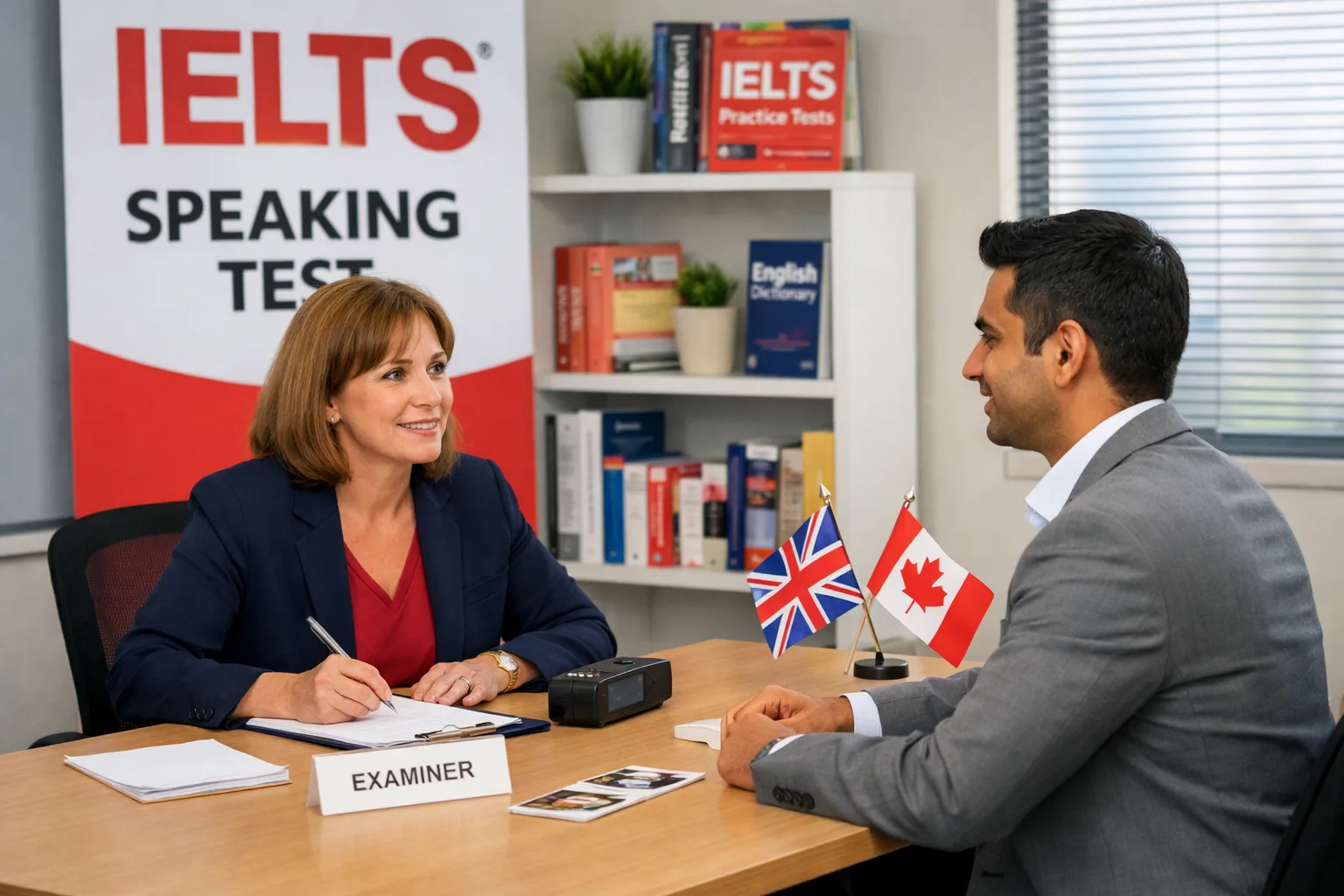
Introduction: Understanding IELTS Requirements for Professionals
In an increasingly competitive global workforce, professional qualifications alone are often not enough to secure international opportunities. Many employers, licensing authorities, universities, and immigration programs now require applicants to demonstrate their ability to communicate effectively in English. Because of this, the International English Language Testing System (IELTS) has become one of the most widely recognized ways to verify English proficiency across the world.
For professionals planning to work, study, or migrate abroad, understanding the specific requirements of the IELTS exam is essential. Unfortunately, many candidates face delays in their plans simply because they choose the wrong test type, misunderstand required scores, or fail to prepare according to official standards.
This guide offers a clear and practical explanation of IELTS requirements specifically for professionals. It highlights what you need to know before registering for the exam and explains how to avoid common mistakes that can cost time and money.
Whether you are a doctor, nurse, engineer, teacher, accountant, IT specialist, or skilled worker, this comprehensive guide will help you understand the expectations, requirements, and preparation strategies necessary to succeed in the IELTS examination.
Please read Common Mistakes to Avoid in IELTS Preparation, which can further enhance your understanding and readiness for the exam.
What Is IELTS? IELTS Exam Requirements for Professionals: Complete 2026 Guide
IELTS (International English Language Testing System) is a globally recognized English proficiency test jointly managed by British Council, IDP Australia, and Cambridge Assessment English.
It assesses a candidate’s ability in four core language skills:
- Listening
- Reading
- Writing Speaking
IELTS is accepted in 140+ countries by:
- Employers
- Professional bodies
- Universities
- Immigration authorities
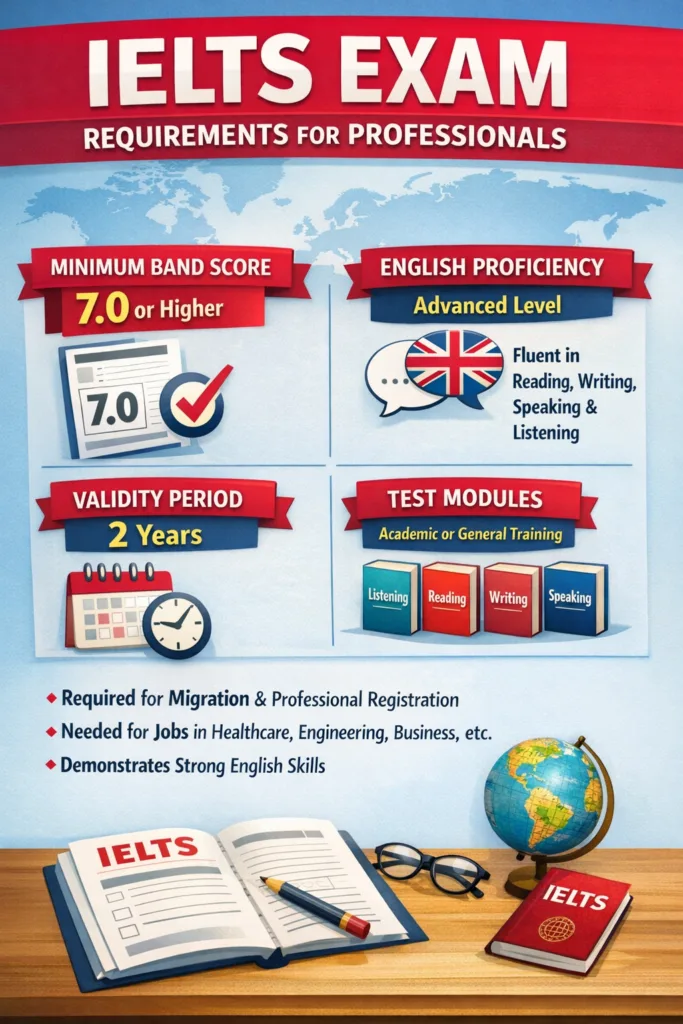
IELTS Exam Requirements for Professionals (Quick Overview)
Featured Snippet: IELTS Requirements at a Glance
| Requirement | Details |
| Minimum Age | 16 years |
| Academic Qualification | No formal degree required |
| English Background | Not mandatory |
| Valid ID | International passport or national ID |
| Test Type | Academic or General Training |
| Validity | 2 years |
| Score Range | Band 1.0 – 9.0 |
Who Needs IELTS as a Professional?
IELTS is required by professionals seeking:
- Overseas employment
- Professional licensing
- Skilled migration
- International training or certification
- Permanent residency
Common Professions That Require IELTS for IELTS Exam Requirements for Professionals: Complete 2026 Guide
- Medical doctors
- Nurses and midwives
- Engineers
- Accountants
- Teachers
- Pharmacists
- IT professionals
- Architects
- Social workers
- Skilled trades workers
IELTS Test Types: Which One Is Right for Professionals?
Choosing the wrong IELTS test type is one of the most common and costly mistakes.
IELTS Academic (For Regulated Professions)
Required for:
- Doctors
- Nurses
- Pharmacists
- Engineers
- Teachers
- University lecturers
Used by:
- Professional licensing councils
- Universities
- Regulatory bodies
IELTS General Training (For Work and Migration)
Required for:
- Skilled migration
- Work visas
- Permanent residency
Used by:
- Immigration authorities
- Employers (non-regulated roles)
Proven guides: Always confirm your required test type with your employer, licensing body, or immigration authority.
IELTS Band Score Requirements for Professionals
Different professions and countries require different band scores.
Common IELTS Score Requirements by Profession
| Profession | Typical IELTS Score |
| Doctors | 7.0 – 7.5 |
| Nurses | 7.0 |
| Pharmacists | 7.0 |
| Engineers | 6.5 – 7.0 |
| Teachers | 6.5 – 7.0 |
| Accountants | 6.5 |
| Immigration (PR) | 6.0 – 7.0 |
Some organizations require minimum scores in each module, not just an overall band.
Detailed IELTS Exam Requirements for Professionals
1. Identification Requirements
You must present:
- A valid international passport (most accepted)
- Or a government-approved national ID
The ID must:
- Match your registration details
- Be original (no photocopies)
2. Registration Requirements
Professionals must:
- Register online via British Council or IDP
- Select test type and test date
- Choose test center location
- Pay exam fee
3. IELTS Exam Fee (Varies by Country)
IELTS fees vary based on:
- Country
- Test type
- Test center
Always confirm current fees through official test partners.
4. Test Format and Duration
| Section | Duration |
| Listening | 30 minutes |
| Reading | 60 minutes |
| Writing | 60 minutes |
| Speaking | 11–14 minutes |
| Total Time | 2 hours 45 minutes |
Step-by-Step guides on How Professionals Should Prepare for IELTS
Step 1: Confirm Your Required Band Score
Check:
- Employer requirements
- Professional body guidelines
- Immigration authority rules
Step 2: Take a Diagnostic Test
Identify weaknesses in:
- Writing structure
- Listening accuracy
- Speaking fluency
- Reading speed
Step 3: Use Profession-Focused Materials
Avoid generic practice alone. Use materials that:
- Reflect professional vocabulary
- Match your test type
Step 4: Practice Time Management
IELTS is not only about English, it’s also about speed and accuracy.
Step 5: Get Expert Feedback
Especially for:
- Writing Task 1 and 2
- Speaking performance
To find out how to get the best feedback and other scholarship programs, read our article on How to Obtain Constructive Feedback for Your IELTS Preparation.
Common Mistakes Professionals Make in IELTS
- Choosing the Wrong Test Type
- Academic vs General confusion leads to rejection.
- Ignoring Module Cut-offs
- Some bodies reject results if any section is below a specific band.
- Overconfidence
- Professional success ≠ IELTS success.
- Poor Writing Strategy IELTS writing follows strict assessment criteria.
Pros and Cons of IELTS for Professionals for IELTS Exam Requirements for Professionals: Complete 2026 Guide
Advantages
- Globally recognized
- Accepted by regulators
- Clear scoring system
- Valid for 2 years
Limitations
- Expensive
- Time-bound validity – Requires focused preparation
Guides to Score High in IELTS as a Professional for IELTS Exam Requirements for Professionals: Complete 2026 Guides
- Focus on clarity, not accent
- Use simple professional English, not complex grammar
- Structure essays clearly
- Practice speaking aloud daily
- Simulate real exam conditions
IELTS vs Other English Tests (For Professionals)
IELTS vs Other English Tests (For Professionals)
| Test | Best For |
| IELTS | UK, Australia, Canada |
| TOEFL | USA-focused |
| PTE | Fast results |
| OET | Healthcare professionals |
Many healthcare bodies prefer OET, but IELTS remains more widely accepted
How IELTS Is Interpreted by Licensing Bodies (What Professionals Rarely Realize)
Most professionals assume IELTS is assessed the same way everywhere. In reality, regulatory bodies interpret IELTS scores very differently from employers or universities.
Licensing Bodies Use IELTS as a Risk-Filtering Tool
For regulated professions (medicine, nursing, engineering, teaching):
- IELTS is not just proof of English
- It is a public safety and liability filter
- Scores are used to predict:
-
Communication errors
-
Workplace misunderstandings
-
Documentation risks
-
Patient or client safety exposure
-
This is why:
- Module minimums matter more than overall band
- Writing and Speaking often carry heavier scrutiny
- Some councils reject results that employers would accept
Why this matters:
Professionals who aim “just to pass” often fail licensing, not because of weak English, but because they misunderstand how scores are evaluated. To find out how to get the best feedback and other scholarship programs in other country, read our article on Best Data Privacy Law Certification and Educational Pathways for Aspiring Privacy Lawyers in the US, Canada & UK 2026
The IELTS Module Risk Matrix for Professionals
Not all IELTS sections carry equal consequences for professionals.
High-Risk Modules by Profession
Writing
High risk for:
- Doctors
- Nurses
- Pharmacists
- Teachers
Why:
- Reports, prescriptions, lesson plans, legal records
- Poor coherence = professional liability
Speaking
High risk for:
- Healthcare
- Social work
- Teaching
Why:
- Direct client/patient interaction
- Clarity under pressure
Listening
-
High risk for:
-
Clinical and technical roles
-
-
Why:
-
Misunderstood instructions can cause real-world harm
-
Reading
-
Often underestimated
-
Critical for:
-
Engineers
-
Accountants
-
IT professionals
-
-
Why:
-
Contracts, manuals, policies, compliance documents
-
Expert insight:
Professionals should allocate preparation time based on risk, not comfort. The module you “like” least may be the one your regulator values most.
Why Professionals With Strong English Still Fail IELTS
IELTS does not test intelligence, experience, or job competence. It tests controlled communication under strict assessment criteria.
Common Hidden Failure Triggers
- Writing like a professional report instead of an IELTS response
- Overuse of technical jargon that reduces clarity
- Speaking too formally, reducing fluency scores
- Ignoring task instructions due to overconfidence
- Assuming accent reduction is required (it is not)
Key misconception:
Professional communication ≠ IELTS communication.
IELTS rewards clarity, structure, and relevance, not seniority or expertise.
The “Score Ceiling” Problem Among Professionals
Many professionals repeatedly score the same band despite multiple attempts.
Why This Happens
- Preparation focuses on practice, not diagnosis
- Weak areas are masked by strong modules
- Writing errors are structural, not grammatical
- Speaking feedback is vague or inaccurate
Breaking the Ceiling (Expert Framework)
To move from:
- 6.5 → 7.0
- 7.0 → 7.5
Professionals must:
-
Identify band descriptor gaps, not mistakes
Fix:
- Coherence logic
- Task response precision
- Lexical control (not vocabulary size)
-
Use targeted correction, not more mock tests
Why this matters:
Without this shift, repeated attempts waste money and delay migration or licensing timelines.
IELTS Validity vs Professional Timelines (A Critical Planning Issue)
IELTS validity (2 years) often clashes with real-world professional processes.
Where Professionals Get Caught Off Guard
- Licensing assessments take 6–18 months
- Migration pathways involve multiple stages
- Job offers may be delayed or conditional
Result:
- IELTS expires mid-process
- Re-sitting becomes unavoidable
Strategic Timing Model
Professionals should:
-
Sit IELTS after document verification begins
-
Align test date with:
-
Licensing application windows
-
Visa submission timelines
-
-
Avoid sitting IELTS “just to have it”
Expert warning:
Expired IELTS results are one of the most common and avoidable professional migration setbacks.
IELTS One Skill Retake: Strategic Advantage or Trap?
The IELTS One Skill Retake (OSR) option is often misunderstood.
When OSR Makes Sense
- Only one module is below requirement
- Overall band is already acceptable
- Licensing body explicitly accepts OSR
When OSR Is Risky
- Multiple weak modules
- Writing or Speaking is the issue
- Regulatory body does not recognize OSR
Professional advice:
Always confirm OSR acceptance before relying on it. Some regulators still require a full test retake.
How Immigration Authorities Weight IELTS Differently From Employers
Employers
Focus on:
- Overall communication ability
- Practical workplace interaction
Often flexible with module scores
Immigration Authorities
Use IELTS as:
- A points-based filter
- A fairness standard across applicants
-
Strict thresholds
-
No contextual consideration
Why this matters:
A score accepted by an employer may still be rejected for visa purposes. Professionals must plan for the strictest authority involved, not the most lenient.
Ethical and Compliance Considerations Professionals Should Know
IELTS results are tied to identity verification and data integrity.
Common Compliance Errors
- Using inconsistent name formats
- Passport renewal after test without update
- Sharing results without consent verification
- Submitting expired or mismatched TRFs
Consequences:
- Application delays
- Rejections
- Allegations of misrepresentation
Best practice:
Maintain a document consistency checklist from IELTS registration to final submission.
The Long-Term Career Value of a Strong IELTS Score
A high IELTS score is not just an entry requirement.
Long-Term Advantages
- Reduces re-testing across countries
- Improves employability in multinational firms
- Strengthens internal promotion prospects
- Enhances professional credibility
Professionals with strong scores often:
- Access wider job markets
- Negotiate better relocation terms
- Transition careers internationally with less friction
Final Expert Perspective: IELTS as a Career Strategy, Not an Exam
Professionals who succeed in IELTS treat it as:
- A career infrastructure tool
- A regulatory requirement
- A strategic investment
Those who fail treat it as:
- A language test
- A one-time hurdle
- An afterthought
The difference is not English ability, but informed preparation and strategic planning.
How IELTS Band Descriptors Actually Determine Professional Outcomes
Most professionals focus on scores. Examiners focus on band descriptors. This disconnect explains many unexpected results.
What Examiners Really Judge (Beyond “Good English”)
IELTS examiners assess performance strictly against public band descriptors, not effort, experience, or intention. These descriptors evaluate:
- Logical progression of ideas (not topic knowledge)
- Functional grammar accuracy (not advanced grammar)
- Precision of meaning (not vocabulary volume)
- Listener or reader effort required to understand you
This is explicitly outlined in examiner documentation used by IELTS partners (British Council; Cambridge Assessment English).
Why this matters:
Two professionals can express the same idea, but only one aligns with the descriptor language required for Band 7+ performance (Cambridge English Assessment).
The Hidden Role of Cognitive Load in IELTS Performance
IELTS is as much a cognitive stress test as a language exam.
Why High-Pressure Professionals Sometimes Underperform
Professionals are trained to:
- Process complex information
- Multitask
- Self-correct in real time
IELTS penalizes all three under time pressure.
Under exam conditions:
- Overthinking increases hesitation
- Self-correction lowers fluency scores
- Complex sentence planning increases grammatical errors
Research into standardized language testing consistently shows that time-restricted tasks amplify minor weaknesses, even in fluent speakers (IELTS Research Reports).
Professional insight:
Simpler language delivered decisively often scores higher than complex language delivered cautiously.
Country-Specific IELTS Interpretation Patterns Professionals Overlook
Although IELTS is standardized, score interpretation is not culturally neutral.
Subtle but Real Differences
-
UK & Australia
-
Heavier emphasis on Writing coherence and task fulfillment
-
-
Canada
-
Strict module cut-offs tied to immigration frameworks
-
-
New Zealand
-
Conservative acceptance for healthcare roles
-
-
Middle East employers
-
Often accept overall band flexibility for non-clinical roles
-
Immigration authorities explicitly publish IELTS equivalency frameworks linked to national language benchmarks (Government of Canada; UK Home Office).
Why this matters:
A “safe score” in one country may be insufficient or excessive in another, affecting cost, preparation time, and retake necessity.
IELTS Score Inflation vs Real Acceptance Thresholds
Some professionals aim far above required scores, believing higher is always safer.
The Overqualification Trap
Scoring significantly above requirements can:
- Delay application timelines
- Increase preparation fatigue
- Lead to score expiration before use
Regulatory bodies do not apply weighted advantage for scores beyond minimum thresholds (British Council IELTS Guidance).
Strategic rule:
Aim for requirement + 0.5 band buffer, not perfection.
IELTS Results, Verification, and the Growing Role of Digital Validation
Paper Test Report Forms (TRFs) are no longer the primary verification method.
What Professionals Must Know in 2026 and Beyond
- Most organizations now use IELTS Results Service (electronic verification)
- Direct submission reduces fraud risk
- Manual uploads may trigger secondary checks
Institutions increasingly rely on centralized verification to ensure authenticity and reduce processing delays (IELTS Official Test Partners).
Expert warning:
Failure to authorize result sharing correctly can invalidate an otherwise acceptable score.
Why IELTS Remains the Default Benchmark Despite Newer Tests
Despite alternatives, IELTS remains dominant for professionals.
Institutional Reasons (Not Marketing)
- Longitudinal performance data
- Legal defensibility in appeals
- Consistent examiner training
- Transparent public scoring criteria
These factors explain why regulators continue to rely on IELTS for high-stakes decisions affecting public safety and migration integrity (Cambridge Assessment English; British Council).
Professional Reality Check: IELTS Is a Compliance Tool, Not a Language Debate
IELTS does not measure how good your English is.
It measures whether your English is predictable, safe, and reliable in regulated environments.
That distinction explains:
- Strict cut-offs
- Module-specific requirements
- Low tolerance for ambiguity
Professionals who internalize this framework prepare more efficiently and succeed faster.
Frequently Asked Questions (FAQ) for IELTS Exam Requirements for Professionals: Complete 2026 Guide
Is IELTS compulsory for all professionals?
No. It depends on your destination country, profession, and employer.
How long is IELTS valid?
IELTS results are valid for 2 years.
Can I retake IELTS if I fail?
Yes. There is no limit to the number of attempts.
Is IELTS difficult for professionals?
It is manageable with structured preparation and understanding of exam criteria.
Can IELTS be used for job applications?
Yes. Many employers require IELTS as proof of English proficiency.
Conclusion: IELTS Success Starts with the Right Information
Understanding the IELTS exam requirements for professionals is the first and most critical step toward international career success. With the right test type, accurate score targets, and strategic preparation, IELTS becomes a gateway, not a barrier.
Professionals who succeed in IELTS are not necessarily better English speakers, but better-prepared candidates.
Call to Action
Download the full stack explained IELTS Exam Requirements for Professionals (2026 Guide) PDF.
- British Council (IELTS Official Guidance)
- Cambridge Assessment English
- Government of Canada (Language Benchmark Frameworks)
- UK Home Office (Immigration Language Requirements)
Written by Massodih Okon, Senior Exam Preparation Researcher and Academic Education Content Specialist with over 10 years of experience developing high-impact learning resources aligned with Nigerian and international examination standards. Reviewed and updated: 2026. Based on official and verified data.
About the Author
Massodih Okon is an experienced educator, researcher, and digital publishing professional with a strong academic and practical background. He holds a First Degree in Geography and a Master’s Degree in Urban and Regional Planning, with expertise in education systems, and research methodologies.
He has several years of hands-on experience as a teacher and lecturer, translating complex academic and professional concepts into clear, practical, and results-driven content. Massodih is also a professional SEO content strategist and writer. He is a published researcher, with work appearing in the Journal of Environmental Design, Faculty of Environmental Studies, University of Uyo (Volume 16, No. 1, 2021), P. 127-134. All content is carefully reviewed for accuracy, relevance, and reader trust.
Related Posts
- Canada Scholarships for Nigerian Students Full Guide 2026
- Fully Funded Scholarships for Nigerian Students 2026 Guide
- Germany Scholarships for International Students: The Ultimate 2026 Guide
- Data Science Courses with Certificates: The Complete 2026 Guide for Beginners
- Cloud Computing Courses Online: The Complete Expert Guide For 2026
- Insurance vs Risk Management Salary in Nigeria and Abroad: Careers, Jobs & Professional Certifications
- Law vs Medicine: Which Career Pays More After 10 Years in Nigeria and Abroad?
- JAMB Mathematics Topic Repetition Index (2016–2025): Data-Based Exam Trend Analysis