
Introduction to JAMB Cut-Off Mark for Nursing 2026: Requirements, How Much Score Is Needed & Salary Guide
If you are searching for the JAMB Cut-Off Mark for Nursing 2026: Requirements, How Much Score Is Needed & Salary Guide, you are already thinking seriously about your future. Nursing is one of the most competitive health science courses in Nigeria. Therefore, understanding the exact score you need, how universities calculate merit, and what salary prospects look like will give you a real advantage.
Every year, thousands of candidates apply for Nursing through the Joint Admissions and Matriculation Board (JAMB). However, only a small percentage secure admission. Consequently, many students miss admission not because they are not intelligent, but because they do not understand how cut-off marks truly work. JAMB Cut-Off Mark for Nursing 2026: Requirements, How Much Score Is Needed & Salary Guide.
In this guide, I will explain:
- The approved JAMB cut-off mark for Nursing 2026
- University-specific Nursing cut-off trends
- O’Level and subject requirements
- Post-UTME scoring strategies
- Salary outlook in Nigeria, UK, US, Canada, Australia and beyond
- International equivalents and global opportunities
If you are serious about admission, also read our detailed breakdown on JAMB Score Calculation Explained 2026 to understand how each question carries marks and how universities compute aggregates.
What Is the JAMB Cut-Off Mark for Nursing 2026?
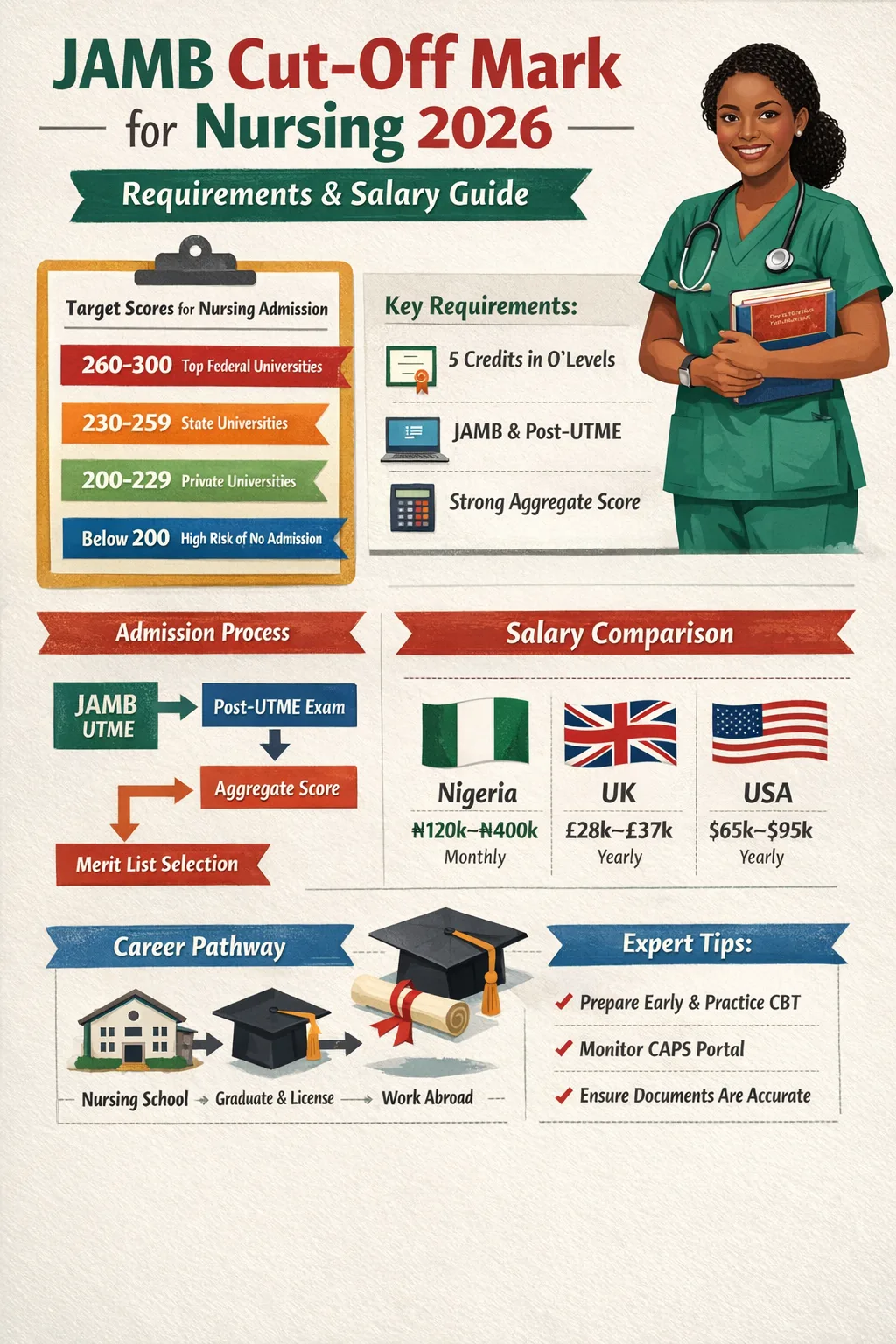
The JAMB cut-off mark for Nursing 2026 is expected to remain between 180 and 200 as the general minimum benchmark. However, competitive universities usually require 220–280+ for merit consideration.
Official Benchmark Policy
JAMB sets a national minimum cut-off mark yearly. Universities then decide their departmental cut-off based on:
- Number of applicants
- Available admission quota
- Performance statistics
- Federal admission guidelines
Although JAMB may approve 180 as the baseline, top federal universities rarely admit Nursing candidates below 240.
For better preparation strategy, also study our guide on JAMB Registration Fee 2026: Cost & Requirements so you do not make costly registration errors.
Why Nursing Cut-Off Marks Are Always High
Nursing remains competitive for five key reasons:
- High employment demand in Nigeria and abroad
- Global recognition of Nigerian nurses
- Strong salary prospects
- Migration pathways to UK, US, Canada, Australia
- Limited accreditation slots per university
The Nursing and Midwifery Council of Nigeria regulates accreditation capacity. Therefore, schools cannot admit unlimited students.
If you want to understand subject combinations, see our article on Cost of Studying Medicine in Nigeria, USA, and UK With Scholarships
JAMB Subject Combination for Nursing 2026
You must register the correct four subjects:
- English Language (compulsory)
- Biology
- Chemistry
- Physics
Wrong subject combination automatically disqualifies candidates, even with high scores.
Also review our guide on WAEC and NECO Requirements for Nursing to confirm O’Level standards.
O’Level Requirements for Nursing: JAMB Cut-Off Mark for Nursing 2026: Requirements, How Much Score Is Needed & Salary Guide
You need at least five credits in:
- English Language
- Mathematics
- Biology
- Chemistry
- Physics
Most universities require results in not more than two sittings. However, some top schools prefer one sitting for merit lists.
Realistic Score You Should Target in 2026
Although 180 is the general cut-off, you should realistically target:
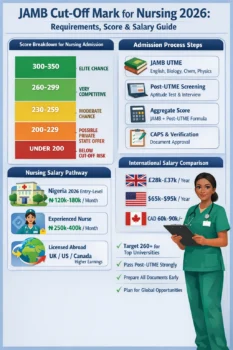
- 250+ for federal universities
- 230+ for strong state universities
- 200–220 for private universities
My Professional Recommendation
From experience advising candidates over the years, students who score above 260 rarely struggle with admission if their O’Level grades are strong.
However, students scoring 220 often depend heavily on Post-UTME performance.
How Universities Calculate Nursing Aggregate
Most schools use this formula:
Aggregate = (JAMB score ÷ 8) + (Post-UTME score ÷ 2)
Example:
- JAMB: 260 → 32.5
- Post-UTME: 80 → 40
- Aggregate: 72.5
Each school differs slightly. Therefore, always confirm on the official portal.
Also read our detailed guide on How to Score 300+ in JAMB for strategic preparation tips.
Post-UTME Strategy for Nursing Candidates
To increase your admission chances:
- Start practicing CBT immediately after JAMB
- Revise Biology and Chemistry deeply
- Focus on time management
- Study past departmental cut-off trends
- Avoid overconfidence
Candidates who ignore Post-UTME often lose admission despite high JAMB scores.
Salary Guide for Nurses in Nigeria (2026 Outlook)
Entry-Level Salary
Government hospitals: ₦120,000 – ₦180,000 monthly
Private hospitals: ₦80,000 – ₦150,000 monthly
Teaching hospitals: ₦150,000 – ₦220,000 monthly
Senior-Level Salary
- ₦250,000 – ₦400,000 monthly in federal institutions
However, salary depends on grade level and years of experience.
Global Salary Comparison
| Country | Average Annual Salary |
|---|---|
| UK | £28,000 – £37,000 |
| US | $65,000 – $95,000 |
| Canada | CAD 60,000 – 90,000 |
| Australia | AUD 65,000 – 95,000 |
| Germany | €35,000 – €55,000 |
| Switzerland | CHF 70,000+ |
| New Zealand | NZD 60,000+ |
| Singapore | SGD 40,000+ |
| Scandinavia | Competitive national scales |
Therefore, many Nigerian nurses migrate after gaining experience.
How Nigerians Abroad Can Study Nursing Through JAMB Pathway
If you are living in the UK, US, Canada, Germany or Australia but want Nigerian admission:
- Register JAMB at approved foreign centres
- Write UTME abroad
- Upload O’Level credentials early
- Monitor admission through CAPS
However, ensure your secondary school results meet Nigerian equivalency requirements.
For International Students Seeking Nursing in Nigeria
International applicants must:
- Present equivalent secondary education certificates
- Meet Biology, Chemistry and Physics requirements
- Apply through the university’s international admission office
Nigeria offers affordable tuition compared to the UK, US, Canada and Australia.
UK/US Admission Equivalents: JAMB Cut-Off Mark for Nursing 2026: Requirements, How Much Score Is Needed & Salary Guide
If you plan to relocate:
- UK requires UCAS application and IELTS
- US may require SAT or ACT depending on institution
- Canada requires English proficiency tests
- Australia uses ATAR equivalency
Although admission systems differ, your Nigerian Nursing degree remains recognized after licensing exams.
Common Mistakes Nursing Applicants Make
- Choosing wrong subject combination
- Scoring below 220 and expecting federal admission
- Ignoring Post-UTME preparation
- Uploading O’Level late
- Not monitoring CAPS regularly
Avoid these errors to protect your chances.
Pros and Cons of Studying Nursing
Pros
- Global mobility
- High job demand
- Career stability
- Specialization opportunities
Cons
- Competitive admission
- Physically demanding profession
- Licensing exams required abroad
Expert Best Practices for 2026 Admission
- Target 260+ in JAMB
- Practice CBT daily
- Keep two university options ready
- Monitor official announcements
- Maintain strong O’Level grades
Consistency matters more than last-minute reading.
Admission Quota Reality: Understanding the NMCN Bottleneck
One of the least discussed realities about Nursing admission is institutional quota control by the Nursing and Midwifery Council of Nigeria (NMCN).
Each university receives a fixed accreditation capacity based on:
- Clinical training facilities
- Tutor-to-student ratio
- Laboratory equipment standards
- Teaching hospital partnerships
This means even if 3,000 candidates score above 250, a school accredited for 120 students cannot exceed that number.
Why This Matters
High scores do not compete against “average students.”
They compete against a limited, regulated seat count.
Strategically, this means:
- Always apply to at least one less competitive but accredited institution.
- Monitor NMCN accreditation updates yearly.
- Avoid institutions under probationary review.
Quota awareness is often the hidden factor separating admitted candidates from disappointed ones.
The Nursing Competitiveness Index (NCI): A Smarter Admission Prediction Model
Instead of guessing your chances, use this simple expert framework:
Step 1: Score Positioning
- 260+ → High Merit Tier
- 240–259 → Competitive Tier
- 220–239 → Conditional Tier
2: School Demand Level
- Tier A (Top Federal)
- Tier B (Established State)
- Tier C (Private / Emerging)
3: Combine Both Variables
If you are:
- Competitive Tier + Tier A School → High Post-UTME dependency
- High Merit Tier + Tier B School → Strong probability
- Conditional Tier + Tier A → High risk
This framework helps you think statistically, not emotionally.
Clinical Training Capacity: The Silent Determinant of Cut-Off Spikes
Cut-off marks rise sharply in years when:
- Teaching hospitals limit student intake
- Clinical rotation slots reduce
- Internship backlogs increase
Nursing is not purely classroom-based. Universities must secure:
- Maternity ward exposure
- Pediatric rotations
- Community health placements
- Surgical ward training
When clinical capacity tightens, cut-off marks automatically increase to reduce admission numbers.
Expert Insight
Track teaching hospital stability.
Schools linked to strong federal medical centers typically maintain consistent intake numbers.
One Sitting vs Two Sittings: The Merit Ranking Effect
Many candidates assume two sittings are equal to one sitting. Technically, some schools allow both.
However, in merit ranking:
- Candidates with one sitting and strong grades often rank higher.
- Some departments unofficially prioritize single-sitting distinctions for Nursing.
Why?
Nursing demands academic precision. Admissions panels often interpret single-sitting results as consistency under pressure.
If you are planning a retake, consider upgrading strategically before applying to highly competitive institutions.
Post-Admission Screening Beyond Scores
After meeting cut-off requirements, some institutions conduct:
- Physical fitness screening
- Medical tests
- Character verification
- Age compliance checks
Nursing is physically demanding and patient-facing. Schools may quietly screen for:
- Chronic health conditions
- Severe communication barriers
- Documentation inconsistencies
Practical Advice
Keep your:
- Birth certificate consistent
- Medical fitness certificate ready
- O’Level details accurate across portals
Small inconsistencies have delayed admissions in past cycles.
Nursing vs Other Health Courses: Risk–Reward Comparison
Many candidates list Nursing alongside:
- Medicine
- Pharmacy
- Medical Laboratory Science
However, from a strategic admission standpoint:
| Course | Admission Risk | Migration Speed | Financial Stability |
|---|---|---|---|
| Medicine | Extremely High | Slower (long training) | High |
| Pharmacy | High | Moderate | High |
| Nursing | High but Flexible | Faster pathway | Stable |
Nursing often provides quicker global mobility compared to longer medical tracks.
This makes it uniquely attractive in competitive admission cycles.
International Licensing Reality After Nigerian Degree
A Nigerian Nursing degree does not automatically grant foreign practice rights.
You must pass licensing exams such as:
- Nursing and Midwifery Council (UK CBT & OSCE)
- National Council of State Boards of Nursing (NCLEX-RN)
What Strong Admission Scores Signal
Students admitted through highly competitive programs often:
- Perform better in international exams
- Adapt faster to structured healthcare systems
- Secure foreign sponsorship earlier
High entry standards indirectly influence long-term global mobility.
The Financial Planning Blueprint for Nursing Students
Beyond admission, plan for:
- Clinical uniform expenses
- Professional registration fees
- Induction ceremonies
- Licensing registration after graduation
Many students underestimate these structured costs.
Smart Financial Preparation Checklist
- Save before resumption
- Budget for hospital equipment kits
- Prepare for final-year indexing fees
Financial readiness reduces stress during clinical years.
Psychological Preparedness: The Overlooked Admission Edge
Nursing programs experience:
- High academic pressure
- Intense clinical exposure
- Emotional patient encounters
Universities sometimes observe candidate maturity during screening phases.
Self-Assessment Questions
- Can you handle night shifts during training?
- Are you emotionally stable under medical emergencies?
- Can you work in hierarchical teams?
Admission is not only academic. It is suitability-based.
Data-Driven Strategy for 2026 Applicants
To maximize admission probability:
- Analyze three-year historical cut-off trends.
- Compare your mock UTME scores with past merit lists.
- Simulate aggregate calculation early.
- Keep a secondary course backup in JAMB portal.
- Avoid late change-of-institution panic decisions.
Why This Approach Works
Candidates who treat admission like a data-driven project outperform those relying on hope.
Nursing admission is competitive but predictable when approached strategically.
Position yourself not just to meet the cut-off, but to outperform the competition with calculated precision.
State of Origin Advantage and Catchment Area Strategy
One rarely discussed factor in Nursing admission is federal character and catchment considerations.
Federal universities may categorize candidates into:
- Merit list
- Catchment area list
- Educationally less developed states (ELDS) list
If you are applying outside your geopolitical zone, understand that:
- Cut-off marks for non-catchment candidates are often higher
- Merit-only competition becomes more intense
Strategic Implication
If your score is 235–245, applying within your catchment zone may significantly increase admission probability compared to targeting an oversubscribed institution outside your region.
Admission is not purely academic; it is also structurally distributed.

Age Sensitivity in Nursing Admission
Although not publicly emphasized, age can influence competitive courses like Nursing.
Most institutions prefer candidates within a certain maturity bracket, typically:
-
16–24 years for undergraduate entry
Older candidates are not disqualified. However:
- Clinical intensity requires physical stamina
- Long academic gaps may be scrutinized
Why This Matters
If you have a study gap:
- Be prepared to explain it clearly during screening.
- Ensure your academic records show recent intellectual engagement.
Prepared candidates anticipate institutional expectations.
The Impact of UTME Question Distribution Patterns
Many candidates prepare broadly but ignore question weighting trends.
Historically:
- Biology carries the most scoring leverage for Nursing aspirants.
- Chemistry often separates high scorers from average candidates.
- Physics performance affects aggregate positioning significantly.
Tactical Preparation Insight
A 10-mark improvement in Chemistry can shift you from 238 to 248, enough to move from borderline to competitive.
Serious candidates analyze subject-level weaknesses months before the exam, not weeks.
Private Universities: The Hidden Competitive Advantage
Private institutions are often overlooked due to tuition costs.
However, advantages include:
- Stable academic calendar
- Lower aggregate volatility
- Smaller clinical batches
- Less admission uncertainty
For candidates scoring 210–230, private universities may provide:
- Faster graduation timeline
- Better student-to-lecturer ratio
- Reduced admission anxiety
When evaluated long-term, stability sometimes outweighs prestige.
Deferred Admission Risk: What Most Candidates Ignore
Some candidates meet cut-off marks but lose admission due to:
- Incomplete document uploads
- CAPS acceptance delays
- Incorrect subject combination at verification stage
- Failure to accept admission within stipulated deadlines
Professional Advice
Once offered admission:
- Accept immediately on CAPS.
- Print evidence.
- Confirm department clearance instructions.
- Track resumption notices weekly.
Admission can be reversed for administrative negligence.
Nursing Specializations and Long-Term Career Scaling
Your admission score is only the beginning.
After graduation, specialization areas include:
- Pediatric Nursing
- Psychiatric Nursing
- Community Health Nursing
- Perioperative Nursing
- Critical Care Nursing
Higher-performing students during undergraduate studies are more likely to:
- Secure postgraduate sponsorships
- Gain leadership roles
- Transition into academic Nursing
Admission competitiveness correlates with long-term professional trajectory.
The Transfer Myth: Why Switching Into Nursing Is Difficult
Some candidates plan to:
- Gain admission into another health course
- Later transfer internally into Nursing
In reality, this is extremely rare.
Reasons include:
- Accreditation seat limits
- Clinical capacity restrictions
- Regulatory constraints
Nursing departments rarely have surplus slots to absorb transfers.
If Nursing is your goal, pursue it directly from the start.
How Admission Trends Shift During Economic Downturns
Economic conditions influence Nursing competition.
During periods of:
- Currency instability
- High unemployment
- Increased migration interest
Applications to Nursing typically increase.
Why?
Because Nursing provides:
- Stable income
- International mobility
- Structured professional growth
When economic pressure rises, cut-off marks often trend upward due to application surge.
Serious candidates monitor national economic patterns alongside academic preparation.
Ethical and Professional Suitability Screening
Nursing is ethics-driven.
Institutions increasingly emphasize:
- Professional conduct
- Respectful communication
- Background credibility
Cases of falsified results or inconsistent identity details can lead to:
- Immediate withdrawal
- Reporting to regulatory authorities
Protect Your Admission
- Use authentic documents only
- Ensure name consistency across all records
- Correct affidavit discrepancies before screening
Integrity is non-negotiable in healthcare professions.
Long-Term Return on Academic Excellence in Nursing
High entry performance creates ripple effects:
- Strong academic confidence
- Better internship placement
- Increased foreign recruitment visibility
- Competitive postgraduate admission
Students admitted with marginal scores often struggle under program intensity.
Students admitted with strong academic foundations adapt faster and outperform consistently.
Final Strategic Perspective
Do not aim to “just meet” the cut-off.
Aim to dominate it.
In competitive courses like Nursing, margin determines outcome and outcome determines future mobility.
The Second-Choice Illusion: Why Nursing Rarely Favors Backup8 Placement
Many candidates list Nursing as a second-choice course, assuming they can secure it if their first choice fails.
In reality, most universities:
- Prioritize first-choice candidates for competitive courses
- Fill Nursing quotas before reviewing second-choice lists
- Restrict departmental changes once merit lists close
Strategic Reality
If Nursing is your priority, make it your first choice.
Using it as a fallback strategy significantly reduces your probability in high-demand institutions.
Change of Institution Timing: When It Helps and When It Harms
Some candidates panic after seeing their UTME score and immediately change institutions.
This can be strategic but only if data-driven.
Smart Change Conditions
- Your score falls within historical cut-off range of the new school
- The school has stable accreditation status
- You switch early before Post-UTME deadlines
Risky Change Behavior
- Switching to another highly competitive federal university
- Changing after Post-UTME registration closes
- Following social media rumors instead of official notices
Late emotional decisions reduce admission predictability.
Merit List Psychology: Why 1–3 Marks Make Massive Differences
In competitive Nursing programs, aggregate rankings are tightly packed.
Example scenario:
- Candidate A: 71.8 aggregate
- Candidate B: 72.3 aggregate
That 0.5 difference may determine final admission slot.
What This Means
Every single mark matters.
- One extra correct Chemistry answer
- One additional Post-UTME improvement
- One upgraded O’Level distinction
Small margins create large outcomes in merit-based systems.
The Role of English Proficiency in Screening Performance
Although Nursing focuses heavily on sciences, English proficiency subtly influences admission success.
Why?
- Post-UTME comprehension passages affect scores
- Interview-based screenings test communication clarity
- Clinical training requires patient interaction
Candidates with weak written or spoken communication sometimes underperform despite strong science scores.
Competitive Edge Tip
Practice:
- Timed reading comprehension
- Clear written responses
- Structured verbal explanation
Healthcare professionals must communicate effectively, admission panels recognize this early.
Urban vs Rural University Advantage in Nursing Admission
Location influences competition intensity.
Urban-based federal universities often experience:
- Higher applicant volumes
- Increased cut-off marks
- Greater merit pressure
Meanwhile, some state universities in less populated regions may:
- Have moderate cut-off thresholds
- Maintain strong accreditation
- Offer smaller batch sizes
Prestige matters but admission probability also matters.
Balancing both strategically increases success odds.
The Repeat Candidate Advantage (If Used Correctly)
Candidates rewriting UTME often feel disadvantaged.
However, repeat candidates who:
- Analyze previous score breakdown
- Correct subject weaknesses
- Improve CBT familiarity
Frequently outperform first-time applicants.
Expert Observation
Second attempts with structured strategy often produce 20–40 mark improvements.
The key difference is intentional preparation, not repetition alone.
CAPS Monitoring Discipline: A Competitive Habit
Many candidates prepare academically but neglect admission portal discipline.
On the JAMB Central Admission Processing System (CAPS), delays in:
- Accepting admission
- Responding to transfer proposals
- Updating O’Level results
Can result in losing a slot.
Best Practice Routine
- Log into CAPS weekly during admission season
- Use a stable internet connection
- Screenshot important status changes
Administrative awareness is part of admission strategy.
Early Preparation vs Last-Minute Intensity: Outcome Patterns
High-performing Nursing candidates typically:
- Begin preparation 6–9 months before UTME
- Complete at least two full syllabus revisions
- Practice 10–15 CBT simulations
Last-minute cramming often produces:
- Score volatility
- Weak Chemistry performance
- Time-management errors
Admission consistency comes from long-term preparation cycles.
Admission Year Variability: Why Cut-Off Marks Fluctuate
Cut-off marks are not fixed constants.
They fluctuate based on:
- National UTME performance averages
- Increase in Nursing application volume
- Institutional quota adjustments
- Policy directives from educational authorities
One year may see 240 sufficient for merit; another year may require 255+.
Strategic Advice
Do not rely solely on last year’s cut-off.
Aim above historical averages to buffer against upward shifts.
Professional Identity Begins at Admission
Nursing is not just a course, it is a regulated profession.
From admission stage onward, you are entering:
- Ethical accountability
- Patient safety responsibility
- Structured professional discipline
Candidates who approach admission casually often struggle with professional standards later.
High-Impact Insight
Think beyond gaining admission.
Think in terms of:
- Professional competence
- Long-term mobility
- Ethical credibility
- Global readiness
Admission is the gateway but your mindset determines how far the Nursing profession will take you.
People Also Ask (FAQ)
What is the minimum JAMB score for Nursing in 2026?
Minimum benchmark is 180–200, but competitive admission requires 230–280+.
Can I study Nursing with 200 in JAMB?
Yes, mainly in some state or private universities. However, federal universities usually require higher scores.
Does Nursing require Mathematics?
Yes. Mathematics credit is compulsory in O’Level.
Is Nursing profitable in Nigeria?
Yes. Although starting salaries vary, career growth and foreign opportunities increase earning potential.
Can I migrate after studying Nursing in Nigeria?
Yes. However, you must pass licensing exams in the UK, US, Canada, Australia or other destination countries.
Backlog of Recommended Study Guides
To strengthen your admission chances, also read:
- JAMB Past Questions for Nursing
- Biology Strategy Guide for UTME
- Chemistry Calculation Masterclass
- Post-UTME Success Blueprint
- How to Upload O’Level on CAPS Correctly
Building subject mastery improves confidence and performance.
Conclusion: What You Should Do Now
The JAMB Cut-Off Mark for Nursing 2026: Requirements, How Much Score Is Needed & Salary Guide clearly shows that scoring the minimum is not enough. Instead, aim higher, prepare smarter and understand admission calculations early.
If you are serious about securing Nursing admission in 2026, start preparing today. Also read our complete guide on JAMB Admission Requirements 2026 to avoid common mistakes that cost students a full academic year.
Your preparation today determines your admission tomorrow.
Written by Massodih Okon, Senior Exam Preparation Researcher and Academic Education Content Specialist with over 10 years of experience developing high-impact learning resources aligned with Nigerian and international examination standards. Reviewed and updated: 2026.
About the Author
Massodih Okon is an experienced educator, researcher, and digital publishing professional with a strong academic and practical background. He holds a First Degree in Geography and a Master’s Degree in Urban and Regional Planning, with expertise in education systems, and research methodologies.
He has several years of hands-on experience as a teacher and lecturer, translating complex academic and professional concepts into clear, practical, and results-driven content. Massodih is also a professional SEO content strategist and writer. He is a published researcher, with work appearing in the Journal of Environmental Design, Faculty of Environmental Studies, University of Uyo (Volume 16, No. 1, 2021), P. 127-134. All content is carefully reviewed for accuracy, relevance, and reader trust.
RELATED POST
- IELTS Exam Requirements for Professionals: Complete 2026 Guide
- Fully Funded Scholarships for Nigerian Students (2026 Guide)
- JAMB Success Strategies for Science Students in Nigeria: Best Requirements & JAMB Registration Portal
- JAMB Mathematics Revision Notes: The Most Complete, Exam-Focused Guide for 2026 Candidates
- JAMB Cut-off Marks for All Universities (2026 Guide)
- UniUyo Cut-Off Marks for All Courses (2026 Complete Guide)
- JAMB Marking Scheme Explained for 2026 Candidates
- JAMB Cut-Off Mark for Medicine in Nigeria (2026 Complete Guide)
- Germany Scholarships for International Students: The Ultimate 2026 Guide
- National Examination Trends and Policy Changes in Nigeria (2010–2025)