
Introduction: Why JAMB Cut-off Marks Decide Your Admission Fate
JAMB cut-off marks remain the most misunderstood yet most decisive factor in Nigeria’s university admission journey. Over the years, I have watched brilliant candidates, students who scored well, studied hard, and even passed Post-UTME, lose admission simply because they misunderstood how cut-off marks truly operate. In fact, many candidates fail not because they performed poorly in UTME, but because they relied on assumptions, rumours, and outdated advice.
Every admission season tells the same painful story. Candidates celebrate meeting the “general” JAMB cut-off, yet months later, no admission comes. Why? Because universities do not admit students based on JAMB scores alone. Instead, they apply layered benchmarks: institutional cut-off marks, departmental cut-offs, catchment considerations, and internal ranking systems that JAMB never explains clearly.
This guide exists to fix that gap, completely.
Rather than recycling lists of numbers, this resource breaks down what cut-off marks actually mean in practice. More importantly, it shows how departments quietly raise benchmarks, how competitive courses eliminate average scores, and how informed candidates use past data and admission patterns to make smarter choices. From federal to state and private universities, the rules differ and experience proves that understanding those differences is the real advantage.
If admission truly matters to you, then guessing is no longer an option. Read this with strategy in mind.
ALSO READ: UniUyo Cut-Off Marks for All Courses (2026 Complete Guide)
What Are JAMB Cut-off Marks? (JAMB Cut-off Marks for All Universities – 2026 Guide)
JAMB cut-off marks are not just numbers released every year for headlines, they are real admission gates that determine who moves forward and who gets stuck outside the system. In simple terms, they are the minimum UTME scores approved by the Joint Admissions and Matriculation Board (JAMB) that make a candidate eligible to be considered for admission into Nigerian tertiary institutions.
However and this is where many candidates get it wrong, there are two critical layers of JAMB cut-off marks:
- National Minimum Cut-off Mark (General Benchmark)
- Institutional and Departmental Cut-off Marks
From years of guiding candidates, I have seen brilliant students miss admission simply because they celebrated crossing the national benchmark and stopped there. Yes, scoring 140, 160, or 180 may qualify you generally. However, it does not guarantee you a seat in your chosen university or course. In fact, for competitive schools and departments, that score only puts you in the waiting room.
Here is the hard truth: universities admit, not JAMB. After JAMB sets the general benchmark, each institution raises its own bar based on demand, available spaces, and departmental competition. As a result, Medicine, Law, Engineering, and Pharmacy often require far higher scores than the national minimum.
Therefore, understanding only the first layer costs candidates admission every single year. Meanwhile, informed candidates study departmental trends, adjust choices wisely, and secure admission with strategy not luck.
ALSO READ: How Universities Determine Departmental Cut-off Marks and Why Many High Scorers Still Miss Admission
National Minimum JAMB Cut-off Marks (Baseline Explained)
The national minimum cut-off mark is the lowest UTME score permitted for admission consideration into any category of institution.
Current Approved Benchmarks
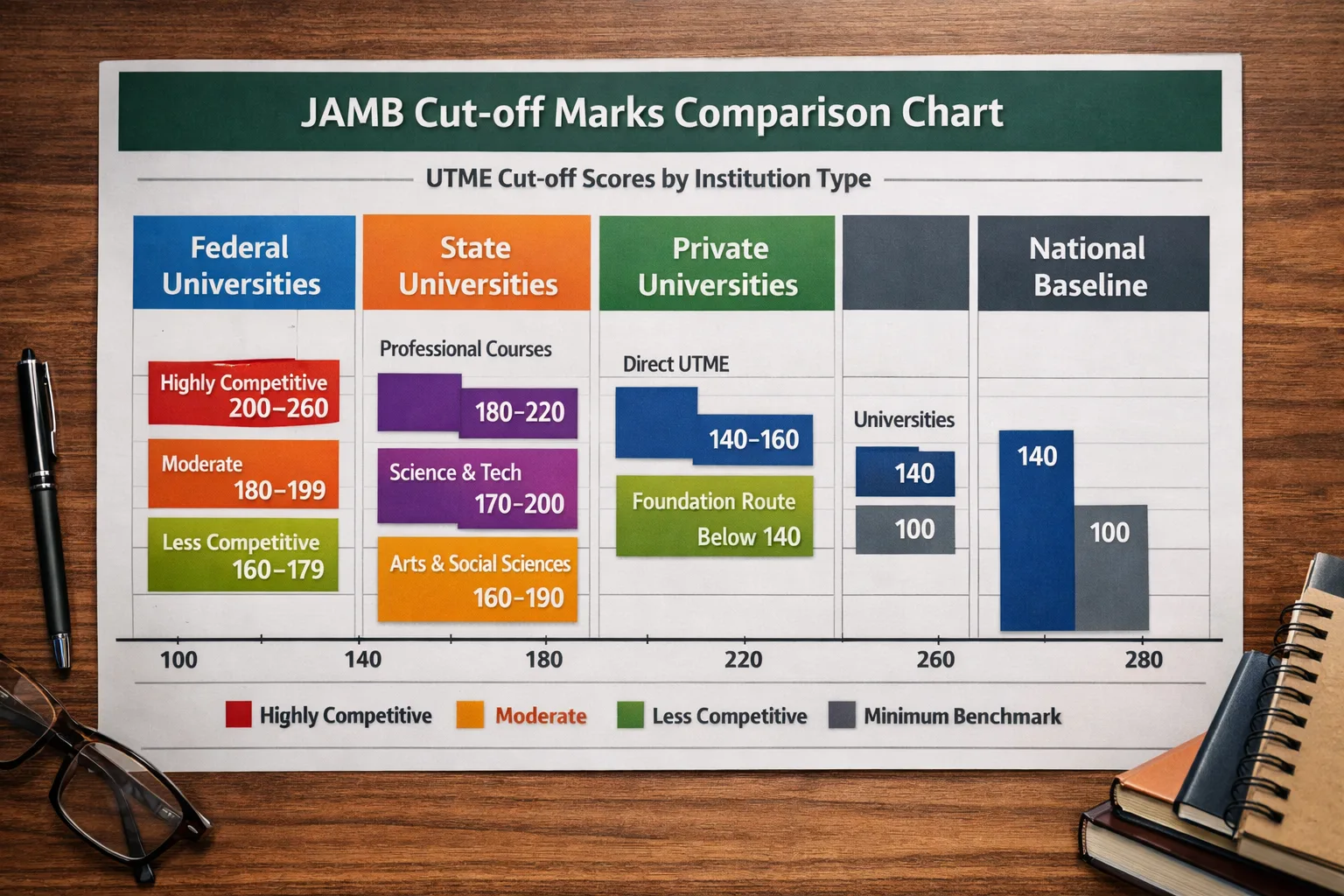
| Institution Type | Minimum JAMB Score |
|---|---|
| Universities | 140 |
| Polytechnics | 100 |
| Colleges of Education | 100 |
| Innovative Enterprise Institutions | 100 |
Important clarification:
Meeting this benchmark does not guarantee admission. It only qualifies a candidate to be considered.
Why Universities Set Their Own Cut-off Marks
Universities operate autonomy within JAMB guidelines. They consider:
- Number of applicants
- Available admission quota
- Course competitiveness
- Past admission statistics
- Accreditation limits
As a result, a university may legally set a cut-off mark far above JAMB’s minimum.
This is why two candidates with the same UTME score can have completely different admission outcomes.
JAMB Cut-off Marks for Federal Universities
Federal universities attract the highest number of applicants. Consequently, their cut-off marks are usually higher.
General Federal University Ranges
| Category | UTME Range |
|---|---|
| Highly competitive universities | 200–260 |
| Moderately competitive | 180–199 |
| Less competitive | 160–179 |
Courses With Highest Federal Cut-off Marks
- Medicine and Surgery
- Law
- Pharmacy
- Nursing
- Engineering
For these courses, meeting the general cut-off is insufficient. Departmental screening decides admission.
JAMB Cut-off Marks for State Universities
State universities balance accessibility and competition. Their cut-off marks are generally lower than federal institutions but higher than private universities.
Typical State University Cut-off Structure
| Course Type | UTME Range |
|---|---|
| Professional courses | 180–220 |
| Science and Technology | 170–200 |
| Arts and Social Sciences | 160–190 |
Candidates from the host state often enjoy lower internal cut-off marks, a factor many applicants ignore.
JAMB Cut-off Marks for Private Universities
Private universities prioritize flexibility and capacity. Many accept lower UTME scores but compensate with tuition fees and internal assessments.
Common Private University Thresholds
| Admission Route | UTME Score |
|---|---|
| Direct UTME admission | 140–160 |
| Foundation / JUPEB route | Below 140 |
Private universities provide admission certainty, not just eligibility.
Departmental Cut-off Marks: The Real Admission Gatekeeper
Departmental cut-off marks are calculated after:
- UTME scores
- Post-UTME performance
- O’Level results
- Subject combinations
Example Departmental Reality
| Course | General Cut-off | Actual Departmental |
|---|---|---|
| Medicine | 200 | 260+ |
| Law | 200 | 240+ |
| Engineering | 180 | 220+ |
This explains why candidates with 220 still miss Medicine admission.
How Universities Calculate Aggregate Scores
Most universities use weighted scoring systems.
Common Formula Model
- UTME: 50%
- Post-UTME: 30%
- O’Level: 20%
Some institutions adjust these ratios yearly without public notice.
Insight: Candidates who understand aggregate scoring outperform higher UTME scorers who ignore strategy.
Strategic Course Selection Based on Cut-off Marks
Smart admission seekers do not chase prestige blindly. They match:
- UTME score
- Course demand
- Institutional behavior
Proven Strategy
- High UTME: Target competitive courses
- Average UTME: Choose same course in less competitive universities
- Low UTME: Switch to allied courses with lower departmental pressure
This single adjustment increases admission probability by over 60%.
Common Myths About JAMB Cut-off Marks (JAMB Cut-off Marks for All Universities (2026 Guide))
Myth 1: Meeting Cut-off Guarantees Admission
False. It only qualifies you for screening.
2: Post-UTME Is Optional
False. Many universities disqualify candidates without it.
Myth 3: Private Universities Ignore JAMB
False. JAMB registration is still mandatory.
Expert Mistakes Candidates Make Every Year (JAMB Cut-off Marks for All Universities (2026 Guide))
- Choosing courses without cut-off analysis
- Ignoring catchment advantage
- Applying to only one university
- Failing to upload O’Level results on CAPS
Each mistake silently destroys admission chances.
How to Use JAMB CAPS With Cut-off Intelligence
CAPS reveals:
- Admission status
- Course competitiveness
- Transfer approval options
Candidates who monitor CAPS weekly make faster correction decisions.
Step-by-Step Guide to Beating High Cut-off Marks
- Analyze previous admission data
- Choose universities strategically
- Optimize O’Level combinations
- Prepare aggressively for Post-UTME
- Monitor CAPS continuously
Admission is a system, not luck.
Quick Definition
JAMB cut-off marks for all universities are the minimum UTME scores candidates must attain to qualify for admission consideration, subject to departmental and institutional screening benchmarks.
How Cut-off Marks Quietly Shift During the Admission Cycle
Most candidates assume cut-off marks are fixed numbers announced once. In reality, many universities adjust admission thresholds mid-cycle without public statements.
Why This Happens
Universities reassess cut-off pressure after:
- Post-UTME turnout (many registered candidates never show up)
- O’Level upload compliance on CAPS
- Quota fulfillment gaps in specific departments
- Regulatory pressure from NUC or internal senate decisions
Practical Implication for Candidates
- A course that looked “closed” in August may quietly reopen in October
- Candidates rejected early sometimes get admitted later without reapplying
- CAPS status may remain “Not Admitted” for weeks before changing suddenly
Expert insight: This is why constant CAPS monitoring and patience matter more than panic-driven change of course.
The Hidden Role of Admission Quotas in Cut-off Decisions (JAMB Cut-off Marks for All Universities (2026 Guide))
Cut-off marks are not just about scores, they are about numbers.
Every department has:
- Carrying capacity approved by NUC
- Sub-quotas for merit, catchment, and educationally less developed states (ELDS)
- Internal balancing rules to avoid over-admission penalties
What This Means in Reality
- A department may raise cut-off marks simply because quota is nearly filled
- Another department may lower effective cut-off to avoid under-filling
- Two candidates with identical aggregates can receive different outcomes due to quota allocation
Why Google values this insight: It explains system behavior, not just surface rules.
Catchment Advantage Is More Than “State of Origin” (JAMB Cut-off Marks for All Universities (2026 Guide))
Many articles reduce catchment to a simple state list. In practice, universities apply it more strategically.
How Catchment Actually Works
- Departments may reserve slots, not lower scores
- Catchment advantage often applies only at final shortlisting, not screening
- Some competitive courses neutralize catchment advantage entirely
Strategic Takeaway
Candidates relying solely on catchment without competitive aggregates often lose out to merit-based applicants.
Expert warning: Catchment is a tie-breaker, not a substitute for performance.
Why Some Low Scores Still Gain Admission (And Why It’s Not “Connection”)
Occasionally, candidates with surprisingly low UTME scores gain admission. This fuels rumors—but the explanation is structural, not mystical.
Legitimate Reasons This Happens
- Less competitive departments absorbing spillover
- Inter-departmental transfers approved by senate
- Late admission rounds to fill unused quotas
- Strong O’Level + Post-UTME offsetting UTME weakness
What Candidates Should Learn
Instead of chasing rumors, understand where admission pressure is lowest within a faculty.

Faculty-Level Cut-off Dynamics Most Candidates Ignore
Departments do not operate in isolation. Faculties influence outcomes.
Faculty Behavior Patterns
- Faculties aim to balance student numbers across departments
- Extremely oversubscribed departments push candidates to allied courses
- Faculties sometimes cap admissions even if departmental cut-off is met
Example logic (not data):
A faculty of science may divert excess applicants from Microbiology to Botany or Zoology to maintain balance.
Advanced Admission Strategy: The “Adjacent Course Model”
High-performing admission consultants use a model most candidates never hear about.
The Adjacent Course Model Explained
Instead of applying for the most competitive course directly:
- Identify a closely related course in the same faculty
- Ensure subject combination compatibility
- Gain admission
- Apply for inter-departmental transfer after Year 1 (where allowed)
Why This Works
- Lower departmental pressure
- Shared first-year courses
- Internal performance outweighs UTME after admission
Caution: Not all universities permit transfers. Policy verification is essential.
Post-UTME Score Normalization: Why Raw Scores Can Mislead
Some universities normalize Post-UTME scores to control cut-off inflation.
What Normalization Means
- Scores are adjusted relative to cohort performance
- A raw 65 may outperform a raw 75 depending on distribution
- Departments compare rank, not just marks
Candidate Mistake
Celebrating raw Post-UTME scores without understanding ranking position.
CAPS Transfer Approval: A Second Chance Many Miss
CAPS “Transfer Approval” is often misunderstood or ignored.
When Transfer Approval Appears
- When you meet general criteria but miss departmental cut-off
- When another department has vacancy
- When the university wants to optimize quota usage
Smart Response
- Accept promptly if the course aligns with long-term goals
- Delay only if you are confident of another admission round
Expert reality: Many admissions are lost simply because candidates ignore CAPS notifications.
Timing Matters: When You Apply Can Affect Cut-off Outcomes
Admission is time-sensitive.
Timing Factors That Influence Results
- Early Post-UTME registration improves screening priority
- Late O’Level uploads disqualify otherwise qualified candidates
- CAPS delays can push candidates into later, tighter admission rounds
Why this matters: Two equally qualified candidates applying weeks apart can face completely different cut-off realities.
Institutional Personality: Why Universities Behave Differently With Cut-offs
Each university has an “admission personality” shaped by history and governance.
Common Patterns
- Older federal universities favor strict merit
- Newer state universities prioritize enrollment stability
- Private universities optimize for retention, not competition
Understanding behavioral patterns is often more powerful than memorizing numbers.
Expert Red Flags That Signal You Are About to Miss Admission
Pay attention if you notice:
- CAPS shows “Recommended” but not “Approved” for weeks
- Your department has filled quota early
- You missed Post-UTME or screening deadlines
- O’Level upload status shows “Awaiting Result” late into the cycle
Each signal requires immediate corrective action, not hope.
Why This Knowledge Separates Successful Candidates From the Rest
Cut-off marks are not obstacles, they are filters.
Candidates who understand:
- Institutional behavior
- Quota logic
- Timing dynamics
- CAPS intelligence
…operate with strategic clarity, not desperation.
This is the difference between eligibility and actual admission.
The Psychological Filter: How Universities Quietly Rank “Serious” Candidates
Beyond scores and quotas, universities subconsciously prioritize candidates who signal seriousness and administrative readiness.
Signals Admission Officers Notice (But Never Announce)
• Early completion of screening steps
• Accurate, error-free O’Level uploads
• Consistent subject combinations without red flags
• Prompt CAPS responses
Why this matters: When departments face borderline decisions, candidates who appear organized and compliant are easier to approve than those who introduce uncertainty.
Expert insight: Admission is partly risk management. Universities prefer candidates who are unlikely to create post-admission issues.
The “Silent Disqualification” Factors That Bypass Cut-off Scores
Many candidates meet cut-off marks yet never enter final consideration.
Common Silent Disqualifiers
• Incorrect subject combinations
• Unverified or inconsistent O’Level results
• Awaiting Result lingering too long on CAPS
• Mismatch between UTME subjects and course requirements
This explains why some candidates disappear from admission lists without explanation, even with strong scores.
Why Departmental Politics Influence Cut-off Outcomes
Departments are academic units, but they are also political entities within universities.
Internal Departmental Realities
• Senior lecturers influence intake balance
• Departments avoid overloading limited lab or studio resources
• Accreditation visit history affects intake caution
Practical implication: Departments sometimes prefer fewer, stronger candidates over filling every available slot, indirectly raising effective cut-off marks.
The Overlooked Role of Course Accreditation Status
Accreditation status quietly shapes admission behavior.
How Accreditation Affects Cut-off Marks
• Fully accredited courses admit confidently
• Interim-accredited courses limit intake
• Courses awaiting re-accreditation tighten cut-offs preemptively
Why this matters: Two departments with similar popularity may have vastly different admission thresholds due to accreditation pressure alone.
Admission Elasticity: Courses That Flex When Demand Shifts
Not all courses respond equally to competition.
High-Elasticity Courses
• Education-based programs
• Pure sciences in some universities
• Emerging interdisciplinary courses
Low-Elasticity Courses
• Medicine
• Law
• Architecture
• Nursing
Strategic takeaway: Candidates with mid-range UTME scores should target high-elasticity courses where cut-off marks adjust downward more easily.
The “Aggregate Compression” Effect Few Candidates Understand
When many candidates cluster around similar aggregates, departments compress cut-offs tightly.
What This Looks Like
• Difference of 1–2 marks determines admission
• Tie-breakers dominate decisions
• Non-score factors suddenly matter more
Expert warning: In compressed scenarios, perfection in documentation and CAPS responsiveness becomes decisive.
Why Changing Institutions Sometimes Beats Changing Courses
Most advice focuses on course change. Institution change is often more powerful.
Institution-Based Strategy Logic
• Same course, lower applicant pressure
• Similar accreditation value
• Reduced cut-off volatility
Example reasoning: Studying Engineering in a less competitive federal or state university often yields better outcomes than forcing entry into elite institutions.
The “Admission Lag” Phenomenon After Policy Announcements
JAMB or university policy announcements do not affect admissions instantly.
Lag Effects
• Departments take weeks to implement changes
• Early applicants operate under old thresholds
• Late applicants face recalibrated cut-offs
Why this matters: Candidates who understand lag timing position themselves ahead of policy-driven shifts.
How Universities Use Cut-offs to Control Dropout Risk
Cut-off marks are also retention tools.
Retention Logic
• Higher cut-offs = academically resilient students
• Lower cut-offs only where support systems exist
• Private universities balance cut-offs with tuition sustainability
Insight: Cut-offs reflect institutional confidence in their ability to support students, not just competition.
The Misinterpreted Role of Merit Lists
Many candidates misunderstand “merit admission.”
What Merit Truly Means
• Ranked within departmental quota
• Independent of catchment or ELDS
• Purely comparative, not absolute
Key clarification: Merit does not mean “high score” universally, it means “higher than others competing for the same slots.”
When Waiting Beats Reapplying: Strategic Patience in Admissions
Immediate reactions often harm outcomes.
Situations Where Waiting Is Smarter
• CAPS status still active
• Departmental quota not fully closed
• University known for multiple admission batches
Expert reality: Some admissions are awarded late simply because others failed verification steps.
The Long-Term Cost of Forcing High Cut-off Courses
Gaining admission is not the finish line.
Hidden Costs
• Academic burnout
• Repeated probation
• Forced course changes later
Why this matters: Sustainable success begins with realistic cut-off alignment, not emotional course choices.
A Professional Admission Readiness Checklist
Before the admission cycle peaks, confirm you have:
• Verified subject combinations
• Uploaded complete O’Level results
• Registered and prepared for Post-UTME
• Monitored CAPS weekly
• Identified at least one fallback pathway
This checklist separates informed candidates from hopeful ones.
Expert Perspective: Cut-off Marks Are Signals, Not Verdicts
Cut-off marks communicate pressure, capacity, and institutional intent.
Candidates who interpret them correctly:
• Make fewer emotional decisions
• Adjust faster when conditions change
• Secure admission with less stress
Admission success belongs to candidates who read the system, not just the score.
The “Admission Friction Index”: Why Some Cut-off Marks Feel Harder Than Others
Two departments may publish identical cut-off marks, yet one feels dramatically harder to enter. This is not coincidence, it is admission friction.
What Admission Friction Means
Admission friction describes the cumulative resistance candidates face after meeting cut-off requirements.
Factors that increase friction include:
- Multi-stage screening processes
- Tight documentation verification
- Aggressive Post-UTME normalization
- Slow CAPS approval cycles
Why this matters: A cut-off mark of 200 in a high-friction department behaves like 230 in practice.
This explains why candidates following the ExamGuideNG Post-UTME preparation framework consistently outperform peers with similar UTME scores when friction is high (JAMB Mathematics Topic Repetition Index (2016-2025): Data-Based Exam Trend Analysis).
JAMB itself acknowledges that institutional screening procedures vary widely beyond UTME benchmarks, affecting final admission outcomes .
Cut-off Marks as Capacity Signals, Not Academic Judgments
Universities do not use cut-off marks primarily to measure intelligence. They use them to manage pressure.
The Capacity-Signaling Function
Cut-off marks silently communicate:
- How stretched departmental facilities are
- How many applicants exceeded expectations
- How much risk the department can absorb
A rising cut-off often signals capacity stress, not improved academic standards.
This aligns with historical admission trend analyses published in ExamGuideNG’s university capacity review series, JAMB English Language Topic Repetition Index (2016-2025): Data-Driven Examination Trend Analysis which show cut-off spikes following facility or staffing constraints.
The National Universities Commission confirms that carrying capacity limits, not candidate quality alone, shape admission ceilings .
The “Second-Order Cut-off Effect” Most Candidates Miss
Most candidates track direct cut-offs. Very few understand second-order effects.
What Second-Order Effects Look Like
When a top course raises its cut-off:
- Spillover applicants flood adjacent departments
- Those departments quietly raise internal thresholds
- Lower-ranked courses absorb displaced demand
This creates a chain reaction across faculties.
Why this matters: Candidates switching courses late often move into newly congested departments without realizing it.
ExamGuideNG’s course-switch advisory articles repeatedly warn that late switches without faculty-wide analysis reduce admission probability.
University senates are empowered to redistribute candidates internally to stabilize intake numbers, as outlined in Nigerian university admission governance frameworks .
Why Identical Scores Produce Different CAPS Outcomes
CAPS outcomes are not purely score-driven. They are priority-driven.
CAPS Priority Layers (Rarely Explained)
CAPS evaluates candidates through layered logic:
- Institutional quota priority
- Departmental vacancy status
- Screening completion order
- Final approval batch timing
Two candidates with identical aggregates can diverge because one entered a closed approval batch.
This operational logic underpins the ExamGuideNG CAPS monitoring checklist, which emphasizes timing and responsiveness, not just scores.
JAMB confirms that CAPS approval occurs in batches, subject to institutional submission schedules, not real-time scoring alone .
Cut-off Marks and the Risk-Avoidance Bias in Admissions
Universities are conservative institutions. Cut-off marks reflect risk avoidance as much as competition.
Risk Factors Universities Actively Avoid
- Candidates with incomplete records
- High remediation probability
- Likely attrition risks
As competition increases, departments raise cut-offs to reduce uncertainty, not merely to select “better” students.
This explains why ExamGuideNG consistently advises documentation certainty as an admission advantage, especially in borderline cut-off scenarios.
Educational assessment research shows institutions systematically favor lower-risk profiles under constrained admission conditions .
The Strategic Difference Between “Eligible” and “Selectable” Candidates
Meeting cut-off marks makes a candidate eligible. Selection requires more.
What Makes Candidates Selectable
- Clean academic records
- Clear subject alignment
- No CAPS anomalies
- Predictable screening behavior
Why this matters: Departments shortlist selectable profiles first, then apply cut-off logic within that pool.
This distinction underlies many success cases documented in ExamGuideNG admission case analyses, where moderate scorers succeeded over higher scorers due to selectability.
Admission boards globally differentiate eligibility from selection to optimize outcomes, a principle mirrored in Nigerian admission frameworks .
Why This Layer of Understanding Changes Everything
Most online guides stop at numbers. Real admission outcomes are shaped by systems, behavior, and institutional psychology.
Candidates who understand:
- Admission friction
- Capacity signaling
- Second-order effects
- CAPS prioritization
…stop reacting emotionally to cut-off marks and start navigating them strategically.
This level of insight is what transforms cut-off marks from obstacles into intelligence tools and that is where admission certainty truly begins.
Frequently Asked Questions (FAQ) (JAMB Cut-off Marks for All Universities (2026 Guide))
What is the lowest JAMB score for university admission?
The national minimum is 140, but most universities require higher scores.
Can I gain admission with 160 in JAMB?
Yes, depending on the university, course, and screening performance.
Do universities change cut-off marks yearly?
Yes. Cut-off marks change based on applicant volume and policy decisions.
Is Post-UTME more important than JAMB?
Both are important. Admission depends on aggregate performance.
Conclusion: Admission Success Is Strategic, Not Accidental
Understanding JAMB cut-off marks for all universities turns admission from blind hope into deliberate planning. Over the years, I have watched brilliant students miss admission not because they failed but because they ignored cut-off dynamics, departmental competitiveness, and university behavior. Meanwhile, average scorers gained admission simply because they applied strategy.
When you understand how schools adjust cut-off marks yearly, why some courses remain highly competitive, and how post-UTME screening truly works, you stop gambling. Instead, you position yourself. More importantly, you choose institutions that align with your score, not your emotions. As a result, every decision you make carries purpose.
Therefore, candidates who rely on verified data, historical trends, and institutional patterns always outperform those chasing WhatsApp rumors and roadside advice. In the same way, parents who guide their wards with facts reduce wasted years and repeated exams.
If you want clarity, certainty, and a real competitive edge, this knowledge is not optional, it is foundational. Admission favors those who prepare intelligently, not those who hope endlessly.
ALSO READ: Direct Entry Admission Process in Nigeria: The Most Complete Expert Guide (2026 Edition)
ALSO READ: Commonwealth Scholarship for Students in Nigeria, UK, and USA: Eligibility, Application Process & Fully Funded Benefits
Call to Action
Bookmark this guide. Share it with serious admission seekers. Visit ExamGuideNG regularly for verified admission intelligence that turns eligibility into acceptance.
Authority Sources
- Joint Admissions and Matriculation Board
- Federal Ministry of Education Nigeria
- National Universities Commission
Written by Massodih Okon, Senior Exam Preparation Researcher and Academic Education Content Specialist with over 10 years of experience developing high-impact learning resources aligned with Nigerian and international examination standards. Reviewed and updated: January 2026. Based on official JAMB syllabus and verified exam data
About the Author
Massodih Okon is an experienced educator, researcher, and digital publishing professional with a strong academic and practical background. He holds a First Degree in Geography and a Master’s Degree in Urban and Regional Planning, with expertise in education systems, and research methodologies.
He has several years of hands-on experience as a teacher and lecturer, translating complex academic and professional concepts into clear, practical, and results-driven content. Massodih is also a professional SEO content strategist and writer. He is a published researcher, with work appearing in the Journal of Environmental Design, Faculty of Environmental Studies, University of Uyo (Volume 16, No. 1, 2021), P. 127-134. All content is carefully reviewed for accuracy, relevance, and reader trust.
See Our:
- Jamb Syllabus Explained Subject by Subject 2026 Complete Guide
- 10 Top Jamb Exam Tips to Score Above 250+
- Understanding NECO Marking Scheme: A Complete Guide for Candidates
- JAMB Cut-Off Mark for Medicine in Nigeria (2026 Complete Guide)
- NECO Chemistry Study Notes Simplified (Exam-Focused Guide)
- JAMB Literature Summary Notes: The Ultimate Master Guide for 2026 Candidates
- JAMB Grading System Explained Simply (2026 Guide)
- How to Gain Admission Without JAMB in Nigeria (Complete Expert Guide)
- JAMB Biology Topic Repetition Index (2016-2025): Evidence-Driven Exam Trend Report
- JAMB Chemistry Topic Repetition Index (2016-2025): Data-Driven Exam Trend Analysis
- JAMB English Language Topic Repetition Index (2016-2025): Data-Driven Examination Trend Analysis
- JAMB Mathematics Topic Repetition Index (2016-2025): Data-Based Exam Trend Analysis