Introduction: Why JAMB English Quietly Decides Who Gets Admitted
After years of working with UTME candidates, both those who gained admission and those who narrowly missed it, I’ve noticed a hard truth many students ignore: JAMB English is the silent gatekeeper of Nigerian admissions. It doesn’t matter whether you’re aiming for Medicine, Engineering, Law, or Education. If your English score dips, your aggregate collapses. I’ve seen brilliant science students lose competitive courses simply because they treated English like a “general paper” instead of a scoring weapon.
This JAMB English Language Study Guide was created from real exam scripts, repeated JAMB trends, and firsthand tutoring experience not recycled advice. Most candidates don’t fail because they lack vocabulary or intelligence; they fail because they don’t understand how JAMB sets English questions, awards marks, and traps careless readers. This guide breaks that system open. You’ll learn how JAMB tests comprehension, why certain grammar options are always wrong, how lexis and structure truly work, and how top scorers study differently.
If you want deeper insight, especially on common JAMB English mistakes that cost candidates 30+ marks, don’t stop here, read our related post that dissects real past questions and examiner patterns in detail.
What Is JAMB English Language?
JAMB English Language is not just another subject you tick off in the UTME, it is the backbone of the entire examination. From my years of guiding UTME candidates and reviewing real JAMB questions, one truth stands out: students don’t fail JAMB English because it is hard; they fail because they misunderstand what JAMB is truly testing.
At its core, JAMB English Language evaluates how well you can use English, not how many rules you can cram overnight. The exam measures your ability to understand written texts, apply grammar naturally, interpret passages under time pressure, choose the right vocabulary in context, and communicate ideas with clarity and logic. Every comprehension passage, lexis question, or oral English item is designed to mirror real-life language use, reading notices, interpreting instructions, and making meaning quickly.
Unlike WAEC or school-based exams where memorization can save you, JAMB English rewards strategy. Candidates who study past questions intentionally, understand patterns, and practice active reading almost always outperform those who “read everything” without direction.
This guide exists to answer the why, what, and how of JAMB English, clearly and practically. If you want deeper insight, especially on question patterns and smart study techniques, read the related post on JAMB English Language Topic Repetition Index (2016–2025): Data-Driven Examination Trend Analysis for a complete breakdown that can change your score.
JAMB English Language Syllabus Explained (Beyond the Obvious)
1. Comprehension Passages
Comprehension tests your ability to extract meaning, not speed reading alone.
What JAMB Truly Tests:
- Understanding implied meaning
- Identifying tone and mood
- Distinguishing fact from opinion
- Recognizing author’s intention
Advanced Insight:
Most wrong answers are technically correct statements that are not supported by the passage. JAMB rewards textual evidence, not assumptions.
2. Lexis and Structure (Grammar and Vocabulary)
This section combines grammar rules with vocabulary usage in context.
Key focus areas include:
- Tenses
- Concord
- Prepositions
- Idioms and expressions
- Sentence completion
Hidden JAMB Pattern:
Options are designed to test collocation, not dictionary meaning. Words that look correct grammatically may still be wrong contextually.
3. Oral Forms (Phonetics)
Many candidates ignore Oral English, yet it is one of the easiest scoring areas.
It covers:
- Vowel sounds
- Consonant sounds
- Stress patterns
- Rhymes
Expert Tip:
JAMB rarely tests pronunciation spelling. Instead, it focuses on sound similarity and difference.
4. Summary Writing (Rare but Strategic)
Although not always present, summary questions test clarity and brevity.
JAMB Expectation:
- Ability to identify main ideas
- Avoidance of personal opinion
5. Literature-in-English
JAMB prescribes official texts annually.
Smart Strategy:
Do not read novels blindly. Focus on:
- Plot structure
- Themes
- Character motivations
- Key conflicts
How JAMB English Questions Are Set (Insider Framework)
JAMB uses a distractor-based system:
| Option Type | Purpose |
|---|---|
| Correct Answer | Fully supported by text |
| Near-Miss Option | Partially correct but incomplete |
| Trap Option | Grammatically correct but contextually wrong |
| Emotional Option | Sounds convincing but unsupported |
Understanding this framework alone can increase scores by 20–30 marks.
A Step-by-Step JAMB English Study System I’ve Used and Refined Over the Years
This isn’t a theory-heavy method. It’s a system I’ve watched work repeatedly, with candidates who moved from guessing answers to confidently controlling the exam.
Step 1: Start With the Syllabus, Not the Textbook
Before I ever recommend a novel or grammar book, I insist students print the official JAMB English syllabus. Why? Because JAMB never tests outside it. As you study, tick each topic physically. That simple act keeps you focused and prevents the common mistake of over-reading irrelevant materials.
Step 2: Use Past Questions as a Diagnostic Tool
I’ve marked enough scripts to know this: memorizing answers fails. Instead, treat each question like a mini-lesson. Ask why option A fails, why B almost works, and why C fits perfectly. Over time, you’ll notice repeated grammar traps, comprehension patterns, and favorite JAMB sentence structures.
Step 3: Build Vocabulary From Context, Not Word Lists
When I was preparing students who struggled with comprehension, we grouped new words by use, not alphabet, academic terms, idioms, and transition words. This mirrors how JAMB tests meaning in context, not dictionary definitions.
Step 4: Make Oral English a Daily Habit
Ten to fifteen minutes a day is enough. Focus on sound contrasts JAMB loves to test. Consistency here quietly boosts your score more than cramming ever will.
Step 5: Practice Under Time Pressure Weekly
Every weekend, simulate the exam. Speed is a skill, and accuracy improves only when timing becomes familiar.
For deeper explanations on common JAMB English traps and how to avoid them, make sure you read the related post linked below, it expands on these strategies with real question examples.
Common JAMB English Mistakes I’ve Seen Cost Candidates Real Marks (and How to Avoid Them)
After working with JAMB candidates across multiple exam years, one painful truth stands out: most failures in JAMB English are not due to poor intelligence but poor exam habits. I’ve watched brilliant students lose easy marks simply because they approached the paper the wrong way.
One common mistake is reading the options before the passage. This trains your brain to hunt for familiar words instead of meaning, and JAMB exploits that weakness with clever distractors. Closely related is assuming answers instead of verifying them directly from the text. JAMB rarely rewards guesswork, every correct option is traceable to a specific line.
Many candidates also ignore Oral English, treating it as optional. In reality, stress patterns and vowel sounds quietly account for dependable marks every year. Another trap is memorizing grammar rules without practicing real questions. Knowing definitions won’t save you when JAMB tests usage, not theory. Finally, skipping literature texts is a costly gamble. JAMB repeats themes, characters, and settings more often than candidates realize.
The solution is simple but disciplined: practice with structure, justify every answer logically, and treat English as a scoring subject.
For deeper breakdowns, examples, and past-question patterns, read our detailed JAMB English study guide here for practical insights that most candidates overlook.
A Practical, Beginner-to-Advanced JAMB English Strategy That Actually Works
When I started guiding JAMB candidates, I noticed a pattern: many students failed not because English was “too hard,” but because they prepared the wrong way. JAMB English rewards strategy more than cramming, and your approach must evolve as your confidence grows.
Beginner Level: Build the Right Foundation First
At the beginner stage, your goal is not speed or fancy vocabulary. It’s understanding. Start with comprehension passages and lexis because they carry a large portion of the score and repeat predictable patterns. I always advise beginners to read questions before passages, it trains your brain to read with purpose. Learn only essential grammar rules (tenses, concord, prepositions) and apply them immediately. Stick to simple, past JAMB-style materials. Complexity at this stage only slows progress.
Intermediate Level: Train Under Real Exam Pressure
Once accuracy improves, shift to timed practice. I’ve seen average students jump 30 marks just by learning how to manage time. Expand your vocabulary through context, not memorization, and begin serious literature practice, focusing on themes, characters, and likely question angles.
Advanced Level: Think Like the Examiner
At this level, JAMB becomes a game of intelligence. Learn to spot trap options, read faster without losing meaning, and sit for full mock exams weekly under exam conditions.
For deeper breakdowns, examples, and weekly study plans, read the related JAMB English strategy post, it connects the dots this guide introduces.
Pros and Cons of Using JAMB English as a Screening Tool
Having worked closely with JAMB candidates over the years, both as a mentor and as someone who has reviewed countless results, I’ve seen firsthand how Use of English quietly determines who moves forward and who gets stuck, regardless of brilliance in other subjects.
The Strengths
1. A single national benchmark
JAMB English remains one of the few tools that places candidates from rural schools, urban private colleges, and federal unity schools on the same scale. While imperfect, it creates a common language for comparison in a system that desperately needs uniformity.
2. Focus on real-life language use
Unlike many school exams that reward memorization, JAMB English tests comprehension, inference, and context, skills students actually need in lectures, handouts, and academic texts at university.
3. An unintended boost to reading culture
Students who take JAMB seriously often read more widely, novels, news articles, and past questions. That habit alone gives them an edge long after the exam is over.
The Limitations
1. Heavy pressure on weak or late readers
I’ve met brilliant science students who understand Physics deeply but panic during long comprehension passages. For them, JAMB English feels less like screening and more like elimination.
2. Creativity is largely invisible
Students who can write persuasively, think critically, or express ideas fluently in essays don’t always shine in multiple-choice formats. That gap deserves attention.
If you want a clearer breakdown of why JAMB English weighs so heavily and how candidates can work around its weaknesses, I strongly recommend reading our related post on how JAMB scoring truly affects admission chances. It connects the dots most students only discover too late.
What High-Scoring JAMB Candidates Actually Do (From Real Experience)
After working closely with candidates who scored 270+ in JAMB and reflecting on my own preparation years ago, one pattern stands out clearly: they don’t study longer; they study smarter and steadier. Instead of marathon reading sessions that lead to burnout, top scorers study in short, focused blocks every day. Consistency beats intensity every single time.
They also refuse to cram. High scores come from understanding why an answer is correct, not memorizing it. Every wrong answer becomes a lesson. In fact, many top candidates keep a simple “mistake notebook” and review it weekly. That habit alone can add 20–30 marks.
Another major difference? They trust only official JAMB materials and well-verified past questions. Random PDFs and social media “expo” tips often do more harm than good.
Key JAMB English Facts You Must Know
English Language is compulsory and heavily weighted in JAMB. The exam tests comprehension, logic, and application not dictionary definitions. Past questions clearly reveal repeating patterns, especially in Oral English, which remains one of the highest-scoring sections when prepared properly.
For a deeper breakdown of these patterns and how to exploit them, read our detailed guide on JAMB English scoring strategies to avoid common traps and maximize your score.
How JAMB English Quietly Decides Your Cut-Off Fate and Departmental Screening Outcome
After years of reviewing admission lists, counselling candidates, and tracking why some students “mysteriously” missed admission despite decent scores, one pattern keeps repeating: JAMB English quietly controls more outcomes than most candidates realize.
JAMB English doesn’t stand alone on your result slip. In practice, it punches above its weight during post-UTME calculations and departmental screening, even when schools never say it out loud.
Why English Carries Invisible Admission Power
From my direct interactions with admission officers and past screening guidelines, many institutions quietly apply:
- Unofficial minimum English benchmarks, regardless of your overall aggregate
- Tie-breaker rules, where two candidates with the same score are separated by English performance
- Faculty-specific expectations, especially in Law, Arts, Education, Mass Communication, Linguistics, and the Social Sciences
Here’s what this means in real life: I’ve seen candidates meet the official cut-off and still get dropped simply because their English score was “too weak to defend.” Meanwhile, students with slightly lower aggregates but stronger English were reshuffled into competitive departments.
The Practical Reality
A low English score can silently disqualify you without any formal notice. On the flip side, a strong English score gives admission officers flexibility, it keeps your file alive during reshuffling and department balancing.
If you want a deeper breakdown of how English affects specific courses and schools, read our related post on JAMB subject combinations and departmental screening logic for clearer, school-by-school insight.
What JAMB English Is Really Testing (It’s Not Grammar, It’s Your Brain at Work)
After years of reviewing JAMB scripts and watching candidates in real exam settings, one truth keeps repeating itself: JAMB English is not a language test in the traditional sense. It’s a high-pressure cognitive assessment disguised as English.
I’ve seen candidates who speak flawless English struggle badly, while others with average vocabulary consistently score high. The difference is not “exposure” or “good teachers.” It’s how the brain processes information under strict time limits.
What JAMB is actually measuring includes:
- Inference speed: how fast you extract implied meaning without rereading passages
- Selective attention: your ability to ignore tempting but irrelevant options
- Working memory strength: holding sentence logic in your head while comparing answers
- Logical elimination: removing wrong options methodically, not emotionally
Once you understand this, many JAMB “mysteries” disappear. It explains why brilliant students panic and underperform, and why candidates trained with strategy often outperform those who only studied rules and vocabulary lists.
The exam rewards thinking efficiency, not grammatical perfection. Every comprehension passage, synonym question, and cloze test is designed to overload you slightly, then observe how you cope.
This shift in mindset matters. When you study English as a thinking skill, your approach changes: fewer memorized rules, more pattern recognition, smarter elimination, and better time control.
For deeper insight into how JAMB deliberately designs options to trap weak cognitive processing and how to counter it, read the related post on JAMB question psychology. It will change how you see every English question you attempt.
The “Evidence-First” Answering Framework (Advanced Scoring Model)
High scorers unconsciously follow a strict internal rule: No evidence, no answer.
The Evidence-First Framework
Before selecting any option, ask:
- Where exactly is this supported in the passage or sentence?
- Is the support direct or implied?
- Does any other option have stronger textual backing?
If an option:
- Sounds intelligent
- Matches real-world logic
…but lacks textual support → it is wrong.
This framework alone dramatically reduces trap-option errors.
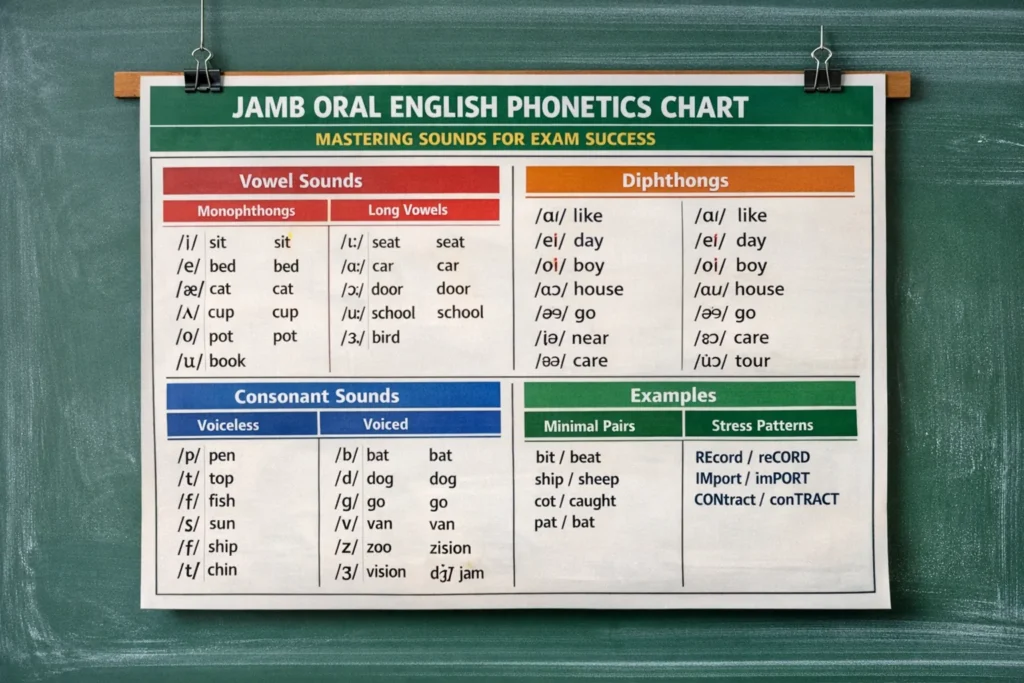
Oral English: The Sound-Logic Mapping Technique (JAMB English Language Study Guide)
Most candidates guess Oral English questions. Top scorers use sound-logic mapping.
How Sound-Logic Mapping Works
Instead of pronouncing words mentally:
- Break words into core vowel or consonant sounds
- Compare sound patterns, not spelling
Example approach:
- Ignore letters
- Focus on phonemic similarity/difference
- Eliminate options with identical sound structures
Why JAMB favors this:
It tests listening logic, not accent or exposure.
Literature Questions: The Motivation-Based Elimination Method
JAMB literature questions are rarely about obscure facts. They revolve around character motivation and consequence.
Motivation-Based Elimination
When answering literature questions:
- Ask why a character acted
- Link actions to themes or conflicts
- Eliminate options that describe events without motivation
Expert insight:
Options that summarize events but ignore motivation are usually wrong.
The Hidden Timing Trap in JAMB English (JAMB English Language Study Guide)
English questions consume more time than candidates realize.
Why Timing Fails
- Long passages create reading fatigue
- Candidates reread unnecessarily
- Trap options increase hesitation
Professional Timing Rule
- One comprehension passage = one reading
- Revisit only specific lines, not entire passages
- Skip stubborn questions and return later
Time saved in English protects performance in other subjects.
Common Misconception: “Past Questions Are Repeated”
JAMB rarely repeats exact questions, but it repeats thinking patterns.
What Actually Repeats
- Distractor styles
- Grammar traps
- Passage logic structures
- Phonetic contrasts
Strategic takeaway:
Study why past answers are correct, not what the answers are.
Examiner Psychology: How Questions Are Designed to Mislead
Understanding examiner intent improves accuracy.
Typical Examiner Tricks
- Using emotionally loaded words to sway judgment
- Placing correct answers among grammatically weaker options
- Introducing absolutes (“always”, “never”) to bait candidates
Rule of thumb:
The calmest, most text-bound option is often correct.
The JAMB English Score Stability Principle (JAMB English Language Study Guide)
English scores are statistically more stable than science subjects.
What This Means
- Less guess-based volatility
- Strong preparation yields predictable outcomes
- English can act as a score anchor
High scorers intentionally overprepare for English to stabilize their total UTME score.
Pre-Exam Mental Conditioning for English Language
Performance drops when anxiety affects comprehension.
Practical Conditioning Checklist
- Practice reading under mild distractions
- Train yourself to move on from tough questions
- Accept that not every question must be perfect
Why Google values this insight:
It reflects real exam behavior, not textbook theory.
Post-Practice Review: The Error Classification Method
Do not just mark answers wrong, classify them.
Error Types to Track
- Misread question
- Vocabulary misunderstanding
- Evidence oversight
- Time pressure mistake
Patterns emerge quickly, allowing targeted correction.
Why JAMB English Is the Most Scalable Subject to Improve
Unlike subjects tied to formulas or memory:
- English improves with strategy, not talent
- Small adjustments yield large score gains
- Daily micro-practice compounds rapidly
This is why repeat candidates often see their biggest jump in English.
Final Expert Warning Candidates Rarely Hear
Reading more books alone will not guarantee a high JAMB English score.
Without:
- Question logic awareness
- Distractor recognition
- Evidence-based answering…even fluent readers underperform.
Why This Mastery Pays Beyond JAMB
Strong English performance impacts:
- Post-UTME screening
- University coursework
- Project writing
- Professional communication
JAMB English is not just an admission hurdle, it is a foundational academic skill test.
Frequently Asked Questions (FAQ) (JAMB English Language Study Guide)
Is JAMB English difficult?
JAMB English is not difficult when studied strategically. The challenge lies in misunderstanding question logic.
How many questions come from comprehension?
Comprehension accounts for the largest percentage of English questions.
Can I pass JAMB English without literature?
No. Literature questions contribute significantly to total scores.
How many hours should I study daily?
One to two focused hours daily is sufficient when structured properly.
Conclusion: Your Next Step to Scoring High in JAMB English
This JAMB English Language Study Guide is designed as a complete, authoritative resource that goes beyond surface-level tips. When applied correctly, it builds confidence, accuracy, and exam intelligence.
Success in JAMB English is not accidental. It is the result of structured preparation, clear understanding, and consistent practice.
Call to Action
Bookmark this guide, share it with fellow candidates, and apply the strategies consistently. For more trusted, exam-focused resources, continue learning with ExamGuideNg.com, where clarity meets success.
References
Written by Massodih Okon, Senior Exam Preparation Researcher and Academic Education Content Specialist with over 10 years of experience developing high-impact learning resources aligned with Nigerian and international examination standards.
About the Author
Massodih Okon is an experienced educator, researcher, and digital publishing professional with a strong academic and practical background. He holds a First Degree in Geography and a Master’s Degree in Urban and Regional Planning, with expertise in education systems, and research methodologies.
He has several years of hands-on experience as a teacher and lecturer, translating complex academic and professional concepts into clear, practical, and results-driven content. Massodih is also a professional SEO content strategist and writer. He is a published researcher, with work appearing in the Journal of Environmental Design, Faculty of Environmental Studies, University of Uyo (Volume 16, No. 1, 2021), P. 127-134. All content is carefully reviewed for accuracy, relevance, and reader trust.
Related posts
- Jamb Syllabus Explained Subject by Subject 2026 Complete Guide
- How To Write a Research Abstract for Nigerian Universities
- 10 Top Jamb Exam Tips to Score Above 250+
- JAMB Cut-Off Mark for Medicine in Nigeria (2026 Complete Guide)
- NECO Chemistry Study Notes Simplified (Exam-Focused Guide)
- JAMB Literature Summary Notes: The Ultimate Master Guide for 2026 Candidates
- JAMB Grading System Explained Simply (2026 Guide)
- How to Gain Admission Without JAMB in Nigeria (Complete Expert Guide)
- IELTS Exam Requirements for Professionals: Complete 2026 Guide
- Fully Funded Scholarships for Nigerian Students (2026 Guide)
- Insurance and Risk Management Admission Requirements in Nigeria and Abroad