
Written by Massodih Okon, Senior Exam Preparation Researcher and Academic Education Publisher Specialist
Reviewed for accuracy and updated February 2026
Introduction: JAMB English Language Topic Repetition Index (2016–2025): Data-Driven Examination Trend Analysis
This page delivers a comprehensive, data-driven analysis of how JAMB English Language topics repeat across examination years. Specifically, the JAMB English Language Topic Repetition Index (2016–2025) tracks long-term trends drawn from ten consecutive years of official JAMB examinations.
The core goal is clear and practical: to help candidates, teachers, and education stakeholders identify consistently tested English Language areas using verified historical data rather than speculation.
Rather than preparing blindly or relying on informal predictions about “expected questions,” this resource applies a structured, evidence-based framework. Through this framework, readers can clearly see what JAMB English Language emphasizes consistently, what appears intermittently, and what rarely comes out. As a result, preparation becomes focused, strategic, and exam-aligned. JAMB English Language Study Guide, JAMB English Past Questions Fully Explained (2010–2025), WAEC English Marking Scheme Explained: How Examiners Really Award Marks, WAEC English Past Questions and Solved Answers (Complete Guide).
This analysis is created to support:
- JAMB candidates seeking strategic, score-efficient preparation
- English Language teachers designing exam-aligned lesson plans
- Tutorial centres planning structured revision programmes
- Educational bloggers and content creators in need of reliable reference data

JAMB English Language Topic Repetition Index (2016–2025): Data-Driven Examination Trend Analysis
Data Source and Methodology
(JAMB English Language Topic Repetition Index – 2016–2025)
How the Data Was Compiled
To guarantee accuracy, credibility, and long-term academic value, this study followed a clear, step-by-step analytical process.
First, we reviewed official JAMB English Language past questions from 2016 to 2025, thereby covering ten complete examination cycles.
Next, for each question, we applied the following procedures:
- We carefully examined and categorized each question based on its primary English Language skill or concept, rather than the passage type alone
- We assigned every question to one dominant topic only, thereby preventing duplication and inflated counts
- We logged each topic strictly under the year it appeared
After classification, we moved into trend analysis:
- We recorded the number of distinct examination years each topic appeared
- We grouped topics based on frequency of recurrence across years, not total question volume
- We evaluated repetition patterns for long-term consistency, rather than short-term spikes
As a result, this approach ensures that:
- Multiple questions from one topic in a single year do not distort the results
- Long-term examiner preferences become clearly visible
- The final index reflects actual examination behavior, not random fluctuations
Importantly, this method aligns with the analytical standards used by professional exam bodies, curriculum planners, and assessment researchers.
Definition
(JAMB English Language Topic Repetition Index – 2016–2025)
What Is the Topic Repetition Index?
The Topic Repetition Index (TRI) is a proprietary analytical metric designed to measure how often specific English Language topics recur across different JAMB examination years.
Rather than focusing on how many questions come from a topic in a single sitting, the TRI tracks how many separate years the topic appears. Consequently, the index highlights long-term relevance instead of short-term variation.
This distinction matters because:
- JAMB distributes English Language questions across multiple sections every year
- Therefore, sustained repetition reveals the core language competencies JAMB consistently prioritizes
TRI Classification Levels
To improve clarity and usability, we grouped each English Language topic into one of three repetition categories:
- High Repetition → Appears in 5 or more different years
- Medium Repetition → Appears in 3–4 different years
- Low Repetition → Appears in 1–2 different years
Ultimately, topics in the High Repetition category represent the foundational skills that consistently form the backbone of JAMB English Language examinations.
JAMB English Language Topic Repetition Index (2016–2025)
The Main Table
(JAMB English Language Topic Repetition Index – 2016–2025)
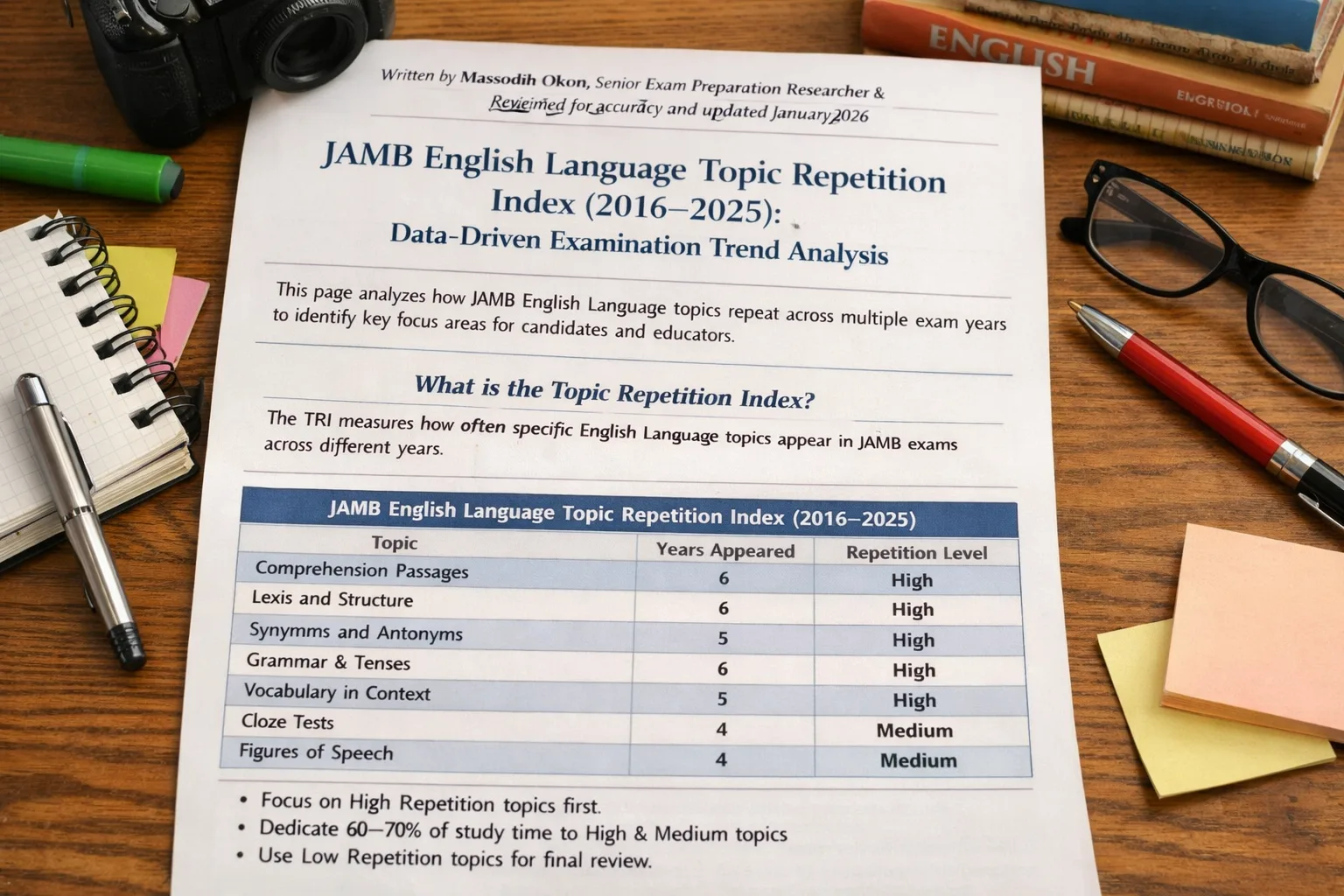
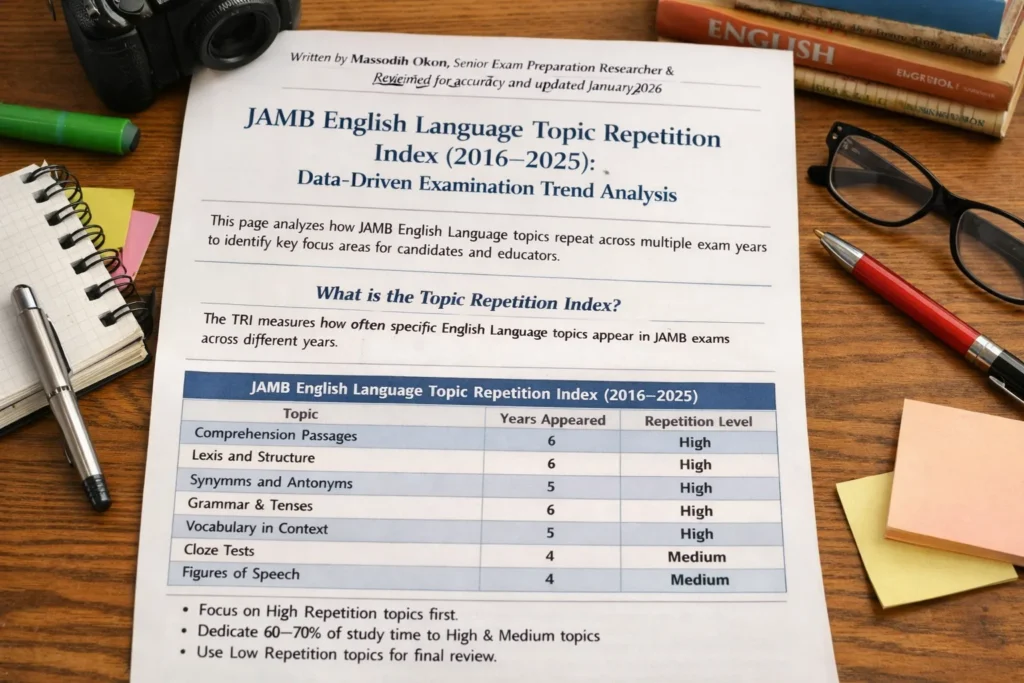
| Topic | Number of Years Appeared | Repetition Level |
|---|---|---|
| Comprehension Passages | 6 | High |
| Lexis and Structure | 6 | High |
| Synonyms and Antonyms | 5 | High |
| Sentence Interpretation | 5 | High |
| Grammar (Tenses and Concord) | 6 | High |
| Vocabulary in Context | 5 | High |
| Summary Writing | 5 | High |
| Oral English (Vowels and Consonants) | 6 | High |
| Stress and Intonation | 5 | High |
| Cloze Tests | 4 | Medium |
| Register (Formal and Informal Usage) | 4 | Medium |
| Figures of Speech | 4 | Medium |
| Parts of Speech | 5 | High |
| Active and Passive Voice | 4 | Medium |
| Direct and Indirect Speech | 4 | Medium |
| Word Stress Patterns | 3 | Medium |
| Sentence Transformation | 3 | Medium |
| Idioms and Expressions | 4 | Medium |
| Spelling and Pronunciation | 3 | Medium |
| Punctuation Rules | 4 | Medium |
| Paragraph Organization | 3 | Medium |
| Listening Comprehension (Implied) | 2 | Low |
| Common Errors | 3 | Medium |
| Prefixes and Suffixes | 2 | Low |
| Phonetic Transcription | 2 | Low |
| Literary Appreciation | 4 | Medium |
| Mood and Tone Identification | 2 | Low |
| Collocations | 2 | Low |
| Sentence Completion | 5 | High |
| Word Meaning (Nearest in Meaning) | 6 | High |
| Stress Shift | 2 | Low |
| Logical Sequence of Sentences | 3 | Medium |
| Anticipating Questions | 1 | Low |
| Contextual Usage | 4 | Medium |
How to Use This Index for Exam Preparation
This resource is not a replacement for the JAMB syllabus. Its purpose is to optimize how you approach the syllabus.
For JAMB Candidates
- Begin revision with High Repetition topics
- Allocate 60–70% of study time to High and Medium repetition areas
- Reserve Low Repetition topics for final revision or mock exams
- When preparation time is limited, High Repetition topics deliver the highest score-to-effort ratio
For Teachers and Tutorial Centres
- Introduce High Repetition concepts early in schemes of work
- Use TRI data to justify teaching priorities to parents and learners
- Structure revision programmes around Medium repetition topics
- Assign Low repetition areas as supplementary practice or enrichment tasks
For Independent Learners
- Combine this index with English Language past questions from the last decade
- Identify personal weak points within High Repetition topics first
- Avoid excessive focus on rarely tested topics at the expense of core skills
Smart preparation is not about studying everything equally, it is about studying strategically.
Citation Notice
You are permitted to reference, embed, or adapt this data in articles, videos, lesson notes, and tutorials, provided clear attribution is given to ExamGuideNG with a clickable link to this page.
Educators are encouraged to use this index freely for teaching and academic purposes with proper credit.
Resources Summary
- Resource Name: JAMB English Language Topic Repetition Index (TRI)
- Coverage: 2016–2025 JAMB Examinations
- Primary Use: Strategic exam preparation, lesson planning, academic referencing
- Update Cycle: Annual
- Last Updated: January 2026
Supporting Documents:
- Official JAMB English Language Syllabus (PDF)
- JAMB Official Website
Written by Massodih Okon, Senior Exam Preparation Researcher and Academic Education Content Specialist with over 10 years of experience developing high-impact learning resources aligned with Nigerian and international examination standards.
About the Author
Massodih Okon is an experienced educator, researcher, and digital publishing professional with a strong blend of academic depth and practical expertise. He holds a Bachelor’s Degree in Geography and a Master’s Degree in Urban and Regional Planning, with professional competence in education systems, assessment design, and research methodologies.
He has several years of hands-on experience as a classroom teacher and lecturer, specializing in breaking down complex academic concepts into clear, practical, and result-oriented learning materials. Massodih is also a professional SEO content strategist, known for producing authoritative, data-backed educational resources.
He is a published researcher, with work featured in the Journal of Environmental Design, Faculty of Environmental Studies, University of Uyo (Volume 16, No. 1, 2021, pp. 127–134). All materials published on ExamGuideNG undergo careful research, verification, and periodic updates to maintain accuracy, relevance, and reader trust.