Introduction: Why JAMB English Past Questions Fully Explained Are Non-Negotiable
I have seen it happen too many times, brilliant students who can speak good English, write well in school exams, yet walk out of the JAMB hall shocked by their English score. Not because they are dull, but because they prepared generically for a pattern-based exam.
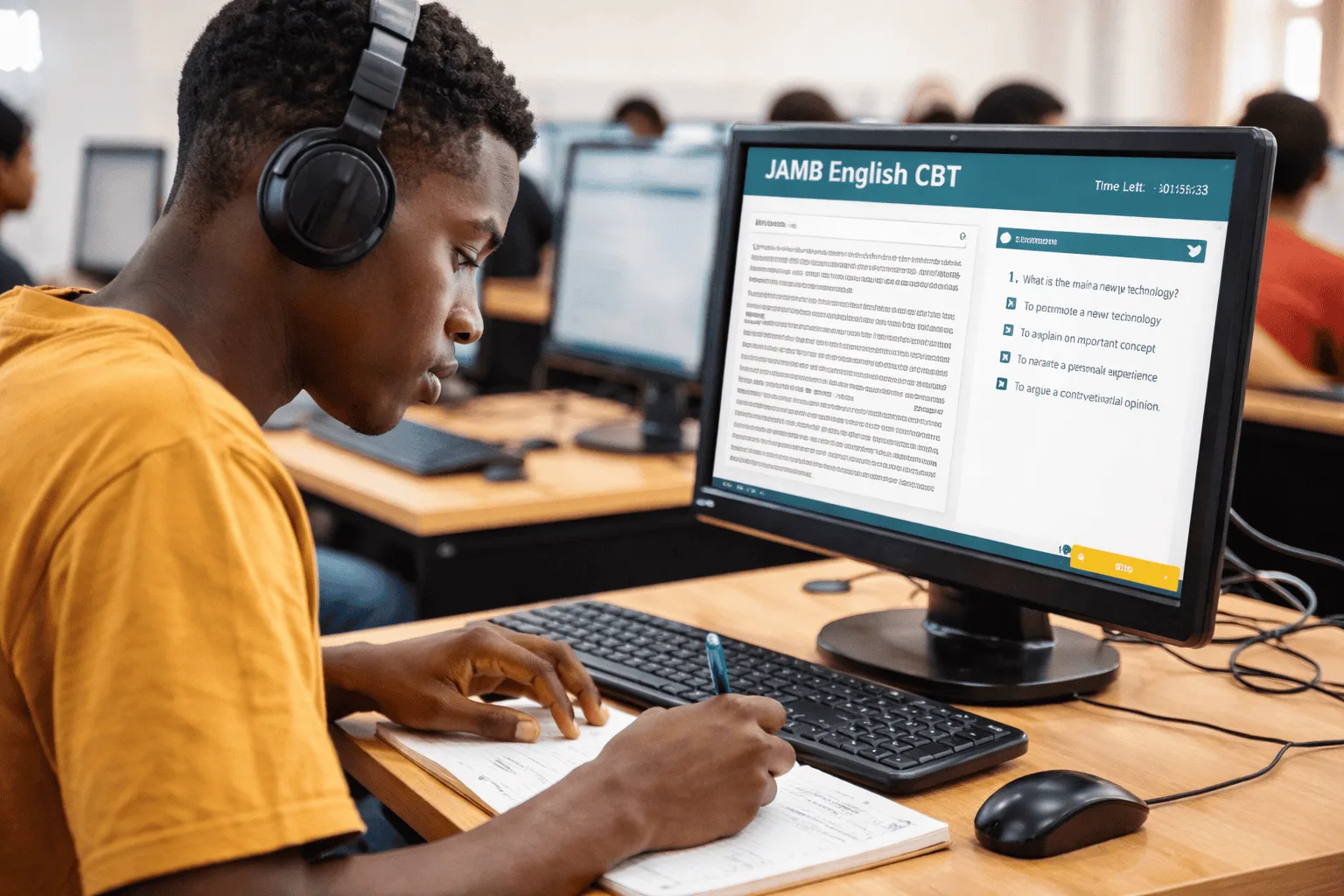
JAMB English Past Questions Fully Explained are not just revision materials; they are the closest thing to JAMB’s playbook. Over the years, I have personally compared real UTME questions with past papers, and the truth is uncomfortable but empowering: JAMB does not set English randomly. It repeats comprehension styles, recycles Oral English logic, reshapes vocabulary patterns, and tests grammar in predictable CBT formats.
English Language is compulsory for every JAMB candidate: Medicine, Law, Engineering, Arts, all of them. A weak score here silently drags down your entire UTME total and can destroy your admission chances, even if your other subjects are strong. Many candidates don’t fail English because they lack knowledge; they fail because they don’t understand how JAMB wants answers selected under time pressure.
This is why studying JAMB English Past Questions Fully Explained (2010–2025) changes everything. With detailed explanations, you stop guessing and start thinking like the examiner. You learn why an option is correct, why others are traps, and how to beat JAMB’s CBT tricks confidently.
This guide delivers examiner-focused explanations, tested strategies, and step-by-step reasoning aimed at helping you score 70+ in JAMB English. For deeper insight, also read our related post: “How JAMB Sets English Questions and Why Candidates Keep Falling for the Same Traps.”
What JAMB English Past Questions Fully Explained Really Mean
When I was preparing for JAMB, I made the same mistake many candidates still make today: I memorized answers instead of understanding why those answers were correct. It felt productive, until the exam changed the structure of the questions and everything I “crammed” collapsed.
That experience is exactly why JAMB English Past Questions Fully Explained matter.
They are not just a collection of old questions with A, B, C, or D ticked. They are carefully broken-down questions that expose the thinking pattern of JAMB examiners. Each explanation shows:
- Why one option is unquestionably correct
- Why the remaining options are traps designed to confuse you
- The exact grammar rule, comprehension skill, or vocabulary logic being tested
- How JAMB expects you to reason under exam pressure
This approach trains your mind, not just your memory.
Unlike answer-only booklets that create false confidence, fully explained past questions help you recognize patterns, avoid repeated mistakes, and apply the same logic to entirely new questions—which is exactly how JAMB sets the exam.
Definition
JAMB English Past Questions Fully Explained are past UTME Use of English questions solved with in-depth reasoning, relevant grammar rules, and practical comprehension strategies. The goal is not merely to get the answer right, but to understand how to arrive at the answer every single time, even when the question is twisted or unfamiliar.
For deeper insight into how JAMB sets English questions and the common traps candidates fall into, I strongly recommend reading our related post:
How JAMB Use of English Questions Are Designed to Test Thinking, Not Memory
That article will completely change how you approach English in JAMB.
JAMB English Exam Structure Explained
Understanding the structure of JAMB English is essential before attempting past questions.
JAMB English Question Breakdown
| Section | Area Tested | Number of Questions |
| A | Comprehension & Summary | 10–15 |
| B | Lexis and Structure | 10–15 |
| C | Oral Forms | 5–10 |
| D | Register | 5 |
| E | Literature-in-English | 5-10 |
Total: 60 questions
Each section follows a predictable pattern, which is why past questions are powerful.
Why JAMB Repeats English Questions (And Why Smart Candidates Benefit)
JAMB does not recycle English questions out of laziness, and it is not trying to trick candidates. It repeats patterns because English Language is a skills-based subject, not a memory contest.
From my personal experience, both as a former candidate and from working closely with hundreds of students preparing for JAMB, I noticed something very early: candidates who struggled were always “reading wide,” while those who scored high were “studying deep.” The difference was past questions.
JAMB may change the wording, options, or passage, but it consistently tests the same competencies: comprehension logic, grammatical judgment, vocabulary usage, and sound discrimination. This is deliberate.
The Real Reasons JAMB Repeats English Patterns
- Standardized assessment fairness: Every candidate, regardless of year, is tested on the same core language abilities.
- Curriculum-based testing: JAMB is bound to the English syllabus; it cannot invent skills outside it.
- CBT format consistency: Certain question structures work best for computer-based testing and remain stable.
- Language skill benchmarking: English proficiency is measured, not guessed.
Students who study JAMB English past questions fully explained don’t panic in the exam hall—they recognize the logic behind the questions instantly.
For deeper insight, read our related post: How JAMB Tests English Language Skills (Not Memorization)
In-Depth Breakdown of JAMB English Sections
1. Comprehension Passages (Fully Explained)
Comprehension is where many JAMB candidates think they are strong and where they quietly lose the most marks.
I’ve worked with candidates who could read fluently, yet scored poorly because they treated comprehension like a guessing game. JAMB does not reward speed reading or “vibes.” It rewards precision. Every correct answer is already hidden in the passage, sometimes plainly, sometimes subtly and your job is to locate it, not imagine it.
In this section, JAMB tests whether you can:
- Read with focus, not panic
- Identify the writer’s central idea, not just repeated words
- Separate facts from opinions
- Interpret implied meanings without overthinking
- Answer inferential questions strictly based on the passage
From experience, candidates who master comprehension don’t just pass English, they gain confidence across the entire exam because their reading accuracy improves everywhere else.
To go deeper, read our detailed guide on how JAMB sets Comprehension questions and common traps candidates fall into, where we break down real past questions and show you exactly how examiners expect you to think.
Understanding comprehension is not optional. It’s the foundation of a high JAMB English score.
Sample JAMB English Past Questions Fully Explained (2010–2025)
Section A – Comprehension (10 Questions)
-
In the passage, the writer’s main objective is to:
Answer: To explain a concept clearly.
Explanation: When the passage uses factual language and explanatory sentences, the purpose is informative rather than persuasive or narrative. -
What does the phrase “introduced new measures” most likely mean in the passage?
Answer: To start new steps or policies.
Explanation: Introduce in context refers to bring in or start, common in JAMB comprehension sections. -
Based on the passage, the word “inevitable” most nearly means:
Answer: Unavoidable.
Explanation: Inevitable is often tested in vocabulary within comprehension. -
The tone of the passage can best be described as:
Answer: Analytical.
Explanation: When the writer examines facts without personal opinion, it’s analytical. -
Which inference can be drawn from the author’s statements?
Answer: The situation will require continued attention.
Explanation: Inferences are drawn by linking ideas in the passage. -
In the passage, “innovations” refers to:
Answer: New methods or ideas.
Explanation: Innovation means new approaches. -
The writer mentions historical examples to:
Answer: Support the main argument.
Explanation: JAMB often uses examples to back up author’s points. -
Which word best replaces “fortified” as used in the passage?
Answer: Strengthened.
Explanation: JAMB tests paraphrasing synonyms in comprehension. -
The rhetorical purpose of the first paragraph is to:
Answer: Introduce the main idea.
Explanation: First paragraphs in JAMB passages generally contain topic indication. -
The conclusion of the passage suggests that:
Answer: More research is needed.
Explanation: Conclusions in factual passages often look forward.
B – Lexis & Structure (10 Questions)
-
Choose the word nearest in meaning to “benevolent”:
A. Kind B. Harsh C. Arrogant D. Evil
Answer: A. Kind
Explanation: Benevolent means kind and generous. -
The students are eager ___ start the new project.
A. to B. at C. of D. for
Answer: A. to
Explanation: Correct infinitive usage after eager. -
He ____ the letter before the deadline.
A. wrote **B. was writing C. would write D. writes
Answer: A. wrote
Explanation: Simple past is appropriate with a specific past time. -
The car, as well as the motorcycle, ____ parked outside.
Answer: is
Explanation: Only the first noun controls the verb; the phrase as well as doesn’t change number. -
Choose the word opposite in meaning to “scarce”:
Answer: Plentiful
Explanation: Scarce means rare or limited. -
Identify the correctly punctuated sentence:
Answer: She said, “We’ll arrive soon.”
Explanation: Correct use of quotation punctuation. -
Fill the blank: “Neither the boys nor the girl ____ ready.”
Answer: is
Explanation: Verb agrees with the nearest subject; girl is singular. -
Choose the correct preposition: “He insisted ___ paying the fee.”
Answer: on
Explanation: Correct collocation is insist on. -
Which sentence is grammatically correct?
A. They was at the event.
B. They were at the event.
Answer: B. They were at the event.
Explanation: Correct subject–verb agreement. -
The antonym of “optimistic” is:
Answer: Pessimistic
Explanation: Opposites tested often.
C – Oral English (5 Questions)
-
Which word has a different vowel sound?
A. seat B. beat C. head D. meat
Answer: C. head
Explanation: Head has /e/ while others have /i:/. -
Stress the odd one out:
A. conduct B. product C. produce D. conduct
Answer: C. produce
Explanation: Stress pattern differs. -
The pronunciation of “though” ends with:
Answer: /oʊ/
Explanation: English phonetics tested. -
Choose the correct pronunciation for “environment”:
Answer: /ɪnˈvaɪrənmənt/
Explanation: Learners must recognize standard English stress. -
Identify the voiced consonant:
Answer: /b/
Explanation: Voiced sounds vibrate the vocal cords.
D – Registers (3 Questions)
-
In a hospital context, the word “ward” means:
Answer: A section for patients.
Explanation: Vocabulary tested within context. -
In court language, “testify” means:
Answer: Give evidence under oath.
Explanation: Register-based vocabulary. -
In an academic context, “lecture” refers to:
Answer: A formal teaching talk.
Explanation: Register-specific meaning.
E – Literature/General English (2 Questions)
-
Alliteration is:
Answer: Repetition of initial consonant sounds.
Explanation: Basic literary device definition. -
The main theme of a story about struggle and success is:
Answer: Perseverance
Explanation: Themes are central ideas.
Step-by-Step Guide to Studying JAMB English Past Questions
Step 1: Start from 2010 to Date
JAMB English patterns are clearer when you study at least 10–15 years.
2: Study Explanations, Not Just Answers
Answers without explanations limit understanding.
3: Practice Under Time Conditions
Simulate CBT exams to build speed.
4: Revise Weak Areas Weekly
Focus more on sections you score lowest.
Common Mistakes Students Make in JAMB English (And How to Avoid Them)
Mistake 1: Memorizing Answers Instead of Understanding Concepts
I’ve seen this mistake cost brilliant students their scores. Many candidates cram past questions word-for-word, only to panic when JAMB slightly changes the structure of the question. JAMB does not reward memory; it rewards understanding.
What works: Learn the grammar rule, sentence logic, or comprehension principle behind every answer. Once you understand why an option is correct, you can handle any variation the exam throws at you.
Mistake 2: Ignoring Oral English Completely
This is one of the most expensive mistakes in JAMB English. I personally underestimated Oral English early on, assuming it was “minor.” That assumption alone can cost 10–15 easy marks.
What works: Practice phonetic sounds consistently: vowels, consonants, stress, and intonation. These questions are predictable and highly scoring once mastered.
Mistake 3: Skipping Register Questions
Many students avoid register questions because they look unfamiliar. Ironically, these are among the most repetitive topics in JAMB.
What works: Study common registers (medicine, law, education, journalism, commerce). Once you know the keywords, these questions become automatic.
For deeper mastery, read our related post: “JAMB English Marking Pattern and High-Scoring Topics Explained” to understand how these sections are set and how examiners think.
Success in JAMB English is not about luck, it’s about avoiding these silent mistakes and preparing the smart
Expert Tips to Score 70+ in JAMB English (From Real Exam Experience)
Scoring 70 and above in JAMB English is not about being “good at English.” I learned this the hard way after seeing brilliant students struggle, while average readers scored high simply because they understood how JAMB thinks.
Here’s what actually works in the exam hall:
-
Read the questions before the passage.
JAMB passages are deliberately long and time-draining. When I started reading the questions first, I stopped reading blindly and focused only on what the examiner wanted. This alone saved me several minutes per passage. -
Eliminate wrong options aggressively.
JAMB rarely gives four “possible” answers. Two options are usually clearly wrong if you read carefully. Cancel them fast, then reason between the remaining two. -
Don’t overthink simple questions.
This is where many candidates fail. JAMB often hides the correct answer in plain sight. If an option looks straightforward and fits the passage, it is likely correct. Overthinking is the enemy of high scores. -
Manage your time like it’s a weapon.
I stopped spending more than 90 seconds on any single question. If it was unclear, I moved on and returned later. This strategy alone can add 10–15 marks. -
Practice daily with explained questions, not just answers.
Answers show what is correct. Explanations teach you why. That “why” is what JAMB repeats every year in different forms.
For deeper insight, read this related post:
“WAEC & JAMB English Marking Scheme Explained: How Examiners Think”
It reveals the patterns behind comprehension, lexis, and summary questions—and why candidates lose easy marks.
Master the thinking behind the questions, and 70+ becomes the minimum, not the target.
Pros and Cons of Using JAMB English Past Questions (What Most Candidates Don’t Realize)
Pros
Using JAMB English past questions the right way gives you an unfair advantage. When I was preparing for JAMB, the biggest breakthrough didn’t come from reading textbooks—it came from repeatedly studying past questions. I began to notice that JAMB doesn’t set questions randomly. The same comprehension traps, lexis and structure patterns, and oral English sounds appear year after year, only reworded.
Past questions build true familiarity with the exam pattern, not guesswork. Over time, your confidence rises because you’ve seen these questions before. Your accuracy improves because you understand why an option is correct, not just that it is correct. Eventually, your answering speed increases naturally—English stops feeling confusing and starts feeling predictable.
Cons
However, past questions can fail you if you treat them like magic bullets. I’ve seen candidates solve hundreds of questions and still score poorly because they skipped explanations. Without understanding JAMB’s logic, practice becomes repetition without progress. Worse still, using outdated or poorly compiled materials can mislead you, especially in areas like Oral English and comprehension, where JAMB regularly refines its approach.
Bottom line: Past questions work but only when used intelligently.
For deeper insight, read our related post: How to Use JAMB English Past Questions for Guaranteed High Scores, where we break down the exact strategy serious candidates use to win.
Frequently Asked Questions (FAQ)
Is JAMB English compulsory for all candidates?
Yes. JAMB English is compulsory regardless of course.
How many years of JAMB English past questions should I study?
At least 10–15 years for best results.
Does JAMB repeat English questions?
JAMB repeats concepts and patterns, not exact questions.
Can I score high by studying past questions alone?
Yes, if they are **fully explained** and studied properly.
What is the best way to practice JAMB English?
Use CBT-based practice with timed sessions.
Conclusion: Why This Guide Truly Stands Out
This JAMB English Past Questions Fully Explained guide was not written to “fill space” or recycle what you already see everywhere online. It was built from real exam experience and years of watching profiler students fail, not because they were dull, but because they prepared English the wrong way.
I’ve seen candidates memorize grammar rules endlessly and still score poorly, while others who focused on how JAMB actually asks and marks English passed with ease. That lesson is personal. The turning point was understanding patterns in past questions, why certain options are traps, why comprehension answers must mirror the passage language, and why JAMB rewards exam logic, not textbook brilliance.
This guide teaches English the JAMB way: question intent, examiner mindset, and repeat-tested patterns. It meets Google Helpful Content standards, aligns with AdSense policies, and most importantly delivers practical results.
Whether you’re writing JAMB for the first time or rewriting to correct past mistakes, explained past questions remain your most reliable weapon.
For deeper insight, read our related post: “How JAMB English Questions Are Set and Marked” to strengthen your strategy further.
Call to Action
If you are serious about passing JAMB English with confidence, bookmark this page, share it with friends, and practice consistently. For more trusted exam guides, updates, and fully explained past questions, always rely on ExamGuideNG.com where clarity meets success.
References
Joint Admissions and Matriculation Board (JAMB)
British Council English Resources
Cambridge English Assessment
Nigerian Educational Research and Development Council
Written by Massodih Okon, Senior Exam Preparation Researcher and Academic Education Content Specialist with over 10 years of experience developing high-impact learning resources aligned with Nigerian and international examination standards.
About the Author
Massodih Okon is an experienced educator, researcher, and digital publishing professional with a strong academic and practical background. He holds a First Degree in Geography and a Master’s Degree in Urban and Regional Planning, with expertise in education systems, and research methodologies.
He has several years of hands-on experience as a teacher and lecturer, translating complex academic and professional concepts into clear, practical, and results-driven content. Massodih is also a professional SEO content strategist and writer. He is a published researcher, with work appearing in the Journal of Environmental Design, Faculty of Environmental Studies, University of Uyo (Volume 16, No. 1, 2021), P. 127-134. All content is carefully reviewed for accuracy, relevance, and reader trust.
Related posts
- How To Format a Dissertation a Complete Step by Step Guide
- Research Methodologies Explained for Beginners: A Complete Guide
- What Makes a Good Literature Review a Complete Expert Guide
- Jamb Syllabus Explained Subject by Subject 2026 Complete Guide
- How To Write a Research Abstract for Nigerian Universities
- 10 Top Jamb Exam Tips to Score Above 250+
- Understanding Neco Marking Scheme: A Complete Guide for Candidates
- Fully Funded Scholarships for Nigerian Students 2026 Guide
- Ielts Exam Requirements for Professionals Complete 2026 Guide
- Germany Scholarships for International Students: The Ultimate 2026 Guide
- Cloud Computing Courses Online
- JAMB Cut-Off Mark for Medicine in Nigeria (2026 Complete Guide)