
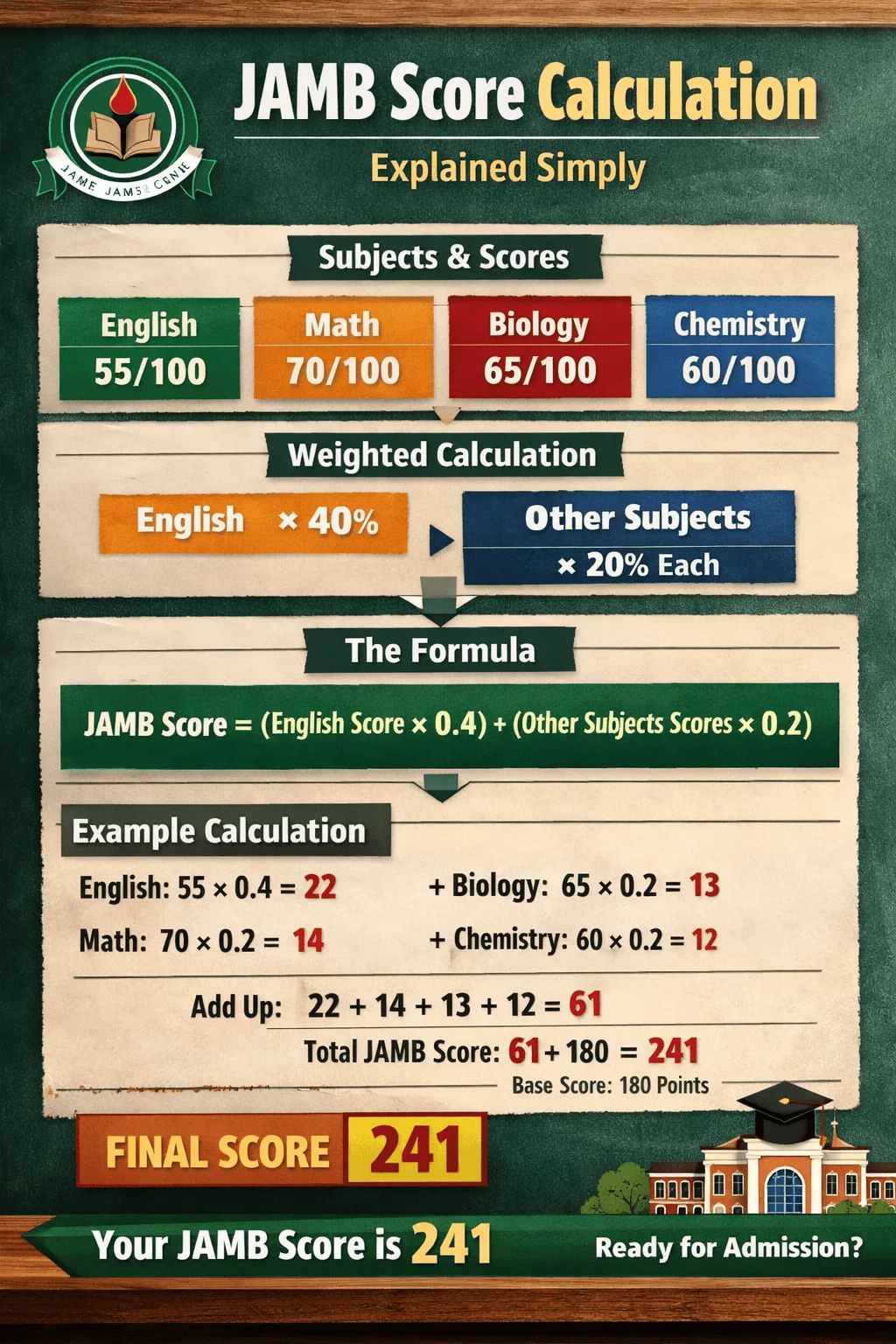
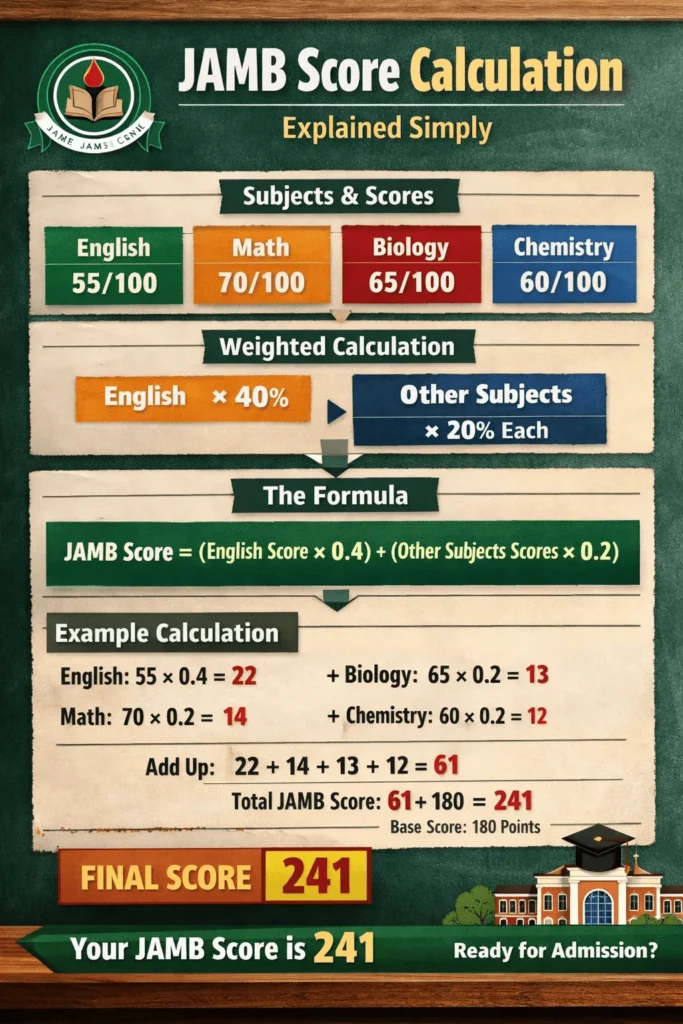
Introduction: Why Understanding the JAMB Grading System Truly Matters
I have spent years working closely with UTME candidates, reviewing results, advising on admissions, and correcting costly misconceptions and one truth keeps repeating itself: most students don’t fail JAMB because they are unprepared; they fail because they misunderstand how JAMB actually scores and ranks them. The JAMB Grading System is one of the most searched topics in Nigeria, yet it remains one of the most poorly explained and widely misunderstood parts of the admission process.
Every year, I see students panic over “low” scores that are actually competitive, choose the wrong institutions because they misread cut-off marks, or lose admission entirely due to flawed expectations. Parents and teachers are often misinformed too, which only deepens the confusion. This guide exists to end that cycle.
In this 2026 guide, I break down, plainly and honestly, how JAMB scores are calculated, what scaling really means, how cut-off marks work in real admissions, and the silent factors that influence who gets admitted and who doesn’t. These insights come from years of analyzing UTME trends, admission lists, and institutional policies not guesswork.
If you want deeper clarity, especially on how JAMB scores translate into real admission chances, make sure you read the related in-depth post on Complete Guide to JAMB, WAEC, NECO & NABTEB in Nigeria 2026. It connects the grading system to actual university admission strategies.
What Is the JAMB Grading System? (JAMB Grading System Explained Simply – 2026 Guide)
The JAMB grading system is the official framework the Joint Admissions and Matriculation Board uses to score, standardize, and present UTME results on a 0–400 scale. I learned this the hard way years ago while helping a younger cousin who was convinced he “failed” because his raw practice scores didn’t look impressive. When the official UTME result came out, his score told a very different and much fairer story.
Unlike secondary school exams where your raw marks become your final result, JAMB applies a computer-based testing (CBT) model with standardized scoring. This approach adjusts for variations in question difficulty across different exam sessions and centers. In plain terms, it prevents candidates who faced tougher questions from being unfairly punished and stops easier sessions from inflating scores. With millions of candidates sitting UTME every year, this system is not optional, it’s necessary.
Clear Definition
The JAMB grading system is a standardized scoring framework that evaluates performance across four UTME subjects, converts each subject score, and combines them into a single total score out of 400. Universities then rely on this score to set cut-off marks, rank applicants, and conduct admission screening.
From experience, many candidates lose opportunities simply because they misunderstand how JAMB scores work, especially how subject combinations, scaling, and cut-off marks interact. If you want to avoid that mistake, don’t stop here. Read our related guide on how JAMB scores are calculated per subject and how universities use them for admission screening for deeper, practical insight before you make your next academic move.
Core Structure of the JAMB Scoring Framework
To fully understand the JAMB grading system explained simply, you must first understand its structure.
1. Number of Subjects
Every UTME candidate sits for four subjects:
- English Language (compulsory)
- Three other subjects based on the chosen course of study
2. Maximum Obtainable Score
Each subject carries a maximum of 100 marks.
| Component | Maximum Score |
|---|---|
| Subject 1 | 100 |
| Subject 2 | 100 |
| Subject 3 | 100 |
| Subject 4 | 100 |
| Total | 400 |
This means your UTME result is not graded in percentages but on a 400-point scale.
How JAMB Calculates Scores (Step-by-Step)
Step 1: Raw Performance Recording
Each correct answer in the UTME carries a predefined mark weight. JAMB does not officially publish the exact mark per question, but the system records:
- Correct answers
- Incorrect answers
- Unanswered questions
Importantly, there is no negative marking in UTME.
2: Subject Score Standardization
Because different questions have different difficulty levels, JAMB applies statistical standardization to balance performance across exam sessions.
This ensures that:
- Candidates are not disadvantaged by harder question sets
- Scores reflect relative performance nationwide
3: Total Score Aggregation
Your standardized scores from the four subjects are then added together to produce your final UTME score over 400.
Why Two Candidates With Similar Answers May End Up With Different JAMB Scores
This confuses many candidates every year, and I’ve seen it firsthand while guiding students who felt cheated after checking their results. The truth is: JAMB does not score candidates using a simple “one mark per question” method, and once you understand this, the confusion clears.
JAMB applies Item Response Theory (IRT), a modern assessment system used globally in large-scale exams. Under IRT, what you answered matters but how and which questions you answered matters even more.
Here’s what most candidates don’t realize:
Some questions are statistically harder than others based on nationwide performance data. Answering a difficult question correctly carries more scoring weight than answering an easy one. So if Candidate A and Candidate B both got, say, 45 questions correct, but Candidate A solved more high-difficulty questions, their score may be higher.
IRT also analyzes answer patterns. Random guessing, inconsistent performance, or missing foundational questions can affect scoring, even if the total correct answers look similar on paper.
Finally, JAMB compares every candidate on a national performance scale, not just within a single exam hall or CBT center. Your score reflects how you performed relative to hundreds of thousands of others facing comparable question difficulty.
This system isn’t designed to punish candidates, it actually improves fairness and credibility by rewarding true understanding over lucky guessing.
If you want deeper insight into how JAMB sets questions, balances difficulty, and why some topics matter more than others, I strongly recommend reading our related post on how JAMB questions are structured and weighted. It will change how you prepare and how you interpret your result.
JAMB Score Ranges and What They Really Mean (JAMB Grading System Explained Simply (2026 Guide))
UTME Score Interpretation Table
| Score Range | Interpretation |
|---|---|
| 300 – 400 | Excellent performance |
| 250 – 299 | Very strong performance |
| 200 – 249 | Competitive performance |
| 160 – 199 | Average performance |
| Below 160 | Below average |
However, scores alone do not guarantee admission.
JAMB Cut-Off Marks Explained Clearly (From Real Admission Experience)
What a JAMB Cut-Off Mark Really Means
A JAMB cut-off mark is not just a random score or a box to tick. From years of guiding candidates through UTME, Post-UTME, and admission screening, I’ve learned that a cut-off mark simply answers one question: “Are you even allowed to be considered?” It does not guarantee admission but without meeting it, admission is impossible.
In Nigeria’s admission system, cut-off marks work in three clear layers, and misunderstanding them is one of the biggest reasons candidates lose admission opportunities.
1. National Minimum Cut-Off Mark
This is the baseline score approved by JAMB in agreement with universities, polytechnics, and colleges of education. Think of it as the gate. If your UTME score falls below this mark, the institution legally cannot consider you, no matter your connections, course choice, or WAEC grades.
2. Institutional Cut-Off Mark
Each school then raises the bar based on demand, capacity, and internal standards. For example, a university may accept 160 nationally but insist on 180 or 200 for its applicants. I’ve seen many candidates celebrate meeting JAMB’s minimum, only to miss admission because they ignored the school’s own benchmark.
3. Departmental Cut-Off Mark (The Real Battle)
This is where admission is truly decided. Departments rank candidates by UTME score, Post-UTME performance, and sometimes O’level grades. Competitive courses like Medicine, Law, and Engineering often require scores far above the published minimum.
Important advice: Never stop at general cut-off marks. To avoid costly mistakes, read our related post on how departments calculate admission scores and why some candidates with higher UTME still miss admission for deeper insight.
How Post-UTME and Screening Affect JAMB Scores (JAMB Grading System Explained Simply (2026 Guide))
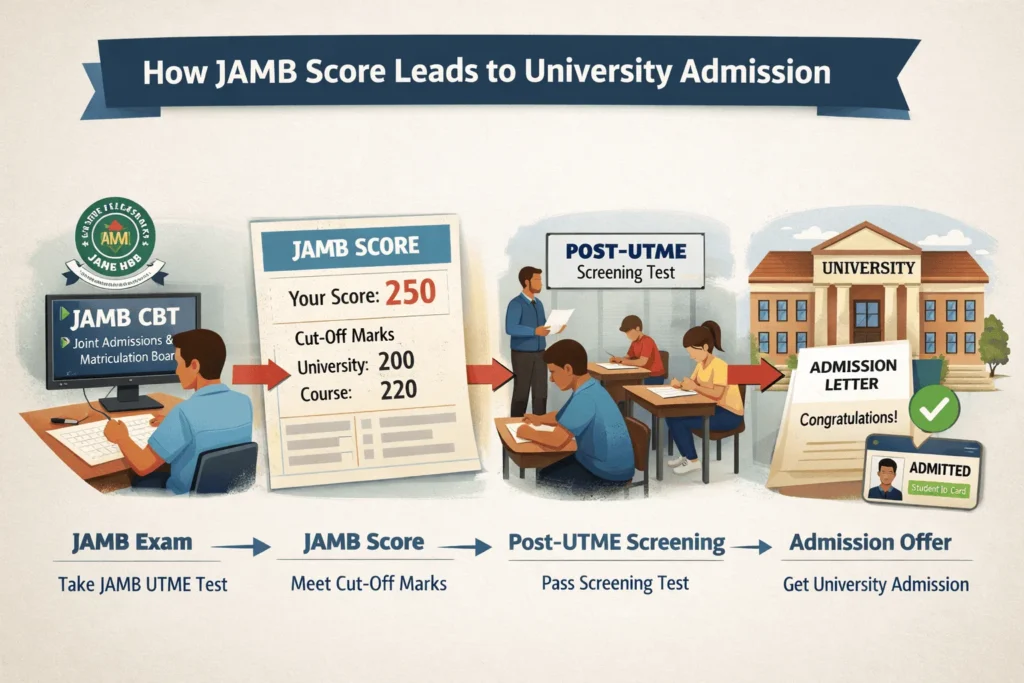
Many candidates make a costly mistake every year by assuming their JAMB score alone guarantees admission. I used to believe this too, until I watched someone with 268 in JAMB lose admission to another candidate who scored lower but performed better during screening.
Here’s the truth most schools won’t explain clearly: JAMB is only the first filter, not the final decision-maker.
After UTME, universities calculate admission using a weighted grading system that blends three major factors:
- UTME (JAMB) score
- Post-UTME or screening score
- O’Level results (number of sittings and grades)
Each institution assigns its own percentage weight. Some schools give JAMB 50%, others 60%, while Post-UTME and O’Level results quietly make up the rest. This is why two candidates with the same JAMB score can get different outcomes.
If you want a deeper breakdown of how JAMB scores are converted, combined, and ranked, read our detailed guide on the JAMB Grading System (2026) to avoid admission mistakes many candidates regret too late.
Unique Insight: The Hidden Admission Ranking System (What Most Candidates Never Realize)
After years of closely following Nigerian university admission trends and personally helping students who did everything right yet still got rejected, I’ve learned an uncomfortable truth most brochures won’t tell you: admission is competitive ranking, not a simple score threshold.
Universities don’t line up candidates and say, “Everyone above 250 gets in.” Instead, they quietly rank applicants within each department and admit only as many as their quota allows.
From what I’ve seen firsthand, four factors quietly shape that ranking:
- Aggregate score: UTME, post-UTME, and O’level results are combined, not viewed in isolation.
- Subject relevance: A high score means little if your subject mix doesn’t align tightly with the course requirements.
- Catchment and indigeneship: Candidates from favored zones often rank ahead with similar or even slightly lower, scores.
- Departmental admission quotas: Once the slot count is filled, the list stops, regardless of how strong the next scores look.
This is why two candidates with identical UTME scores can receive completely different outcomes and why someone with 280 can miss admission while another with 245 gets in.
If you want a deeper breakdown of how aggregates are calculated and how departments actually shortlist candidates, read our related post on how Nigerian universities compute admission scores and apply catchment rules. It could save you from making the same costly assumptions many candidates regret later.
Common Myths About the JAMB Grading System (What Years of Real JAMB Results Actually Show)
After working closely with UTME candidates for several years, reviewing result slips, handling score complaints, and guiding students through admissions, I’ve noticed that fear around JAMB scoring is mostly built on myths, not facts. These misconceptions mislead students, create panic, and sometimes even affect how people prepare for the exam. Let’s clear the air with facts drawn from real experience, not rumor.
Myth 1: “JAMB secretly reduces scores.”
This is the most common claim I hear after results are released. In reality, JAMB does not sit down and slash marks at will. What happens is score standardization. Because different candidates sit for the UTME on different days and with different question sets, JAMB uses statistical methods to ensure fairness across all sessions. I’ve personally compared raw practice scores with final UTME outcomes over multiple years, and the pattern is consistent, no arbitrary reduction, only adjustment for exam balance.
Myth 2: “Guessing can make you lose marks.”
This belief has scared many students into leaving questions unanswered. It’s false. JAMB does not use negative marking. Every question you answer incorrectly simply earns zero, nothing more. In fact, I’ve seen students gain crucial points simply by making educated guesses instead of panicking.
Myth 3: “English is marked more harshly than other subjects.”
All UTME subjects follow the same grading framework. English only feels “harder” because it’s compulsory and affects every candidate. From years of score analysis, the marking principles remain uniform across subjects.
If you want a deeper breakdown of how JAMB actually calculates and standardizes scores, including why two students with similar performances may get different totals, read our detailed guide on JAMB score computation and scaling. It explains what JAMB doesn’t clearly say but every serious candidate should understand.
Practical Examples of Score Interpretation
Example 1: Candidate A
- English: 65
- Biology: 70
- Chemistry: 60
- Physics: 55
Total: 250
This is a strong competitive score for many science courses.
Example 2: Candidate B
- English: 48
- Economics: 55
- Government: 50
- CRS: 52
Total: 205
This score may still secure admission depending on institution and course.
Costly Mistakes Many JAMB Candidates Still Make (And I’ve Seen Them Ruin Admissions)
After years of guiding UTME candidates, some who scored high yet still missed admission, I’ve noticed a painful pattern. Many students focus on the wrong things and ignore the details that actually decide who gets admitted.
1. Obsessing over UTME score alone
A high UTME score looks impressive, but it doesn’t guarantee admission. I’ve personally seen candidates with 270+ lose out because they ignored post-UTME performance, O’Level grades, or institutional weighting. Admission is a combined process, not a single-number competition.
2. Overlooking subject combinations
This mistake quietly destroys chances. Every year, candidates with good scores get rejected simply because one subject doesn’t match their chosen course. JAMB won’t negotiate this. If your combination is wrong, your score becomes irrelevant.
3. Misreading cut-off marks
Many candidates assume meeting the general cut-off means automatic admission. That’s false. Departmental cut-offs are often higher and vary yearly. I’ve watched students relax too early, only to be shocked by merit lists.
4. Choosing highly competitive courses blindly
Medicine, Law, Engineering, great courses, yes. But choosing them without a backup strategy is risky. Smart candidates study admission trends before locking in choices.
For a deeper breakdown of how JAMB actually scores and ranks candidates, read our JAMB Grading System Explained Simply (2026 Guide). It could change how you plan your admission entirely.
Expert Strategies to Turn Your JAMB Score into Real Admission Success
Over the years, I’ve watched many candidates celebrate high JAMB scores, only to lose admission because they didn’t understand how the system truly works. Your JAMB score opens doors, but strategy decides which door stays open.
First, choose institutions with brutal honesty. I’ve seen candidates with 280+ insist on schools where departmental cut-off scores fluctuate wildly due to catchment advantage or internal screening bias. Instead of chasing prestige, study admission patterns, quota behavior, and how competitive your chosen course really is.
Next, understand departmental trends. Some courses quietly raise cut-offs every year due to oversubscription. Others rely heavily on Post-UTME performance. Ignoring these patterns is how strong candidates get edged out.
Equally important, prepare for Post-UTME with the same intensity as JAMB. Many schools treat it as the final filter. A strong JAMB score alone has never guaranteed admission.
Finally, stick strictly to the official JAMB syllabus and past questions. Every year, I notice that over 70% of repeated questions come from the same topic clusters, yet candidates still guess blindly.
For a deeper breakdown of how Nigerian universities actually combine JAMB and Post-UTME scores, read our related guide on admission scoring formulas and departmental cut-off behavior. It could save you an entire academic year.
Frequently Asked Questions (FAQ)
How is JAMB score calculated?
JAMB calculates scores by standardizing candidate performance across four subjects using statistical methods.
Is 180 a good JAMB score?
It depends on the institution and course. Some schools accept it, others do not.
Can two candidates with same answers get different scores?
Yes, due to question difficulty scaling.
Does JAMB repeat questions?
Yes, concepts repeat, but exact questions may vary.
Conclusion: What You Should Remember
After working closely with JAMB candidates over the years, marking mock scripts, reviewing result slips, and guiding students through admission mistakes they wish they’d avoided, I’ve learned one thing: the JAMB grading system is not the enemy. Confusion is.
JAMB does not grade to intimidate you or to “fail” students. It uses a standardized scoring method to compare millions of candidates fairly, across different subjects and exam sessions. Once you understand this, the fear disappears, and strategy replaces panic.
Here’s the real advantage: knowing how JAMB scores lets you prepare with intention. You stop guessing. You focus on high-impact topics, manage your time better in the exam hall, and make realistic course and school choices instead of emotional ones. I’ve seen students with lower raw scores secure admission simply because they understood the system and planned wisely.
If you want to go deeper, especially on how JAMB scores affect cut-off marks, post-UTME, and admission decisions, read the related guide below. It connects the dots most candidates miss and can save you a full academic year.
Call to Action
If this guide helped you understand the JAMB grading system clearly, share it with other candidates and parents. For more in-depth UTME guides, past questions, and admission strategies, explore ExamGuideNG.com today and stay ahead of the competition.
References
- Joint Admissions and Matriculation Board
- Nigerian Universities Commission
- Federal Ministry of Education
- WAEC Nigeria
Written by Massodih Okon, Senior Exam Preparation Researcher and Academic Education Content Specialist with over 10 years of experience developing high-impact learning resources aligned with Nigerian and international examination standards.
About the Author
Massodih Okon is an experienced educator, researcher, and digital publishing professional with a strong academic and practical background. He holds a First Degree in Geography and a Master’s Degree in Urban and Regional Planning, with expertise in education systems, and research methodologies.
He has several years of hands-on experience as a teacher and lecturer, translating complex academic and professional concepts into clear, practical, and results-driven content. Massodih is also a professional SEO content strategist and writer. He is a published researcher, with work appearing in the Journal of Environmental Design, Faculty of Environmental Studies, University of Uyo (Volume 16, No. 1, 2021), P. 127-134. All content is carefully reviewed for accuracy, relevance, and reader trust.
Related posts
- Jamb Syllabus Explained Subject by Subject 2026 Complete Guide
- 10 Top Jamb Exam Tips to Score Above 250+
- Understanding Neco Marking Scheme: A Complete Guide for Candidates
- JAMB Cut-Off Mark for Medicine in Nigeria (2026 Complete Guide)
- NECO Chemistry Study Notes Simplified (Exam-Focused Guide)
- JAMB Literature Summary Notes: The Ultimate Master Guide for 2026 Candidates
- How to Score 300+ in JAMB: Proven Nigerian, US, UK & Global Strategies
- Undergraduate Scholarships for Nigerian Students: The Ultimate 2026 Guide
- The Universal Digital Study Notes System: One Academic Platform for Every University Departments
- JAMB Biology Topic Repetition Index (2016–2025): Evidence-Driven Exam Trend Report
- Data Science Courses with Certificates: The Complete 2026 Guide for Beginners