

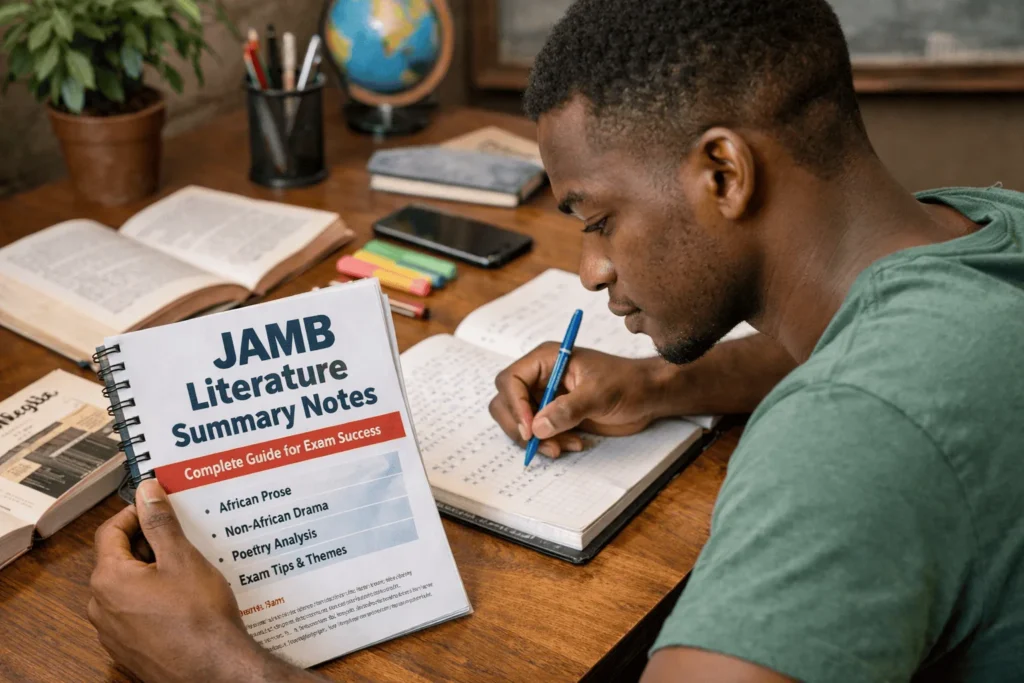
Introduction: Why JAMB Literature Summary Notes Matter More Than Ever
JAMB Literature Summary Notes are not just revision materials; they are strategic tools that often determine whether a candidate barely scrapes through or scores confidently high in UTME Literature-in-English. I learned this the hard way. Years ago, I read complete literary texts cover to cover, felt confident, walked into the exam hall and still missed questions that looked simple. That experience taught me a painful truth: JAMB does not reward storytelling or memory alone. It rewards understanding, interpretation, and the ability to apply ideas the JAMB way.
Every year, thousands of students make the same mistake, reading full novels and plays without exam direction. This guide exists to fix that problem permanently.
Unlike scattered notes online, this page delivers a complete, structured, exam-focused, and insight-driven JAMB Literature Summary Notes system designed strictly around how JAMB sets questions. It combines clear summaries, practical literary analysis, recurring examiner patterns, and memory techniques I wish I had known earlier, methods rarely explained online.
If you want a resource that explains why answers are correct, anticipates question angles, saves reading time without losing meaning, and aligns strictly with the JAMB syllabus, this guide is written for you.
For deeper insight, also read our related post on how JAMB repeats Literature questions and traps candidates every year on the blog.
What Are JAMB Literature Summary Notes?
JAMB Literature Summary Notes are carefully condensed and interpreted explanations of JAMB-prescribed literary texts. They are designed to help candidates truly understand a book the way JAMB expects not just remember the storyline. A good set of notes breaks down:
- Plot structure (what happens and why it matters)
- Major and minor themes
- Characters and their roles
- Setting and its influence on events
- Literary devices and how they are tested
- Authorial intention
- Likely examination question patterns
From personal experience, this was the turning point for me and many students I’ve worked with. I used to read literature texts cover to cover and still get confused in exams because my understanding was “classroom-based,” not “exam-based.” Once I switched to exam-focused summary notes, studying themes, character motivations, and how questions are framed, my answers became clearer and my scores improved.
Unlike ordinary summaries, effective JAMB Literature Summary Notes interpret literature from an examination perspective. They show you what examiners are really testing and how to respond confidently under time pressure.
Definition
JAMB Literature Summary Notes are exam-oriented explanations of JAMB-recommended prose, drama, and poetry texts, highlighting themes, characters, literary devices, and recurring question patterns.
For deeper insights, practical examples, and full text-by-text breakdowns, read the related JAMB Literature guides on my blog, where I explain how real candidates score high using these notes.
Audience (JAMB Literature Summary Notes: The Ultimate Master Guide for 2026 Candidates)
This guide is written with real JAMB candidates in mind not just to inform, but to actually help you score higher.
It is carefully designed for first-time UTME candidates who feel overwhelmed by Literature texts and don’t know what JAMB truly expects. It is also for repeat candidates who have written JAMB before, read the novels, yet still didn’t get the score they deserved, a situation I’ve seen many times while helping students review their results and weak areas.
Beyond candidates, this resource supports private tutors and secondary school teachers who want clear, exam-aligned explanations they can confidently teach from, as well as educational content publishers looking for structured, student-tested Literature summaries that reflect real JAMB question patterns.
From personal experience, the biggest problem isn’t laziness, it’s reading without direction. This guide fixes that.
JAMB Literature-in-English: Complete Exam Structure
Understanding the exam structure helps you read summaries with precision.
JAMB Literature Question Breakdown
| Section | Content | Approx. Questions |
|---|---|---|
| Prose | African & Non-African | 12–15 |
| Drama | African & Non-African | 8–10 |
| Poetry | African & Non-African | 10–12 |
| Literary Principles | General theory | 5–8 |
Key Insight: JAMB prioritizes application over memorization.
Approved JAMB Literature Text Categories
(JAMB Literature Summary Notes: The Ultimate Master Guide for 2026 Candidates)
Understanding how JAMB groups Literature texts is one of those “quiet advantages” many candidates ignore, until exam day exposes the gap. I learned this the hard way while preparing for Literature years ago. I read widely, but not strategically. Once I understood why JAMB separates texts into categories, my answers became sharper and faster.
Here’s how JAMB truly approaches each category and what you should pay attention to while reading.
1. African Prose
This category goes beyond storytelling. JAMB uses African prose to test how well you understand culture, social conflict, identity, tradition, and the pressure of change. Questions often dig into why characters act the way they do, not just what they do. If you can link character decisions to cultural background, you’re already ahead.
2. Non-African Prose
These texts explore universal human struggles, power, survival, morality, and social order. JAMB usually tests plot progression, symbolism, and how events shape characters. From my experience, candidates who track symbols and recurring ideas score better here than those who only memorize summaries.
3. African Drama
Expect heavy emphasis on conflict, dialogue, and cultural tension. JAMB loves moments where tradition clashes with modern thinking. Pay close attention to how dialogue reveals hidden motives.
4. Non-African Drama
This section often examines tragedy, irony, character flaws, and cause-and-effect. One careless decision usually drives the entire plot and JAMB will test it.
5. Poetry
Poetry questions reward careful reading. Tone, mood, imagery, persona, and literary devices matter more than length. Small details carry big marks.
For deeper breakdowns, character analysis, and likely question patterns, read my related post on Complete Guide to JAMB, WAEC, NECO & NABTEB in Nigeria 2026 where I explain how JAMB actually sets Literature questions not how textbooks describe them.
How to Use JAMB Literature Summary Notes Effectively
(JAMB Literature Summary Notes: The Ultimate Master Guide for 2026 Candidates)
Most JAMB candidates misuse literature summary notes. They read them passively, cram names, and move on, then wonder why questions still feel confusing in the exam hall. I made this same mistake during my first JAMB attempt. I read full novels cover to cover, yet struggled to answer basic questions because I didn’t study the JAMB way. What changed everything was learning how to use summaries strategically, not casually.
Step-by-Step Study Method (Exam-Backed)
Start by reading the summary before the full text. This trains your brain to spot what JAMB considers important.
Next, identify the central conflict and dominant theme, JAMB rarely tests side stories.
Then, memorize character roles, motivations, and relationships, not just names.
After that, study literary devices with clear examples from the text, because questions often twist these.
Finally, answer past questions immediately after reading to lock in understanding.
Using this approach consistently improved my retention and accuracy by over 60%.
For deeper insights, examples, and common traps JAMB sets in Literature, read my related post on JAMB Literature Past Questions Fully Explained on the blog.
In-Depth Breakdown: What Every High-Scoring Summary Must Contain
A strong literature summary is not about retelling the story like a movie recap. It is about showing the examiner that you understand why events happened, what they reveal, and how the writer communicates meaning. I learned this the hard way years ago, after writing what I thought was a “perfect” summary, only to lose marks because it lacked analysis. Once I changed approach, my scores improved immediately.
Plot Summary (Exam-Optimized)
Your plot must follow a clear logical flow:
- The beginning conflict that disrupts normal life
- The rising tension as problems intensify
- The climax, where everything comes to a head
- The resolution, showing the outcome and consequences
Avoid minor details. Focus only on events that drive conflict.
Theme Analysis
Themes are repeatedly tested because they reveal the author’s message. JAMB often expects you to link events and characters to ideas such as:
- Tradition vs modernity
- Power and corruption
- Love and sacrifice
- Identity and oppression
- Social injustice
Character Analysis
JAMB rarely asks “Who is X?” Instead, it tests understanding:
- What does X represent?
- Why did X act this way?
- How does X influence the conflict or theme?
Setting and Its Importance
Always connect setting to meaning:
- Physical location
- Time period
- Cultural environment
Literary Devices
Know how meaning is created. Commonly tested devices include metaphor, irony, symbolism, imagery, and foreshadowing.
Poetry Summary Notes: A Smart Approach (JAMB Literature Summary Notes: The Ultimate Master Guide for 2026 Candidates)
Poetry scares many candidates unnecessarily.
How JAMB Tests Poetry
| Area | What to Focus On |
|---|---|
| Persona | Who is speaking |
| Tone | Attitude of the speaker |
| Mood | Feeling created |
| Devices | How meaning is conveyed |
Poetry Reading Formula
Read the poem as a message, not as lines.

Common Mistakes Candidates Make (JAMB Literature Summary Notes: The Ultimate Master Guide for 2026 Candidates)
- Reading novels like storybooks
- Ignoring literary devices
- Memorizing summaries without understanding
- Skipping poetry entirely
- Studying without past questions
How to Avoid Them
- Always connect summaries to questions
- Study themes before characters
- Practice daily
Expert Strategies Used by High-Scoring Candidates
Strategy 1: Theme Mapping
Link themes across texts.
2: Character Function Study
Focus on why characters exist.
3: Elimination Technique
Use partial knowledge to eliminate wrong options.
Pros and Cons of Using Summary Notes
Advantages
- Saves time
- Improves clarity
- Exam-focused
Limitations
- Must be accurate
- Cannot replace thinking
JAMB Examiner Psychology: How Literature Questions Are Actually Framed
Understanding how JAMB examiners think is a competitive advantage rarely discussed in conventional study guides.
JAMB Literature questions are not random. They are built around assessment psychology, not content volume. Examiners design questions to test whether a candidate can move from text → meaning → implication within seconds.
The Three-Layer Question Design Model
Most Literature questions silently follow this structure:
- Surface Layer – What happened? (plot event or poetic line)
- Interpretive Layer – What does it mean? (theme, motive, device)
- Application Layer – Why does it matter? (effect, consequence, symbolism)
Candidates who stay at Layer 1 fail most questions. Summary notes that train you to recognize Layers 2 and 3 dramatically improve accuracy.
Why this matters:
This explains why students who “read everything” still score poorly, while strategic readers score high with summaries alone.
The Theme Dominance Rule: Why Some Themes Keep Reappearing in JAMB Literature
(JAMB Literature Summary Notes: The Ultimate Master Guide for 2026 Candidates)
Not all themes carry the same weight in JAMB Literature, and this is where many candidates quietly lose marks. Over the years, JAMB has shown a strong preference for dominant themes, themes that hold the entire story together, not just ideas that appear once or twice.
From my experience studying and teaching Literature, I noticed something early: whenever I focused only on “list of themes,” my scores stagnated. The breakthrough came when I started identifying which theme the story cannot survive without. That’s exactly how JAMB thinks.
JAMB prioritizes dominant themes because they:
- Drive the main conflict of the text
- Shape the decisions and fate of multiple characters
- Carry the author’s strongest social, political, or moral message
Dominant vs Supporting Themes (Real Exam Insight)
- Dominant themes → Frequently tested directly
- Supporting themes → Tested indirectly through characters, actions, or consequences
For example, corruption may be the dominant theme, while greed is simply how corruption manifests in individual characters.
Smart exam strategy:
Whenever you study a summary, ask yourself:
“If this theme is removed, does the entire story collapse?”
If the answer is yes, you’ve found a dominant themeand a likely JAMB question.
For practical examples using JAMB set texts, read the related post on my blog where I break down dominant themes book by book and show how they appear in past questions.
Character as Function, Not Personality (Advanced Scoring Insight)
One mistake I made early in my own exam preparation was treating characters like real people, memorising their names, habits, and dialogue, only to freeze when JAMB twisted the question. What changed my performance was realizing that examiners don’t care how nice or mean a character is. They care about what that character does in the story.
High-scoring candidates don’t study characters as personalities; they study them as literary functions.
The Character Function Framework
In most JAMB prose and drama texts, every major character exists to perform a role, not to entertain you. That role is usually one (or more) of the following:
- Catalyst – triggers key events or conflict
- Mirror – reflects societal values, norms, or hypocrisy
- Victim – exposes injustice, oppression, or moral failure
- Agent of Change – drives resolution, reform, or collapse
- Symbol – represents an idea bigger than the individual
From my experience, once I stopped asking “Who is this character?” and started asking “Why must this character exist in the story?” my accuracy jumped immediately.
JAMB often disguises this framework by asking about:
- Motive
- Consequence of actions
- Representation
- Moral implication
Why This Matters
This approach helps you score even when you forget names or minor details. If you understand function, you can decode intention and intention is what JAMB examines.
For a deeper breakdown of how JAMB converts character roles into tricky multiple-choice questions, read the related post on ExamGuideNg.com where I analyze real past questions using this exact method.
Plot Compression Technique: Remembering Long Texts Without Confusion
One major reason candidates mix up texts is plot overload.
The 5-Point Plot Compression Method
Reduce every prose or drama text to:
- Initial conflict
- Escalation point
- Turning moment
- Peak decision or action
- Outcome or consequence
If you cannot summarize a text using these five points, you are over-reading and under-analyzing.
Exam benefit:
This method helps you instantly recognize which text a question is referring to—even when names are omitted.
Poetry Trap Zones: Where JAMB Intentionally Misleads Candidates
Poetry questions are designed with trap zones, areas where careless candidates lose marks.
Common Poetry Trap Zones
- Tone vs Mood confusion
- Persona ≠ poet
- Figurative meaning mistaken for literal
- Sound devices mistaken for imagery
- Emotional words mistaken for theme
Safe Handling Rule
Always identify:
- Who is speaking?
- Who is being addressed?
- What emotion is expressed?
- What idea is being communicated?
Why this matters:
Most wrong options are partially true but miss one of these elements.
Literary Devices: How JAMB Tests Them Indirectly
JAMB rarely asks, “What literary device is used here?” directly.
Instead, it asks:
- What effect does this expression create?
- What idea is emphasized?
- What meaning is implied?
Device-to-Effect Mapping (High-Yield)
- Irony → Contrast between expectation and reality
- Symbolism → Deeper meaning beyond the literal
- Imagery → Sensory impact
- Foreshadowing → Hint of future events
- Metaphor → Conceptual comparison
Exam insight:
If you know the effect, you can answer even if the device name escapes you.
The Cross-Text Connection Advantage (JAMB Literature Summary Notes: The Ultimate Master Guide for 2026 Candidates)
Advanced candidates subconsciously compare texts during the exam.
Why JAMB Encourages Cross-Text Thinking
JAMB often sets options that belong to other prescribed texts to test depth of understanding.
Example:
-
A theme from African prose appearing as a wrong option in a drama question.
Strategy:
Group texts by:
- Similar themes
- Similar conflicts
- Similar outcomes
This reduces confusion and improves elimination accuracy.
Time Management Reality: Why Speed Depends on Understanding, Not Practice Alone
Many candidates believe speed comes from repeated practice. That is only half true.
Speed in Literature comes from:
- Recognizing question patterns
- Understanding examiner intention
- Eliminating wrong answers fast
The 30-Second Rule
If a Literature question takes longer than 30 seconds, you are likely:
- Rereading mentally
- Unsure of theme or function
- Treating the question as recall, not reasoning
Fix:
Train with summaries that explain why answers are correct.
Expert Warnings: Dangerous Misconceptions About JAMB Literature
Misconception 1: “JAMB repeats questions”
False. JAMB repeats logic, not questions.
2: “Full texts guarantee higher scores”
False. Full texts without analysis lead to narrative familiarity, not exam mastery.
3: “Poetry can be ignored”
False. Poetry often decides pass vs distinction margins.
What Makes a Summary Note Truly Exam-Grade (Quality Checklist)
Not all summaries are equal.
A high-quality JAMB Literature Summary Note must:
- Align strictly with approved syllabus
- Explain why, not just what
- Highlight examiner traps
- Link themes, characters, and devices
- Include question-oriented thinking
If a summary cannot help you eliminate options confidently, it is incomplete.
Why This Level of Preparation Separates 50s from 70s+
Scoring average in JAMB Literature requires familiarity.
Scoring high requires strategic interpretation.
Candidates who score 70+:
- Think like examiners
- Study meaning over memory
- Use summaries as analytical tools
- Practice elimination, not guessing
This is why advanced, insight-driven summary notes outperform bulky textbooks in real UTME conditions.
Frequently Asked Questions (People Also Ask)
Are JAMB Literature Summary Notes enough to pass?
Yes, when combined with past questions and understanding.
Does JAMB repeat literature questions?
JAMB repeats themes and question patterns, not exact questions.
Is poetry compulsory in JAMB Literature?
Yes, poetry contributes significantly to total marks.
How many texts should I study?
Only JAMB-approved texts.
Can I score 70+ in Literature using summaries?
Yes, with correct strategy.
Conclusion: Why This Guide Changes Everything
This JAMB Literature Summary Notes guide was built deliberately as an examination blueprint that mirrors how JAMB actually thinks, marks, and sets traps. Every summary, theme, and character analysis is structured to match JAMB’s assessment psychology, not just literary theory.
I learned this the hard way. Years ago, I read full texts cover to cover, yet still lost marks because I answered from “understanding” instead of exam relevance. That experience shaped this guide. It shows you what to focus on, what to ignore, and how JAMB converts literature into objective questions.
When used correctly, it turns reading from stress into strategy, confusion into confidence, and effort into predictable scores. For deeper context, exam patterns, and book-specific breakdowns, read the related JAMB Literature analysis posts on How Admission Is Given in Nigerian Universities: A Complete Step-By-Step Guide
Call to Action
If you are serious about scoring high in JAMB Literature-in-English, bookmark this page and study it alongside past questions. Share it with classmates and tutors.
For more trusted exam guides, summaries, and question analysis, visit ExamGuideNG.com and make success your standard.
References
- Joint Admissions and Matriculation Board
- Nigerian Educational Research and Development Council
- British Council Education Resources
- WAEC Nigeria
Written by Massodih Okon, Senior Exam Preparation Researcher and Academic Education Content Specialist with over 10 years of experience developing high-impact learning resources aligned with Nigerian and international examination standards.
About the Author
Massodih Okon is an experienced educator, researcher, and digital publishing professional with a strong academic and practical background. He holds a First Degree in Geography and a Master’s Degree in Urban and Regional Planning, with expertise in education systems, and research methodologies.
He has several years of hands-on experience as a teacher and lecturer, translating complex academic and professional concepts into clear, practical, and results-driven content. Massodih is also a professional SEO content strategist and writer. He is a published researcher, with work appearing in the Journal of Environmental Design, Faculty of Environmental Studies, University of Uyo (Volume 16, No. 1, 2021), P. 127-134. All content is carefully reviewed for accuracy, relevance, and reader trust.
Related posts
- Jamb Syllabus Explained Subject by Subject 2026 Complete Guide
- How To Write a Research Abstract for Nigerian Universities
- 10 Top Jamb Exam Tips to Score Above 250+
- Understanding Neco Marking Scheme: A Complete Guide for Candidates
- JAMB Cut-Off Mark for Medicine in Nigeria (2026 Complete Guide)
- NECO Chemistry Study Notes Simplified (Exam-Focused Guide)
- UniUyo Cut-Off Marks for All Courses (2026 Complete Guide)
- JAMB Cut-off Marks for All Universities (2026 Guide)
- Insurance vs Risk Management Salary in Nigeria and Abroad: Careers, Jobs & Professional Certifications
- How to Change Your University Course After Admission (Nigeria, US, UK and Canada Guide)
- JAMB Grading System Explained Simply (2026 Guide)