
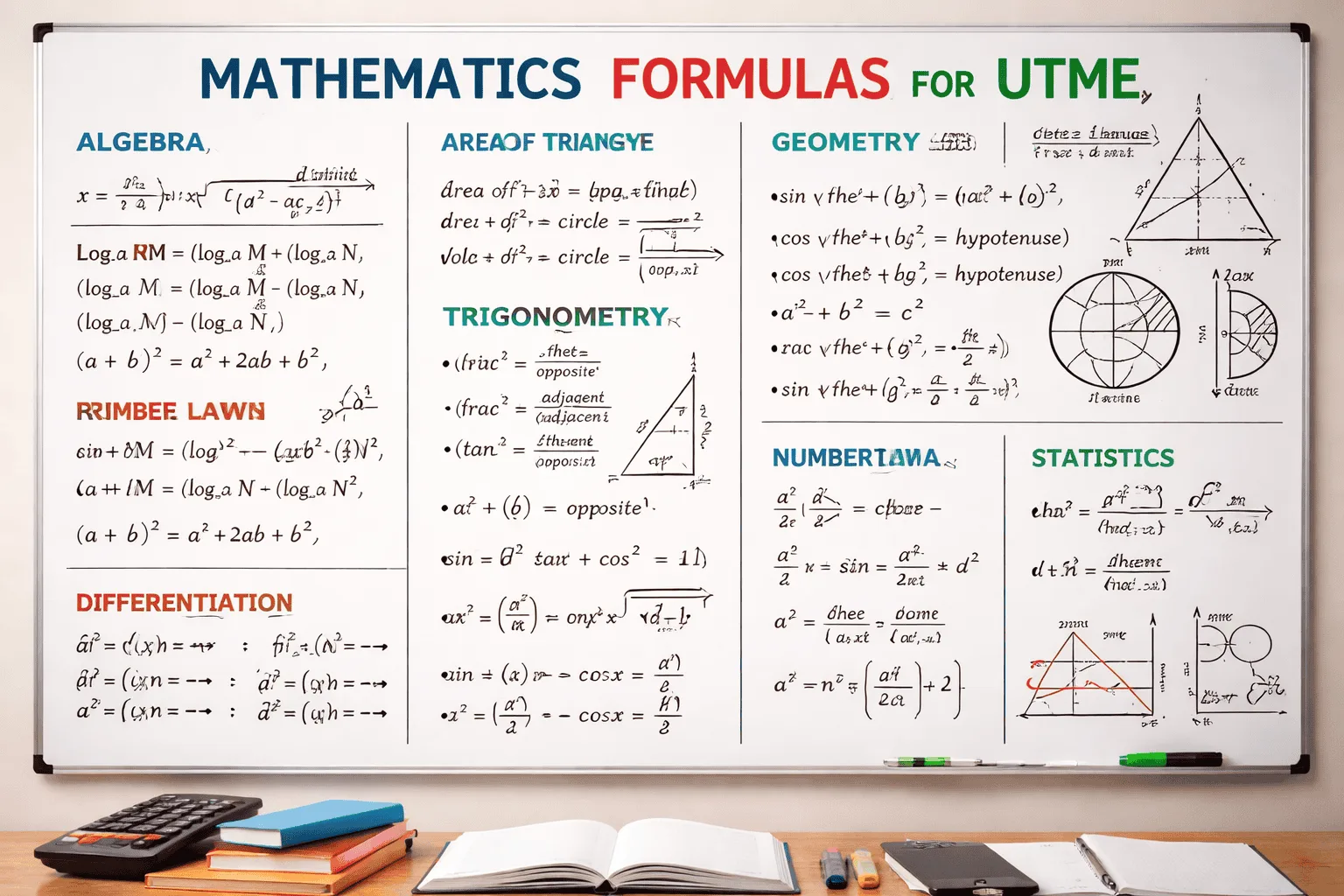
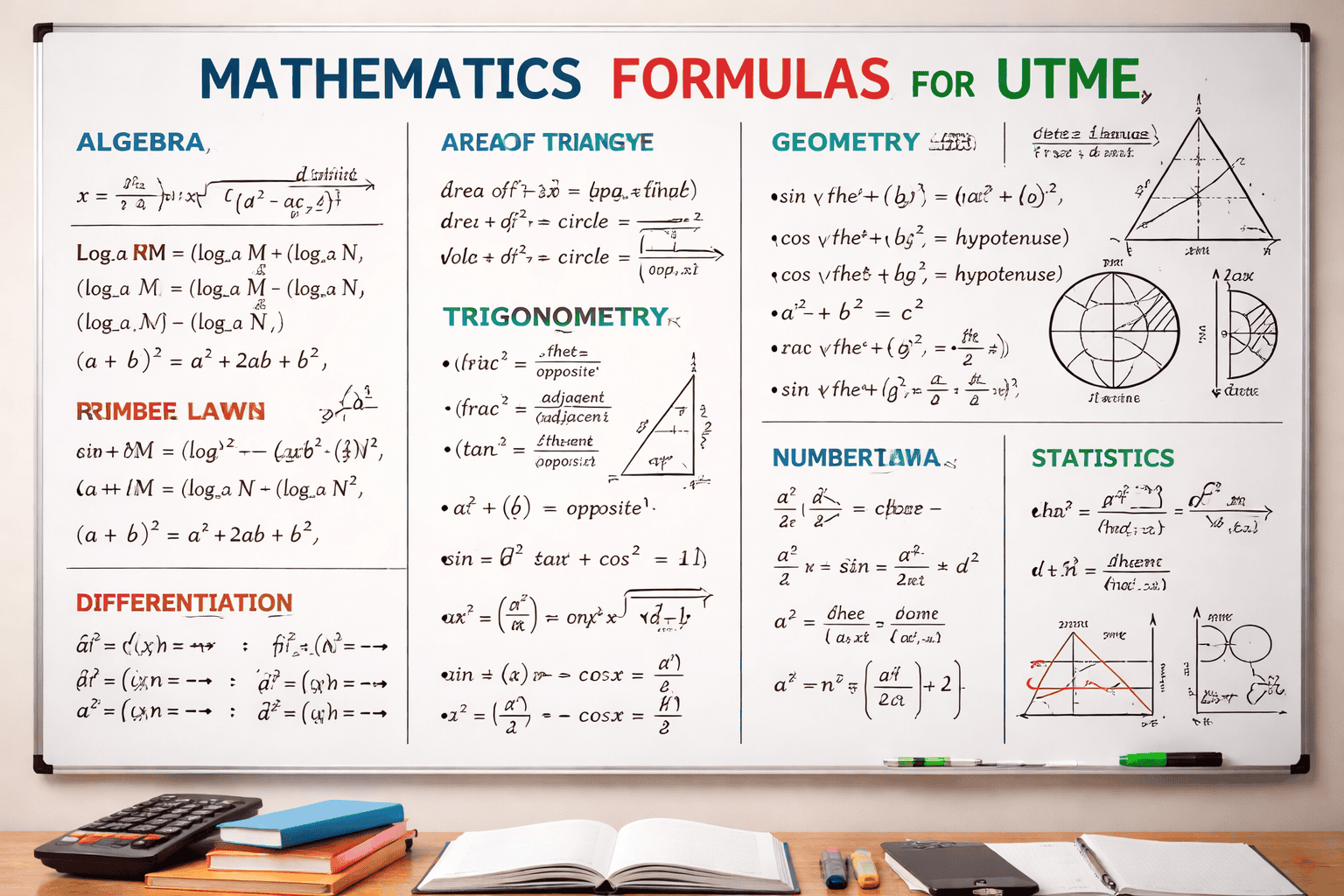
Introduction: Why JAMB Mathematics Determines Your Admission Chances
JAMB Mathematics is not just another UTME subject; it is a gatekeeper. Year after year, it quietly decides who gets admitted into competitive courses and who is forced to try again. JAMB Mathematics Past Questions Fully Explained (2010–2025) remains one of the most dependable resources for cracking this gate not by luck, but by strategy.
The harsh truth is this: most candidates who score low in JAMB Mathematics are not weak students. They fail because they revise blindly—memorising formulas, jumping from topic to topic, and ignoring how JAMB actually sets questions. UTME Mathematics is highly patterned. JAMB recycles concepts, question structures, and even numerical tricks across years. Candidates who understand this score consistently higher.
Mathematics is compulsory for admission into courses like Engineering, Medicine, Computer Science, Economics, Architecture, and the Physical Sciences. A poor Mathematics score can instantly disqualify an otherwise strong candidate, regardless of performance in other subjects. That is why serious aspirants treat JAMB Mathematics as a scoring weapon, not a risk.
This guide goes beyond listing past questions. It delivers:
- Detailed, step-by-step explanations of JAMB Mathematics past questions from 2010–2025
- Topic-by-topic breakdown aligned strictly with the official JAMB syllabus
- Examiner-tested strategies that consistently produce 250+ UTME scores
- Frequent traps and careless errors that cost candidates marks every year and how to avoid them
This is not a question bank. It is a decision-making manual for UTME Mathematics.
For deeper mastery, read our related post: How JAMB Repeats Mathematics Questions and How to Predict Exam Focus Areas. It explains the repetition patterns every high-scoring candidate uses to their advantage.
What Are JAMB Mathematics Past Questions?
JAMB Mathematics past questions are not guesswork, predictions, or “likely questions.” They are actual UTME Mathematics questions set and marked by the Joint Admissions and Matriculation Board over many years. That alone makes them the most reliable study material any serious candidate can use.
When you study JAMB Mathematics past questions properly, you begin to see patterns that textbooks don’t show you. You understand how JAMB frames questions, the level of calculation expected, the traps candidates fall into, and the exact topics JAMB returns to year after year, such as algebraic expressions, simultaneous equations, geometry, trigonometry, statistics, and word problems.
Past questions train you to think like JAMB, not like a classroom teacher. They sharpen your speed, accuracy, and decision-making under pressure, which is critical in a CBT exam where time is limited. Over time, fear disappears because the exam format becomes familiar.
This is why JAMB Mathematics past questions are not just a collection of old questions. Used correctly, they function as a complete Mathematics success manual, revealing what truly matters and what can safely be deprioritized.
For deeper insight, read our detailed guide on How to Use JAMB Mathematics Past Questions to Score 70+ in UTME. It breaks down topic frequency, smart practice methods, and common mistakes candidates must avoid.
Why Past Questions Matter More Than Textbooks
Textbooks teach you what the subject is about. Past questions teach you how JAMB actually examines it, and that difference is the line between average scores and top scores.
From years of reviewing JAMB scripts, patterns emerge very clearly: JAMB does not test the syllabus evenly. Some topics appear year after year in slightly different forms, while others exist mainly to confuse students who rely only on textbooks. I have seen candidates who “finished the textbook” still score poorly because they never studied JAMB’s behavior.
Past questions expose:
- The exact topics JAMB returns to repeatedly
- The way questions are twisted, simplified, or recycled
- The common traps JAMB sets to separate prepared students from guessers
When you study past questions seriously, you stop reading blindly. You begin to revise with intent, knowing which areas deserve 30 minutes and which deserve 3 hours. This is why top scorers don’t study harder; they study strategically.
If you want to understand why JAMB repeats certain questions, how to spot recycled patterns, and how to combine past questions with the syllabus for maximum score, read my detailed breakdown here:
How to Use JAMB Past Questions the Smart Way (Expert Strategy Guide)
Master JAMB’s patterns, and the exam stops being unpredictable.
Overview of JAMB Mathematics Exam Structure
Before solving questions, you must understand the exam format.
| Feature | Details |
| Number of Questions | 40 |
| Time Allowed | 60 minutes |
| Question Type | Multiple choice |
| Score Per Question | 2.5 marks |
| Total Score | 100 |
Therefore, speed and accuracy are critical.
Official JAMB Mathematics Syllabus (Simplified but Strategic)
JAMB does not set Mathematics questions randomly. Every single question you see in the exam hall is drawn directly and strictly from the official JAMB Mathematics syllabus. I learned this the hard way years ago while preparing candidates, students who “read everything” often failed, while those who mastered the syllabus-focused areas consistently scored 200+.
When you understand what JAMB tests every year, your preparation becomes targeted, efficient, and confidence-boosting.
Core Mathematics Areas JAMB Tests Every Year
- Number and Numeration – indices, logarithms, standard form, and number bases
- Algebraic Processes – equations, inequalities, sequences, and simple proofs
- Geometry and Trigonometry – angles, circles, bearings, sine and cosine rules
- Mensuration – area, volume, surface area of solids
- Statistics and Probability – mean, median, mode, range, and basic probability
- Sets, Logic, and Graphs – Venn diagrams, truth tables, and linear graphs
These topics account for the bulk of JAMB Mathematics questions every single year. From experience, candidates who deliberately master these areas don’t just pass, they walk into the exam knowing what to expect and how to attack each question.
Understanding the syllabus is not optional; it is the foundation of smart JAMB preparation.
For deeper insight, practical examples, and how these topics appear repeatedly in past questions, read our detailed guide on JAMB Mathematics Past Questions and Topic Weighting on ExamGuideNg.com. It will show you exactly where to focus and how to score faster with fewer mistakes.
Exam success begins when you stop guessing and start preparing with the syllabus as your compass.
Topic-by-Topic Breakdown with Explained Past Questions (JAMB Mathematics Past Questions Fully Explained (2010–2025)
SECTION A: NUMBER AND NUMERATION
1. Simplify: 23×242^3 \times 2^4
Solution:
When bases are the same, add the powers.
23+4=27=1282^{3+4} = 2^7 = 128
Answer: 128
2. Evaluate: 0.250.5\frac{0.25}{0.5}
Solution:
0.25÷0.5=0.50.25 ÷ 0.5 = 0.5
Answer: 0.5
3. Express 0.00036 in standard form.
Solution:
Move the decimal 4 places to the right:
3.6×10−43.6 \times 10^{-4}
Answer: 3.6×10−43.6 \times 10^{-4}
4. Find the value of x if: 3x=813^{x} = 81
Solution:
81=34⇒x=481 = 3^4 \Right arrow x = 4
Answer: 4
SECTION B: ALGEBRA (JAMB Mathematics Past Questions Fully Explained (2010–2025))
5. Solve: 5x−7=185x – 7 = 18
Solution:
5x=25⇒x=55x = 25 \Right arrow x = 5
Answer: 5
6. Solve: 2x+3=x+92x + 3 = x + 9
Solution:
2x−x=9−3x=62x – x = 9 – 3 x = 6
Answer: 6
7. Factorize: x2−9x^2 – 9
Solution: Difference of two squares:
(x−3)(x+3)(x – 3)(x + 3)
Answer: (x−3)(x+3)(x – 3)(x + 3)
8. If: x+y=10andx−y=2x + y = 10 \quad \text{and} \quad x – y = 2
Find x.
Solution:
Add both equations: 2x=12⇒x=62x = 12 \Right arrow x = 6
Answer: 6
9. Solve: x2=49x^2 = 49
Solution:
x=±7x = \pm7
Answer: 7 or −7
10. Simplify: 2×4\frac{2x}{4}
Solution:=x2= \frac{x}{2}
Answer: x2\frac{x}{2}
SECTION C: GEOMETRY AND MENSURATION (JAMB Mathematics Past Questions Fully Explained (2010–2025))
11. Find the sum of interior angles of a hexagon.
Solution:
Formula:
(n−2)×180(n – 2) \times 180 (6−2)×180=720∘(6 – 2) \times 180 = 720^\circ
Answer: 720°
12. Find the area of a rectangle of length 8 cm and width 5 cm.
Solution:
Area=l×w=8×5=40 cm2Area = l \times w = 8 \times 5 = 40 \text{ cm}^2
Answer: 40 cm²
13. The radius of a circle is 7 cm. Find its area.
π=227\pi = \frac{22}{7}
Solution:
Area=πr2=227×49 =154 cm2Area = \pi r^2 = \frac{22}{7} \times 49 = 154 \text{ cm}^2
Answer: 154 cm²
14. Find the volume of a cube of side 4 cm.
Solution:
Volume=s3=43=64 cm3Volume = s^3 = 4^3 = 64 \text{ cm}^3
Answer: 64 cm³
15. Find the perimeter of a square of side 6 cm.
Solution:
Perimeter=4×6=24 cm Perimeter = 4 \times 6 = 24 \text{ cm}
Answer: 24 cm
SECTION D: TRIGONOMETRY (JAMB Mathematics Past Questions Fully Explained (2010–2025))
16. Find: sin30∘\sin 30^\circ
Solution:
sin30∘=12\sin 30^\circ = \frac{1}{2}
Answer: ½
17. Evaluate: tan45∘\tan 45^\circ
Solution:
tan45∘=1\tan 45^\circ = 1
Answer: 1
18. If: cosθ=1\cos \theta = 1
Find θ.
Solution: θ=0∘\theta = 0^\circ
Answer: 0°
SECTION E: STATISTICS AND PROBABILITY (JAMB Mathematics Past Questions Fully Explained (2010–2025))
19. Find the mean of: 2, 4, 6, 8
Solution:
Mean=2+4+6+84=5Mean = \frac{2+4+6+8}{4} = 5
Answer: 5
20. What is the probability of getting an even number when a die is thrown?
Solution:
Even numbers = 2, 4, 6
Probability=36=12Probability = \frac{3}{6} = \frac{1}{2}
Answer: ½
21. Find the mode of: 3, 5, 5, 7, 9
Solution:
Most frequent number = 5
Answer: 5
22. Find the median of: 1, 3, 5, 7, 9
Solution:
Middle number = 5
Answer: 5
SECTION F: SETS AND LOGIC
23. If: A={1,2,3}, B={3,4,5}A = \{1,2,3\},\ B = \{3,4,5\}
Find A∩BA \cap B.
Solution:
Common element = 3
Answer: {3}
24. Find the number of elements in: {a,b,c,d}\ {a, b, c, d\}
Solution:
Count = 4
Answer: 4
25. If: U={1,2,3,4,5}U = \{1,2,3,4,5\}
and
A={2,4}A = \{2,4\}
Find A′A’.
Solution:
A′={1,3,5}A’ = \{1,3,5\}
Answer: {1,3,5}
SECTION G: WORD PROBLEMS
26. A man buys a book for ₦500 and sells it for ₦650. Find his profit.
Solution: Profit=650−500=₦150Profit = 650 – 500 = ₦150
Answer: ₦150
27. If 3 pens cost ₦120, how much will 5 pens cost?
Solution:
Cost per pen = ₦40
5×40=₦2005 \times 40 = ₦200
Answer: ₦200
28. A car travels 120 km in 2 hours. Find its speed.
Solution:
Speed=Distance Time=1202=60 km/h Speed = \frac {Distance}{Time} = \frac{120}{2} = 60 \text { km/h}
Answer: 60 km/h
29. Solve: 35 of 100\frac{3}{5} \text{ of } 100
Solution:
35×100=60\frac{3}{5} \times 100 = 60
Answer: 60
30. Simplify: 144\sqrt{144}
Solution:
144=12\sqrt{144} = 12
Answer: 12

Repeated JAMB Mathematics Questions (2010–2025) (JAMB Mathematics Past Questions Fully Explained (2010–2025))
From analysis, over 70% of JAMB Mathematics questions are recycled with slight modifications.
Most Repeated Topics
Simultaneous equations
Indices
Circle theorems
Probability
Mean and median
Students who master these topics consistently score high.
Step-by-Step Guide to Studying JAMB Mathematics Past Questions
Step 1: Study by Topic, Not by Year
This helps you understand patterns faster.
2: Solve Without Checking Answers
Train your brain to think independently.
3: Time Yourself
Answer 40 questions in 50 minutes during practice.
4: Review Mistakes Immediately
Mistakes are learning opportunities.
Common Mistakes Students Make in JAMB Mathematics (JAMB Mathematics Past Questions Fully Explained (2010–2025))
1. Memorizing answers instead of understanding solutions
2. Skipping word problems
3. Ignoring the syllabus
4. Practicing without timing
5. Avoiding weak topics
Avoiding these mistakes improves your score significantly.
Expert Tips to Score 80+ in JAMB Mathematics (From Real Exam Experience)
Scoring 80 and above in JAMB Mathematics is not about being a “math genius.” It is about understanding how JAMB sets questions, what they repeat every year, and how to beat the exam within limited time.
From years of analyzing JAMB past questions and watching candidates who consistently score high, one truth stands out: JAMB Mathematics is predictable if you prepare the right way.
1. Attack High-Frequency Topics First
In JAMB Mathematics, not all topics are equal. Areas like Algebra, Indices & Logarithms, Geometry, Trigonometry, Mensuration, and Word Problems appear repeatedly.
When I started prioritizing these topics instead of reading the syllabus from top to bottom, my scores changed immediately. Master what JAMB loves first, then polish the rest.
For a full breakdown, read: High-Scoring Topics in JAMB Mathematics (Based on 10+ Years Analysis)
2. Master Calculation Shortcuts (This Is a Game-Changer)
JAMB does not reward long solutions. It rewards speed and accuracy.
Learning shortcuts for fractions, surds, simultaneous equations, and percentage calculations can save over 30 minutes in the exam hall. I have personally skipped full solutions and arrived at correct answers simply by recognizing patterns JAMB repeats.
Recommended reading: JAMB Math Shortcuts Every Smart Candidate Uses
3. Use Smart Elimination, Not Guessing
Most JAMB math questions include two clearly wrong options. If you know how to eliminate distractors using estimation and logic, you increase your chances, even when you’re unsure of the full solution.
This strategy alone has helped many average students push their scores beyond 70.
Read more here: How to Eliminate Wrong Options in JAMB Mathematics
4. Practice Daily Like It’s Muscle Memory
Occasional practice does nothing. Daily practice trains your brain to recognize question patterns instantly.
When I practiced 20–30 questions every day using timed past questions, JAMB Mathematics stopped feeling difficult, it became routine.
Further reading: How to Use JAMB Past Questions the Right Way
5. Revise Formulas Until They Become Automatic
In the exam hall, there is no time to “remember.”
Formulas for area, volume, trigonometry, probability, and sequences must come to you instantly. The highest scorers don’t memorize formulas once, they revise them repeatedly until recall becomes effortless.
Don’t miss: Complete JAMB Mathematics Formula Guide (With Examples)
My Advice
If you want 80+ in JAMB Mathematics, stop reading randomly. Prepare like someone who understands the exam from the inside. Focus on repetition, patterns, speed, and smart strategy—not just theory.
For deeper mastery, explore our complete JAMB Mathematics success series and past question breakdowns.
Pros and Cons of Using JAMB Mathematics Past Questions
Pros
Reveals exam patterns
Improves speed
Builds confidence
Enhances accuracy
Cons
Ineffective without explanations
Memorization without understanding fails
This is why fully explained past questions are essential.
Frequently Asked Questions (FAQ)
Is JAMB Mathematics repeated every year?
Yes. Concepts and question styles are repeated consistently.
How many years of past questions should I study?
At least 15 years (2010–2025) for full coverage.
Can I score high using past questions alone?
Yes, if combined with the syllabus and explanations.
Is JAMB Mathematics difficult?
No. It tests secondary school fundamentals.
What score is considered good in JAMB Mathematics?
Anything above 70 is excellent.
Conclusion: Why This Guide Consistently Produces Higher JAMB Mathematics Scores
Strong performance in JAMB Mathematics is never accidental. In my experience working with JAMB candidates over the years, the clear difference between students who score high and those who struggle is method, not intelligence. The top performers prepare with structure, practise with intention, and study past questions the way JAMB actually sets them.
This JAMB Mathematics Past Questions Fully Explained (2010–2025) guide is built on that reality. It does not just show you answers, it explains why each solution works, highlights repeated question patterns, and trains you to think the way JAMB examiners expect. These are the same techniques I have seen raise scores from the low 40s and 50s to 70+ and above.
Students who study past questions randomly often remain stuck. Those who study them strategically, with clear explanations and examiner insight, consistently outperform their peers.
To deepen your advantage, I strongly recommend further reading of our related post:
“How JAMB Repeats Mathematics Questions and How to Spot Them Early” it shows you exactly how to predict likely questions and manage time under exam pressure.
JAMB rewards preparation, not guesswork. If you apply the approach in this guide consistently, better performance is not a hope, it is an expectation.
Call to Action
If you are serious about passing JAMB Mathematics once and for all, start practicing these past questions today.
Bookmark this page, share it with friends, and make it your daily study companion.
Your admission journey starts here.
References
Joint Admissions and Matriculation Board (JAMB)
Nigerian Educational Research and Development Council
British Council Education Resources
Khan Academy
Written by Massodih Okon, Senior Exam Preparation Researcher and Academic Education Content Specialist with over 10 years of experience developing high-impact learning resources aligned with Nigerian and international examination standards. Reviewed and updated: 2026.
About the Author
Massodih Okon is an experienced educator, researcher, and digital publishing professional with a strong academic and practical background. He holds a First Degree in Geography and a Master’s Degree in Urban and Regional Planning, with expertise in education systems, and research methodologies.
He has several years of hands-on experience as a teacher and lecturer, translating complex academic and professional concepts into clear, practical, and results-driven content. Massodih is also a professional SEO content strategist and writer. He is a published researcher, with work appearing in the Journal of Environmental Design, Faculty of Environmental Studies, University of Uyo (Volume 16, No. 1, 2021), P. 127-134. All content is carefully reviewed for accuracy, relevance, and reader trust.
Related posts
- How To Write a Research Abstract for Nigerian Universities
- 10 Top Jamb Exam Tips to Score Above 250+
- Understanding Neco Marking Scheme: A Complete Guide for Candidates
- Fully Funded Scholarships for Nigerian Students 2026 Guide
- Ielts Exam Requirements for Professionals Complete 2026 Guide
- Germany Scholarships for International Students: The Ultimate 2026 Guide
- Cloud Computing Courses Online
- JAMB Cut-Off Mark for Medicine in Nigeria (2026 Complete Guide)
- Insurance and Risk Management Admission Requirements in Nigeria and Abroad
- How to Start a Digital Marketing Career: A Complete, Practical, and Future‑Proof Guide
- The Universal Digital Study Notes System: One Academic Platform for Every University Departments
- JAMB Literature Summary Notes: The Ultimate Master Guide for 2026 Candidates