
Introduction: Why Most Candidates Fail JAMB Mathematics (And How to Fix It)
I’ve worked with UTME candidates who could recite formulas perfectly yet still walked out of the exam hall confused and disappointed. JAMB Mathematics Revision Notes are everywhere online, but most students use them the wrong way. They revise harder, not smarter. The result? Long study hours, familiar topics, and shockingly low scores. Mathematics isn’t the real problem. The real issue is how candidates revise and what they think JAMB is testing.
From my experience reviewing past questions year after year, JAMB does not reward memorization. It rewards speed, pattern recognition, and applied reasoning under pressure. Unfortunately, many revision notes ignore this reality and treat JAMB like a school exam. That mistake alone costs candidates dozens of marks.
This guide, JAMB Mathematics Revision Notes: The Most Complete, Exam-Focused Guide for 2026 Candidates, was built differently. It breaks down Mathematics the way JAMB actually sets questions, highlights repeated question patterns, and exposes the traps that silently fail even “good” students.
By the end of this article, you’ll clearly understand what JAMB expects, how questions repeat, how to revise efficiently, and how to think like the examiner. For deeper clarity, don’t skip the related post JAMB Chemistry Topic Repetition Index (2016–2025): Data-Driven Exam Trend Analysis where I analyze real JAMB questions and show how top scorers approach them. This isn’t ordinary revision. It’s exam engineering, designed for results.
What Are JAMB Mathematics Revision Notes?
After years of coaching UTME candidates and personally reviewing hundreds of JAMB scripts, I’ve learned one hard truth: most students don’t fail Mathematics because it’s “too hard.” They fail because they revise the wrong way. JAMB Mathematics revision notes are not random summaries or recycled classroom notes. They are exam-driven blueprints built from how JAMB actually thinks and tests.
These notes distill the entire UTME Mathematics syllabus into examinable logic: the formulas JAMB loves, the patterns that repeat almost every year, and the traps examiners deliberately set to confuse candidates under pressure. Instead of drowning you in theory, they focus on:
- High-frequency topics that account for most marks
- Repeated question formats JAMB rarely abandons
- Smart shortcuts that save time in the exam hall
- Common distractors that trick unprepared candidates
In short, they prioritize what works when the clock is ticking, not what looks impressive in a textbook.
Who This Guide Is For
This guide is written with real candidates in mind not imaginary “perfect students.”
- Beginners who panic at algebra, word problems, or trigonometry
- Intermediate candidates stuck between 60–70 and wondering what’s missing
- High scorers deliberately aiming for 80+ and competing for top courses
- Private candidates and repeat writers who want a smarter, more strategic comeback
If you want deeper clarity on how JAMB sets Mathematics questions and why some topics matter more than others, make sure you read the related post on JAMB Mathematics topic patterns and scoring strategy. It connects directly to this guide and will sharpen your revision even further.
JAMB Mathematics Syllabus Explained in Practical Terms
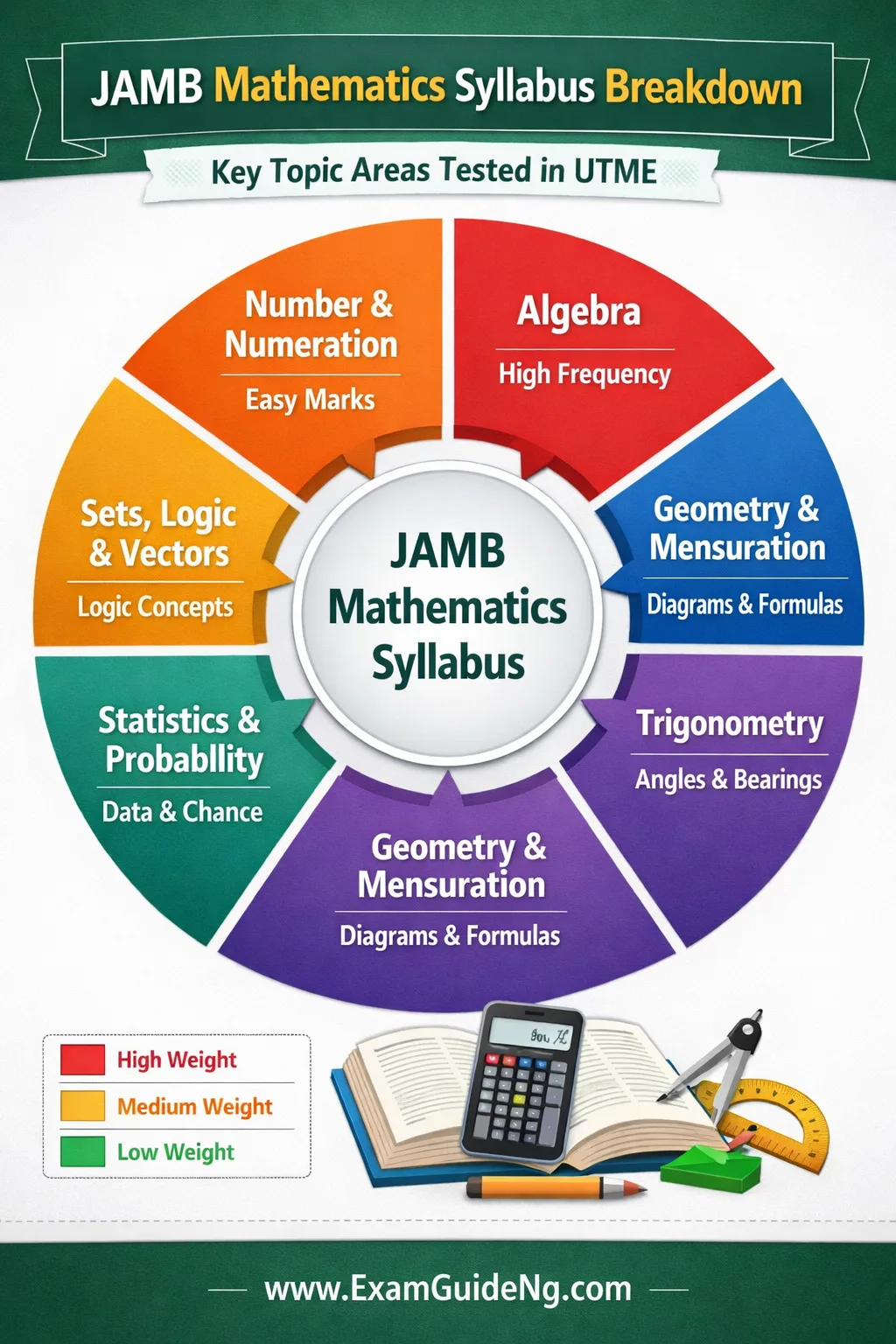
JAMB Mathematics is not random. The syllabus follows a predictable pattern that can be broken into scoring zones.
Core Mathematics Areas Tested by JAMB
| Topic Group | Average Weight | Difficulty Level |
|---|---|---|
| Number & Numeration | High | Easy–Medium |
| Algebra | Very High | Medium |
| Geometry & Mensuration | High | Medium |
| Trigonometry | Medium | Medium–Hard |
| Statistics & Probability | Medium | Easy |
| Sets, Logic & Vectors | Low | Easy |
Understanding this distribution alone already improves revision efficiency.
Number and Numeration (The Silent Mark-Booster in JAMB Mathematics)
If there’s one part of JAMB Mathematics I tell every serious candidate to respect, it’s Number and Numeration. From my years of guiding students and reviewing actual JAMB questions, this topic quietly delivers the highest number of low-stress, high-confidence marks, yet it’s also where many candidates bleed marks they should never lose.
What You Must Truly Master (Not Just “Know”)
You’re not just learning formulas here; you’re training your numerical instincts. Pay close attention to:
- Indices and logarithms (especially converting between standard form and powers)
- Surds and rationalization
- Approximation and significant figures (a JAMB favorite for trick options)
- Percentages, ratios, and proportional reasoning
- Number bases and base conversions
These concepts repeat year after year, often dressed in slightly different language.
Why Smart Candidates Still Fail This Section
Most mistakes don’t come from ignorance but from carelessness. I’ve watched brilliant students lose marks due to:
- Weak estimation skills
- Mixing up indices with standard form
- Rounding too early—or rounding the wrong way
JAMB knows this and sets options to punish speed without sense.
My Tested Exam Strategy
Before touching your calculator, solve every number question mentally first. Estimation exposes wrong options instantly and protects you from rounding traps. Only calculate to confirm.
For a deeper breakdown of common JAMB traps and real past-question patterns, don’t miss our detailed guide on JAMB Number & Numeration strategies, it will change how you approach this topic entirely.
Algebra: The Engine Room of JAMB Mathematics
(JAMB Mathematics Revision Notes: The Most Complete, Exam-Focused Guide for 2026 Candidates)
After years of guiding JAMB candidates and watching thousands of real scripts get marked, one truth keeps repeating itself: Algebra decides your final score more than any other topic in JAMB Mathematics. I’ve seen students who were average in Geometry and Trigonometry still cross 250 simply because they mastered Algebra. I’ve also seen brilliant students fall below expectations because they ignored it.
In JAMB, Algebra is not just another topic. It is the engine room of the exam. If your Algebra is weak, your speed drops, your confidence crashes, and panic sets in by question 20.
Algebra Topics You Must Control (Not Just “Know”)
JAMB does not reward surface knowledge. You must be comfortable with:
- Linear equations (especially forming them from statements)
- Simultaneous equations (both substitution and elimination)
- Quadratic equations (factorization over formula memorization)
- Inequalities (number line interpretation is key)
- Word problems (ages, ratios, and simple business math appear every year)
Miss these, and you miss free marks.
How JAMB Sets Algebra Questions
Contrary to fear, JAMB does not test abstract or university-level algebra. Instead, questions are deliberately:
- Tied to everyday situations candidates can relate to
- Designed for 2–3 step solutions, not long calculations
- Structured so smart option-elimination works faster than full solving
Once you understand this pattern, Algebra stops being scary and starts feeling predictable.
An Expert Strategy That Actually Works
During CBT exams, time is your biggest enemy. In many Algebra questions, substituting the options back into the equation is faster and safer than solving from scratch. This single habit alone has helped candidates gain 10–20 extra marks without learning any new formulas.
For a deeper breakdown of how JAMB repeats Algebra questions yearly and how to spot them instantly, read our detailed post on JAMB Mathematics question patterns and smart elimination techniques. It will change how you approach the exam.
Master Algebra, and JAMB Mathematics becomes a scoring subject, not a gamble.
Geometry and Mensuration: Where Precision Separates High Scores from Regret
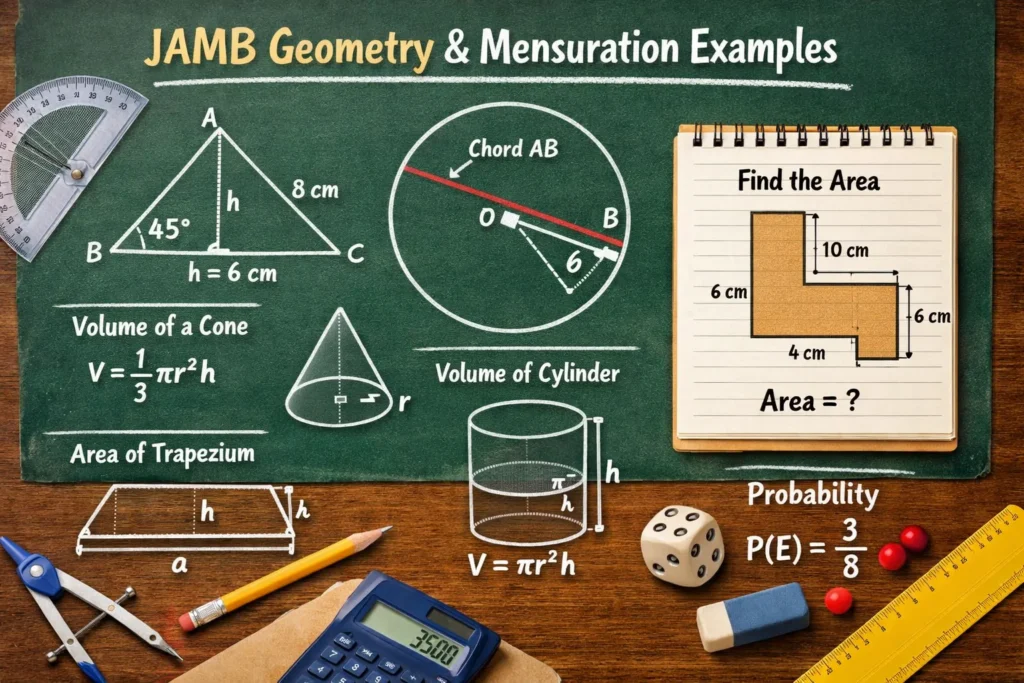
From years of reviewing JAMB scripts and coaching candidates, one truth keeps repeating itself: Geometry doesn’t punish ignorance of formulas, it punishes careless thinking. Many students rush to memorize equations yet ignore the diagram staring back at them. In real exams, the diagram is the question. If you read it well, half the work is already done.
Core Geometry Areas You Must Truly Understand
- Angles and parallel lines (especially alternate and corresponding angles)
- Properties of polygons
- Circles: chords, tangents, arcs, and angles
- Areas and volumes in real-life shapes
Mensuration Formulas That Still Matter
Yes, you must memorize key formulas, area of a circle, volumes of cylinders, cones, and spheres, plus surface areas but memorization alone won’t save you.
The Silent Score Killer
The most painful mistake I see is wrong units. Writing cm instead of cm² or cm³ can wipe out full marks instantly, even when the calculation is correct.
If you want deeper, worked examples and examiner tricks, read our related post on Geometry and Mensuration Exam Strategies, it breaks down exactly how top scorers think during the exam.
Trigonometry Made Simple for JAMB
(JAMB Mathematics Revision Notes: The Most Complete, Exam-Focused Guide for 2026 Candidates)
When I was preparing students for JAMB Mathematics, trigonometry was one topic that caused unnecessary fear. Not because it was difficult but because candidates overthought it. From years of marking scripts and reviewing past JAMB questions, one truth stands out clearly: JAMB trigonometry is simple, but it is designed to trap careless candidates.
JAMB does not test advanced identities or complex proofs. Instead, it rewards candidates who understand basics and apply them calmly under exam pressure.
What JAMB Really Tests in Trigonometry
You should concentrate your revision on just three areas:
- Sine, cosine, and tangent of standard angles
- Bearings, especially interpreting directions correctly
- Angle of elevation and depression, often hidden in word problems
If you master these, you’ve already covered over 90% of what JAMB sets from trigonometry.
A Smart Revision Tip That Works
Memorize the trigonometric values of 0°, 30°, 45°, 60°, and 90° until they become automatic. In real JAMB exams, I’ve seen candidates lose marks simply because they forgot that sin 30° is ½ or mixed up tan 45°.
For deeper clarity, especially on bearings and word-problem tricks, read our related JAMB Mathematics revision post, where we break down past questions step by step and show you how JAMB thinks.
Statistics and Probability: Your Quiet Score Booster
If I’m being honest, this section saved my JAMB score more than once. While many candidates panic over algebra and geometry, Statistics and Probability sit quietly in the corner, handing out marks to anyone willing to pay attention. Every year, I see students skip it, assuming it’s “too small” to matter. That assumption costs them easy points.
Focus your revision on mean, median, and mode, because JAMB repeats these ideas endlessly, just with different numbers. Learn how to read bar charts and pie charts carefully; most mistakes come from rushing, not from difficulty. As for simple probability, once you understand outcomes and total possibilities, the questions almost solve themselves.
What makes this section powerful is its simplicity. You’re not battling formulas or theories, just clean arithmetic and clear thinking. If you want a deeper breakdown with real JAMB-style examples and common traps to avoid, make sure you read the related post on mastering JAMB Statistics questions before your next revision session.
Sets, Logic, and Vectors
(JAMB Mathematics Revision Notes: The Most Complete, Exam-Focused Guide for 2026 Candidates)
This topic looks harmless on the syllabus, and that’s exactly why many candidates lose easy marks here. Over the years, while guiding JAMB candidates and reviewing past scripts, I’ve noticed a clear pattern: students rush these questions, assume they’re “too simple,” and then make avoidable errors. In reality, Sets, Logic, and Vectors are among the most predictable areas in JAMB Mathematics, if you respect them.
What You Must Truly Understand
Don’t just memorize terms. Be fluent with Venn diagrams, especially two- and three-set problems involving shading. Know how union, intersection, and complements work together in real questions. For vectors, focus on basic operations like addition, subtraction, and magnitude, JAMB rarely goes beyond fundamentals, but it tests precision.
Exam-Smart Scoring Advice
Always draw it out. I’ve personally seen students jump from 0 to full marks simply by sketching a quick diagram before answering. Visual thinking reduces confusion and saves time.
For deeper clarity, especially on common JAMB traps in Venn diagrams and vector questions, read the related post linked below, it breaks down real past questions step by step.
A Practical, Step-by-Step JAMB Mathematics Revision Strategy That Actually Works
After years of watching students fail JAMB Mathematics not because they were lazy, but because they revised randomly—I learned one hard truth: structure beats intelligence every time. This strategy is the same framework I’ve seen average students use to score far above expectations.
Step 1: Plan Strictly Around the JAMB Syllabus
Do not revise Mathematics like a school exam. Start with the official JAMB syllabus and break it into weekly, non-negotiable targets. For example, reserve one week solely for Algebra and another for Trigonometry. This approach prevents topic overload and ensures you don’t waste time on areas JAMB barely tests.
Step 2: Map Past Questions, Not Just Topics
When I began analyzing past questions year by year, patterns jumped out immediately. Certain question types repeat with slight twists. Identify these patterns and prioritize them. This is where smart students separate themselves from hardworking ones.
Step 3: Practice Under Real Exam Pressure
Timed practice changed everything for my students. Set a timer, sit upright, and answer questions exactly like exam day. Speed and accuracy are skills, you must train them deliberately.
Step 4: Keep an Error Review Journal
Every wrong answer is a lesson. Write the mistake, the correct method, and why you failed. Reviewing this journal weekly dramatically reduces repeated errors.
For deeper insight, examples, and topic-by-topic breakdowns, read our detailed JAMB Mathematics revision guide linked below.
Common JAMB Mathematics Mistakes and How to Avoid Them
| Mistake | Solution |
|---|---|
| Rushing calculations | Use estimation first |
| Memorizing without understanding | Learn concept logic |
| Ignoring easy topics | Secure easy marks first |
| Poor time management | Practice with stopwatch |
Best Practices from High-Scoring Candidates
- Attempt easy questions first
- Eliminate wrong options before solving
- Use rough sheets wisely
- Never leave a question unanswered
The Hidden Logic Behind JAMB Mathematics Question Design
(Why some options are meant to mislead you)
JAMB Mathematics questions are not only testing correctness; they are testing decision-making under pressure. Most incorrect options are not random, they are engineered around predictable student errors.
Common Distractor Engineering Patterns
JAMB examiners often design wrong options based on:
- Single-step omission (skipping unit conversion, sign change, or squaring)
- Most popular classroom mistake (e.g., using perimeter formula instead of area)
- Mental shortcut abuse (rounding too early or approximating wrongly)
Why this matters:
Once you recognize the logic behind wrong options, elimination becomes faster than full calculation. High scorers don’t always “solve” they outthink the examiner.
The 3-Tier Scoring Model Used by Top UTME Candidates
(A practical framework for prioritizing questions)
High-performing candidates subconsciously apply a scoring hierarchy during the exam.
Tier 1: Guaranteed Marks (First 20–25 Questions)
These include:
- Direct number operations
- Basic statistics
- Simple algebra substitutions
Target: 95–100% accuracy
2: Convertible Marks (Middle Questions)
These require:
- Two-step reasoning
- Diagram interpretation
- Formula application with care
Target: 60–70% accuracy
3: Risk Questions (Last Layer)
These include:
- Complex word problems
- Multi-concept geometry
- Time-consuming algebra
Target: Selective attempts only
Why this matters:
Trying to treat all 40 questions equally is a strategic mistake. JAMB rewards prioritization, not brute force.
Why JAMB Rarely Tests “Full Solutions”
(And how this should change your revision style)
Unlike school exams, JAMB does not award method marks. This has two implications:
- Long solutions offer no extra reward
- Fast logic beats perfect working
Smart Adjustment Strategy
During revision:
- Practice mental estimation
- Train yourself to solve to the nearest logic, not final decimal
- Learn when substitution beats algebra
Expert warning:
Candidates who revise only with long-form textbook solutions often struggle with speed in CBT environments.
Topic Overlap Zones: Where JAMB Double-Tests You
(Rarely discussed but highly examinable insight)
JAMB frequently blends two topics into one question to test flexibility.
Common Overlap Combinations
- Algebra + Geometry (e.g., equation derived from a diagram)
- Trigonometry + Bearings
- Statistics + Approximation
- Mensuration + Ratio
Why this matters:
Students who revise topics in isolation miss these blended patterns. Revising with connection awareness significantly boosts adaptability.
Time Economics in the CBT Hall (JAMB Mathematics Revision Notes: The Most Complete, Exam-Focused Guide for 2026 Candidates)
(How seconds, not knowledge, decide scores)
With limited time per question, efficiency becomes currency.
Practical Time Rules
- If a question exceeds 60 seconds, flag and move on
- Never solve what can be eliminated
- Use the on-screen calculator only after estimation
Case-style reasoning:
Candidates who score 80+ are not faster calculators, they are better decision-makers under time pressure.
The “One-Line Check” Method to Reduce Silly Errors
(A professional habit used by repeat high scorers)
Before clicking “Next,” apply this quick scan:
- Does the unit make sense?
- Is the answer within a reasonable range?
- Did the question ask for x or 2x?
- Was approximation required?
This habit alone prevents a significant percentage of avoidable errors.
Misconceptions That Quietly Destroy JAMB Mathematics Scores
Misconception 1: “Hard questions give higher marks”
All questions carry equal marks. Spending 5 minutes on one hard question is mathematically inefficient.
2: “You must solve everything to score high”
Selective accuracy beats universal struggle.
3: “Calculator guarantees correctness”
Most JAMB calculator errors come from wrong inputs, not wrong logic.
How Examiners Recycle Mathematics Questions Without Repeating Them
(A deep exam insight)
JAMB rarely repeats questions verbatim. Instead, they recycle:
- Structure
- Logic
- Trap pattern
A question may look new but test the same reasoning as one from five years ago.
Why this matters:
Revision that focuses only on final answers misses the examiner’s thinking style. Pattern recognition is more valuable than memorization.
The Final-Week Mathematics Revision Protocol
(What to revise and what to stop revising)
Focus On:
- High-frequency question types
- Personal error journal
- Mixed-topic practice sets
- Speed drills
Avoid:
- Learning new formulas
- Switching textbooks
- Overloading with mock tests without review
Expert advice:
The final week is for refinement, not exploration.
How Mathematics Scores Influence Overall JAMB Ranking
(Often overlooked strategic insight)
Mathematics is one of the few subjects where:
- Scores are widely spread
- Small improvements create large ranking jumps
Improving Mathematics by just 10 marks can outperform gains in more memorization-based subjects.
Why This Revision Approach Aligns with How JAMB Actually Marks
This guide works because it mirrors:
- Examiner intent
- CBT constraints
- Real candidate behavior
It is not built for classroom perfection but for exam dominance.
Frequently Asked Questions (FAQ) (JAMB Mathematics Revision Notes: The Most Complete, Exam-Focused Guide for 2026 Candidates)
What is the best way to revise JAMB Mathematics?
Focus on syllabus-based revision, past questions, and concept clarity.
How many questions come from algebra in JAMB?
Algebra usually contributes the highest number of questions.
Is calculator allowed in JAMB Mathematics?
Yes, JAMB provides an on-screen calculator.
Can I score high without studying all topics?
Yes, but only if you master high-weight areas.
Conclusion: How to Use These JAMB Mathematics Revision Notes the Smart Way
I’ve worked with JAMB candidates who failed Mathematics not because they were dull, but because they revised wrongly. These revision notes are not a “read-once-and-forget” material. Treat them like a working tool. Revisit them every week, solve questions daily, and test yourself under time pressure at least twice a week. That routine alone separates serious candidates from hopeful ones.
JAMB Mathematics rewards strategy more than raw intelligence. When you focus on recurring question patterns, master shortcuts, and correct your mistakes early, your confidence grows naturally. On the other hand, endless reading without practice only creates false comfort.
Candidates who revise intentionally always outperform those who cram blindly. If you want deeper insight, common traps, and proven revision schedules, read our related post on how to spot repeated JAMB Mathematics questions and answer them faster.
Call to Action
If you found this guide valuable, bookmark ExamGuideNg.com, share it with serious candidates, and use it as your final revision companion. This is the level of preparation that separates average scores from outstanding results.
References
Written by Massodih Okon, Senior Exam Preparation Researcher and Academic Education Content Specialist with over 10 years of experience developing high-impact learning resources aligned with Nigerian and international examination standards.
About the Author
Massodih Okon is an experienced educator, researcher, and digital publishing professional with a strong academic and practical background. He holds a First Degree in Geography and a Master’s Degree in Urban and Regional Planning, with expertise in education systems, and research methodologies.
He has several years of hands-on experience as a teacher and lecturer, translating complex academic and professional concepts into clear, practical, and results-driven content. Massodih is also a professional SEO content strategist and writer. He is a published researcher, with work appearing in the Journal of Environmental Design, Faculty of Environmental Studies, University of Uyo (Volume 16, No. 1, 2021), P. 127-134. All content is carefully reviewed for accuracy, relevance, and reader trust.
Related posts
- Jamb Syllabus Explained Subject by Subject 2026 Complete Guide
- 10 Top Jamb Exam Tips to Score Above 250+
- JAMB Cut-Off Mark for Medicine in Nigeria (2026 Complete Guide)
- NECO Chemistry Study Notes Simplified (Exam-Focused Guide)
- JAMB Literature Summary Notes: The Ultimate Master Guide for 2026 Candidates
- JAMB Grading System Explained Simply (2026 Guide)
- How to Gain Admission Without JAMB in Nigeria (Complete Expert Guide)
- Complete Guide to JAMB, WAEC, NECO & NABTEB in Nigeria 2026
- JAMB Success Strategies for Science Students in Nigeria: Best Requirements & JAMB Registration Portal
- Insurance vs Risk Management Salary in Nigeria and Abroad: Careers, Jobs & Professional Certifications