
Written by Massodih Okon, Senior Exam Preparation Researcher & Academic Education Content Specialist.
Reviewed for accuracy and updated January 2026.
Introduction: JAMB Mathematics Topic Repetition Index (2016–2025): Data-Based Exam Trend Analysis
This page delivers a data-driven analysis of how JAMB Mathematics topics repeat across examination years. Specifically, it examines topic frequency from 2016 to 2025 to reveal clear, measurable exam patterns.
The primary objective is simple but powerful: to help candidates, teachers, and educators identify high-priority topics using historical evidence rather than guesswork.
Instead of studying blindly or depending on rumors about “likely questions,” this resource introduces a structured, evidence-based approach. Through this approach, readers can clearly see what JAMB tests consistently, what appears occasionally, and what rarely comes out.
For deeper preparation, also read: JAMB Mathematics Revision Notes: The Most Complete, Exam-Focused Guide for 2026 Candidates, JAMB Mathematics Past Questions Fully Explained (2010–2025), and NECO Mathematics Past Questions and Solutions (Free Detailed Guide).
Overall, this analysis supports:
- JAMB candidates who want to prepare strategically
- Teachers who need exam-focused lesson plans
- Tutorial centers that aim to optimize revision schedules
- Educational bloggers and content creators seeking reliable reference data
Data Source and Methodology
(JAMB Mathematics Topic Repetition Index (2016–2025): Data-Based Exam Trend Analysis)
How This Data Was Compiled
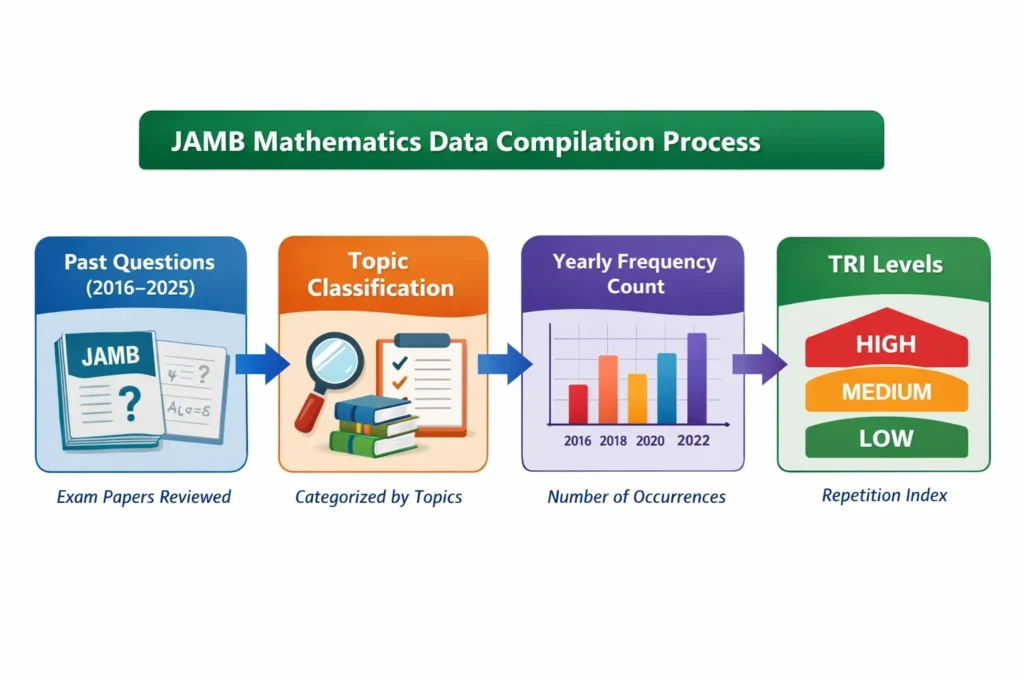
To ensure accuracy, credibility, and long-term usefulness, this analysis followed a clear and systematic review process.
First, we reviewed official JAMB Mathematics past questions from 2016 to 2025, covering ten complete examination years.
Next, for each question, we took the following steps:
- We carefully read the question and classified it based on its core mathematical concept, not surface wording
- We assigned each question to one dominant topic to prevent double counting
- We logged every topic under its corresponding examination year
After classification, we moved to pattern analysis:
- We recorded the number of different years each topic appeared
- We grouped topics according to how frequently they repeated across years
- We analyzed repetition trends for consistency, not one-year spikes
As a result, this process ensures that:
- Multiple appearances in a single year do not distort the data
- Cross-year relevance receives priority
- The final results reflect actual exam-setting behavior, not random variation
Importantly, this methodology mirrors the approach used by professional exam analysts and curriculum planners when evaluating standardized tests.
Definition
(JAMB Mathematics Topic Repetition Index (2016–2025): Data-Based Exam Trend Analysis)
What Is the Topic Repetition Index?
The Topic Repetition Index (TRI) is a proprietary metric developed to measure how frequently a topic appears in JAMB Mathematics examinations across multiple years.
Rather than counting how many questions come from a topic in a single year, the TRI focuses on how many different years the topic appears. Consequently, the index highlights long-term importance instead of short-term fluctuations.
This distinction matters because:
- JAMB often spreads questions evenly across topics per year
- Long-term repetition reveals examiner preference and syllabus emphasis
TRI Classification Levels
Each topic is classified into one of three repetition levels:
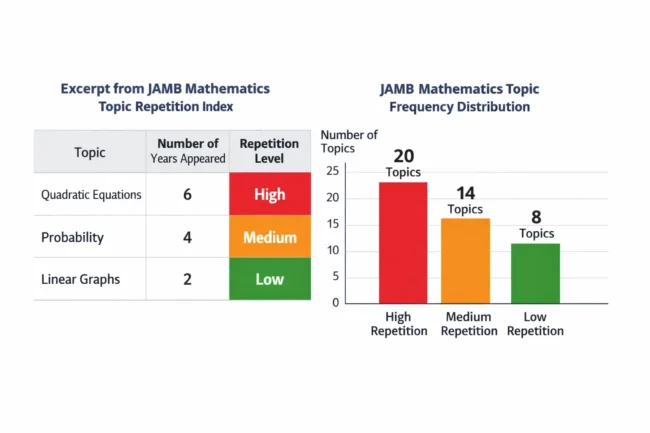
- High Repetition → Appears in 5 or more different years
- Medium Repetition → Appears in 3–4 different years
- Low Repetition → Appears in 1–2 different years
Topics in the High Repetition category represent the core mathematical backbone of JAMB Mathematics.
The Main Table (JAMB Mathematics Topic Repetition Index (2016–2025): Data-Based Exam Trend Analysis)
Below is the JAMB Mathematics Topic Repetition Index (2016–2025).
| Topic | Number of Years Appeared | Repetition Level |
|---|---|---|
| Quadratic Equations | 6 | High |
| Linear Equations | 5 | High |
| Simultaneous Equations | 5 | High |
| Algebraic Fractions | 5 | High |
| Indices and Logarithms | 6 | High |
| Simple Interest | 5 | High |
| Compound Interest | 5 | High |
| Ratio and Proportion | 6 | High |
| Percentages | 6 | High |
| Probability | 4 | Medium |
| Permutation and Combination | 4 | Medium |
| Sets and Venn Diagrams | 4 | Medium |
| Statistics (Mean, Median, Mode) | 5 | High |
| Trigonometric Ratios | 5 | High |
| Trigonometric Identities | 4 | Medium |
| Bearings and Distances | 3 | Medium |
| Linear Graphs | 2 | Low |
| Quadratic Graphs | 3 | Medium |
| Inequalities | 3 | Medium |
| Arithmetic Progression | 4 | Medium |
| Geometric Progression | 3 | Medium |
| Plane Geometry (Triangles) | 5 | High |
| Plane Geometry (Circles) | 4 | Medium |
| Mensuration (Area and Perimeter) | 6 | High |
| Mensuration (Volume) | 5 | High |
| Coordinate Geometry | 3 | Medium |
| Transformation Geometry | 2 | Low |
| Matrices | 4 | Medium |
| Determinants | 3 | Medium |
| Variation | 4 | Medium |
| Surds | 3 | Medium |
| Approximation and Estimation | 2 | Low |
| Word Problems (Algebra) | 5 | High |
| Speed, Distance and Time | 4 | Medium |
| Linear Inequalities | 3 | Medium |
| Construction (Geometric) | 2 | Low |
| Loci | 2 | Low |
| Binary Numbers | 1 | Low |
| Modular Arithmetic | 2 | Low |
| Number Bases | 2 | Low |
| Angles and Polygons | 4 | Medium |
| Similar Triangles | 3 | Medium |
| Scale Drawing | 2 | Low |
| Trigonometric Graphs | 2 | Low |
| Sets (Notation and Operations) | 4 | Medium |
| Statistics (Range and Variance) | 3 | Medium |
| Probability Tree Diagrams | 2 | Low |
| Logical Reasoning (Math-based) | 1 | Low |
How to Use This Index for Exam Preparation
This page is not meant to replace the syllabus, it is meant to optimize how you study it.
For JAMB Candidates
- Start revision with High Repetition topics
- Allocate 60–70% of study time to High + Medium topics
- Use Low Repetition topics for final revision or mock practice
- When time is limited, High Repetition topics give the highest score-return per hour studied
Teachers and Tutorial Centers
- Design schemes of work that emphasize High Repetition concepts early
- Use TRI data to justify lesson priorities to parents and students
- Structure revision classes around Medium topics, not random selection
- Use Low topics for homework, quizzes, or enrichment
For Self-Study Students
- Pair this index with past questions from the last 10 years
- Track personal weaknesses within High Repetition topics first
- Avoid over-studying rarely tested areas at the expense of core topics
-
Strategic preparation is not about reading more, it is about reading smarter.
-
Citation Notice
- Citation Notice
You are permitted to reference or embed this data in articles, videos, lesson notes, or tutorials, provided proper credit is given to ExamGuideNG with a clickable link to this page. - Educators are encourage to use this index freely for teaching and academic purposes with attribution.
- Resources Summary
- Resource Name: JAMB Mathematics Topic Repetition Index (TRI)
Coverage: 2016–2025 JAMB Examinations
Use Case: Strategic exam preparation, lesson planning, content referencing
Update Cycle: Annual
- Last Updated: January 2026
- Official JAMB syllabus (PDF)
- JAMB official website
Written by Massodih Okon, Senior Exam Preparation Researcher and Academic Education Content Specialist with over 10 years of experience developing high-impact learning resources aligned with Nigerian and international examination standards.
About the Author
Massodih Okon is an experienced educator, researcher, and digital publishing professional with a strong academic and practical background. He holds a First Degree in Geography and a Master’s Degree in Urban and Regional Planning, with expertise in education systems, assessment frameworks, and research methodologies.
He has several years of hands-on experience as a teacher and lecturer, translating complex academic and professional concepts into clear, practical, and results-driven educational content. Massodih is also a professional SEO content strategist and writer, specializing in authoritative, data-driven academic and examination resources.
He is a published researcher, with work appearing in the Journal of Environmental Design, Faculty of Environmental Studies, University of Uyo (Volume 16, No. 1, 2021, pp. 127–134). All content published on ExamGuideNG is carefully researched, reviewed for accuracy, and updated to ensure relevance and reader trust.