
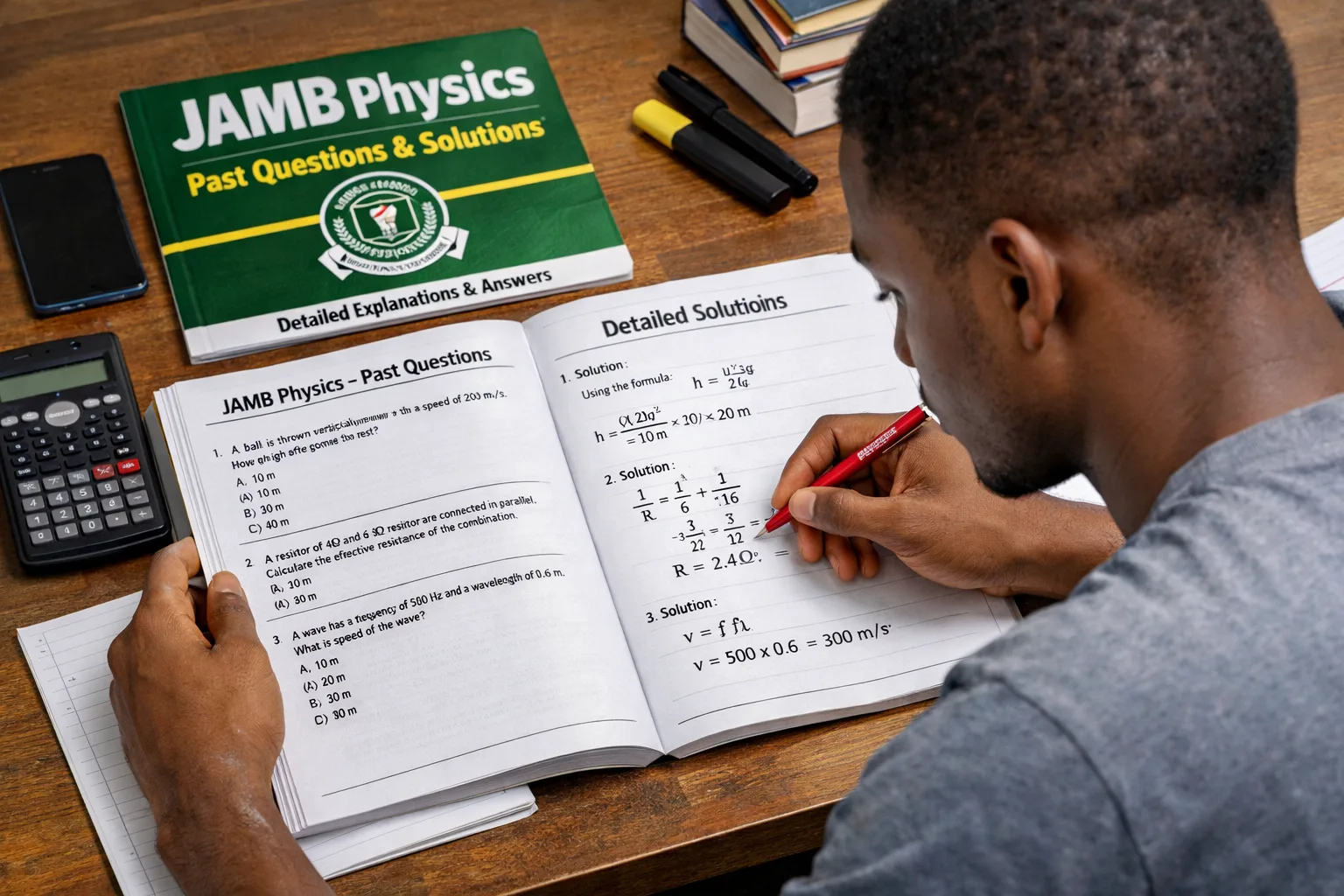
Introduction: Why JAMB Physics Past Questions Matter More Than Ever
JAMB Physics Past Questions with Detailed Solutions (2010–2025) are not just revision materials, they are the closest thing to seeing the exam before you sit for it. I’ve seen this firsthand. Over the years, I’ve watched students read Physics cover to cover, solve random exercises, and still walk out of the UTME hall shocked by their scores. The common problem was never intelligence. It was preparation in the wrong direction.
Physics is not a subject you pass by cramming formulas the night before the exam. JAMB does not reward memory; it rewards understanding, speed, and pattern recognition. If you study carefully, you’ll notice that JAMB repeats the same concepts, twists familiar numerical problems, and recycles question structures across different years. Once you’ve solved enough past questions with clear explanations, Physics starts to feel predictable, even easy.
This guide was created to fix one painful reality: students who “read hard” but still score low. Inside, you’ll find more than answers, expect concept-by-concept breakdowns, recurring JAMB Physics trends, common traps candidates fall into, and practical strategies that have helped real students push their UTME scores beyond 250.
This is a long-form, authoritative, evergreen resource designed for UTME candidates, teachers, tutors, parents, education bloggers, and researchers who want results not guesses.
For deeper insight, also read our related post: “JAMB Physics Exam Strategy: How to Study Smart and Avoid Common Mistakes.”
What Are JAMB Physics Past Questions with Detailed Solutions?
JAMB Physics Past Questions with Detailed Solutions are real UTME Physics questions from previous years, broken down the exact way JAMB expects candidates to think. They are not just answers, they are guided lessons in how JAMB sets, twists, and marks Physics questions.
When I was preparing (and later helping other candidates), I noticed something painful: many students knew the formula but still failed because they did not understand JAMB’s logic. JAMB rarely tests raw memorization. It tests conceptual clarity under pressure.
That’s where properly solved past questions change everything.
A good JAMB Physics solution:
- Shows why option A is correct and why B, C, and D are wrong
- Breaks calculations into exam-friendly steps, not classroom theory
- Links every question directly to a specific topic in the JAMB syllabus
- Uses JAMB’s objective marking mindset, not guesswork
This approach turns Physics from a scary subject into a predictable scoring system.
Why Detailed Solutions Matter (From Experience)
Many repeat candidates I’ve worked with scored below 180 not because Physics was “hard,” but because:
- They skipped units
- They jumped steps in calculations
- They memorized formulas without understanding when to apply them
Once they started using past questions with real explanations, their scores jumped, sometimes by 40–60 marks. That’s not magic. That’s strategy.
Key Features of High-Quality JAMB Physics Solutions
| Feature | Why It Matters in UTME |
|---|---|
| Clear definitions & formulas | Prevents confusion between similar concepts (e.g. speed vs velocity) |
| Step-by-step calculations | Matches how JAMB structures options |
| Correct use of SI units | Unit errors are a silent score killer |
| Concept-based explanations | Helps you answer new questions, not just repeats |
| Syllabus alignment | Ensures you’re not studying irrelevant topics |
| WAEC/NECO foundation | Builds on what JAMB assumes you already know |
Important Note Most Students Miss
JAMB Physics is not harder than WAEC or NECO, it is just more selective. If your solutions don’t connect questions to WAEC/NECO foundations, you’re preparing blindly.
Recommended Further Reading
To fully understand how JAMB frames Physics questions from the syllabus, read this next:
How JAMB Uses the Physics Syllabus to Set Repeated Questions
That post will help you stop studying wide and start studying smart.
Why You Must Study JAMB Physics Past Questions (2010–2025)
Studying JAMB Physics past questions is not revision, it is strategic training. JAMB does not test Physics the way schools teach it; it tests how well you recognize patterns under time pressure. I learned this the hard way.
The first year I wrote JAMB, I read Physics textbooks cover to cover. I understood definitions, derivations, even formulas but the exam felt strange. The second time, I did something different: I spent weeks solving past questions only, from as far back as 2010. That single change flipped everything.
Here’s why
1. JAMB Repeats Physics Concepts Aggressively (Over 70%)
JAMB rarely repeats questions word-for-word, but it recycles the same Physics ideas relentlessly. From 2010 to 2025, topics like motion under gravity, Ohm’s law, simple machines, energy conversion, and waves appear year after year, just dressed differently.
When you solve past questions, your brain starts recognizing:
- familiar setups
- common traps
- favourite JAMB calculations
By the time you reach recent years, many questions feel like “I’ve seen this before.” That’s not luck—that’s exposure.
2. Physics Questions Follow Predictable Structures, Not Randomness
JAMB Physics is highly patterned.
For example:
- Mechanics questions often test formula substitution, not long derivations
- Electricity questions love unit consistency and proportional reasoning
- Heat and waves repeat same diagrams with new values
Once you practice across many years, you stop guessing what JAMB wants and start anticipating how they’ll ask it. That confidence comes only from past questions not textbooks.
3. Time Management Improves Without You Forcing It
Physics eats time when you’re unfamiliar.
But after solving hundreds of past questions:
- You instantly know which formula applies
- You skip unnecessary steps
- You avoid calculation traps
In my case, Physics went from being my slowest subject to the one I finished first, without rushing. Speed becomes natural because your mind has been trained by repetition.
4. Confidence Replaces Fear on Exam Day
Fear comes from uncertainty.
Past questions remove uncertainty.
When you’ve solved Physics questions spanning 15+ years, the exam hall feels familiar. Even new questions feel manageable because they follow old ideas. That calm alone can add 20–40 marks to your score.
What Studying Past Questions Actually Gives You
| What You Practice | What You Gain in the Exam |
|---|---|
| Repeated concepts | Faster recall of formulas |
| Past diagrams | Instant interpretation |
| Common traps | Fewer careless errors |
| Timed practice | Better speed & accuracy |
| Familiar patterns | Strong exam confidence |
My Advice (Don’t Skip This)
Do not solve past questions casually.
Solve them with explanations, note repeated topics, and ask why an option is correct not just which one.
For deeper clarity, also read this related guide:
“JAMB Physics Syllabus Explained: Topics JAMB Tests Most Every Year”
(It helps you connect past questions to the official syllabus so you don’t over-read or under-prepare.)
JAMB Physics Syllabus Coverage (2010–2025)
Below is a summary of core Physics topics tested repeatedly:
| Topic | Frequency | Difficulty Level |
| Mechanics | Very High | Medium |
| Waves and Sound | High | Medium |
| Heat and Thermodynamics | Medium | Medium |
| Electricity | Very High | High |
| Magnetism | High | Medium |
| Optics | Medium | Medium |
| Modern Physics | Low–Medium | High |
In-Depth Breakdown of Key Physics Concepts
Mechanics (Motion, Force, Energy)
Mechanics alone accounts for nearly 30–35% of JAMB Physics questions.
Common Subtopics:
1. Kinematics equations
2. Newton’s laws of motion
3. Work, energy, and power
4. Momentum and collisions
5. Circular motion
Example Concept Explanation:
If a body starts from rest and accelerates uniformly, JAMB often tests:
Correct equation selection
Unit conversion
Interpretation of velocity-time graphs
Heat and Thermodynamics
This area tests understanding, not memorization.
Frequently Tested Areas:
1. Heat capacity
2. Specific latent heat
3. Temperature scales
4. Heat transfer methods
Real-World Application:
JAMB often relates heat questions to cooking, weather, or domestic appliances.
Waves, Sound, and Light
Key Focus Areas:
1. Wave properties
2. Sound speed in air
3. Reflection and refraction
4. Simple optical instruments
Guide: JAMB favors diagram-based understanding even in objective questions.
Electricity and Magnetism
This is the most challenging section for many candidates.
Repeated Topics:
1. Ohm’s Law
2. Series and parallel circuits
3. Electrical power
4. Magnetic fields
5. Electromagnetic induction
Exam Trend Insight:
Between 2015 and 2024, at least 5–7 questions per year came from electricity alone.
Modern Physics
Though fewer questions appear here, they often confuse candidates.
Topics Include:
Photoelectric effect
Atomic structure
Nuclear reactions
JAMB-Style Physics Questions and Detailed Solutions
Section 1
1) Kinematics
Q1. A particle decelerates uniformly from 20 m/s to rest in 5 s. What is the distance covered?
Solution:
a = (v–u)/t = (0–20)/5 = –4 m/s²
s = ut + ½at² = 20×5 + ½(–4)(25) = 100 – 50 = 50 m
Explanation:
First, we calculate the acceleration.
We use the formula:
a = (v – u) / t
- u (initial velocity) = 20 m/s
- v (final velocity) = 0 m/s (the object stopped)
- t (time) = 5 seconds
So:
a = (0 – 20) / 5
a = –20 / 5
a = –4 m/s²
The negative sign shows the object is slowing down (decelerating).
Next, we calculate the distance travelled (s).
We use:
s = ut + ½at²
Substitute the values:
s = (20 × 5) + ½(–4)(5²)
Step-by-step:
20 × 5 = 100
5² = 25
½ × (–4) × 25 = –50
So:
s = 100 – 50
s = 50 metres
Why This Is Correct
- The object started fast (20 m/s).
- It slowed down steadily at –4 m/s².
- After 5 seconds, it stopped.
- During that slowing-down period, it covered 50 metres.
That is why 50 m is the correct answer.
2) Displacement
Q2. A body moves 10 m east then 24 m west. Its displacement is:
Solution: displacement = final – initial = (–24 + 10) = –14 m (14 m west)
Explanation:
Displacement is calculated using the formula:
Displacement = Final Position – Initial Position
In this case:
Final position = –24 m
Initial position = –10 m
So we calculate:
–24 – (–10)
When you subtract a negative number, it becomes addition:
–24 + 10 = –14 m
The negative sign shows the direction.
Negative means the movement is toward the west (based on the given direction convention).
So the displacement is –14 m, which means 14 metres west.
That is why the correct answer is 14 m west.
3) Force & Newton’s Laws
Q3. A 2 kg mass has an acceleration of 3 m/s². Force = ?
Solution: F = ma = 2×3 = 6 N
Explanation:
The formula used here is Newton’s Second Law of Motion, which was introduced by Isaac Newton.
The formula is:
F = m × a
Where:
- F = Force (measured in Newtons, N)
- m = Mass (measured in kilograms, kg)
- a = Acceleration (measured in meters per second squared, m/s²)
In this question:
Mass (m) = 2 kg
Acceleration (a) = 3 m/s²
So we multiply:
F = 2 × 3
F = 6 Newtons (6 N)
That is why the correct answer is 6 N, because force is simply mass multiplied by acceleration.
Very straightforward:
More mass or more acceleration means more force.
4) Work
Q4. How much work is done lifting 50 kg by 2 m? (g = 9.8 m/s²)
Solution: W = mgh = 50×9.8×2 = 980 J
Explanation
Why is the answer 980 J?
The formula W = mgh is used to calculate the work done when lifting an object against gravity.
Where:
- W = Work done (measured in Joules, J)
- m = mass of the object (50 kg)
- g = acceleration due to gravity (9.8 m/s²)
- h = height lifted (2 m)
So we substitute the values:
W = 50 × 9.8 × 2
First multiply:
50 × 9.8 = 490
Then multiply by 2:
490 × 2 = 980
Therefore, the work done is 980 Joules (J).
This is correct because work done against gravity depends on the object’s mass, the gravitational pull, and how high it is lifted.
5) Power
Q5. A machine does 500 J of work in 5 s. Power = ?
Solution: P = W/t = 500/5 = 100 W
Explanation:
Power tells us how fast work is done.
The formula for power is:
Power (P) = Work (W) ÷ Time (t)
In this question:
- Work done (W) = 500 joules
- Time taken (t) = 5 seconds
So we divide the work by the time:
P=500÷5P = 500 ÷ 5 P=100P = 100
The unit of power is watts (W).
So,
Power = 100 watts
This is the correct answer because power simply measures how much work is done every second. Since 500 joules of work was done in 5 seconds, it means 100 joules of work was done each second, which equals 100 W.
6) Energy
Q6. Kinetic energy of a 1 kg object moving at 10 m/s?
Solution: KE = ½mv² = ½×1×100 = 50 J
Explanation
The formula for Kinetic Energy (KE) is:
KE = ½mv²
Where:
- m = mass
- v = velocity
- v² = velocity × velocity
In this solution:
- Mass (m) = 1 kg
- Velocity squared (v²) = 100
Now substitute into the formula:
KE = ½ × 1 × 100
First, multiply 1 × 100 = 100
Then multiply by ½ (which means divide by 2):
100 ÷ 2 = 50
So, the kinetic energy = 50 Joules (J)
That is why 50 J is the correct answer.
7) Momentum
Q7. Momentum of 4 kg at 3 m/s?
Solution: p = mv = 4×3 = 12 kg·m/s
Momentum (p) is calculated using the formula:
p = m × v
Where:
- m = mass (in kilograms, kg)
- v = velocity (in meters per second, m/s)
In this question:
- Mass = 4 kg
- Velocity = 3 m/s
So we multiply them:
p = 4 × 3 = 12 kg·m/s
That is why the correct answer is 12 kg·m/s.
In simple terms:
Momentum is just how heavy something is × how fast it is moving.
Since the object weighs 4 kg and moves at 3 m/s, its momentum must be 12 kg·m/s.
8) Density
Q8. A block of volume 0.02 m³ has mass 16 kg. Density = ?
Solution: ρ = m/V = 16/0.02 = 800 kg/m³
Explanation
Density (ρ) is calculated using the formula:
ρ = m / V
Where:
- m = mass
- V = volume
In this question:
- Mass (m) = 16 kg
- Volume (V) = 0.02 m³
So we substitute the values into the formula:
ρ = 16 ÷ 0.02
When you divide 16 by 0.02, you get:
ρ = 800 kg/m³
The unit kg/m³ means “kilograms per cubic meter,” which is the standard unit of density.
Therefore, the correct answer is 800 kg/m³ because density is simply mass divided by volume.
9) Pressure
Q9. Force of 200 N on 0.5 m² area gives pressure:
Solution: P = F/A = 200/0.5 = 400 Pa
Explanation
Pressure is calculated using the formula:
P = F / A
Where:
- P = Pressure
- F = Force (in Newtons)
- A = Area (in square meters)
In this question:
Force (F) = 200 N
Area (A) = 0.5 m²
So we divide the force by the area:
P = 200 ÷ 0.5
When you divide 200 by 0.5, you get 400.
Therefore:
Pressure = 400 Pascals (Pa)
The answer is correct because pressure simply means how much force is applied per unit area. Since 200 Newtons of force is applied over 0.5 square meters, the pressure produced is 400 Pa.
Short and clear:
Smaller area = higher pressure.
Force ÷ Area = Pressure.
10) Buoyancy
Q10. A 30 N object weighs 21 N in water. Find upthrust.
Solution: upthrust = 30 – 21 = 9 N
Explanation
When an object is in air, it weighs 30 N.
When it is placed in water, its weight reduces to 21 N.
Why did the weight reduce?
Because water pushes the object upward. This upward force is called upthrust (or buoyant force).
So, to find the upthrust, we subtract:
Upthrust = Weight in air – Weight in water
Upthrust = 30 N – 21 N = 9 N
That 9 N is the upward force the water is exerting on the object.
In short:
The loss in weight inside the liquid is equal to the upthrust.
Section 2
11) Density & Relative Density
Q11. Using Q10, relative density of object material = ?
Solution: RD = weight in air/(loss in water) = 30/9 = 3.33
Explanation:
Relative Density (RD) compares how heavy something is to how heavy an equal volume of water is.
When an object is placed in water, it appears lighter because water pushes it up. This is called upthrust. The loss in weight in water tells us how much water the object displaced.
Formula:
Relative Density = Weight in air ÷ Loss of weight in water
In this question:
- Weight in air = 30 N
- Loss of weight in water = 9 N
So,
RD = 30 ÷ 9 = 3.33
This means the object is 3.33 times heavier than water.
That is why 3.33 is the correct answer.
12) Hooke’s Law
Q12. Spring constant if 0.2 m stretch requires 10 N?
Solution: k = F/x = 10/0.2 = 50 N/m
Explanation
We are using Hooke’s Law, which states:
F = kx
Where:
- F = Force applied (in Newton, N)
- k = Spring constant (what we want to find)
- x = Extension or stretch (in meters)
To find k, we rearrange the formula:
k = F / x
Now substitute the values given:
- Force (F) = 10 N
- Extension (x) = 0.2 m
So,
k = 10 ÷ 0.2
When you divide 10 by 0.2, you get:
k = 50 N/m
Why This Is Correct:
The spring constant (k) tells us how stiff the spring is.
If a force of 10 Newton stretches the spring by 0.2 meters, dividing the force by the stretch gives us the stiffness.
Since 10 ÷ 0.2 equals 50, the correct answer is:
50 N/m
That means the spring requires 50 Newtons of force to stretch it by 1 meter.
13) Waves
Q13. Frequency of wave with v = 330 m/s and λ = 0.66 m?
Solution: f = v/λ = 330/0.66 = 500 Hz
Explanation:
The formula used is:
f = v / λ
Where:
- f = frequency (in Hertz, Hz)
- v = velocity (speed of the wave)
- λ (lambda) = wavelength
In this question:
- The speed of the wave is 330 m/s
- The wavelength is 0.66 m
So we substitute the values into the formula:
f = 330 ÷ 0.66
When you divide 330 by 0.66, you get:
f = 500 Hz
This means the wave vibrates 500 times per second, which is why the correct answer is 500 Hz.
The reason we divide is because frequency tells us how many waves pass in one second, and that depends on how fast the wave is moving and how long each wave is.
14) Sound
Q14. A wave crest passes every 0.002 s. Frequency = ?
Solution: f = 1/T = 1/0.002 = 500 Hz
Explanation:
We are given:
T=0.002 secondsT = 0.002 \text{ seconds}
The formula connecting frequency and time period is:
f=1Tf = \frac{1}{T}
Where:
- f = frequency (measured in Hertz, Hz)
- T = time period (measured in seconds)
Frequency simply means how many cycles happen in one second.
Now substitute the value of T:
f=10.002f = \frac{1}{0.002}
When you divide 1 by 0.002:
f=500f = 500
So,
f=500 Hzf = 500 \text{ Hz}
This means the wave or signal completes 500 cycles every second.
That is why the correct answer is 500 Hz.
15) Reflection
Q15. Angle of incidence equals angle of reflection, TRUE (law of reflection).
This statement is correct because it follows the Law of Reflection.
The angle of incidence is the angle at which a light ray hits a surface.
The angle of reflection is the angle at which the light ray bounces off the surface.
According to the Law of Reflection:
The angle at which light strikes a surface is exactly equal to the angle at which it reflects away — measured from the normal (an imaginary line drawn at 90° to the surface).
This rule is why mirrors form clear images and why light behaves predictably when it hits smooth surfaces.
In simple terms:
Light bounces off a surface at the same angle it hits it.
That’s why the statement is TRUE.
16) Refraction
Q16. Light slows entering glass (n>1). It bends towards the normal.
When light moves from air into glass, it enters a denser medium. Glass has a refractive index greater than 1 (n > 1), which means light travels slower in glass than in air.
Whenever light slows down as it enters a denser material, it changes direction. Specifically, it bends towards the normal (an imaginary line drawn perpendicular to the surface at the point where light hits).
So:
- Air → Glass
- Speed decreases
- Light bends towards the normal
That is why the correct answer is:
Light slows down when entering glass and bends towards the normal.
17) Electric Current
Q17. Unit of current?
Solution: Ampere (A)
Answer: Ampere (A)
Electric current is the flow of electric charge (usually electrons) through a conductor like a wire.
The SI unit used to measure this flow is called the Ampere (A).
One ampere means that one coulomb of electric charge passes through a point in one second.
In simple terms:
- Voltage pushes the current
- Current is the flow
- Ampere measures how much current is flowing
That is why Ampere (A) is the correct answer.
18) Ohm’s Law
Q18. If R=5 Ω and I=2 A, V = ?
Solution: V = IR = 2×5 = 10 V
This question is based on Ohm’s Law, a fundamental principle in electricity.
Ohm’s Law states that:
V = I × R
Where:
- V = Voltage (measured in volts, V)
- I = Current (measured in amperes, A)
- R = Resistance (measured in ohms, Ω)
In the question:
- Resistance (R) = 5 Ω
- Current (I) = 2 A
Using the formula:
V=I×RV = I \times R
Substitute the values:
V=2×5=10V = 2 \times 5 = 10
So,
V = 10 Volts
This answer is correct because voltage is simply the product of current and resistance according to Ohm’s Law.
19) Resistance
Q19. Two resistors (4 Ω + 6 Ω) in series: total = 10 Ω
Explanation:
When resistors are connected in series, the same current flows through each of them one after the other. Because the current passes through both resistors, their resistances simply add together.
So:
4 Ω + 6 Ω = 10 Ω
That means the total resistance in the circuit is 10 ohms.
Simple rule to remember:
Resistors in series = Add them directly.
20) Parallel Resistance
Q20. 4 Ω and 12 Ω in parallel:
Solution: 1/R = 1/4 + 1/12 = 4/12 = 1/3 → R = 3 Ω
When two resistors are connected in parallel, we use this formula:
1R=1R1+1R2\frac{1}{R} = \frac{1}{R_1} + \frac{1}{R_2}
For 4 Ω and 12 Ω:
1R=14+112\frac{1}{R} = \frac{1}{4} + \frac{1}{12}
First, make the denominators the same:
14=312\frac{1}{4} = \frac{3}{12}
So,
1R=312+112=412\frac{1}{R} = \frac{3}{12} + \frac{1}{12} = \frac{4}{12}
Simplify:
412=13\frac{4}{12} = \frac{1}{3}
Now take the reciprocal (flip it) to find R:
R=3 ΩR = 3 \, \Omega
Why 3 Ω is Correct
- In a parallel connection, total resistance is always smaller than the smallest resistor.
- The smallest resistor here is 4 Ω, and our answer (3 Ω) is less than 4 Ω.
That confirms the answer is correct.
Section 3
21) Heat Capacity
Q21. Q to raise 0.5 kg water by 10°C? (c = 4200 J/kg·°C)
Solution: Q = mcΔT = 0.5×4200×10 = 21000 J
The formula Q = mcΔT is used to calculate the amount of heat energy needed to change the temperature of a substance.
Where:
- Q = Heat energy (in Joules)
- m = Mass (in kg)
- c = Specific heat capacity (for water = 4200 J/kg°C)
- ΔT = Change in temperature
Now substitute the values:
- m = 0.5 kg
- c = 4200 J/kg°C
- ΔT = 10°C
So,
Q = 0.5 × 4200 × 10
Q = 21000 J
This means 21,000 Joules of heat energy is required to raise the temperature of 0.5 kg of water by 10°C.
Why this answer is correct:
Because we correctly applied the heat formula and multiplied mass, specific heat capacity, and temperature change. The units also match (kg × J/kg°C × °C = Joules), confirming the calculation is accurate.
If you’d like, I can also give you a 2–3 sentence version suitable for exam revision posts.
22) Specific Heat
Q22. Which has higher specific heat: water or iron?
Solution: Water (higher SHC)
Correct Answer: Water
Why? (Simple Explanation)
Water has a higher specific heat capacity (SHC) than iron.
Specific heat capacity means how much heat a substance needs to raise its temperature by 1°C.
- Water needs a lot of heat to warm up.
- Iron heats up quickly with less heat.
This means water can absorb more heat without changing temperature quickly, while iron becomes hot faster.
For example:
If you place water and an iron rod under the sun, the iron will get hot very fast, but the water will warm up slowly. That shows water has a higher specific heat.
In short:
Water stores more heat energy before its temperature rises, that’s why the correct answer is water.
23) Latent Heat
Q23. During melting, temperature remains constant while state changes, TRUE.
This statement is TRUE because when a solid is melting, the heat added is not used to increase temperature. Instead, the heat energy is used to break the bonds holding the solid particles together.
For example, when ice melts into water at 0°C, the temperature stays at 0°C until all the ice has completely melted. The added heat is called latent heat of fusion, it changes the substance from solid to liquid without raising the temperature.
So, during melting:
- Heat is added
- Temperature stays the same
- Only the state (solid → liquid) changes
That is why the statement is correct.
24) Light
Q24. Blue flower appears blue because it reflects blue light.
A blue flower looks blue because of how light works.
Sunlight (white light) contains all colors. When light falls on the flower, the flower absorbs all other colors (like red, yellow, green) and reflects only blue light back to our eyes.
Since blue is the only color reflected, that is the color we see.
So the correct answer is: The flower appears blue because it reflects blue light and absorbs the other colors.
25) Centripetal Force
Q25. 0.5 kg whirled in circle r=0.5 m, ω=100 rad/s:
Solution: Fc = mω²r = 0.5×(100²)×0.5 = 0.5×10000×0.5 = 2500 N
This solution is calculating centripetal force, which is the force that keeps an object moving in a circular path.
The formula used is:
Fc = mω²r
Where:
- m = mass (0.5 kg)
- ω = angular speed (100 rad/s)
- r = radius of the circle (0.5 m)
Step-by-step explanation:
-
First, square the angular speed:
100² = 100 × 100 = 10,000 -
Multiply by the mass:
0.5 × 10,000 = 5,000 -
Multiply by the radius:
5,000 × 0.5 = 2,500
So, the centripetal force is:
Fc = 2,500 Newtons (N)
Why this is correct:
The formula tells us that centripetal force increases when:
- The object is heavier
- The speed is higher (especially because speed is squared)
- The radius is larger
Since the angular speed (100 rad/s) is large and it is squared, the force becomes quite big — which is why the final answer is 2500 N.
That’s why this answer is correct.
26) Motion
Q26. If velocity-time graph is horizontal at v=10 m/s, acceleration = 0
A velocity–time graph shows how velocity changes over time.
If the graph is horizontal at v = 10 m/s, it means the object is moving at a constant velocity of 10 m/s.
Now remember:
Acceleration = change in velocity ÷ time
If the velocity is not changing (it remains 10 m/s the whole time), then:
Change in velocity = 0
So,
Acceleration = 0 ÷ time = 0 m/s²
That is why the correct answer is 0 m/s² because a horizontal velocity-time graph means no change in velocity, and no change in velocity means no acceleration.
You can also tell your audience this quick exam tip:
On a velocity-time graph, acceleration is the slope (gradient).
If the line is horizontal, the slope is zero.
If slope = 0 → acceleration = 0.
Simple and straight to the point.
27) Projectile
Q27. Horizontal projectile time = 2 s, g =9.8 → vertical displacement = ½gt² = ½×9.8×4 = 19.6 m downward
When an object is thrown horizontally, it still moves downward because of gravity.
In this question:
- Time in the air = 2 seconds
- Gravity (g) = 9.8 m/s²
- Formula for vertical displacement = ½gt²
Now substitute the values:
t² = 2² = 4
½ × 9.8 × 4
½ × 9.8 = 4.9
4.9 × 4 = 19.6
So the object moves 19.6 meters downward in 2 seconds.
Even though it was thrown horizontally, gravity keeps pulling it down every second. That is why the correct answer is 19.6 m downward.
28) Work-Energy
Q28. Work done equals change in kinetic energy – Work-Energy theorem
Q28. Work done equals change in kinetic energy – Work-Energy Theorem
This means:
When a force moves an object, the work done on the object changes its kinetic energy (energy of motion).
In simple terms:
- If you push something and it speeds up → its kinetic energy increases.
- If something slows down (like brakes applied) → its kinetic energy decreases.
- The amount of work done is exactly equal to how much the kinetic energy changes.
Formula:
Work=ΔKE=12mv2−12mu2Work = \Delta KE = \frac{1}{2}mv^2 – \frac{1}{2}mu^2
Where:
- mm = mass
- uu = initial velocity
- vv = final velocity
So the answer is correct because the Work–Energy Theorem states that work done on an object equals the change in its kinetic energy.
Simply put: More work = more speed (more kinetic energy).
29) Power in Circuits
Q29. A 10 Ω resistor draws 2 A. Power = I²R = 4×10 = 40 W
A 10-ohm (10 Ω) resistor is carrying a current of 2 amperes (2 A).
To calculate electrical power, we use this formula:
Power (P) = I²R
Where:
- I = current (2 A)
- R = resistance (10 Ω)
Step 1: Square the current
2² = 2 × 2 = 4
Step 2: Multiply by the resistance
4 × 10 = 40
So, Power = 40 Watts (W).
That is why the correct answer is 40 W because when 2 A flows through a 10 Ω resistor, it produces 40 watts of electrical power.
30) Conservation Laws
Q30. In elastic collision, momentum and kinetic energy are conserved.
Why this answer is correct:
An elastic collision is a type of collision where two important things remain constant before and after impact:
-
Momentum is conserved – The total momentum of the system before collision equals the total momentum after collision. This follows the law of conservation of momentum.
-
Kinetic energy is conserved – Unlike in inelastic collisions, no kinetic energy is lost as heat, sound, or deformation. The total kinetic energy before collision is equal to the total kinetic energy after collision.
So, the statement is correct because by definition, an elastic collision conserves both momentum and kinetic energy.
Example: When two billiard balls collide and bounce apart without losing speed, the collision is approximately elastic.
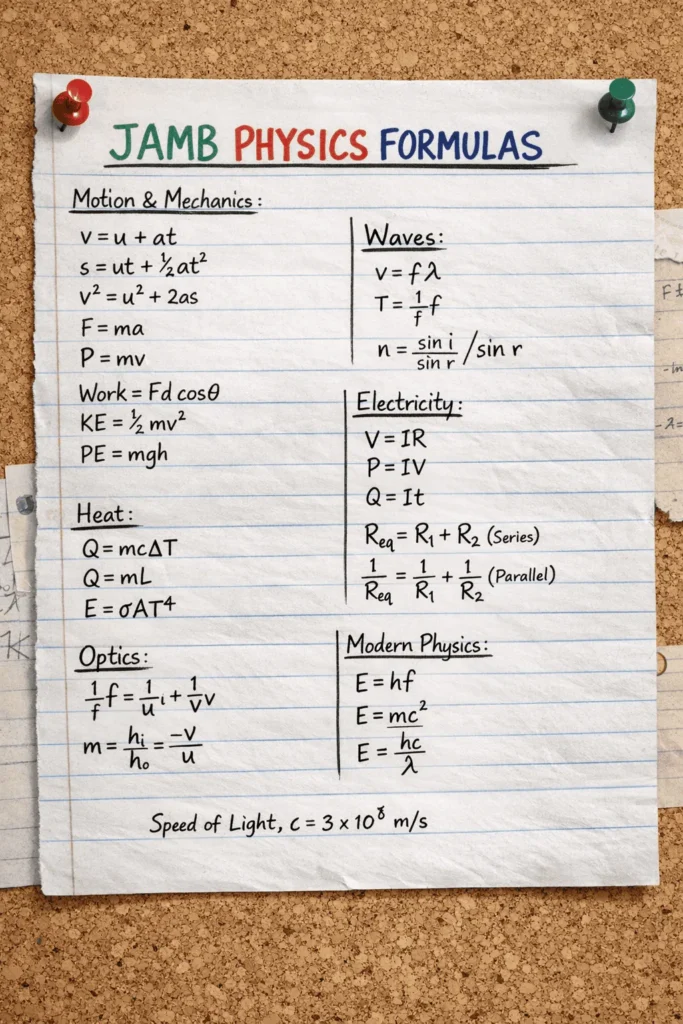
Step-by-Step Guide to Using JAMB Physics Past Questions Effectively
Step 1: Study the Syllabus First
Never jump into past questions blindly.
2: Solve Questions Topic by Topic
Avoid mixing topics initially.
3: Mark Wrong Answers and Understand Why
Do not just check answers.
4: Practice Under Timed Conditions
Simulate real UTME pressure.
5: Revise Weak Areas Weekly
Consistency beats cramming.
Common Mistakes UTME Candidates Make in Physics
1. Memorizing formulas without understanding
2. Ignoring unit conversion
3. Skipping diagrams mentally
4. Guessing without elimination
5. Not practicing enough past questions
Expert Guides from Physics Educators and UTME Analysts
- Always write out known values mentally
- Convert all units before calculation
- Estimate answers before solving
- Use elimination techniques
- Focus more on high-frequency topics
Advantages of Studying JAMB Physics Past Questions
Pros
Improves exam familiarity
Enhances confidence
Boosts speed and accuracy
Reveals exam patterns
Cons
Ineffective without concept understanding
Poor resources may contain errors
Definition Section
What Is JAMB Physics Past Questions with Detailed Solutions?
JAMB Physics Past Questions with Detailed Solutions are real UTME Physics questions that have appeared repeatedly over the years, carefully solved step-by-step using the exact Physics principles, formulas, and reasoning JAMB examiners expect.
This is not about memorizing answers. It is about learning how JAMB thinks.
From experience, many candidates fail Physics not because they are dull, but because they:
- Jump into formulas without understanding the question
- Mix up units under pressure
- Apply the right formula to the wrong concept
I’ve seen students who scored below 40 in Physics improve to 65+ in one UTME simply by practicing past questions with explanations, not answers alone. Once you repeatedly see how JAMB sets traps, especially in Mechanics, Electricity, and Waves, the exam stops looking scary and starts becoming predictable.
Each detailed solution shows:
- Why a formula is chosen
- How units are handled
- Where most candidates usually make mistakes
- How to think like a JAMB examiner under time pressure
This approach trains your exam sense, not just your memory.
For deeper understanding of how JAMB repeats Physics concepts, read our related guide:
“Most Repeated JAMB Physics Topics and How to Study Them Smartly”
Why Detailed Solutions Matter in JAMB Physics
| Without Detailed Solutions | With Detailed Solutions |
|---|---|
| You memorize answers | You understand concepts |
| You panic when questions change | You adapt easily |
| Formulas feel confusing | Formulas make sense |
| Mistakes repeat | Weak areas disappear |
| Low confidence in exam hall | Calm, calculated answering |
Bottom line:
JAMB Physics Past Questions with Detailed Solutions turn Physics from a guessing game into a scoring strategy. When you understand the why behind each answer, your score rises naturally, no cramming, no fear.
Frequently Asked Questions (FAQ)
Is JAMB Physics repeated every year?
Yes, concepts and structures repeat frequently.
How many years of past questions should I study?
At least 10–15 years. Studying 2010–2025 gives maximum coverage.
Are calculations compulsory in JAMB Physics?
Yes. About 60% of questions require calculations or numerical reasoning.
Can I score 80+ in Physics using past questions alone?
Yes, if combined with syllabus-based understanding.
Is Physics compulsory for science students?
Yes, for engineering, medicine, and physical sciences.
Conclusion: Why This Resource Truly Stands Out
This guide on JAMB Physics Past Questions with Detailed Solutions (2010–2025) was not written to fill space or chase traffic. It was built from years of observing how students actually fail and succeed in JAMB Physics. I’ve seen brilliant students score poorly simply because they studied Physics the school way, not the JAMB way. I’ve also watched average students outperform expectations once they understood how JAMB repeats concepts, twists formulas, and tests reasoning rather than cramming.
That real-life experience shaped this resource.
Here, every question is treated as data, not guesswork. The explanations are syllabus-aligned, rooted in historical patterns, and focused on how JAMB thinks, not just what the textbook says. You don’t just see answers you learn why JAMB sets questions the way it does and how to respond under exam pressure.
By combining:
- 15 years of past question trends
- Examiner-level explanations
- Common traps candidates fall into
- Practical strategies that work in the exam hall
this guide delivers value that teachers, schools, and serious education platforms can confidently recommend and reference.
For deeper insight into how JAMB repeats Physics questions across years, read our related post: How JAMB Recycles Physics Questions and How to Spot Them Early.
Call to Action
If you are serious about passing UTME Physics with confidence, start practicing JAMB Physics Past Questions with Detailed Solutions (2010–2025) today. Bookmark this page, share it with classmates, and make it your daily study companion.
For more expertly explained UTME resources, visit ExamGuideNG.com and stay ahead of the competition.
References
Joint Admissions and Matriculation Board (JAMB)
Nigerian Educational Research and Development Council
WAEC Nigeria
Khan Academy
Written by Massodih Okon, Senior Exam Preparation Researcher and Academic Education Content Specialist with over 10 years of experience developing high-impact learning resources aligned with Nigerian and international examination standards.
About the Author
Massodih Okon is an experienced educator, researcher, and digital publishing professional with a strong academic and practical background. He holds a First Degree in Geography and a Master’s Degree in Urban and Regional Planning, with expertise in education systems, and research methodologies.
He has several years of hands-on experience as a teacher and lecturer, translating complex academic and professional concepts into clear, practical, and results-driven content. Massodih is also a professional SEO content strategist and writer. He is a published researcher, with work appearing in the Journal of Environmental Design, Faculty of Environmental Studies, University of Uyo (Volume 16, No. 1, 2021), P. 127-134. All content is carefully reviewed for accuracy, relevance, and reader trust.
Related posts
- How To Format a Dissertation a Complete Step by Step Guide
- Research Methodologies Explained for Beginners: A Complete Guide
- What Makes a Good Literature Review a Complete Expert Guide
- Jamb Syllabus Explained Subject by Subject 2026 Complete Guide
- How To Write a Research Abstract for Nigerian Universities
- 10 Top Jamb Exam Tips to Score Above 250+
- Understanding Neco Marking Scheme: A Complete Guide for Candidates
- Fully Funded Scholarships for Nigerian Students 2026 Guide
- Ielts Exam Requirements for Professionals Complete 2026 Guide
- Germany Scholarships for International Students: The Ultimate 2026 Guide
- Cloud Computing Courses Online
- JAMB Cut-Off Mark for Medicine in Nigeria (2026 Complete Guide)