
Introduction: Before You Pay for JAMB 2026, Read This
Every year, thousands of candidates rush to pay the JAMB Registration Fee 2026 without understanding the full cost, official requirements, or the correct portal process. As a result, many lose money to cybercafés, fake agents, or simple mistakes.
Therefore, this guide gives you verified, experience-based clarity. I have personally guided candidates through registration cycles, and I have seen students save money simply because they understood the process before paying.
If you are new to UTME, first read our detailed breakdown on “JAMB Score Calculation Explained“ to understand how scoring affects admission decisions. That knowledge will shape your subject choices and reduce costly mistakes. JAMB Registration Fee 2026: Cost, How Much & Requirements + Portal Guide.
In addition, you may review our “JAMB Exam Success Tips for First-Time Candidates“ to prepare ahead of registration. Finally, check our “WAEC and NECO Requirements for University Admission“ to confirm you meet O’Level standards.
Now, let us break everything down clearly.
What Is JAMB and Why the Registration Fee Matters
The Joint Admissions and Matriculation Board (JAMB) is Nigeria’s official body responsible for conducting the Unified Tertiary Matriculation Examination (UTME) and managing admissions into universities, polytechnics, and colleges of education.
Because JAMB centralizes admission processing, your registration fee does more than pay for an exam. It covers:
- CBT examination logistics
- Biometric verification
- Result processing
- Central Admission Processing System (CAPS)
- Technical infrastructure and data management
For official policy confirmation, refer to the Joint Admissions and Matriculation Board (JAMB) website.
After reading this section, you should also explore our guide on “How to Choose the Right JAMB Subject Combination” to avoid future admission rejection.
JAMB Registration Fee 2026: Official Cost Breakdown
Expected Official Cost Structure (Based on Previous Cycles)
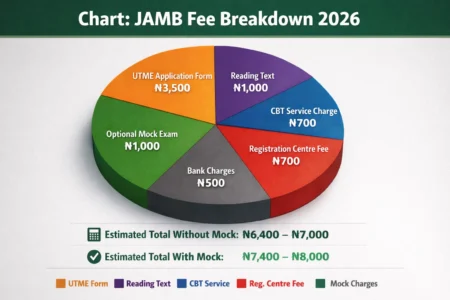
| Item | Estimated Cost (NGN) |
|---|---|
| UTME Application Form | ₦3,500 |
| Reading Text | ₦1,000 |
| CBT Service Charge | ₦700 |
| Registration Centre Fee | ₦700 |
| Optional Mock Exam | ₦1,000 |
| Bank Charges | ₦500 |
Estimated Total Without Mock: ₦6,400 – ₦7,000
Estimated Total With Mock: ₦7,400 – ₦8,000
However, always verify updated figures directly on the JAMB portal once 2026 registration opens.
For global academic comparison, standardized test bodies like College Board (SAT) and Pearson VUE charge significantly higher examination fees. This comparison shows that Nigeria’s UTME remains affordable relative to the UK, US, Canada, Australia, Germany, Switzerland, Scandinavia, Singapore, and New Zealand entry systems.
After reviewing cost, read our detailed post on “How Much Each JAMB Question Carries“ to understand exam scoring value.
Step-by-Step Guide: How to Register on JAMB Portal 2026
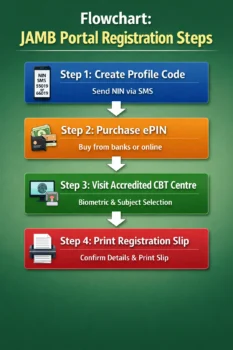
Step 1: Create Profile Code
Send NIN via SMS to 55019 or 66019.
Step 2: Purchase ePIN
Buy from approved banks or online platforms listed on JAMB portal.
Step 3: Visit Accredited CBT Centre
Complete biometric capture and subject selection.
Step 4: Print Registration Slip
Confirm:
- Name spelling
- Subject combination
- Exam town
After completing this section, review our guide on “Common JAMB Registration Mistakes and How to Avoid Them”.
JAMB Registration Requirements 2026
Before visiting any CBT centre, prepare:
- National Identification Number (NIN)
- Valid phone number
- O’Level result (WAEC/NECO/NABTEB)
- Passport photograph
- Email address
For official identification policies, confirm through the National Identity Management Commission (NIMC).
Then read our post on “O’Level Requirements for Nigerian Universities“ to ensure eligibility.
How Nigerians Abroad Can Register for JAMB 2026
Many Nigerians in the UK, US, Canada, Australia, Germany, Switzerland, Scandinavia, Singapore, and New Zealand ask whether they can register remotely.
Currently:
- Registration requires biometric capture
- Candidates must visit approved CBT centres
- Some foreign centres may be designated
However, Nigerians abroad may also consider international pathways such as A‑Levels (UK), SAT (US), or foundation programs in Canada and Australia.
After this, read “Study Abroad vs JAMB: Which Path Is Better?” for comparative insight.
For International Students Considering Nigerian Universities
International applicants must:
- Meet O’Level equivalency
- Validate credentials through university guidelines
- Possibly write UTME or Direct Entry
For equivalency reference, review World Education Services (WES) standards.
You may also explore our article on “Direct Entry Admission in Nigeria Explained“.
UK/US Admission Equivalents Compared to JAMB
| Nigeria | UK | US | Canada | Australia |
|---|---|---|---|---|
| JAMB UTME | A‑Levels | SAT/ACT | Provincial Exams | ATAR |
Unlike JAMB’s centralized admission system, the US uses decentralized applications via platforms such as Common App, while the UK uses UCAS.
After this section, read our full comparison: “JAMB vs SAT vs A‑Levels: Complete Guide“.
Common Mistakes During JAMB Registration
- Wrong subject combination
- Incorrect date of birth
- Using unaccredited centres
- Waiting until deadline
- Ignoring CAPS updates
Avoiding these errors increases admission chances.
Expert Best Practices for 2026 Candidates
- Register early
- Confirm subject requirements from university website
- Use accredited CBT centres only
- Track deadlines weekly
- Prepare academically before registration
The Hidden Economics of JAMB Registration: What Most Candidates Don’t Calculate
Beyond the official fee, there is a real cost layer many families overlook. Registration decisions trigger financial ripple effects that influence preparation quality and admission outcomes.
Direct and Indirect Cost Layers
Direct costs (visible):
- UTME fee
- Mock fee
- CBT centre charges
- Transportation
Indirect costs (often ignored):
- Practice materials
- Internet data for updates
- CAPS monitoring logistics
- Correction of data fees (if errors occur)
Why this matters:
A candidate who budgets only for the form may struggle later when corrections, reprints, or change-of-course fees arise. Strategic planning reduces financial stress during critical admission windows.
A Risk-Audit Framework Before Paying the JAMB Fee
Think of JAMB registration as a compliance process. Before paying, conduct a quick 5-Point Registration Risk Audit:
-
Identity Alignment Check
Ensure NIN details match O’Level records exactly (name order, date of birth). -
Subject Eligibility Verification
Confirm subject requirements directly from your chosen university’s departmental page. -
Admission Strategy Confirmation
Decide whether you are aiming for merit, catchment, or supplementary admission. -
Digital Access Preparedness
Secure stable email access. Many candidates lose admission offers due to forgotten passwords. -
Backup Course Planning
Identify a second-choice program with lower competition but similar career trajectory.
This structured audit prevents costly re-registration cycles.
Understanding CAPS Psychology: Why Registration Accuracy Influences Admission Offers
JAMB’s Central Admission Processing System (CAPS) operates algorithmically. While not publicly detailed, admission flows depend on:
- Correct subject mapping
- Institutional cut-off filtering
- O’Level upload status
- Admission acceptance timelines
A minor registration error can delay visibility to institutions reviewing candidates in bulk.
Why this matters:
Admission isn’t just about scoring high. It’s about being correctly indexed in the system from day one.
The Data Integrity Principle: Why Biometric Capture Is Non-Negotiable
Biometric verification is not merely an anti-malpractice measure. It serves three structural purposes:
- Prevents identity substitution
- Protects institutional credibility
- Ensures result portability across admission years
Candidates who attempt shortcuts through unofficial centres risk long-term disqualification from centralized admission systems.
From a policy perspective, biometric compliance strengthens Nigeria’s academic credibility internationally.
Strategic Timing: Early vs Late Registration Analysis
Most advice says “register early.” But here’s the deeper logic:
Early Registration Advantages
- Wider exam town selection
- Reduced portal congestion
- Faster correction window
Late Registration Risks
- Limited CBT slots
- Higher error probability due to rush
- Technical downtime exposure
However, strategic late registration (within safe window) may allow:
- More time to confirm O’Level status
- Better clarity on institutional cut-offs from prior year trends
The key is controlled timing not panic speed.
Admission Competition Mapping: How Fee Payment Connects to Cut-Off Realities
JAMB registration is the first signal of competitive intent. Consider:
- Medicine and Surgery
- Law
- Engineering (top federal institutions)
These fields often attract tens of thousands of applicants.
A realistic planning model:
- Compare historical departmental cut-offs
- Estimate applicant volume
- Assess personal academic readiness
Registration without competitive awareness leads to avoidable disappointment.
The Parent’s Oversight Checklist: A Governance Model for Families
Parents play a silent but critical compliance role. Here’s a governance-style checklist:
Confirm accredited CBT centre status on official listings
Insist on printed registration slip review
Keep digital copies of:
- ePIN receipt
- Registration slip
- Profile code confirmation
Track deadlines independently
Why this matters:
Many registration errors happen due to delegation without supervision. Oversight reduces systemic risk.
Direct Entry vs UTME Fee Strategy: A Long-Term Perspective
Candidates with ND, NCE, IJMB, or A-Level qualifications often rush into UTME without analyzing Direct Entry eligibility.
Strategic considerations:
- Direct Entry may reduce academic repetition.
- UTME may offer broader institutional options.
- Some competitive courses favor UTME merit rankings.
Financially, choosing the wrong route could mean paying for unnecessary exam cycles.
Evaluate qualification alignment before fee payment.
Ethical Warning: How Fake “Upgrade” Promises Exploit Registration Anxiety
Every registration season brings fraudulent claims such as:
- “Score upgrade after exam”
- “Guaranteed admission slot”
- “Inside connection”
No legitimate system allows post-exam score manipulation.
Red flags include:
- Requests for cash transfers without receipts
- Claims of internal JAMB access
- Pressure tactics before deadline
Understanding these patterns protects families from avoidable financial loss.
Building an Admission Portfolio Mindset (Beyond the Fee)
High-performing candidates treat JAMB registration as one component of a broader admission portfolio that includes:
- Strong O’Level grades
- Strategic institution selection
- Post-UTME preparation (if applicable)
- CAPS monitoring discipline
- Backup admission pathways
This portfolio mindset transforms the JAMB fee from a simple payment into an investment decision.
Why this elevates your outcome:
Candidates who think strategically outperform those who treat registration as a one-time transaction.
Institutional Credibility and National Development: The Bigger Picture
JAMB’s structured fee system supports:
- Standardized national testing
- Reduced admission bias
- Data-driven admission transparency
- Centralized student mobility
From a governance standpoint, centralized admission reduces corruption vulnerabilities that decentralized systems often struggle to control.
Understanding this broader framework increases public trust and reinforces why procedural compliance matters.
Post-Registration Corrections: The Financial and Strategic Impact
Many candidates assume registration ends once the slip is printed. In reality, post-registration corrections can significantly affect both cost and admission positioning.
Common Correction Scenarios
- Change of institution
- Change of course
- Correction of name or date of birth
- O’Level result updates
Each correction attracts additional fees and may temporarily remove a candidate from admission visibility queues.
Strategic insight:
Frequent changes signal indecision. Institutions reviewing candidates during early screening phases may prioritize stable applications over those repeatedly modified.
Plan thoroughly before first submission to minimize correction cycles.
The Geography Factor: How Exam Town Choice Can Influence Performance
Exam town selection is not just logistical, it can affect performance psychology.
Key Considerations
- Distance from residence
- Familiarity with the area
- Transportation reliability
- Security stability
Candidates who choose distant towns to “secure early slots” sometimes experience:
- Fatigue
- Late arrival stress
- Reduced cognitive sharpness
Why this matters:
Exam-day calmness improves recall efficiency. Strategic proximity can indirectly boost score performance.
The Technology Readiness Index: Are You CBT-Prepared?
Registration pays for a Computer-Based Test (CBT), yet many candidates underestimate digital readiness.
Assess yourself on:
- Mouse navigation speed
- On-screen reading endurance
- Time management in digital format
- Familiarity with CBT interface simulations
Candidates transitioning from paper-based practice without CBT exposure often lose valuable minutes adapting during the actual exam.
Investing in CBT simulation practice maximizes the value of your registration fee.
O’Level Result Timing Strategy: Awaiting Result Candidates
Candidates awaiting WAEC or NECO results frequently register without uploading results promptly.
Risk Window
Failure to upload results before institutional screening deadlines may:
- Disqualify admission consideration
- Delay CAPS approval
- Trigger unnecessary anxiety
Best practice:
- Monitor O’Level release timelines
- Upload immediately via accredited centres
- Confirm upload status on CAPS
Registration is incomplete until result documentation aligns with admission processing timelines.
Institutional Screening Policies: Why JAMB Fee Is Only Phase One
Some institutions conduct additional screening steps, including:
- Post-UTME exams
- Online screening verification
- Document uploads
- Physical clearance
Failure to prepare for these follow-up requirements reduces the return on your JAMB investment.
Admission reality:
JAMB qualifies you for consideration. Institutions finalize selection.
Understanding this two-tier system prevents overconfidence after UTME registration.
Data Privacy and Cybersecurity During Registration
Registration season attracts phishing attempts and fake portal clones.
Safety Protocol
- Use only official domain URLs
- Avoid public Wi-Fi during payment
- Do not share profile code publicly
- Confirm SMS sources before responding
Your NIN, phone number, and academic data are sensitive identity assets.
Protecting them safeguards not only admission prospects but long-term digital security.

The Psychology of Cut-Off Marks: Managing Expectations Rationally
Cut-off marks fluctuate yearly due to:
- Applicant volume
- National performance distribution
- Institutional capacity
- Policy adjustments
Many candidates anchor emotionally to previous years’ cut-offs without analyzing trend variability.
Healthy strategy:
- Aim significantly above minimum thresholds
- Avoid “exact cut-off targeting”
- Prepare for competitive margins
Cut-offs are selection filters not performance guarantees.
Transfer, Change, and Upgrade Pathways After Admission
Few candidates understand that admission pathways remain flexible even after initial placement.
Options may include:
- Inter-university transfers (subject to policy)
- Intra-university course changes
- Direct Entry progression after diploma
- Supplementary admission lists
Understanding these pathways reduces the fear of making a “permanent wrong choice” during registration.
Strategic flexibility exists but only for candidates who remain informed.
Registration as a Signal of Academic Commitment
Institutions interpret consistent academic records alongside UTME registration behavior.
Candidates who:
- Meet deadlines early
- Avoid frequent corrections
- Upload complete documentation promptly
Demonstrate administrative discipline.
While not officially scored, disciplined application patterns often align with smoother admission processing experiences.
Professional conduct begins at registration.
Long-Term Academic Identity: Your First Official Admission Record
For many candidates, JAMB registration creates their first centralized academic identity record.
This data may influence:
- Future admission deferment requests
- Inter-institution mobility
- NYSC mobilization records
- Credential verification processes
Accuracy today prevents bureaucratic complications years later.
Treat registration details with the seriousness of a legal document not a casual form.
Economic Inflation and Future Fee Projections
While current fees remain relatively affordable compared to international exams, economic variables can influence future adjustments.
Factors that may affect future registration cost:
- Currency fluctuations
- CBT infrastructure expansion
- Technology upgrades
- Administrative reforms
Candidates planning gap years or deferred admission should monitor potential policy shifts.
Early planning reduces exposure to unexpected financial increases.
Building a Multi-Path Admission Strategy
Smart candidates design at least three parallel pathways:
- Primary Path: Preferred university and course
- Secondary Path: Alternative institution with similar program
- Tertiary Path: Polytechnic, College of Education, or foundation route
This layered approach transforms registration from a single gamble into a structured opportunity matrix.
In competitive systems, diversification increases admission probability.
People Also Ask (FAQ) JAMB Registration Fee 2026: Cost, How Much & Requirements + Portal Guide
How much is JAMB Registration Fee 2026?
The estimated cost ranges between ₦6,400 and ₦8,000 depending on mock selection.
Can I register JAMB without NIN?
No. NIN is mandatory.
When will JAMB 2026 registration start?
Official dates are usually announced in Q1. Always confirm on JAMB portal.
Is JAMB valid outside Nigeria?
Primarily for Nigerian institutions, although some foreign schools may consider it supplementary.
Pros and Cons of JAMB System JAMB Registration Fee 2026: Cost, How Much & Requirements + Portal Guide
Pros
- Centralized admission
- Affordable fees
- Nationwide CBT coverage
Cons
- High competition
- Technical delays sometimes occur
Conclusion: Register Smart, Not Just Fast
The JAMB Registration Fee 2026: Cost, How Much & Requirements + Portal Guide is more than a payment guide. It is a strategic admission blueprint.
Before you proceed, read our detailed post on “How to Score 300+ in JAMB” to maximize your investment.
This resource aligns with policies from JAMB, NIMC, UCAS, College Board, and WES. Schools, teachers, bloggers, and exam forums can reference this guide for clarity and verified insights. JAMB Registration Fee 2026: Cost, How Much & Requirements + Portal Guide
External Authority Sites
- Joint Admissions and Matriculation Board
- National Identity Management Commission
- UCAS
- College Board
- World Education Services
Written by Massodih Okon, Senior Exam Preparation Researcher and Academic Education Content Specialist with over 10 years of experience developing high-impact learning resources aligned with Nigerian and international examination standards. Reviewed and updated: 2026.
About the Author
Massodih Okon is an experienced educator, researcher, and digital publishing professional with a strong academic and practical background. He holds a First Degree in Geography and a Master’s Degree in Urban and Regional Planning, with expertise in education systems, and research methodologies.
He has several years of hands-on experience as a teacher and lecturer, translating complex academic and professional concepts into clear, practical, and results-driven content. Massodih is also a professional SEO content strategist and writer. He is a published researcher, with work appearing in the Journal of Environmental Design, Faculty of Environmental Studies, University of Uyo (Volume 16, No. 1, 2021), P. 127-134. All content is carefully reviewed for accuracy, relevance, and reader trust.