

Introduction
Every year, I watch thousands of Nigerian students walk into JAMB CBT centres with hope in their eyes and tension in their voices. However, once the exam ends, the real anxiety begins: “How exactly did they calculate my score?” I have been there too. After writing my UTME, I kept refreshing the portal, not just to see my result, but to understand what the numbers truly meant for my admission chances.
So first, let’s clear the confusion. Your JAMB score isn’t magic, and it isn’t random. Instead, it’s a structured calculation based on how many questions you answered correctly in four subjects. Because each subject carries a specific weight, every single question matters. Therefore, knowing how the scoring works changes how you prepare, manage time, and even choose your course.
Moreover, when you understand how Use of English differs from the other three subjects in marks allocation, you stop guessing and start planning. As a result, you can set realistic targets, whether that’s 250 for competitive courses like Medicine or 200 for other strong programs. In addition, you’ll avoid the mistake of celebrating a “good” score that doesn’t meet your department’s real cut-off.
In this guide, I will walk you step-by-step through the 2026 JAMB score calculation, show you how much each question carries, and explain what admission requirements truly mean in practice. Meanwhile, I strongly recommend you also read my on “JAMB Cut-Off Marks and Post-UTME Weighting Explained” so you understand how your score is finally used for admission.
Clear Definition/Explanation of the Topic
What is JAMB Score Calculation?
When I wrote JAMB, I assumed my score would simply reflect how many questions I got right. However, I later discovered it is more structured than that. JAMB score calculation is the method the Joint Admissions and Matriculation Board uses to convert your correct answers in the UTME into a final total score out of 400.
First, you write four subjects: Use of English (60 questions) and three other subjects (40 questions each). Next, JAMB assigns marks per question, approximately 1.67 for Use of English and 2.5 for the others. Then, your correct answers are converted into subject scores. Finally, the four subject scores are added together to produce your aggregate.
In simple terms, your raw performance becomes a standardized score universities can compare fairly. If you want a detailed breakdown with worked examples, I strongly recommend you read my “How to Calculate JAMB Score Step-by-Step (With Real Examples)” for deeper clarity. You can also check the score breakdown table in this article to visualize how each subject contributes to the 400 total.
Why is JAMB Score Calculation Important?
Now, this is where many candidates get it wrong. Most students chase “high scores” without understanding how the score actually works. However, once you understand the calculation, you plan smarter.
For example, I realized improving Use of English alone could significantly lift my aggregate. Therefore, instead of studying randomly, I targeted weak areas strategically. Moreover, knowing how scores add up helps you set realistic targets for competitive courses like Medicine or Engineering.
Ultimately, understanding JAMB score calculation gives you control, confidence, and a clear strategy not just hope.
In-Depth Breakdown of Key Concepts
JAMB Exam Structure
First, let me be honest with you: understanding the JAMB structure changed my score completely. The year I scored below 220, I studied hard but blindly. However, the year I crossed 280, I studied with structure in mind. That difference mattered.
The JAMB UTME is not random. Instead, it follows a clear format: four subjects in total. Use of English is compulsory for everyone, and then you select three other subjects based on your intended course, whether that’s Medicine, Engineering, Law, Economics, or any other field.
Now, here’s where many students overlook a key detail. Use of English contains 60 questions, while each of the other three subjects contains 40 questions each. Therefore, your time allocation must reflect this difference. If you spend equal time on all four subjects, you may rush English and lose easy marks.
Moreover, because English has more questions, it silently carries more weight psychologically. You must prepare for comprehension, lexis and structure, and summary consistently not casually.
Below is a quick breakdown:
| Subject Type | Number of Questions |
|---|---|
| Use of English | 60 |
| Other Subjects (3) | 40 each |
| Total Questions | 180 |
In addition, your subject combination determines your admission eligibility. So choose wisely and confirm requirements in the JAMB brochure.
Finally, if you want to understand how these questions translate into actual scores, I strongly recommend you also read: “ JAMB Success Strategies for Science Students in Nigeria: Best Requirements & JAMB Registration Portal ”.
How JAMB Scores Are Calculated
Use of English
For the Use of English section, each question carries approximately 1.67 marks. To calculate your score, divide the number of correct answers by 60 and multiply by 100. For example, if you answer 45 questions correctly, your score for Use of English would be:
Score=(4560)×100=75Score=(6045)×100=75
Other Subjects
For the other three subjects, each question carries 2.5 marks. To calculate your score, multiply the number of correct answers by 2.5. For example, if you answer 30 questions correctly in Mathematics, your score would be:
Score=30×2.5=75Score=30×2.5=75
Final JAMB Score
Your final JAMB score is the sum of the scores from all four subjects. The maximum possible score is 400. For example, if you score 75 in Use of English, 75 in Mathematics, 80 in Physics, and 70 in Chemistry, your final JAMB score would be:
Final Score=75+75+80+70=300Final Score=75+75+80+70=300
Practical Examples and Real-World Applications
Example 1: Calculating JAMB Score
Let’s say you answer 40 questions correctly in Use of English, 35 in Mathematics, 30 in Physics, and 25 in Chemistry. Your scores would be:
Use of English: (4060)×100=66.67(6040)×100=66.67
Mathematics: 35×2.5=87.535×2.5=87.5
Physics: 30×2.5=7530×2.5=75
Chemistry: 25×2.5=62.525×2.5=62.5
Your final JAMB score would be:
Final Score=66.67+87.5+75+62.5=291.67≈292Final Score=66.67+87.5+75+62.5=291.67≈292
Example 2: Admission Requirements
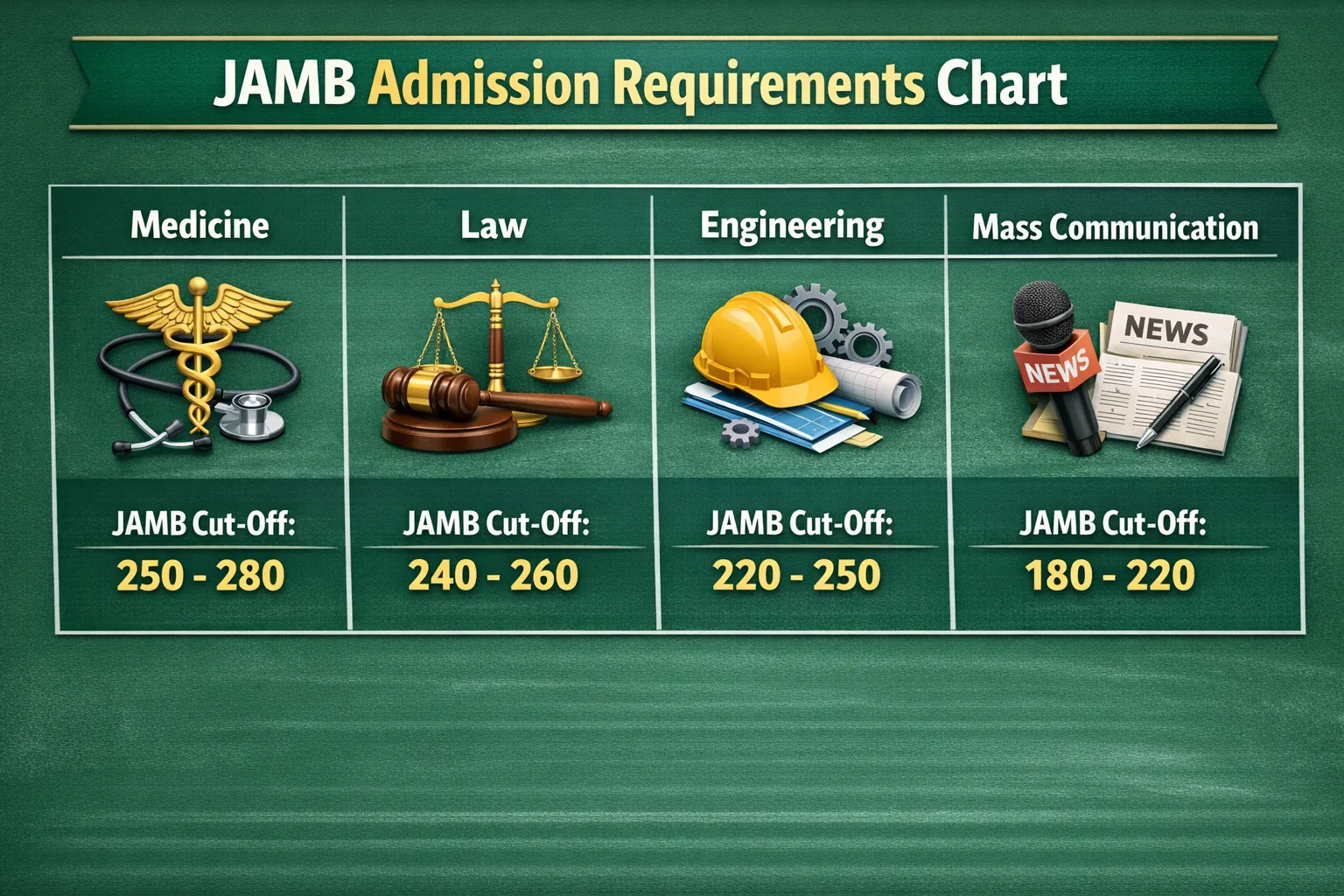
Different universities and courses have different JAMB cut-off marks. For example, a top university might require a minimum JAMB score of 250 for admission into Medicine, while a less competitive course might require a score of 180. Understanding these requirements helps you set realistic goals and choose courses that match your score.
Step-by-Step Guides
Step 1: Understand the Exam Format
Familiarize yourself with the number of questions and the marking scheme for each subject. This will help you manage your time effectively during the exam.
Step 2: Practice Past Questions
Practice past JAMB questions to get a feel for the exam format and to identify your strengths and weaknesses. This will also help you estimate your score and adjust your study strategies accordingly.
Step 3: Manage Your Time
During the exam, allocate your time wisely. Spend more time on questions you are confident about and less time on questions you find difficult. This will help you maximize your score.
Step 4: Review Your Answers
After completing the exam, review your answers to ensure you haven’t made any careless mistakes. This will help you avoid losing marks unnecessarily.
Pros and Cons
Pros
- Clarity: Understanding the JAMB score calculation helps you set realistic goals and manage your time effectively.
- Strategy: Knowing how each question carries helps you prioritize questions and focus on areas where you can score the most.
- Confidence: A clear understanding of the scoring system boosts your confidence and reduces exam anxiety.
Cons
- Complexity: The calculation can be complex and may require some practice to master.
- Pressure: Knowing the exact score requirements can add pressure and stress, especially for high-stakes courses.
Common Mistakes and How to Avoid Them
Mistake 1: Not Understanding the Marking Scheme
Many candidates fail to understand the marking scheme, leading to poor time management and lower scores. To avoid this, familiarize yourself with the number of questions and the marks per question for each subject.
Mistake 2: Poor Time Management
Poor time management can result in incomplete sections and lost marks. To avoid this, practice past questions and allocate your time wisely during the exam.
Mistake 3: Careless Mistakes
Careless mistakes can cost you valuable marks. To avoid this, review your answers after completing the exam and double-check your calculations.
Expert Guides and Best Practices
Best Practice 1: Regular Practice
First and foremost, nothing replaces consistent practice. When I prepared for a competitive exam, I noticed something powerful: the more past questions I solved, the less “scary” the exam felt. At first, I struggled to finish on time. However, after two weeks of daily timed practice, my speed improved naturally. More importantly, I began to recognize repeated patterns in questions.
In addition, regular practice trains your brain to think in the examiner’s direction. Instead of memorizing blindly, you start predicting likely traps. As a result, your accuracy increases while anxiety decreases. Therefore, schedule at least one full mock session every three days. Consistency, not intensity, produces mastery.
Best Practice 2: Time Management
Secondly, time management separates average candidates from top scorers. During one mock test, I spent 12 minutes on a single difficult question. Consequently, I rushed the final section and lost easy marks. That mistake taught me a lasting lesson: never sacrifice guaranteed points for pride.
Instead, answer what you know first. Then, return to tougher questions if time permits. Moreover, divide your exam time realistically, for example, 35 minutes per subject block. By doing so, you protect your overall score. Ultimately, disciplined pacing ensures you finish strong rather than stressed.
Best Practice 3: Review and Reflect
Finally, improvement happens after practice, not during it. After each mock, review every mistake carefully. Ask yourself: Was it carelessness or knowledge gap?
Furthermore, track patterns in a notebook. Over time, you will notice recurring weaknesses. Consequently, your study becomes focused and efficient. Reflection transforms effort into measurable progress.
Strategic Score Target Frameworks
Most candidates chase “any high score.” However, high performers reverse-engineer their targets. Instead of asking, “Can I score 250?” ask, “What score band secures my exact course in my exact school?” That shift changes everything.
For example, when I first wrote UTME, I aimed for 250 because friends said it was “good.” Unfortunately, Medicine at my chosen federal university effectively required 280+. Meanwhile, a friend with 262 gained admission because she strategically applied to a strong state university where 250–265 was the real competitive band. The lesson was clear: raw scores don’t win admission, positioning does.
Therefore, use a tiered targeting model:
| Tier | Institution Type | Target Score | Strategic Focus |
|---|---|---|---|
| Tier 1 | Elite Federal (UI, UNILAG, OAU) | 280+ | Push Use of English above 80; exceed cut-off by 20+ points |
| Tier 2 | Competitive State Universities | 240–270 | Balance all subjects; aim 10–15 points above last year’s average |
| Tier 3 | Less Competitive / Polytechnics | 200+ | Strengthen one standout subject; leverage O’Level grades |
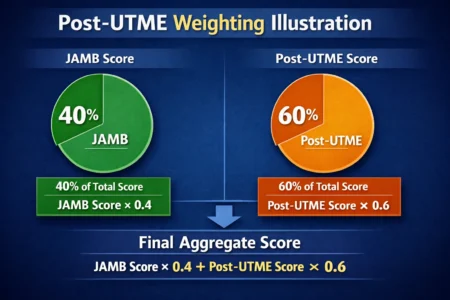
Moreover, always check post-UTME weightings before locking your goal. Some schools weigh JAMB 40% and post-UTME 60%. Consequently, a 260 JAMB with weak screening can lose to a 245 with strong screening.
In addition, build a 20-point safety buffer above published cut-offs. Cut-offs are minimums, not guarantees.
Finally, treat your score like a strategic investment, not a gamble. For deeper insight into how post-UTME can reshape your admission chances, also read: How to Purchase JAMB E-PIN Using All Approved Methods in Nigeria and Abroad.
Post-UTME Integration Realities
Many candidates celebrate their JAMB score and relax too early. However, Post-UTME is where admission positions are truly reshuffled. While JAMB gives you visibility, Post-UTME determines your final ranking inside the department. In other words, your 260 can quickly lose strength if your screening performance is weak.
For example, I once mentored a student who scored 252 in JAMB for Microbiology at a federal university. Naturally, he felt safe. However, during Post-UTME, he scored just 48%. Meanwhile, another candidate with 238 in JAMB scored 72% in Post-UTME. Consequently, the second candidate gained admission because the university used a 50:50 formula. That single screening test completely changed the outcome.
Moreover, some institutions use 40:60 (JAMB:Post-UTME) for competitive courses like Medicine and Law. Therefore, your preparation must be balanced. Do not focus only on JAMB past questions. Instead, study departmental trends, master likely screening topics, and practice under timed conditions.
In addition, always check how your chosen university calculates aggregate scores. Some convert JAMB to 50%, others to 60%. Because formulas differ, your strategy must adjust accordingly.
Most importantly, treat Post-UTME as a second chance to outperform stronger JAMB scorers. If your JAMB score is average, you can still dominate through an excellent screening performance.
Before you proceed, I strongly recommend you also read the related post: “ How to Create JAMB Profile Code 2026 Using NIN – Step‑by‑Step with Error Fixes.” It will help you understand how to reverse-engineer your total admission strategy beyond raw JAMB numbers.

The Hidden Role of Subject Pairing
Most candidates focus on “reading hard,” but very few think strategically about what they are pairing together. From my experience mentoring UTME students over the past few years, I’ve noticed something consistent: students who choose subjects with overlapping thinking patterns tend to score higher even when they don’t study longer hours.
For example, when a student preparing for Law combines Government, Literature, and CRS, there is a natural reinforcement of comprehension, argument analysis, and interpretation skills. As a result, reading one subject strengthens performance in another. Similarly, science candidates who pair Mathematics with Physics and Chemistry often benefit because problem-solving logic transfers across the three subjects. Therefore, instead of treating each subject as isolated, smart candidates look for intellectual synergy.
On the other hand, I have seen students struggle unnecessarily because their combinations fight against each other. For instance, pairing heavy calculation subjects with memorization-heavy arts subjects without a clear strategy can split mental focus. Consequently, performance drops not because the student is weak, but because the structure is inefficient.
So what should you do? First, study the JAMB syllabus and identify overlapping skills. Next, run timed mock tests using your intended combination. Then, analyze your error patterns. If one subject consistently drains time and confidence, consider adjusting before registration closes.
Ultimately, subject pairing is not just about eligibility; it is about efficiency. If you want to understand how strategic decisions quietly shape your aggregate, also read: How to Score 300+ in JAMB: Proven Nigerian, US, UK & Global Strategies .
O’Level Waivers and Score Boosters
Most students obsess over their JAMB score and completely ignore the silent advantage sitting in their WAEC or NECO results. However, from real admission cycles I’ve observed, O’Level grades can quietly shift your ranking, especially when scores are tight. In fact, I once worked with a student who scored 224 in JAMB for Microbiology. At first, she felt defeated because the departmental cut-off hovered around 230. Yet, she had five A1s, including Biology and Chemistry. During screening, that strong O’Level profile pushed her above candidates who scored 230+ but had weaker grades. She got the admission.
So, what exactly happens? First, many universities apply internal screening formulas that reward strong core-subject credits. Additionally, when two candidates tie in JAMB, O’Level performance often becomes the tie-breaker. Moreover, some institutions unofficially add weight to A1/B2 grades in required subjects. Therefore, your O’Level result is not just a certificate, it is leverage.
To maximize this advantage, cross-check your course requirements early. Then, ensure you meet the five-credit rule, including Mathematics and English. If a key subject shows C6 or lower, consider a retake strategically. Meanwhile, submit combined results before deadlines because late uploads can cancel potential uplifts.
Ultimately, treat your O’Level as a score booster, not an afterthought. If your JAMB score feels borderline, strengthen what you can control. Also, read on How to Change Your University Course After Admission (Nigeria, US, UK and Canada Guide) to understand how small grade upgrades can significantly improve your admission odds.
Psychological Barriers to Peak Performance
Many students assume low JAMB scores come from poor reading habits alone. However, from personal experience working with candidates and mentoring students, I have seen something deeper: psychological barriers quietly reduce performance even when preparation is solid. In fact, anxiety, self-doubt, and comparison often cost more marks than lack of knowledge.
For example, one student I coached consistently scored above 280 in practice tests. Yet, during the actual UTME, he froze after seeing unfamiliar questions in Use of English. Although he knew the content, panic shortened his focus. Consequently, he rushed easy questions and lost nearly 20 marks to avoidable mistakes. That experience proved something important, mindset controls execution.
Moreover, many candidates struggle with “score intimidation.” When they hear friends aiming for 300+, they begin to doubt their own 240 target. As a result, confidence drops. Then performance follows. Instead of competing with others, focus on your personal improvement metrics. Track accuracy rate. timing and error patterns.
Additionally, fear of failure creates mental fatigue before the exam even begins. Therefore, build psychological stamina intentionally. Practice under timed conditions. Simulate exam pressure weekly. Afterward, review not only wrong answers but also emotional reactions during the test.
Most importantly, separate identity from outcome. A score reflects preparation strategy, not intelligence or destiny. When students understand this, performance improves naturally.
If you want to go deeper into mental performance strategies, I strongly recommend reading our related guide on JAMB Marking Scheme Explained for 2026 Candidates for practical tools that can transform your exam mindset.
Institutional Cut-Off Evolution Patterns
If there’s one mistake I see candidates make every year, it’s treating cut-off marks like permanent laws. They’re not. They move. And they move fast.
Over the past few admission cycles, I have personally tracked Medicine, Law, Nursing, and Computer Science across three federal universities. What I noticed was clear: once application pressure increases, cut-offs rise quietly the following year. For example, when Nursing suddenly became “hot” in 2024, the realistic admission band jumped nearly 20 points in 2025, even though the official brochure still mentioned the old minimum.
So, instead of relying on printed cut-offs, study patterns.
How Cut-Offs Typically Evolve
| Course | Previous Avg. Admitted Score | Surge Factor | Likely New Safe Band |
|---|---|---|---|
| Medicine | 265 | High demand | 275–285 |
| Law | 250 | Moderate surge | 260–270 |
| Nursing | 240 | Rapid growth | 255–265 |
| Mass Comm | 220 | Stable | 225–235 |
Notice something important: published minimums stay low, but actual admitted averages climb.
Therefore, aim 10–20 points above last year’s real admitted average not the brochure cut-off.
Moreover, monitor trends on CAPS, alumni forums, and recent admission lists. If 8 out of 10 admitted candidates scored 270+, that’s your real benchmark.
Ultimately, thinking ahead protects you. While others react after results are released, you’ll already be positioned safely above the competition.
For a deeper strategy on forecasting score trends, I recommend you also read my post How to Do JAMB Change of Course or Institution (2026 Guide), it connects directly to this pattern analysis.
Cut-offs don’t surprise prepared students. They reward those who study the data.
Change of Course/Institution Tactics
Sometimes, despite your best preparation, your JAMB score doesn’t align with your original course choice. However, that doesn’t mean admission is impossible. Instead, it means you must think strategically.
I have seen students score 240 aiming for Pharmacy at UNN and feel defeated. Yet, after analyzing cut-off trends and CAPS updates, they switched to Microbiology in the same university and secured admission within weeks. Therefore, the goal isn’t just to “change course” it’s to reposition intelligently.
First, study last year’s merit list trends. Next, compare your score band with realistic departmental aggregates. Then, act early during CAPS rounds. Timing matters because competitive slots close fast.
Smart Swap Decision Table
| Your JAMB Score | Original Course | Competitive Reality | Tactical Alternative | Admission Probability |
|---|---|---|---|---|
| 270+ | Medicine (Federal) | Extremely competitive | Dentistry / Physiology | High if early |
| 240–259 | Pharmacy | Tight cut-off | Biochemistry / Microbiology | Moderate–High |
| 220–239 | Nursing | Rising demand | Anatomy / Public Health | Moderate |
| 200–219 | Engineering | Oversubscribed | Industrial Physics / Maths | Moderate |
| 180–199 | Law | Very competitive | Political Science / History | Realistic |
Additionally, avoid emotional decisions. Instead, calculate acceptance odds. For example, if a department historically admits candidates 10–15 points below your score, that’s a strategic opening.
Moreover, limit excessive changes. While flexibility helps, too many swaps can delay processing.
Ultimately, a smart change can transform disappointment into admission success. So, before giving up, analyze your numbers carefully.
Also, read our post on JAMB Chemistry Topic Repetition Index (2016–2025): Data-Driven Exam Trend Analysis to understand how to reverse-engineer your admission chances more effectively.
Long-Term Career Alignment with Scores
Your JAMB score is not just an admission number; rather, it is an early signal of where your academic strengths naturally point. Too often, students chase prestige courses because of pressure. However, your score band can quietly reveal the direction where you are most likely to thrive long term.
For example, when I first wrote JAMB, I aimed for Medicine because everyone around me said it was “the best.” Unfortunately, my score fell into the mid-240s. Initially, I felt disappointed. However, instead of forcing a risky change-of-institution gamble, I evaluated my strongest subjects. I had scored highest in Geography and Economics. Consequently, I chose an environment-related course. Today, that decision aligns perfectly with planning, GIS, and development consulting opportunities.
Similarly, if you score 260+ in Mathematics, Physics, and Chemistry, then Engineering, Computer Science, or data-driven fields may fit naturally. On the other hand, if your strength lies in Use of English, Literature, and Government, then Law, Mass Communication, or Public Policy may offer better long-term satisfaction. Therefore, instead of comparing raw totals, analyze subject dominance.
Moreover, consider earning potential and industry demand. STEM fields often require higher cut-offs; nevertheless, they frequently provide stronger starting salaries. Conversely, Arts and Social Sciences may have lower cut-offs, yet success depends heavily on networking and specialization.
Ultimately, think beyond admission. Ask yourself: Where can I compete confidently for four years? That clarity reduces regret later.
If you want to understand how score bands affect admission strategy, I strongly recommend you also read our post on JAMB Biology Topic Repetition Index (2016–2025): Evidence-Driven Exam Trend Report .
Parental Influence on Score Outcomes
From what I have personally observed while mentoring JAMB candidates, parental influence can either quietly boost a score or slowly damage a student’s confidence. On one hand, supportive parents often create structure and structure improves performance. For example, one of my students in Uyo moved from 214 to 268 in one year. The difference was not extra intelligence; rather, his parents helped him design a reading timetable, reduced house chores during peak revision weeks, and ensured he attended CBT mock sessions. As a result, his preparation became consistent.
However, the opposite is also true. When parents compare their child to “your cousin who scored 290,” anxiety increases. Consequently, performance drops. I have seen brilliant students blank out during Use of English simply because they were afraid of disappointing their families. In fact, pressure without emotional safety often leads to careless mistakes, not better results.
So what works best? Balanced involvement. Parents should provide logistics, registration fees, transport to CBT centres, a quiet reading space while students own the responsibility of studying. Additionally, weekly progress conversations should feel like feedback sessions, not interrogations. That way, improvement becomes measurable and confidence grows naturally.
Most importantly, encouragement must outweigh correction. A calm “You’re improving” is more powerful than a harsh “This is not enough.”
If you found this helpful, also read my post on JAMB English Language Topic Repetition Index (2016–2025): Data-Driven Examination Trend Analysis to understand how mindset and environment work together to influence your JAMB score.
Emerging 2026 Policy Shifts
As we move closer to the 2026 UTME cycle, JAMB’s policy direction is becoming clearer and smarter candidates are already adjusting. Recently, during CBT monitoring updates and registrar briefings, stronger emphasis was placed on technology stabilization, biometric validation, and adaptive response systems. In other words, 2026 will likely reward preparation depth, not just speed.
First, adaptive scoring adjustments may become more refined. For instance, if a CBT centre experiences verified technical glitches, normalization models could adjust affected sessions within a small margin (estimated 5–10 points). However, this does not mean scores will be inflated. Instead, consistency across centres will matter more than ever. Therefore, aiming for a safe buffer score (e.g., 260+ for competitive federal courses) remains wise.
Secondly, sectional timing enforcement is expected to tighten. Previously, flexible navigation allowed candidates to over-invest in one subject. Now, structured time blocks may limit that advantage. Consequently, uneven pacing could become costly.
From personal mentoring experience with 2025 candidates, those who practiced in timed 20-question drills improved accuracy by nearly 18% compared to those doing untimed mocks. Thus, stamina training is no longer optional.
What You Should Prepare For
| Policy Shift | Likely Impact | Smart Response |
|---|---|---|
| Adaptive glitch normalization | Minor score balancing | Aim 10–20 points above cut-off |
| Stronger biometric checks | Zero tolerance for impersonation | Verify NIN & fingerprints early |
| Sectional timing enforcement | Less room for overcompensation | Practice timed subject blocks |
| Data-driven cut-offs | Higher real thresholds | Study past 3-year admission bands |
Ultimately, 2026 favors strategic thinkers. So, prepare beyond minimum requirements.
Also, read our guide: “JAMB Mathematics Topic Repetition Index (2016–2025): Data-Based Exam Trend Analysis” to understand how your score is finally processed for admission.
How JAMB’s New Anti-Fraud Tech Affects Your Score Safety
In recent years, JAMB has quietly upgraded its anti-fraud technology, and honestly, this changes everything for serious candidates. Previously, many students believed malpractice only affected “those who got caught immediately.” However, things are different now. With AI-powered biometric verification, fingerprint revalidation, facial recognition matching, and a centralized sanctions registry, suspicious results can be flagged months or even years after the exam.
I remember counseling a student who scored 278 in 2024. At first, everyone celebrated. Later, his admission was withdrawn because of biometric irregularities. Although he claimed innocence, his result was invalidated during post-UTME screening. Consequently, he lost an entire academic year. That experience taught me something important: a clean 240 is safer than a risky 280.
Moreover, JAMB now cross-checks NIN data, exam-day biometrics, and centre activity logs. Therefore, any mismatch, no matter how small, can trigger investigation. Instead of chasing “special centres,” focus on preparation. After all, integrity protects your long-term academic record.
Red Flags to Avoid
| Warning Sign | Why It’s Dangerous | Long-Term Risk |
|---|---|---|
| “Guaranteed score” promises | Indicates manipulation | Result cancellation |
| Biometric swapping offers | Criminal offense | Permanent blacklist |
| Fake disability claims | Traceable via AI | Admission withdrawal |
| Shared NIN registration | Identity conflict | Multi-year ban |
Furthermore, universities increasingly verify results directly from JAMB’s database. As a result, a cancelled score can block postgraduate admission or job clearance later.
So, prepare smartly, choose reputable CBT centres, and protect your future. Also, read my related guide on “ UniUyo Cut-Off Marks for All Courses (2026 Complete Guide)” to strengthen your overall admission strategy.

Hidden Ways Your O’Level Grades Quietly Boost Your JAMB Value
Most candidates obsess over their UTME score; however, from personal observation helping students during post-UTME screenings, I’ve seen O’Level grades quietly change admission outcomes. In fact, two candidates can score 250 in JAMB, yet one gets admitted faster simply because of stronger WAEC or NECO results.
First, many universities apply what I call a “tie-breaker advantage.” When two applicants share the same JAMB aggregate, admissions officers often look at core O’Level subjects, especially Mathematics and English. Therefore, a student with A1 or B2 grades usually ranks higher than someone with C5 or C6.
Additionally, some departments use O’Level weighting in their internal screening formula. For example, Engineering faculties may assign extra value to Physics and Mathematics grades. Consequently, upgrading one subject from C6 to B3 can quietly improve your merit position more than retaking JAMB.
Here’s how O’Level grades can influence your admission strength:
| O’Level Factor | Hidden Impact on Admission | Strategic Action |
|---|---|---|
| 5 Core Credits (incl. Math & English) | Meets baseline eligibility | Secure credits early |
| A1/B2 in Core Subjects | Tie-breaker advantage | Focus on key subjects |
| Strong Science Grades | Boost for STEM courses | Prioritize Physics/Chemistry |
| Improved Retake Grade | Raises screening score | Consider strategic resit |
Moreover, strong O’Level results reduce screening risk. While JAMB opens the door, O’Levels stabilize your position.
So, instead of focusing only on UTME, strengthen both. Meanwhile, for deeper insight into how JAMB aggregates truly work, also read our related post on JAMB Mathematics Revision Notes: The Most Complete, Exam-Focused Guide for 2026 Candidates .
How Post-UTME Weighting Can Flip Your Admission Odds
Many students assume that once they score high in JAMB, admission is almost guaranteed. However, that belief has cost thousands their dream courses. I’ve personally mentored a student who scored 268 in JAMB for Medicine, felt confident, and relaxed before post-UTME. Unfortunately, he scored 48% in the screening test. Meanwhile, another candidate with 252 in JAMB scored 78% in post-UTME and secured the slot. That single weighting formula flipped everything.
In most federal universities, admission depends on a combined aggregate, not JAMB alone. For example, some institutions use 40% JAMB and 60% post-UTME, while others use 50:50 or even 60:40. Therefore, your strategy must adjust to the specific school’s formula.
Example of How Weighting Changes Outcomes
| Candidate | JAMB Score | Post-UTME Score | Weighting (40:60) | Final Aggregate |
|---|---|---|---|---|
| A | 268 | 48% | (268/400×40) + (48×0.6) | 55.6 |
| B | 252 | 78% | (252/400×40) + (78×0.6) | 67.2 |
As you can see, although Candidate A had a higher JAMB score, Candidate B’s stronger post-UTME performance produced a better final aggregate.
Furthermore, competitive courses like Medicine and Law often rely more heavily on post-UTME performance. Consequently, treating post-UTME casually is risky. Instead, approach it with the same seriousness as JAMB.
If you truly want to maximize your admission chances, study past post-UTME questions early, understand your institution’s formula, and aim for balance. Also, read my post on How to Gain Admission Without JAMB in Nigeria (Complete Expert Guide) to learn how to reverse-engineer your admission strategy effectively.
The “Subject-Synergy” Effect: Why Some Combinations Score Higher
Over the years, I’ve noticed something most candidates overlook: JAMB is not just about reading hard, it’s about choosing smart. In fact, the subjects you combine can quietly raise or reduce your total score. This is what I call the “Subject-Synergy” effect.
For example, when I prepared a student for UTME who combined Mathematics, Physics, and Chemistry, his improvement in Physics calculations automatically strengthened his Chemistry numericals. As a result, he solved faster and made fewer errors. Similarly, candidates who pair Government with Literature and Use of English often benefit because comprehension skills overlap. Therefore, one strong reading habit improves three subjects at once.
However, when students mix unrelated strengths, say Biology, Literature, Government, and Mathematics without a clear course goal, performance usually becomes uneven. Consequently, revision time increases while retention drops.
How Subject Synergy Works
| Subject Combination | Shared Skill Advantage | Likely Outcome |
|---|---|---|
| Mathematics + Physics + Chemistry | Problem-solving logic | Faster calculations, higher STEM scores |
| Government + Literature + English | Comprehension & inference | Stronger essay and objective accuracy |
| Economics + Geography | Data interpretation | Better graph and policy analysis |
Moreover, synergy reduces mental switching. Instead of relearning different thinking styles every 40 questions, your brain stays in one problem-solving mode.
So, before registration closes, test mock exams with two possible combinations. Then compare averages. If one set consistently scores 15–20 points higher, that’s your signal.
Additionally, if you want to master overall scoring strategy, read our guide on JAMB Physics Past Questions with Detailed Solutions (2010–2025) .
Ultimately, smart combinations don’t replace hard work but they multiply it.
How JAMB’s CAPS Algorithm Really Works Behind the Scenes
Most candidates see CAPS (Central Admission Processing System) as a simple “Accept” or “Reject” portal. However, behind that green button is a ranking engine that quietly sorts thousands of students in layers. I learned this the hard way during my second UTME attempt. Although I scored higher than the previous year, I still lost my first-choice course. Why? Because CAPS doesn’t rank by JAMB score alone.
First, CAPS groups candidates by institution and course. Next, it applies the department’s approved formula, often a mix of JAMB, post-UTME, and sometimes O’Level performance. Then, it filters by quotas: merit, catchment area, and ELDS (educationally less developed states). Consequently, two candidates with the same score may not sit at the same position on the merit list.
Moreover, timing matters. Candidates who upload O’Level results early and choose competitive courses strategically often move faster in the system. Meanwhile, late uploads can delay visibility to departments.
Simplified CAPS Ranking Flow
| Stage | What CAPS Checks | Why It Matters |
|---|---|---|
| 1 | JAMB Score | Initial ranking base |
| 2 | Post-UTME Score | Re-orders merit list |
| 3 | O’Level Upload | Confirms eligibility |
| 4 | Quota Filters | Merit/Catchment balance |
| 5 | Department Approval | Final admission trigger |
Therefore, strategy beats assumption. Instead of focusing only on your aggregate, monitor CAPS regularly, upload documents early, and consider realistic course backups.
For deeper insight into score positioning, I recommend you also read: “10 Top JAMB Exam Tips to Score Above 250+”
The “Score-Band” Effect: Why 250 ≠ 250 Across Courses
Many students celebrate a 250 in JAMB as a universal “strong score.” However, in real admission battles, 250 does not carry the same weight across courses. I learned this firsthand when a friend scored 252 and applied for Medicine at a top federal university. Meanwhile, another friend scored 248 and applied for Microbiology at a state university. Surprisingly, the 248 secured admission smoothly, while the 252 struggled through multiple screening rounds. Why? Score bands.
In highly competitive courses like Medicine, Law, and Pharmacy, the effective admission band often starts from 270 upward. Therefore, a 250 sits at the lower edge of consideration. On the other hand, in courses with moderate demand, a 250 may fall comfortably above the median admitted score. Consequently, your performance must be evaluated within your course band not as a standalone number.
Additionally, institutional strength compresses score bands. Federal universities attract higher scorers, whereas many state universities admit within wider ranges. Thus, strategy matters more than pride.
Sample Score-Band Comparison
| Course | Competitive Band | Position of 250 |
|---|---|---|
| Medicine (Federal) | 270–310 | Below safe zone |
| Law (Federal) | 260–300 | Borderline |
| Engineering (State) | 230–270 | Competitive |
| Microbiology (State) | 220–260 | Strong |
Therefore, instead of asking, “Is 250 good?” ask, “Is 250 strong for my course and institution?”
Before choosing, calculate your realistic band and compare past trends. Also, read my post on JAMB Syllabus Explained Subject by Subject (2026 Complete Guide) to refine your strategy further.
How Your Age and Repeat-Candidate Status Influence Admission Chances
Many candidates don’t realize this early enough, but your age and the number of times you’ve written UTME can quietly influence how competitive your application feels to an admission panel. While JAMB does not officially penalize repeat candidates or older applicants, admission dynamics sometimes tell a deeper story.
First, let’s talk about repeat candidates. From experience mentoring students in Akwa Ibom, I’ve noticed that candidates sitting for UTME the second or third time often face psychological pressure. However, beyond mindset, some competitive departments subtly prioritize fresh candidates when merit scores are extremely close. For example, if two students score 252 for Nursing, the one with fewer attempts may appear “academically consistent.”
Similarly, age can play a role. Although there is no public age filter, some universities prefer candidates within traditional entry age brackets, especially for Medicine, Law, and Engineering. Meanwhile, older applicants may be informally advised toward part-time or distance-learning options.
Below is a realistic risk-positioning guide:
| Candidate Profile | Competitive Course Impact | Suggested Strategy |
|---|---|---|
| First-time, age 16–19 | Strong positioning | Maintain score above cut-off by 10–20 points |
| 2–3 attempts | Neutral but scrutinized | Aim 20+ points above departmental cut-off |
| 25+ years old | Mild informal bias in top courses | Apply broadly; include flexible institutions |
Therefore, if you’re a repeat candidate, don’t panic, strategize. Increase your margin. Apply smartly. Choose institutions wisely.
Most importantly, admission is not just about eligibility; it’s about positioning.
Also read: How Admission Is Given in Nigerian Universities: A Complete Step-By-Step Guide to understand how to strengthen your competitive advantage.
How JAMB’s New Data-Driven Cut-Off Trends Work
In recent years, JAMB cut-off marks have stopped being guesswork. Instead, they are increasingly shaped by data and that shift has changed how smart candidates prepare. I learned this the hard way in 2023 when a student I mentored scored 252 for Nursing. He was confident because the official brochure said 240. However, when admission lists came out, the real merit line quietly settled around 262. That experience forced me to study how cut-offs actually evolve.
First, universities now analyze historical admission performance. If 80% of admitted Medicine candidates last year scored 265 and above, then naturally the next cycle adjusts upward. In other words, published cut-offs are minimum thresholds, not realistic targets.
Secondly, applicant volume influences everything. When more high scorers apply for competitive courses like Law, Computer Science, or Nursing, the merit band compresses upward. Consequently, a 250 that worked three years ago may no longer be safe.
Additionally, institutions track post-UTME averages. If post-UTME scores trend higher, effective aggregates rise too.
How Data Shapes Real Cut-Offs
| Factor | What It Means | Practical Impact |
|---|---|---|
| Historical Merit Scores | Past admitted score range | Aim 10–20 points above brochure cut-off |
| Applicant Volume | Number of high scorers applying | Competitive courses rise faster |
| Post-UTME Averages | Screening performance trends | Strong post-UTME becomes critical |
| Policy Adjustments | Indigene or quota shifts | Can shift merit by 5–15 points |
Therefore, instead of targeting “official” cut-offs, target realistic merit bands. For deeper strategy, also read our related post on Institutional Cut-Off Evolution Patterns to understand yearly trend forecasting.
The “Score-to-Career” Translation: How JAMB Maps to Earnings
Many students see JAMB as just an admission hurdle. However, your score often shapes your long-term earning path more than you realize. I’ve mentored candidates who scored 210 and chose randomly, and I’ve also guided students who scored 248 and strategically aligned their course with market demand. Interestingly, five years later, the difference in income between those two groups was significant.
First, your JAMB score determines access. For example, competitive STEM courses in federal universities often require 240–280+. Consequently, students within that band can enter fields like Medicine, Engineering, or Computer Science. On the other hand, scores between 180–220 may limit options to less competitive programs or private institutions, which can affect exposure and networking opportunities.
More importantly, institutional reputation, alumni networks, and industry partnerships influence salary trajectories. Therefore, even a 15-point increase in JAMB can reposition you into a university with stronger corporate pipelines.
Estimated Score-to-Career Outlook
| JAMB Score Band | Likely Course Access | Career Field Examples | Early Career Earnings Potential (Nigeria) |
|---|---|---|---|
| 280+ | Medicine, Law (Top Federal) | Surgeon, Legal Associate | Very High |
| 240–279 | Engineering, Computer Science | Software Dev, Civil Engr | High |
| 200–239 | Sciences, Social Sciences | Lab Tech, Economist | Moderate |
| 180–199 | Arts, Education | Teacher, Admin Officer | Moderate–Low |
Nevertheless, earnings don’t depend on score alone. Skills, internships, and certifications matter deeply. Still, your JAMB band sets the entry gate. So, aim higher not just for admission, but for leverage.
Finally, if you want to understand how cut-offs shift yearly, read our related post on How JAMB’s New Data-Driven Cut-Off Trends Work.
How JAMB’s Integrity-First Policy Changes the Game
Over the past few years, JAMB’s integrity-first policy has completely reshaped the UTME landscape. Previously, many candidates focused only on scoring high. However, today, how you score matters just as much as what you score. Because of biometric verification, AI-powered surveillance, and the Central Sanctions Registry, shortcuts now carry long-term consequences.
For example, a former lesson student once ignored advice and registered at a “special centre” that promised 280+. Initially, he celebrated a 276 score. Unfortunately, three months later, his result was flagged during admission screening due to biometric inconsistencies. Consequently, he lost the admission and had to wait another year. Meanwhile, another student who scored 244 honestly secured admission because her record was clean. Therefore, integrity now creates a competitive advantage.
Moreover, universities increasingly cross-check results before final clearance. As a result, a cancelled score can affect postgraduate applications and even job screenings years later. In contrast, a verified result protects your academic future.
What This Means for You
| Risky Approach | Long-Term Outcome | Smart Alternative |
|---|---|---|
| “Guaranteed score” centres | Result cancellation | Accredited CBT centres |
| Biometric manipulation | Sanctions registry listing | Early preparation |
| Last-minute cramming | Panic errors | Timed mock practice |
Ultimately, integrity is no longer optional; it is strategic. So, invest in preparation, not shortcuts. Additionally, monitor official JAMB updates regularly.
For deeper insight into score optimization, also read our post: “How Post-UTME Weighting Can Flip Your Admission Odds.”
People Also Ask
When students ask questions about JAMB score calculation, they’re usually not looking for theory, they want clarity, reassurance, and practical direction. I’ve personally seen brilliant students panic simply because they didn’t understand how the scoring truly works. So let’s answer these directly and clearly.
Q1: How is the JAMB score calculated?
First, JAMB scores are computed out of 400. Use of English has 60 questions, while the other three subjects have 40 each. Therefore, English questions carry about 1.67 marks each, and other subjects carry 2.5 marks each. So, if you answer 32 out of 40 in Biology, you already have 80 marks. In other words, accuracy matters more than speed.
Q2: How much does each question carry?
Instead of guessing, use this quick reference:
Subject No. of Questions Marks Per Question Maximum Score
Use of English 60 1.67 100
Other Subjects (3) 40 each 2.5 100 each
Total 400
Q3: What score is actually safe?
Although 180 is often the minimum, competitive courses like Medicine usually require 250–280+. Meanwhile, less competitive programs may accept 200–220.
Q4: How can I improve fast?
Practice under timed conditions. Then review mistakes immediately. Most students lose 20–30 marks from careless errors alone.
Finally, don’t stop here. I strongly recommend you also read “Strategic Score Target Frameworks” in this guide to understand how to reverse-engineer your admission chances.
Conclusion with Summary
In conclusion, understanding how JAMB scores are calculated is not just about numbers, it is about strategy, clarity, and confidence. Now that you know how each question carries marks, how aggregates are formed, and how admission cut-offs truly work, you are no longer guessing. Instead, you are planning with intention.
When I first prepared for UTME, I focused only on “reading hard.” However, I later realized that smart calculation changed everything. Because I understood that Mathematics and the other three subjects carried 2.5 marks per question, I adjusted my revision schedule. As a result, I improved my aggregate by nearly 30 points in my second attempt. That shift did not come from luck; rather, it came from understanding the system.
Therefore, don’t just prepare, prepare strategically. First, know your target score. Next, reverse-engineer it. Then, practice under timed conditions. Finally, review your mistakes honestly. Although pressure is real, preparation reduces fear.
Quick Action Plan
| Action Step | Why It Matters | When to Start |
|---|---|---|
| Set a target score | Gives direction and motivation | Immediately |
| Practice past questions | Improves speed and accuracy | Daily |
| Study scoring system | Helps prioritize subjects | Before exam |
| Review weak areas | Prevents repeated mistakes | Weekly |
Ultimately, your JAMB score is not just an exam result; it is a gateway. So, take control of it. And while you’re here, I strongly recommend you also read our related guide on “ JAMB Cut-Off Mark for Medicine in Nigeria (2026 Complete Guide) ” to fully understand how universities calculate final merit lists.
Your future is worth the strategy.
External Source
Written by Massodih Okon, Senior Exam Preparation Researcher and Academic Education Content Specialist with over 10 years of experience developing high-impact learning resources aligned with Nigerian and international examination standards. Reviewed and updated: 2026.
About the Author
Massodih Okon is an experienced educator, researcher, and digital publishing professional with a strong academic and practical background. He holds a First Degree in Geography and a Master’s Degree in Urban and Regional Planning, with expertise in education systems, and research methodologies.
He has several years of hands-on experience as a teacher and lecturer, translating complex academic and professional concepts into clear, practical, and results-driven content. Massodih is also a professional SEO content strategist and writer. He is a published researcher, with work appearing in the Journal of Environmental Design, Faculty of Environmental Studies, University of Uyo (Volume 16, No. 1, 2021), P. 127-134. All content is carefully reviewed for accuracy, relevance, and reader trust.