
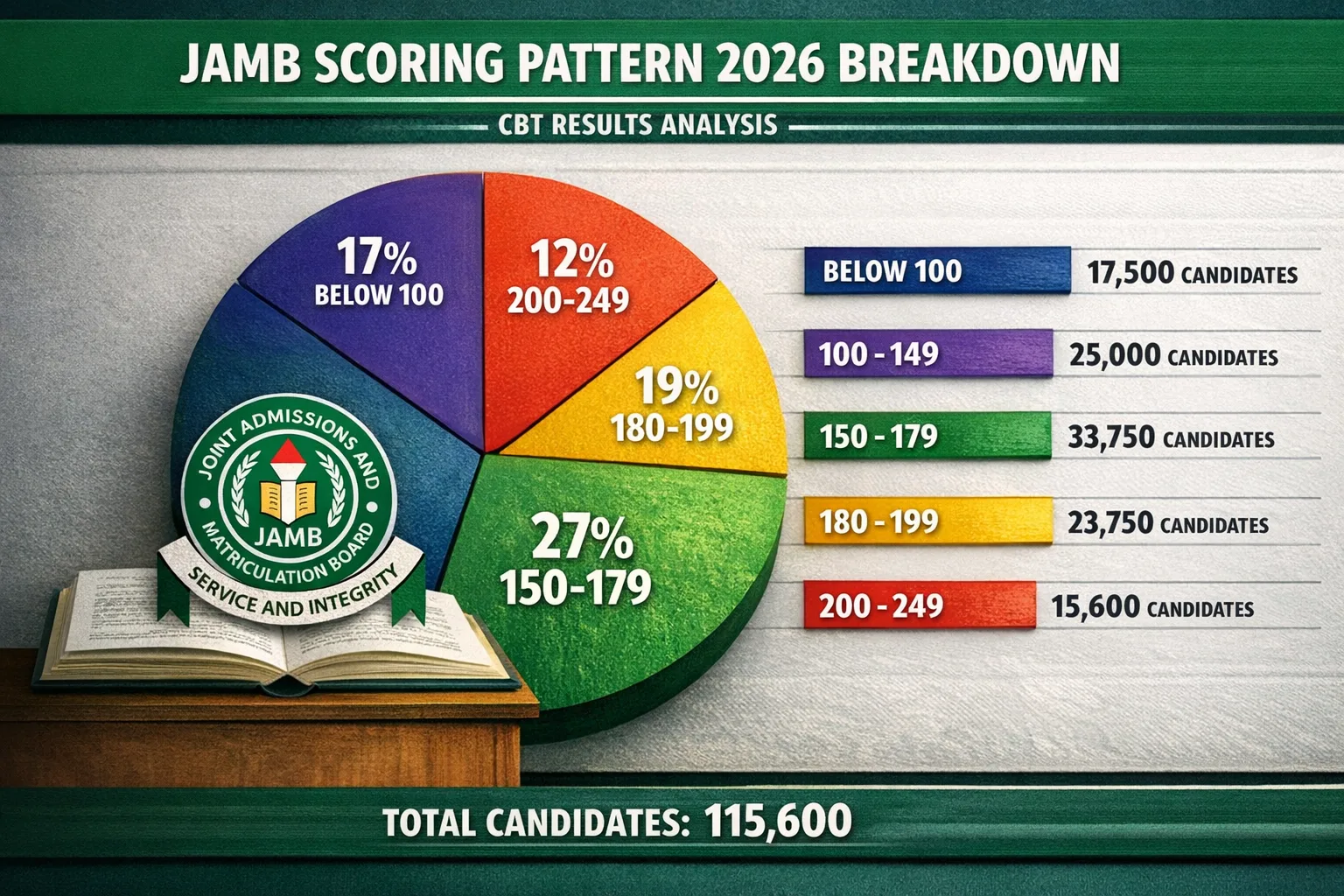

Introduction: Why Understanding the JAMB Scoring Pattern in 2026 Matters More Than Ever
JAMB Scoring Pattern Explained 2026: How Much You Need to Score & Official Registration Portal Guide is not just another exam article. Instead, it is a complete strategic blueprint for candidates who want to understand exactly how the Unified Tertiary Matriculation Examination (UTME) is scored, how to calculate their chances, and how to use the official registration portal correctly.
Every year, thousands of candidates miss admission, not because they are not intelligent, but because they misunderstand how JAMB calculates scores, how cut‑off marks work, and how schools apply aggregate formulas. Therefore, understanding the scoring system early gives you a competitive advantage.
Before you continue, you should also read our detailed breakdown on “JAMB Cut-Off Mark for Nursing 2026” for course‑specific strategy guidance.
What Is the JAMB Scoring Pattern? (Featured Snippet Section)
The JAMB scoring pattern is the official method used to calculate candidates’ performance in the UTME examination.
Core Structure:
- Total score: 400 marks
- Four subjects tested
- Each subject carries 100 marks
- All questions are objective (CBT format)
- Equal weighting across subjects
In simple terms, your final JAMB score equals the total marks obtained from four subjects.
For deeper insight into subject combinations, read “Correct JAMB Subject Combination for 2026 Courses”.
Official Structure of UTME Subjects and Marks (2026 Breakdown)
Understanding subject distribution helps you allocate preparation time wisely.
1. Use of English (Compulsory)
- 60 questions
- 100 marks
- Includes comprehension, lexis, structure, and summary
2. Three Other Subjects
- 40 questions each
- 100 marks each
- Based on chosen course
| Subject | Questions | Marks | Weight |
|---|---|---|---|
| English | 60 | 100 | 25% |
| Subject 2 | 40 | 100 | 25% |
| Subject 3 | 40 | 100 | 25% |
| Subject 4 | 40 | 100 | 25% |
Total = 400 marks.
Additionally, schools later compute aggregate scores differently. Therefore, your UTME score is only one part of admission success.
You may also study our guide on “How JAMB Aggregate Score Is Calculated”.
How JAMB Actually Marks Your Answers (Deep Technical Insight)
Many candidates assume JAMB uses complicated scaling. However, JAMB uses a direct scoring model.
Key Points:
- Each correct answer earns equal marks.
- No negative marking.
- Unanswered questions score zero.
- Computer-based system calculates automatically.
However, although the marking is direct, performance analysis reports sometimes reflect scaled interpretations for statistical balancing.
This explains why understanding performance benchmarking matters.
For score improvement strategies, read “How to Score Above 300 in JAMB“.
How Much Do You Really Need to Score in 2026?
This depends on:
- Your course
- Your university
- Competition level
- State quota system
Safe Score Categories
| Course Category | Competitive Score Range |
|---|---|
| Medicine & Surgery | 280–350 |
| Nursing | 250–320 |
| Law | 260–330 |
| Engineering | 240–300 |
| Social Sciences | 200–260 |
| Education | 180–240 |
However, always target at least 40–60 marks above the general cut‑off. That strategy increases admission probability significantly.
For nursing-specific benchmarks, read “JAMB Cut-Off Mark for Nursing 2026“.
Official JAMB Registration Portal Guide (Step‑by‑Step)
The official registration portal operates under the Joint Admissions and Matriculation Board framework.
Step 1: Profile Creation
- Send NIN to official shortcode
- Receive profile code
2: Purchase ePIN
- Accredited banks
- Approved CBT centres
3: CBT Centre Registration
- Biometric capture
- Subject selection
- Institution selection
4: Print Examination Slip
Always verify information before submission.
How Universities Calculate Aggregate Scores (Critical Section Most Blogs Ignore)
Most candidates stop at UTME score. However, universities calculate admission aggregates differently.
Example Model:
Aggregate = (UTME Score ÷ 8) + (Post‑UTME ÷ 2)
Or
Aggregate = 50% UTME + 50% Post‑UTME
Therefore, a candidate who scores 280 in UTME may still lose admission if Post‑UTME performance is weak.
See “How Post‑UTME Scoring Works in Federal Universities“.
How Nigerians Abroad Can Register and Compete Effectively
Nigerians in the UK, US, Canada, Australia, Germany, Switzerland, Scandinavia, Singapore, and New Zealand sometimes return home for admission or sit for foreign-based centres.
Key Advice:
- Confirm approved foreign CBT centres
- Ensure NIN compliance
- Compare WAEC/NECO equivalence
Many diaspora students underestimate competition. However, understanding aggregate formulas early improves positioning.
For International Students Considering Nigerian Universities
International students from Ghana, Cameroon, UK, US and others may apply through Direct Entry or UTME depending on qualification.
Important Considerations:
- O’Level equivalence
- English proficiency
- Institutional screening
Students intending to later transfer credits to US, UK, Canada or Australia institutions must check course accreditation status.
UK/US Admission Equivalents Explained
Although JAMB is Nigeria-specific, understanding global equivalents improves long-term academic planning.
| Nigeria | UK | US | Canada | Australia |
|---|---|---|---|---|
| JAMB UTME | UCAS Tariff | SAT/ACT | Provincial Entry Exams | ATAR |
However, JAMB score alone does not grant UK or US admission. Instead, it may support transcript evaluation.
Common Mistakes Candidates Make
- Choosing wrong subject combination
- Ignoring Use of English weight
- Registering at unaccredited centres
- Believing rumors about score upgrading
- Failing to check institution-specific cut‑offs
Avoid shortcuts. Always rely on official announcements.
Expert Strategy: How to Safely Target 300+ in 2026
From experience working with candidates:
- Master Use of English early
- Practice CBT timing weekly
- Analyze past question trends
- Simulate 2-hour full tests repeatedly
- Track weak topics
Consistency beats last-minute cramming.
Pros and Limitations of the JAMB Scoring System
Pros
- Transparent 400-scale system
- No negative marking
- Computer-based fairness
Limitations
- Does not test practical skills
- Heavy competition inflation
- Institutional cut-off variations
The 70–20–10 Score Allocation Strategy Most Candidates Overlook
Many candidates read broadly. However, high scorers prepare strategically. Over the years, I noticed a clear pattern among 300+ candidates, they unconsciously follow a 70–20–10 model.
The Framework
-
70% Core Mastery
Focus on high-frequency topics repeatedly tested over the last 10 years. -
20% Application Depth
Practice tricky variations and CBT-based traps. -
10% Edge Topics
Prepare for rare but high-impact questions that differentiate 280 from 320.
This model prevents scattered reading. Instead of covering everything equally, you prepare based on probability and scoring leverage.
Why this matters: JAMB rewards pattern recognition. Candidates who train their minds to recognize question structures score faster and more confidently.
Score Inflation: Why 250 Today Is Not the Same as 250 Five Years Ago
Competition intensity has changed dramatically. Today, more candidates prepare with CBT apps, analytics tools, and structured revision plans.
Therefore, raw scores no longer carry the same competitive weight in top courses.
What This Means Practically
- 250 may secure admission in less competitive institutions.
- 250 for Nursing or Law in a federal university may fall below aggregate thresholds.
- Margins now matter more than minimum cut-offs.
In highly competitive states, 5–10 extra marks can determine admission.
The Psychology of High Scorers: Mental Control Under CBT Pressure
Technical preparation alone does not guarantee 300+. Emotional regulation does.
During mock coaching sessions, I observed that strong candidates fail because of:
- Rushing early questions
- Panicking after two difficult passages
- Losing 10–15 minutes on one stubborn question
The 3-Minute Reset Rule
If a section feels overwhelming:
- Pause for 10 seconds
- Take 3 deep breaths
- Skip and return later
This micro-reset preserves clarity and timing accuracy.
Exams test emotional stability as much as academic knowledge.
You should also review “JAMB Registration Mistakes to Avoid” to eliminate avoidable stress factors.
How Subject Combination Impacts Scoring Probability
Even if your subjects align with your course, performance distribution varies.
For example:
- Science combinations often require calculation speed.
- Arts combinations rely heavily on reading comprehension stamina.
- Social science subjects reward interpretation accuracy.
Therefore, scoring probability differs based on cognitive strengths.
I always advise candidates to evaluate:
- Reading speed per minute
- Calculation accuracy under time pressure
- Retention strength in theory-heavy subjects
Small performance imbalances across subjects explain why some candidates score 280 instead of 310.
Why Timing Strategy Is More Important Than Content Volume
Many candidates read 15 textbooks yet ignore timing simulation.
However, JAMB is a 2-hour decision-speed examination.
Recommended Timing Structure
- English: 45–50 minutes
- Remaining 3 subjects: 20–25 minutes each
- Final 10 minutes: Review flagged questions
Practice with a visible timer weekly.
Content mastery without timing discipline produces average scores.
To strengthen exam-day execution, study “Complete JAMB Preparation Blueprint 2026.”
Institutional Quotas and State Advantage: The Hidden Admission Layer
Beyond scoring, admission also considers:
- Catchment area
- Educationally less developed states (ELDS)
- Merit list
- Supplementary list
Two candidates with identical scores may experience different outcomes based on institutional policies.
This does not reduce merit; rather, it reflects structured admission balancing.
Therefore, always evaluate:
- Institution location
- Your state of origin
- Historical cut-off behavior
For better aggregate insight, read “How JAMB Aggregate Score Is Calculated.”
The Risk of Over-Reliance on Mock Scores
Mock exams help familiarity. However, mock scores do not predict final UTME results accurately.
Why?
- Mock pressure is lower.
- Some candidates treat it casually.
- Question difficulty varies yearly.
Use mock results to diagnose weaknesses not to estimate final performance.
After mock analysis, revisit “10 Top JAMB Exam Tips to Score Above 250+.”
Data-Driven Revision: How to Audit Your Weak Areas Scientifically
Instead of saying “I am weak in Chemistry,” define precision gaps.
Weekly Score Audit Model
Create a simple tracker:
- Topic
- Questions attempted
- Correct answers
- Time spent
- Error type (concept / misread / time pressure)
After four weeks, patterns will emerge clearly.
You will notice that 60% of your errors may come from just three topics.
Fixing those alone can raise your score by 20–30 marks.
For related insights, explore “Post UTME Scoring Explained.”
Ethical Warning: The Truth About Score Upgrade Scams
Every year, fraudsters promise score upgrades.
Understand this clearly:
- JAMB uses encrypted CBT architecture.
- Biometric verification prevents impersonation.
- Result modification claims are fraudulent.
Candidates who pursue shortcuts risk disqualification and financial loss.
Protect your effort by relying only on official channels.
Long-Term Academic Strategy: Think Beyond the UTME Score
A strong UTME score opens doors. However, sustainable academic success requires forward planning.
Ask yourself:
- Does this institution have program accreditation?
- Are there postgraduate pathways?
- Does the course align with global mobility goals?
Some candidates chase prestige without checking curriculum structure.
Therefore, combine score strategy with career mapping.
If you are pursuing competitive healthcare programs, revisit “JAMB Cut-Off Mark for Nursing 2026.”
The First 15 Questions Rule: How Early Accuracy Shapes Your Final Score
Most candidates underestimate how the first 10–15 questions affect momentum. Yet in CBT exams, early confidence influences speed, clarity, and emotional stability.
From coaching experience, candidates who start strong usually maintain rhythm. Conversely, those who panic early lose timing discipline.
Strategic Approach
- Begin with your strongest subject (if allowed by interface flexibility).
- Answer easy questions immediately.
- Skip calculation-heavy questions initially.
Why this matters: A smooth start reduces cortisol spikes and improves cognitive recall for later sections.
To refine exam-day execution, review “How Admission Is Given in Nigerian Universities: A Complete Step-By-Step Guide.”
The 25-Mark Gap Principle: Why You Should Aim Higher Than Your Dream Score
If your target course historically admits at 260, do not aim for 260. Aim for 285+.
Why?
- Cut-offs fluctuate yearly.
- Aggregate formulas differ.
- Post-UTME performance varies.
A 20–30 mark buffer protects against uncertainties.
High scorers do not aim for admission. They aim for dominance within their category.
The Silent Score Killer: Misreading Simple Questions
Interestingly, many lost marks do not result from ignorance but from misinterpretation.
Common causes include:
- Ignoring keywords like “NOT” or “EXCEPT”
- Rushing comprehension passages
- Selecting familiar options without full reading
Prevention Checklist
- Underline keywords mentally.
- Re-read options before confirming.
- Avoid emotional guessing.
Reducing careless errors alone can increase scores by 15–25 marks.
Performance Layering: How Top Candidates Build Weekly Improvement Cycles
Instead of random daily reading, elite candidates structure preparation into layers.
Weekly Structure
- Concept Week – Master difficult topics.
- Practice Week – Solve timed questions.
- Analysis Week – Review error patterns.
- Simulation Week – Full CBT rehearsal.
Then repeat the cycle with improved precision.
Layered preparation increases retention and reduces exam anxiety.
To understand how aggregates amplify performance differences, read “How to Gain Admission Without JAMB in Nigeria (Complete Expert Guide).”
When to Stop Studying: The 72-Hour Pre-Exam Optimization Rule
Many candidates over-read before the exam and enter the hall mentally exhausted.
However, the final 72 hours should focus on:
- Light revision
- Reviewing weak-topic summaries
- Sleep regulation
- CBT navigation familiarity
Avoid learning new heavy topics within 48 hours of the exam.
Mental clarity often contributes more than last-minute memorization.
The Competitive Density Factor: Why Course Popularity Changes Score Expectations
Not all courses experience equal competition pressure.
For example:
- Medicine and Nursing attract top science students.
- Law attracts high verbal-reasoning candidates.
- Engineering attracts calculation-strong applicants.
Therefore, competitive density varies yearly based on applicant pool strength.
Understanding this helps you:
- Choose realistic second-choice options.
- Plan institutional flexibility.
- Avoid emotional decision-making.
Score Recovery Strategy: What To Do If You Underperform
Even strong candidates sometimes score below expectations.
Instead of reacting emotionally:
- Check aggregate formula impact.
- Evaluate Post-UTME opportunity.
- Consider change of institution/course.
- Explore supplementary admission windows.
Admission pathways are broader than most candidates assume.
Before making changes, study “Post UTME Scoring Explained.”
Why Strategic Preparation Always Wins
Every year, rumors circulate about leaked questions or insider assistance.
However:
- Question banks rotate.
- CBT systems randomize order.
- Biometric checks prevent impersonation.
Candidates who chase shortcuts often neglect preparation.
Meanwhile, disciplined candidates outperform consistently.
Protect your investment by focusing on skill development, not rumors.
Digital Literacy: An Overlooked Advantage in CBT Exams
Since JAMB operates fully as a computer-based test, digital familiarity influences performance.
Candidates who:
- Practice with CBT simulators
- Use keyboard navigation comfortably
- Understand flag-and-review functions
perform faster and more confidently.
Small interface advantages can save 5–10 minutes, enough to review difficult questions.
Strategic Institution Selection: A Data-Backed Decision Model
Rather than selecting institutions emotionally, evaluate:
- Historical cut-off patterns
- Post-UTME difficulty trends
- Admission transparency
- Accreditation status
- Course capacity
Create a comparison table before finalizing choices.
Admission is not only about scoring high; it is about aligning score strength with institutional reality.
People Also Ask (FAQ Section)
What is the highest JAMB score possible?
400 marks.
Does JAMB use negative marking?
No. Wrong answers score zero.
Can JAMB score be upgraded?
No. Officially, upgrading claims are fraudulent.
Is 250 a good score in JAMB?
Yes for many courses, but competitive courses require higher scores.
Does JAMB score expire?
Yes. It is valid for one admission cycle.
External Authority
- Joint Admissions and Matriculation Board
- Federal Ministry of Education Nigeria
- WAEC Official Website
- UCAS Official Website
Your Score Is Strategy, Not Luck
JAMB Scoring Pattern Explained 2026: How Much You Need to Score & Official Registration Portal Guide provides more than theory. It gives structure, clarity, and competitive direction.
If you treat JAMB as a strategy exam rather than a guessing exam, your results will reflect that discipline.
Finally, strengthen your preparation plan by reading “Complete JAMB Preparation Blueprint 2026”.
Admission success begins with understanding how the system works. Now you understand
Conclusion
Understanding the JAMB Scoring Pattern 2026 is not just about knowing that the exam is marked over 400, it is about knowing how to strategically position yourself for admission success. The Joint Admissions and Matriculation Board (JAMB) uses a standardized Computer-Based Test (CBT) format where your performance in four subjects directly determines your competitiveness for university, polytechnic, or college of education admission.
The real question is not “Can I pass JAMB?”, it is “How high do I need to score for my course and institution?” Competitive courses like Medicine, Law, Pharmacy, Engineering, and Nursing often require 250+, while many federal and state institutions may consider 180–220 depending on departmental cut-off marks. Scoring below 180 significantly limits options in most federal universities.
Equally important is using the official registration portal correctly. Always register, check results, and make changes of institution through the official JAMB Official Portal to avoid misinformation, scams, or costly mistakes.
In summary:
- Aim higher than the minimum cut-off.
- Understand how your four subjects combine to form 400 marks.
- Research your chosen institution’s realistic departmental target.
- Use only the official JAMB portal for registration and updates.
At the end of the day, JAMB is not about luck, it is about preparation, strategy, and informed decisions. Score smart, choose wisely, and stay updated through official channels.
If you prepare intentionally, 2026 can be your admission year.
Call to Action
Don’t guess your JAMB score, plan it.
Now that you understand how the 2026 JAMB scoring pattern works, the next step is simple: calculate your target score, confirm your course cut-off, and register early through the official portal.
Your admission journey starts with one smart decision.
Written by Massodih Okon, Senior Exam Preparation Researcher and Academic Education Content Specialist with over 10 years of experience developing high-impact learning resources aligned with Nigerian and international examination standards. Reviewed and updated: 2026.
About the Author
Massodih Okon is an experienced educator, researcher, and digital publishing professional with a strong academic and practical background. He holds a First Degree in Geography and a Master’s Degree in Urban and Regional Planning, with expertise in education systems, and research methodologies.
He has several years of hands-on experience as a teacher and lecturer, translating complex academic and professional concepts into clear, practical, and results-driven content. Massodih is also a professional SEO content strategist and writer. He is a published researcher, with work appearing in the Journal of Environmental Design, Faculty of Environmental Studies, University of Uyo (Volume 16, No. 1, 2021), P. 127-134. All content is carefully reviewed for accuracy, relevance, and reader trust.