

Introduction: Why Science Students Fail JAMB—and How to Win
Every year, thousands of science students in Nigeria sit for JAMB with strong WAEC results yet fall short of their dream scores. The gap is rarely intelligence. Instead, it is strategy, subject alignment, registration accuracy, and exam-day execution. This guide delivers JAMB Success Strategies for Science Students in Nigeria, a practical, experience-backed roadmap that covers best requirements, the JAMB registration portal, subject combinations, score optimization, and international equivalents. JAMB Success Strategies for Science Students in Nigeria: Best Requirements & JAMB Registration Portal.
If you are starting out, first understand the official JAMB requirements for science courses, this single step prevents costly errors before registration.
What This Guide Covers (JAMB Success Strategies for Science Students in Nigeria: Best Requirements & JAMB Registration Portal)
- Definition of JAMB and its role for science students
- Best requirements and subject combinations
- Step-by-step JAMB registration portal walkthrough
- Score-boosting strategies by science discipline
- Common mistakes and how to avoid them
- Pathways for Nigerians abroad and international equivalents (UK/US) etc.
Understanding JAMB for Science Students (Definition)
The Joint Admissions and Matriculation Board (JAMB) conducts the Unified Tertiary Matriculation Examination (UTME), which determines eligibility for admission into Nigerian tertiary institutions. For science students, UTME performance must align with course-specific subject combinations, O’Level requirements, and institutional cut-off marks.
Why this matters: Science-based courses apply stricter subject combinations and competitive cut-offs. A single wrong subject or incomplete O’Level can nullify a high score.
Related reading: Science course subject combinations explained
Core Requirements for Science Students (Best Practices)
O’Level Requirements (WAEC/NECO/NABTEB)
Most science courses require five credits including:
- English Language
- Mathematics
- Physics
- Chemistry
- Biology (or a relevant alternative)
Expert tip: Combine results only when institutions permit it. Always verify departmental rules.
Related Resource: WAEC vs NECO for science admissions
UTME Subject Combinations (Table)
| Course | Required UTME Subjects |
|---|---|
| Medicine & Surgery | English, Physics, Chemistry, Biology |
| Engineering | English, Mathematics, Physics, Chemistry |
| Pharmacy | English, Physics, Chemistry, Biology |
| Computer Science | English, Mathematics, Physics, Chemistry |
| Nursing | English, Biology, Chemistry, Physics |
Related Resource : Complete JAMB subject combinations
Step-by-Step: JAMB Registration Portal (UTME)
Step 1: Profile Creation
Create a JAMB profile using your National Identification Number (NIN).
Step 2: ePIN Purchase
Buy the ePIN from approved channels and link it to your profile.
Step 3: Registration at Accredited CBT Centres
Verify bio-data, select institutions, courses, and subjects.
Step 4: Print Slip & Recheck
Confirm spellings, subject combinations, and institutions.
Related Resource: How to register on the JAMB portal safely
Science-Specific Score Optimization Strategies
Biology
- Prioritize diagrams and processes
- Practice genetics and ecology questions
Chemistry
- Memorize reaction trends
- Master stoichiometry and periodicity
Physics
- Focus on formulas and units
- Solve numerical problems daily
Mathematics
- Drill algebra and calculus basics
- Practice speed and accuracy
Related link: CBT practice tips for science students
A Unique Strategy: The 90–30–7 Framework (Original)
90 days: Content mastery by syllabus mapping
30 days: Past questions and error log review
7 days: Light revision and mental readiness
This framework balances memory retention and exam confidence, rarely discussed but highly effective.
Common Mistakes Science Students Make and How to Avoid it
- Wrong subject combinations
- Ignoring institutional cut-offs
- Late registration corrections
- Over-reliance on guesses
Avoidance: Use a checklist before final submission.
Related Resource: JAMB mistakes and corrections
How Nigerians Abroad Can Register for JAMB
Nigerians in the UK, US, Canada, Australia, Germany, Switzerland, Scandinavia, Singapore, and New Zealand can register through designated foreign centres. Requirements include valid NIN, passport bio-data consistency, and early scheduling due to limited slots.
Related Guide: JAMB registration for Nigerians abroad
For International Students Seeking Nigerian Admissions
International candidates must meet O’Level equivalence and UTME subject standards. Institutions may request credential verification and additional screening.
Related link Guide: International admission routes to Nigeria
UK/US Admission Equivalents for Science Students
- UK: UCAS with A-Levels/IB equivalents
- US: SAT/ACT with AP science credits
Understanding equivalence helps students plan dual pathways while preparing for JAMB.
Related Guide link : UK and US admission equivalents explained
Pros and Cons of JAMB for Science Students
Pros: Standardized access, merit-based competition
Cons: High competition, strict combinations
Expert Best Practices (JAMB Success Strategies for Science Students in Nigeria: Best Requirements & JAMB Registration Portal)
- Align O’Level and UTME early
- Use official syllabi and verified past questions
- Track scores against departmental cut-offs
The Hidden Gatekeeper: Departmental Weighting Systems Most Students Ignore
Many science students focus solely on UTME scores, unaware that several Nigerian universities apply department-level weighting formulas after JAMB. These formulas silently reshape admission outcomes.
How Departmental Weighting Works (Behind the Scenes)
While JAMB provides a raw UTME score, institutions may internally:
- Assign higher weight to core science subjects (e.g., Physics for Engineering)
- Downscale performance in less relevant subjects
- Blend UTME with Post-UTME or screening scores using proprietary ratios
Why this matters:
Two students with the same JAMB score can receive different rankings depending on subject strengths. A science student weak in a “core” subject may lose out, even with a high aggregate.
Expert action point:
Study departmental admission patterns from past years, not just general cut-off marks. This insight is rarely discussed but materially affects outcomes.
Strategic Subject Dominance: When to “Over-Invest” in One Science Subject
Not all UTME subjects carry equal strategic value for every science course.
The Subject Dominance Principle (Original Insight)
Instead of spreading effort evenly, top scorers often:
- Dominate one critical subject (85–95%)
- Maintain solid (not perfect) performance in others
Examples:
- Engineering: Physics dominance > Chemistry marginal gains
- Medicine: Biology mastery > excessive Mathematics drilling
- Computer Science: Mathematics accuracy > Biology breadth
Registration-Time Risks That Cause Silent Disqualification
Some failures happen before exam day, without students realizing it.
Overlooked Registration Errors with Long-Term Consequences
- Using awaiting result where departments disallow it
- Selecting institutions with conflicting O’Level policies
- Name discrepancies between NIN, WAEC, and JAMB records
- Choosing courses that reject combined results, even if JAMB accepts them
Expert warning:
These errors rarely trigger immediate alerts. Disqualification often happens during departmental screening, months later.
Preventive checklist (before final submission):
- Cross-check departmental brochures (not just JAMB)
- Ensure bio-data uniformity across all credentials
- Confirm result-combination policies per institution
Cognitive Load Management in CBT Exams (Science-Specific)
Most CBT advice is generic. Science students face a different cognitive challenge.
The Science CBT Fatigue Curve
Science UTME papers:
- Contain more calculations
- Demand higher working memory
- Penalize mental exhaustion faster than arts subjects
Advanced technique:
Adopt calculation batching:
- Skip heavy numericals on first pass
- Secure fast conceptual marks early
- Return to calculations when cognitive load is lower
This mirrors how top candidates manage mental energy, not time alone.
Why High WAEC Scores Sometimes Predict Low UTME Performance
This paradox frustrates many parents and students.
The Assessment Mismatch Problem
WAEC/NECO:
- Reward depth, explanation, and partial marks
UTME: - Rewards speed, precision, and binary accuracy
Implication:
A student strong in theory but slow under pressure may underperform in JAMB despite excellent O’Level results.
Corrective strategy:
- Shift revision from “understanding only” to decision-speed training
- Use timed micro-tests (10–15 questions, 7 minutes)
Course Switching Strategy: A Legitimate Second-Chance Path
Smart science candidates plan controlled flexibility, not desperation.
Ethical Course Switching (Within JAMB Rules)
If your score underperforms:
- Switch to a closely aligned science course
- Maintain subject compatibility (e.g., Biochemistry → Biology, Physics → Industrial Physics)
- Enter through departmental migration after Year 1 where permitted
Why this works:
Universities prioritize proven performance over initial UTME intent—an institutional reality rarely explained publicly.
Post-UTME Reality Check: When JAMB Score Stops Being King
For competitive science faculties, UTME is only the first filter.
The Admission Funnel Effect
- UTME: Mass elimination
- Post-UTME/Screening: Fine-grained ranking
- Departmental review: Final gate
Overlooked factor:
Some schools cap UTME influence at 50–60%, meaning poor screening performance can erase a strong JAMB score.
Expert advice:
Prepare Post-UTME materials immediately after UTME, not after results.
Misconceptions That Cost Science Students Admissions Every Year
Persistent Myths (Debunked)
- “Any 250+ guarantees Medicine” → False
- “JAMB corrects all subject mistakes automatically” → False
- “Post-UTME is easier than UTME” → Often false for science courses
- “Federal universities ignore O’Level grades beyond credit” → False in many faculties
Long-Term Value: How JAMB Performance Affects Scholarships and Mobility
UTME scores are not just for admission.
Downstream Impacts
- Merit-based university scholarships
- Faculty placement and course priority
- International transfer evaluations (as supporting evidence)
- Academic confidence trajectory in Year 1
Insight:
A strong JAMB score creates compounding academic advantages, not just entry.
Expert Guide/Note: Think Like an Admissions System, Not a Candidate
High-performing science students succeed when they:
- Anticipate institutional behavior
- Align strategy with hidden filters
- Optimize effort where it counts most
JAMB is not just an exam, it is a multi-layered selection system. Understanding that system is the real competitive edge.
The Admission Elasticity Index (AEI): Predicting How Forgiving a Course Is to Score Fluctuations
Most guidance treats all science courses as equally rigid. In reality, courses differ in how elastic they are to score variations.
What Is Admission Elasticity? (Original Concept)
Admission Elasticity describes how much a department tolerates:
- Slight drops in UTME score
- Minor O’Level imperfections
- Subject strength imbalance
High vs Low Elasticity Science Courses
Low Elasticity (Rigid)
- Medicine & Surgery
- Dentistry
- Pharmacy
Medium Elasticity
- Engineering disciplines
- Medical Laboratory Science
High Elasticity (Flexible)
- Physics
- Industrial Chemistry
- Microbiology
- Environmental Science
Why this matters:
Students with borderline scores should strategically target high-elasticity courses, where internal ranking systems allow more movement after entry.
The UTME Error Tax: How Small Mistakes Compound into Big Score Losses
Many science students underestimate the cost of micro-errors.
The Error Tax Principle (New Insight)
In science UTME:
- One wrong calculation can invalidate 2–3 dependent questions
- A unit mistake can mislead multiple answer choices
- Misreading one keyword (“except”, “most likely”) can flip logic entirely
Result:
Students lose marks non-linearly, not one question at a time.
Mitigation Strategy
- Treat each question as an isolated decision
- Re-read question stems before committing answers
- Mentally reset after every difficult item
The Registration Confidence Gap: Psychological Errors Created by “Early Registration”
Early registration is often encouraged, but it has hidden risks.
What Actually Happens
Students who register too early may:
- Lock in institutions before final WAEC/NECO outcomes
- Miss late policy updates on result combination
- Fail to reassess realistic cut-off competitiveness
Counter-Strategy
-
Create a provisional course–institution map
-
Delay final institution selection until:
- O’Level status is confirmed
- Last year’s cut-offs are reviewed
- Personal mock UTME averages stabilize
The Science Guessing Paradox: When Guessing Hurts More Than It Helps
Guessing advice is often generic and dangerous for science students.
Why Science Guessing Is Different
- Calculations anchor options close together
- Distractors are often scientifically plausible
- Random guessing increases false confidence bias
Advanced Rule
- Guess only when you can eliminate at least two options
- Never guess numericals without a directional sense of magnitude
This selective-guessing model is rarely articulated but crucial for CBT success.
The Syllabus Saturation Trap: When Studying “Everything” Lowers Scores
Completing the syllabus is not the same as scoring high.
The Saturation Trap Explained
Overexposure to low-frequency topics:
- Increases mental clutter
- Reduces recall speed
- Dilutes mastery of high-yield areas
High-Return Strategy
-
Rank topics by:
- Historical frequency
- Concept dependency
- Speed-to-score ratio
-
Master top 60–70% first before expanding outward
Temporal Intelligence: Choosing When to Solve Which Questions
Time management is not just about speed.
Temporal Intelligence Model (Original)
Top science scorers unconsciously:
- Secure “certainty marks” early
- Defer heavy numericals until rhythm stabilizes
- Avoid switching subjects mid-fatigue
Practical Application
- First 20 minutes: Conceptual questions
- Middle phase: Structured calculations
- Final phase: Re-check high-risk answers only
Institutional Bias Zones: Why Some Universities Favor Certain Science Profiles
Universities subtly favor profiles aligned with their internal strengths.
Examples
- Tech-focused universities favor strong Mathematics–Physics balance
- Health-focused institutions prioritize Biology consistency
- Research-heavy schools penalize uneven science grades
Actionable Insight
Match your academic profile to institutional identity, not reputation alone.

The Post-UTME Shock Factor: Why Good UTME Performers Suddenly Underperform
This phenomenon is common but unexplained online.
Root Cause
Post-UTME questions often:
- Assume UTME-level mastery as baseline
- Test application, not recall
- Penalize shallow memorization strategies
Preparation Shift
- Move from “past questions only” to concept transfer drills
- Practice unfamiliar question framing
The Academic Momentum Effect: How JAMB Performance Shapes First-Year Outcomes
JAMB performance correlates with early university success, not by intelligence, but by habits.
Observed Patterns
High UTME scorers often:
- Adapt faster to lecture pace
- Handle calculation-heavy courses better
- Avoid early academic probation
Why this matters
Admission is not the finish line, JAMB sets the trajectory.
Strategic Insight: Optimize for Admission Systems, Not Just Exams
Science students who win JAMB consistently:
- Think like assessors
- Anticipate institutional filters
- Design effort around return-on-score
Understanding how selection actually works is the rare advantage that separates high scorers from high potentials.
The JAMB Signal-to-Noise Ratio (SNR): Why Some Study Effort Produces No Score Gain
Not all study time translates into UTME marks. The missing variable is signal-to-noise ratio.
Understanding SNR in Science Preparation (Original Model)
- Signal: High-probability concepts, recurring logic patterns, examinable formulas
- Noise: Rare topics, edge-case facts, overly complex derivations
Many science students increase noise while believing they are improving depth.
Why this matters:
Low SNR study creates fatigue without score movement, one reason students “study hard” but stagnate.
Practical application
- Audit each topic: Has this appeared multiple times in different formats?
- Drop topics that consume time but yield minimal marks
- Reallocate effort to high-signal clusters
The Concept Compression Advantage: Scoring More with Fewer Mental Units
Top science scorers don’t know more, they store knowledge more efficiently.
What Is Concept Compression?
It is the ability to:
- Merge multiple formulas into one governing principle
- Reduce many facts into a single causal explanation
- Recall logic, not steps
Example
Instead of memorizing separate gas laws, understand:
“Pressure, volume, and temperature adjust to maintain particle equilibrium.”
The “Wrong Confidence” Problem in Science UTME
Confidence is often celebrated, but misplaced confidence is dangerous.
How Wrong Confidence Develops
- Repeated exposure to familiar past questions
- Memorizing answer patterns instead of reasoning
- Overestimating readiness due to mock inflation
Risk
Students answer quickly, but incorrectly, without rechecking.
Correction Strategy
- Introduce novel question framing weekly
- Force justification for every selected option
- Slow down only on questions that feel “too easy”
Admission Cut-Off Illusion: Why Published Scores Mislead Science Students
Cut-off marks are not fixed barriers, they are statistical outcomes.
The Illusion Explained
Published cut-offs reflect:
- Applicant volume
- Performance distribution
- Departmental capacity
They are retrospective, not predictive.
Why this matters
Targeting last year’s cut-off alone can misguide:
- Course choice
- Institution selection
- Psychological readiness
Advanced approach
Prepare for score bands, not single numbers (e.g., 230–245).
The Intra-Science Competition Effect (JAMB Success Strategies for Science Students in Nigeria: Best Requirements & JAMB Registration Portal)
Science students do not compete equally across courses.
What Changes the Competition Intensity
- Medicine candidates cluster at the top score range
- Engineering has wider score spread
- Pure sciences often have fewer extreme scorers
Implication
A 240 score has different admission power depending on:
- Course density
- Applicant self-selection
- Institutional prestige
The UTME Question Design Bias Few Notice
UTME questions are not neutral, they favor certain thinking styles.
Hidden Biases in Science Questions
- Preference for procedural thinkers over verbose explainers
- Penalization of overthinking
- Emphasis on first-principle logic
Why WAEC toppers sometimes struggle
WAEC rewards explanation. UTME rewards decisive correctness.
The “One-Pass Failure” Pattern in CBT Exams
Many students unknowingly sabotage themselves early.
How the Pattern Works
- Student answers first 20 questions poorly
- Anxiety increases
- Speed deteriorates
- Accuracy collapses
Preventive Rule
Treat the first 10 questions as warm-up, not score-defining.
This mental framing alone improves stability.
The Subject Order Effect: Why Question Sequence Alters Scores
CBT subject order is randomized, but your mental order matters.
Original Insight
Switching between heavy calculation subjects too frequently:
- Increases cognitive switching cost
- Raises careless errors
- Reduces endurance
Optimized approach
- Mentally batch similar thinking tasks
- Complete lighter conceptual blocks before heavy numericals
Post-Admission Reality: Why Some JAMB Strategies Predict University Survival
Certain preparation habits correlate strongly with first-year outcomes.
High-Risk Habits
- Guess-heavy strategies
- Formula memorization without derivation sense
- Avoidance of problem-solving drills
Protective Habits
- Error logging
- Concept compression
- Timed reasoning under pressure
Final System-Level Insight: JAMB Is a Filtering Algorithm, Not an Exam
JAMB functions like a multi-variable sorting system:
- Inputs: subjects, scores, timing, registration accuracy
- Modifiers: institutional rules, departmental logic
- Outputs: ranked admission probability
Students who understand the system logic outperform those who only chase marks.
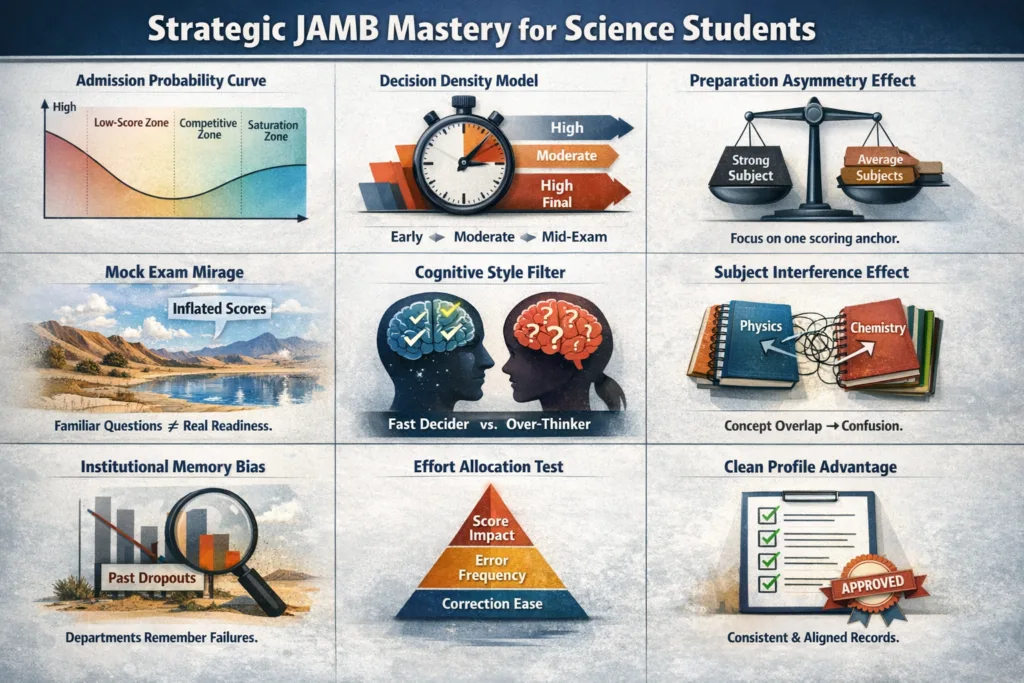
The Admission Probability Curve (APC): Why Extra Marks Stop Helping After a Point
Many science students assume every additional UTME mark increases admission chances equally. That assumption is false.
How the Admission Probability Curve Works (Original Model)
Admission probability rises in three phases:
- Low-score zone – Each extra mark helps significantly
- Competitive zone – Each extra mark helps marginally
- Saturation zone – Extra marks add almost no advantage
For many science courses, the saturation zone begins earlier than students expect.
Why this matters:
A student pushing from 255 → 270 may gain less admission advantage than a student fixing subject alignment or institutional fit.
Strategic takeaway:
Once you approach the competitive band, shift effort from “score chasing” to risk elimination and alignment optimization.
The UTME Cognitive Style Filter: Why Some Brains Score Higher with the Same Knowledge
UTME unintentionally filters for cognitive style, not just knowledge.
Favored Cognitive Traits in Science UTME
- Rapid pattern recognition
- Comfort with approximation
- Tolerance for ambiguity
- Low emotional attachment to single questions
Penalized Traits
- Perfectionism
- Over-verification
- Excessive derivation
- Fear of committing to an option
Implication:
Two students with identical syllabus coverage can score very differently based purely on thinking style.
Adjustment technique:
Train decision confidence under time pressure, not just accuracy in untimed practice.
The Preparation Asymmetry Effect: Why Uneven Strength Can Beat Balanced Weakness
Conventional advice pushes “balanced preparation.” UTME outcomes often contradict this.
The Asymmetry Effect (Original Insight)
A student with:
- One very strong subject
- Two solid subjects
- One average subject
often outperforms a student who is:
-
Mediocre across all four subjects
Why this works
UTME scoring rewards peaks, not flat profiles.
Advanced strategy
Intentionally engineer one scoring anchor subject to stabilize your total score.
The Registration-Inertia Trap: When Early Choices Become Psychological Handcuffs
Once students register, many stop re-evaluating strategy, even when evidence changes.
What Is Registration Inertia?
A cognitive bias where:
- Initial course choice becomes emotionally “fixed”
- Students ignore warning signs (mock scores, competition density)
- Better alternatives are dismissed late
Why this is dangerous
Admission systems reward flexibility; inertia punishes it.
Counter-measure
Schedule a post-registration strategy audit:
- Review mock averages
- Reassess competition intensity
- Adjust institution/course during correction windows
The False Difficulty Bias in Science Preparation
Harder study does not equal better preparation.
How False Difficulty Misleads Students
- Solving Olympiad-level problems
- Using overly advanced textbooks
- Practicing non-UTME-style questions
These create intellectual satisfaction but poor exam transfer.
Rule of thumb
If a practice task:
- Looks impressive
- Feels intellectually heavy
- Rarely resembles UTME phrasing
…it is likely low-return.
The Error-Pattern Fingerprint: Why Each Student Loses Marks Differently
Score loss is not random, it follows a personal pattern.
Common Science Error Fingerprints
- Calculation slip errors
- Misreading qualifiers (“not”, “except”)
- Formula recall confusion
- Diagram interpretation mistakes
High-level tactic
Instead of general revision, build a personal error profile and attack it directly.
This approach mirrors professional test analytics, but is almost never used by UTME candidates.
The Psychological Cut-Off Effect During the Exam
Students unknowingly impose mental cut-offs while writing.
How It Happens
- Student thinks: “I’ve already messed up”
- Motivation drops mid-exam
- Accuracy declines even on easy questions
Reality
UTME scoring is cumulative. There is no point-of-no-return inside the exam.
Correction
Adopt a score-agnostic mindset: treat every question as independent until time ends.
Institutional Capacity Blind Spots Students Rarely Consider
Admission chances are affected by department size, not just popularity.
What Students Miss
- Small departments amplify competition
- Newer programs may admit fewer candidates
- Some faculties cap intake regardless of score distribution
Advanced insight
A slightly less popular institution with a larger departmental intake can outperform a famous school with a narrow quota.
The “Last 15 Minutes” Multiplier Effect (JAMB Success Strategies for Science Students in Nigeria: Best Requirements & JAMB Registration Portal)
Most score volatility occurs at the end of the exam.
Why the Final Phase Matters Disproportionately
- Fatigue peaks
- Careless mistakes increase
- Students rush unchecked answers
Elite technique
Reserve the final minutes only for:
- High-confidence corrections
- Reviewing flagged items
- Avoiding new guesses
This protects existing marks rather than risking them.
Long-Horizon Thinking: Why JAMB Strategy Should Align with Career Trajectory
Some science admissions look successful short-term but fail long-term.
Examples
- Entering a science course misaligned with strengths
- Choosing prestige over aptitude
- Ignoring downstream academic rigor
Why this matters
First-year attrition and course switching are often rooted in poor JAMB-stage decisions.
Final Meta-Insight: High Scores Are Outputs, Not Objectives
The strongest JAMB candidates do not chase marks directly.
They optimize:
- Cognitive efficiency
- System alignment
- Error suppression
- Strategic flexibility
Marks emerge naturally from these conditions.
The UTME Decision Density Model: Why Some Minutes Are More Valuable Than Others
Not all exam minutes contribute equally to your final score.
Decision Density Explained (Original Model)
Decision density measures:
- How many score-affecting choices occur per unit time
- How costly an error is in that time window
In science UTME:
- Early minutes = high decision density
- Mid-exam = moderate density
- Final minutes = high volatility, low density
Why this matters:
Careless early mistakes cost more than late ones.
Advanced execution rule
- Slow down deliberately in the first 15–20 questions
- Speed naturally improves once rhythm is established
The Science Subject Interference Effect (JAMB Success Strategies for Science Students in Nigeria: Best Requirements & JAMB Registration Portal)
Studying science subjects together can silently reduce retention.
What Is Subject Interference?
When:
- Similar formulas overlap (Physics vs Chemistry)
- Similar symbols mean different things
- Related concepts conflict under pressure
Result
Recall errors increase despite adequate preparation.
Mitigation Strategy
- Separate heavy-calculation subjects by at least 6–12 hours during revision
- Avoid back-to-back Physics–Chemistry drill sessions
This insight is grounded in cognitive interference theory but almost never applied to UTME prep.
The “Score Mirage” Phenomenon in Mock Exams
Many students overestimate readiness due to mock structure.
Why Mock Scores Inflate Confidence
- Familiar question banks
- Predictable distractors
- Repeated exposure effects
Danger
Mock performance becomes a mirage, not a forecast.
Correction Mechanism
Introduce cold mocks:
- New question sources
- Mixed topic order
- No revision beforehand
Cold performance is a far better predictor of UTME outcome.
Course-Specific Strategic Overlays (Science Only)
Medicine & Surgery: The Precision Bias
- High penalty for careless errors
- Biology consistency matters more than brilliance
- Guessing tolerance is extremely low
Strategic implication
Aim for error suppression, not aggressive guessing.
Engineering: The Physics–Math Coupling Effect
Engineering UTME performance depends on:
- How well Mathematics supports Physics reasoning
- Not raw difficulty, but transfer ability
Strategic implication
Practice Physics questions using mathematical shortcuts, not full derivations.
Computer Science: The Logic-Speed Tradeoff (JAMB Success Strategies for Science Students in Nigeria: Best Requirements & JAMB Registration Portal)
- Mathematics questions reward speed over elegance
- Physics questions favor approximation sense
Strategic implication
Train fast elimination, not full solution paths.
The Institutional Memory Effect in Admissions
Departments remember their past intakes.
How Institutional Memory Works
If a department:
- Admitted underprepared students previously
- Experienced high failure or dropout rates
It may:
- Raise internal screening strictness
- Penalize borderline profiles quietly
Why this matters
Admission behavior can shift without public notice.
Advanced response
Favor institutions with stable historical admission patterns over volatile ones.
The JAMB–Department Misalignment Gap
JAMB qualification does not equal departmental acceptance.
The Gap Explained
- JAMB ensures minimum eligibility
- Departments enforce suitability
Common casualty
Students who “meet requirements” but lack:
- Subject balance
- Depth in core areas
Strategic fix
Prepare as if the department, not JAMB, is the real examiner.
The Effort Allocation Fallacy in Science Preparation
Students often allocate effort emotionally, not strategically.
Typical Misallocation
- Overstudying favorite subjects
- Avoiding weak areas entirely
- Chasing difficult topics for self-validation
Correct Allocation Rule
Effort should follow:
- Score impact
- Error frequency
- Correction ease
This triad produces faster score movement than motivation-based study.
The Admission Timing Advantage (JAMB Success Strategies for Science Students in Nigeria: Best Requirements & JAMB Registration Portal)
Timing affects competition intensity.
What Few Students Consider
- Early UTME cycles attract more prepared candidates
- Late cycles may have thinner competition pools
- Some institutions fill quotas unevenly
Ethical implication
No manipulation just informed timing.
The “Clean Profile” Advantage in Science Admissions
Beyond scores, profile cleanliness matters.
What a Clean Profile Looks Like
- Consistent subject strengths
- No contradictory choices
- No policy violations (result combination, subject mismatch)
Why departments prefer this
Clean profiles reduce academic risk.
The Invisible Cost of Over-Ambition
Ambition without calibration is costly.
Over-Ambition Signals
- Choosing ultra-competitive courses with marginal scores
- Ignoring safer adjacent pathways
- Betting everything on one institution
System reality
Admissions reward risk-adjusted choices, not courage.
Final Systems Insight: Think in Probabilities, Not Dreams
JAMB success is not about hope, it is about:
- Probability stacking
- Risk minimization
- Strategic optionality
Students who treat admission as a decision system consistently outperform those who treat it as a test alone.
People Also Ask (FAQ) (JAMB Success Strategies for Science Students in Nigeria: Best Requirements & JAMB Registration Portal)
What is the best JAMB score for science courses?
Competitive courses often require 250+, depending on institution.
Can I change my subject combination after registration?
Yes, within JAMB’s correction window.
Is Mathematics compulsory for all science students?
Yes, for most science and technology courses.
Do foreign candidates write UTME?
Yes, at designated centres abroad.
Conclusion: Your Winning Edge
Success in JAMB for science students is deliberate. With the right requirements, accurate registration, and proven strategies, top scores are achievable. Revisit JAMB success checklist for science students and take action today.
Call to Action
Bookmark this guide, share it with peers, and start structured preparation now.
Authority Mentions
- Joint Admissions and Matriculation Board
- West African Examinations Council
- National Examinations Council
- UCAS
Written by Massodih Okon, Senior Exam Preparation Researcher and Academic Education Content Specialist with over 10 years of experience developing high-impact learning resources aligned with Nigerian and international examination standards. Reviewed and updated: January 2026. Based on official JAMB syllabus and verified exam data
About the Author
Massodih Okon is an experienced educator, researcher, and digital publishing professional with a strong academic and practical background. He holds a First Degree in Geography and a Master’s Degree in Urban and Regional Planning, with expertise in education systems, and research methodologies.
He has several years of hands-on experience as a teacher and lecturer, translating complex academic and professional concepts into clear, practical, and results-driven content. Massodih is also a professional SEO content strategist and writer. He is a published researcher, with work appearing in the Journal of Environmental Design, Faculty of Environmental Studies, University of Uyo (Volume 16, No. 1, 2021), P. 127-134. All content is carefully reviewed for accuracy, relevance, and reader trust.