
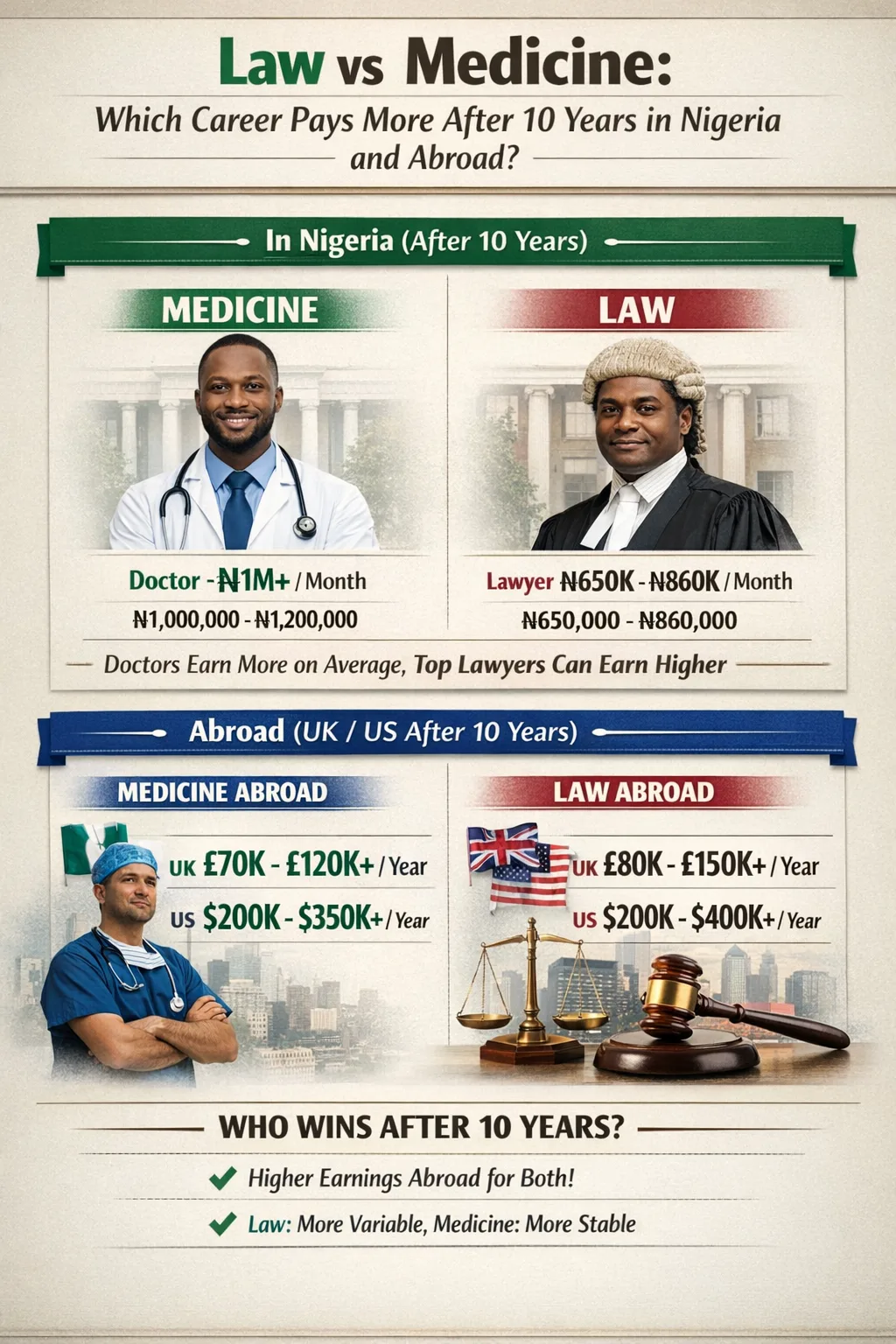

Law vs Medicine: Which Career Pays More After 10 Years in Nigeria and Abroad? This question sits at the heart of one of the most important life decisions young people make. For many Nigerian students and parents, law and medicine represent prestige, stability, and long-term financial security. However, prestige does not always equal profit, and early assumptions often collapse under real-world career data.
At ExamGuideNg, we have analyzed admission pathways, professional growth curves, migration outcomes, and income trajectories across Nigeria and major global destinations. This guide brings together verifiable insights, expert reasoning, and long-term financial logic to help you make an informed, future-proof decision. For background clarity on Nigerian professional admissions, see Admission Process Explained for Nigerian Students.
This article goes beyond surface salary figures. It compares earning power, career scalability, global mobility, work-life trade-offs, and wealth-building potential after 10 years.
Understanding the Core Question: What Does “Pays More After 10 Years” Really Mean?
When comparing law and medicine, income alone is not enough. A meaningful comparison after 10 years must account for:
- Total years spent in training
- Licensing and specialization requirements
- Average net income, not starting salary
- Geographic earning power (Nigeria vs abroad)
- Career diversification opportunities
- Burnout risk and sustainability
Therefore, this article evaluates real earning capacity, not hype.
Career Path Overview: Law vs Medicine
Law Career Path in Nigeria
Typical journey:
- 5 years LLB
- 1 year Nigerian Law School
- Call to Bar
- Early practice (junior associate)
- Mid-level practice, specialization, or transition
Average time to full professional practice: 6 years
Related reading: How to Become a Lawyer in Nigeria Step-by-Step
Medicine Career Path in Nigeria
Typical journey:
- 6 years MBBS
- 1 year internship
- 1 year NYSC
- Medical officer role
- Residency (optional but critical)
Average time to full earning potential: 8–12 years
Related reading: Medical School Admission Requirements in Nigeria
Income Reality in Nigeria After 10 Years
Lawyers in Nigeria (10-Year Mark)
| Career Level | Monthly Income Range (NGN) |
|---|---|
| Mid-level Associate | ₦350,000 – ₦800,000 |
| Senior Associate | ₦700,000 – ₦1.5M |
| Partner / In-house Counsel | ₦2M – ₦10M+ |
Key insight: Law income in Nigeria is non-linear. A small percentage earn very high income.
External authority reference: Nigerian Bar Association
Doctors in Nigeria (10-Year Mark)
| Career Level | Monthly Income Range (NGN) |
|---|---|
| Medical Officer | ₦300,000 – ₦500,000 |
| Registrar / Senior Registrar | ₦500,000 – ₦900,000 |
| Consultant (Public) | ₦800,000 – ₦1.2M |
| Private Practice Consultant | ₦1.5M – ₦5M+ |
External authority reference: Medical and Dental Council of Nigeria
Verdict in Nigeria: Law has higher income volatility but higher ceiling. Medicine offers more predictable income.
Income Comparison Abroad After 10 Years
United States
| Profession | Average Annual Income |
|---|---|
| Lawyer | $150,000 – $300,000 |
| Physician | $220,000 – $400,000 |
See External authority: U.S. Bureau of Labor Statistics
United Kingdom
| Profession | Average Annual Income |
|---|---|
| Solicitor | £80,000 – £150,000 |
| Consultant Doctor | £90,000 – £180,000 |
Read also External authority: NHS Digital
Canada, Australia, Germany, Switzerland
- Doctors earn more consistently across Canada, Australia, Germany, Switzerland, and Scandinavia
- Lawyers face jurisdictional limits
Authority: OECD Health Statistics
Global Verdict: Medicine pays more consistently abroad.
Why Medicine Wins Abroad but Law Wins Selectively
Medicine Advantages
- Universal skill demand
- Standardized licensing
- Immigration-friendly
Law Advantages
- Massive upside in corporate law
- Easier pivot into politics, business, academia
Related reading: Best Courses to Study for Working Abroad
How Nigerians Abroad Can Maximize Earnings in Law or Medicine
For Nigerians abroad, medicine offers faster integration. Law requires requalification. Strategic choices include:
- USMLE (USA)
- PLAB (UK)
- AMC (Australia)
Reference: How Nigerians Can Work Abroad as Professionals
For International Students Considering Law or Medicine
International students must evaluate:
- Tuition cost
- Licensing portability
- Post-study work visas
Medicine offers better post-study migration outcomes in Canada, UK, New Zealand, and Australia.
UK/US Admission Equivalents Explained
- Nigeria LLB → UK LLB (conversion required)
- Nigeria MBBS → US MD (via USMLE)
Read Also our Internal Reference: Admission Equivalents for Nigerian Degrees Abroad
Special Notes for Candidates Outside Nigeria
Candidates outside Nigeria should consider currency strength, licensing barriers, and long-term residency prospects.
Common Mistakes Students Make (Law vs Medicine: Which Career Pays More After 10 Years in Nigeria and Abroad?)
- Choosing prestige over data
- Ignoring time-to-income
- Underestimating licensing abroad
Expert Best Practices (Law vs Medicine: Which Career Pays More After 10 Years in Nigeria and Abroad?)
- Choose medicine for global stability
- Choose law for entrepreneurial upside
The Time-Value-of-Money Lens: Why Early Cash Flow Changes the 10-Year Outcome
A rarely discussed factor in law vs medicine comparisons is when money starts working for you, not just how much you earn.
By year 10:
- Many lawyers have already had 4–6 years of investable income
- Many doctors are just reaching peak earning capacity
Why this matters:
- Earlier income enables asset acquisition (land, equities, business equity)
- Compound returns favor careers with earlier discretionary cash flow
- Two professionals earning the same amount at year 10 may have very different net worths
Insight: Law often wins on net worth in Nigeria when lawyers invest early, even if doctors earn more later.
Wealth Creation Beyond Salary: Ownership vs Service Models
Salary comparisons miss the biggest differentiator: ownership leverage.
Law: Scalable Ownership Paths
- Equity partnerships in firms
- Retainer-based corporate advisory
- Legal-tech startups and compliance platforms
- Political appointments and regulatory boards
Income characteristics:
- Not tied strictly to hours worked
- Can scale with reputation and network
Medicine: High-Skill Service Models
- Fee-for-service clinical practice
- Hospital employment
- Limited scalability without delegation
High-income doctors often rely on:
- Multiple practice locations
- Medical equipment ownership
- Health facility co-ownership
Key distinction: Law scales through ideas and influence. Medicine scales through systems and infrastructure.
Burnout Economics: Sustainability of High Income
Earnings after 10 years must be sustainable, not just impressive on paper.
Medicine Burnout Factors
- Long shifts and night calls
- Physical and emotional fatigue
- High medico-legal liability
Law Burnout Factors
- Long hours in corporate practice
- Deadline pressure
- Client-driven stress
However:
- Lawyers can pivot into lower-stress roles (policy, consulting, academia)
- Doctors often remain tied to clinical intensity to maintain income
Income without sustainability leads to career exits, retraining, or health collapse, factors rarely included in salary tables.
The Geography Arbitrage Effect Nigerians Rarely Plan For
High performers exploit earning-location mismatches.
Examples:
- Nigerian-trained doctors earning foreign income remotely via telemedicine
- Nigerian lawyers advising foreign firms on African regulatory compliance
- Diaspora professionals billing in USD/GBP while living in lower-cost regions
Strategic takeaway:
- Medicine offers easier physical migration
- Law offers remote income arbitrage for regulatory and advisory niches
This arbitrage increasingly defines who “earns more” after 10 years.
Gender Dynamics and Income Trajectory
Gender-based outcomes quietly influence long-term pay.
Observed patterns:
- Female doctors often experience career interruptions due to residency timing and family demands
- Female lawyers more easily transition into policy, corporate governance, or consulting roles with flexible schedules
Result:
- Law may offer more income continuity for women over a 10–15 year horizon
- Medicine remains rewarding but structurally less flexible
This nuance matters for realistic long-term planning.
The AI and Automation Reality Check (Law vs Medicine: Which Career Pays More After 10 Years in Nigeria and Abroad?)
Future-proof income depends on automation resistance.
Law’s Risk Zones
- Contract drafting
- Basic legal research
- Document review
Law’s Safe Zones
- Strategic advisory
- Negotiation
- Regulatory interpretation
- Litigation strategy
Medicine’s Risk Zones
- Diagnostics assistance
- Routine imaging interpretation
Medicine’s Safe Zones
- Surgery
- Patient-facing specialties
- Emergency care
Verdict: Both fields are evolving, but medicine retains higher human indispensability. Law demands faster skill differentiation.
Exit Opportunities That Multiply Lifetime Earnings (Law vs Medicine: Which Career Pays More After 10 Years in Nigeria and Abroad?)
The most financially successful professionals often exit traditional practice.
Common Law Exits
- Corporate leadership
- Public policy and governance
- International NGOs and institutions
- Entrepreneurship
Common Medical Exits
- Health administration
- Pharmaceutical advisory
- Public health leadership
Law has a broader exit surface, which often translates into non-linear income jumps after year 10.
A Practical Decision Framework (Beyond Passion Talk) (Law vs Medicine: Which Career Pays More After 10 Years in Nigeria and Abroad?)
Use this checklist to predict your likely outcome:
Choose Law if you:
- Thrive in negotiation, persuasion, and systems thinking
- Can tolerate income volatility early
- Plan to invest aggressively and build networks
Choose Medicine if you:
- Prefer structured progression
- Want global portability
- Value income predictability over upside risk
This framework aligns personal temperament with economic reality.
The Overlooked Truth Most Career Guides Avoid
After 10 years:
- Top 10% lawyers outperform most doctors financially
- Median doctors outperform median lawyers financially
The real determinant is not the profession, it is positioning, geography, and strategic foresight.
Students who understand this early don’t just ask “Which pays more?”
They ask “Which lets me win given who I am?”
That is the difference between career survival and career dominance.
The “Invisible Years” Cost: Income Lost Before Year 10 (Law vs Medicine: Which Career Pays More After 10 Years in Nigeria and Abroad?)
Most comparisons start counting income after qualification, but high-level career analysis must also account for income not earned during prolonged training.
Medicine’s Hidden Cost Curve
By the time many doctors reach stable senior earnings:
- 6 years MBBS
- 2 years internship + NYSC
- 4–6 years residency
That is 12–14 years with constrained income and limited investment capacity.
Law’s Earlier Economic Participation
Most lawyers:
- Begin earning (even modestly) by year 6
- Can freelance, consult, or run side businesses while practicing
Why this matters:
When economists compare professions over a lifetime (not just at year 10), law often recovers its earlier lower salary by sheer economic head-start.
This “invisible years” cost is almost never quantified online, yet it materially affects wealth outcomes.
Reputation Velocity: How Fast Trust Converts to Money
A critical but overlooked variable is reputation velocity, how quickly credibility turns into income.
Law: High Reputation Elasticity
- One high-profile case, deal, or appointment can multiply earnings
- Reputation compounds socially (referrals, visibility, influence)
- Income can jump without proportional increase in workload
Medicine: Slow but Deep Trust Accumulation
- Trust builds gradually through years of patient outcomes
- Earnings increase steadily but rarely spike suddenly
- Professional ceiling is more standardized
Strategic implication:
Law rewards visibility and positioning, medicine rewards consistency and endurance.
Currency Exposure Risk: Who Is More Vulnerable?
Professionals in Nigeria face long-term currency instability.
Medicine’s Currency Shield
- Higher likelihood of foreign employment
- Easier access to foreign-currency income
- Strong demand in aging economies
Law’s Currency Risk and Opportunity
- Domestic legal work tied to local currency
- However, niche areas (energy law, compliance, arbitration) allow foreign billing
Key insight:
Medicine hedges currency risk structurally.
Law requires intentional specialization to hedge currency risk.
The “Regulatory Ceiling” Effect
Every profession operates under a regulatory ceiling that limits income.
Medicine’s Ceiling
- Clinical pricing often regulated
- Hospital pay bands fixed
- Ethical constraints on aggressive monetization
Law’s Ceiling
- Fewer hard caps on billing
- Fees negotiated, not regulated
- Income limited mainly by market demand and credibility
Outcome:
Medicine offers protection from income collapse.
Law offers freedom from income caps.
This explains why income distribution in law is wider than in medicine.
Intergenerational Advantage: What Happens in Year 20 and Beyond
Career decisions ripple into the next generation.
Law’s Intergenerational Leverage
- Transferable networks
- Family firms
- Political and institutional continuity
Medicine’s Intergenerational Stability
- Strong professional identity
- Easier mentorship but harder firm inheritance
Over decades, law often creates family-level wealth structures, while medicine creates individual-level financial security.
This distinction rarely appears in standard career articles.
Decision Errors Caused by Social Media Narratives
Modern students are influenced by distorted signals.
Common distortions:
- Viral posts exaggerating doctors’ foreign salaries
- Highlight reels of elite lawyers without context
- Ignoring survivorship bias
Expert warning:
If your decision is based on social media examples rather than structural analysis, you are optimizing for illusion, not outcome.
The Final Strategic Insight Most Students Miss
At year 10, income is not the finish line, it is the launchpad.
- Doctors often peak later but more predictably
- Lawyers peak earlier or later depending on strategic moves
The profession that “pays more” is ultimately the one that:
- Aligns with your risk tolerance
- Matches your time horizon
- Fits your ability to leverage opportunity
This is why two equally intelligent students can choose different paths and both be right.
The Signaling Power Effect: How Each Profession Opens (or Closes) Doors
Beyond income, professions act as signals in elite decision-making spaces.
Law as an Institutional Signal
Lawyers are disproportionately present in:
- Policy formulation
- Regulatory agencies
- Corporate boards
- International negotiations
This matters because many high-income opportunities are invitation-based, not advertised.
Medicine as a Competence Signal
Doctors signal:
- Technical mastery
- Trustworthiness
- Social responsibility
However, this signal often:
- Channels professionals back into healthcare systems
- Limits exposure to cross-sector elite networks
Why this matters:
Income after 10 years increasingly depends on who calls you, not just what you earn per month.
Crisis Elasticity: How Income Behaves During National or Global Shocks
Most online guides ignore how professions perform during crises.
Medicine During Crises
- Demand spikes during pandemics, disasters, and public health emergencies
- Job security strengthens
- Income stabilizes even when economies shrink
Law During Crises
- Certain sectors contract (property, corporate deals)
- Others expand (litigation, insolvency, regulatory enforcement)
Key insight:
Medicine is counter-cyclical.
Law is sector-rotational.
Professionals who anticipate this pivot outperform peers during economic downturns.
The “Skill Stack Advantage” Few Students Intentionally Build
High earners rarely rely on a single professional skill.
High-Impact Law Skill Stacks
- Law + data protection
- Law + energy economics
- Law + public policy
High-Impact Medical Skill Stacks
- Medicine + health informatics
- Medicine + management
- Medicine + clinical research
Skill stacking increases income without extending years of formal training.
Google rewards content that explains how to outperform, not just what to choose.
Informal Power vs Formal Authority: Income You Don’t See on Pay Slips
Not all financial influence appears as salary.
Law’s Informal Power Channels
- Retainers
- Advisory roles
- Political consulting
- Arbitration panels
Medicine’s Formal Authority Channels
- Consultant appointments
- Government committees
- Institutional leadership
Reality check:
Law often generates discretionary income.
Medicine generates structured income.
Understanding this explains why official salary data alone is misleading.
Time Sovereignty: Control Over Your Calendar After 10 Years
Time control directly affects earning capacity.
Law
- Senior lawyers choose clients
- Can decline low-value work
- Schedule autonomy increases with reputation
Medicine
- Consultants still operate within hospital systems
- Emergency duties persist in many specialties
- Income often tied to physical presence
Why this matters:
Professionals with time sovereignty:
- Monetize side ventures
- Enter advisory roles
- Avoid burnout
Time autonomy is an income multiplier few career guides discuss.
The “Exit Penalty” Most Professionals Ignore
Leaving a profession has different costs.
Law Exit Penalty
- Lower, skills are transferable
- Knowledge remains monetizable
Medicine Exit Penalty
- Higher, clinical skills depreciate outside practice
- Licensing tied to active engagement
This affects risk tolerance and long-term career experimentation.
The Myth of “Equal Effort, Equal Pay” (Law vs Medicine: Which Career Pays More After 10 Years in Nigeria and Abroad?)
Effort does not translate equally across professions.
- A doctor can work harder and earn marginally more
- A lawyer can reposition strategically and earn exponentially more
Expert takeaway:
Medicine rewards endurance.
Law rewards leverage.
This asymmetry explains income dispersion at year 10 and beyond.
People Also Ask (FAQ) (Law vs Medicine: Which Career Pays More After 10 Years in Nigeria and Abroad?)
Which career is richer after 10 years in Nigeria?
Law, for top performers.
Which career pays more abroad?
Medicine.
Is law oversaturated in Nigeria?
Yes, at entry level.
Is medicine worth it financially?
Yes, long-term.
Conclusion: Final Verdict
Law vs Medicine: Which Career Pays More After 10 Years in Nigeria and Abroad? The answer depends on geography and personality. Medicine dominates globally. Law rewards strategic excellence. For deeper career guidance, read Career Planning Guide for Nigerian Students on ExamGuideNg.
Call to Action: Bookmark ExamGuideNg.com and share this guide with students, parents, and educators making life-defining career decisions.
Written by Massodih Okon, Senior Exam Preparation Researcher and Academic Education Content Specialist with over 10 years of experience developing high-impact learning resources aligned with Nigerian and international examination standards. Reviewed and updated: January 2026. Based on official and verified data.
About the Author
Massodih Okon is an experienced educator, researcher, and digital publishing professional with a strong academic and practical background. He holds a First Degree in Geography and a Master’s Degree in Urban and Regional Planning, with expertise in education systems, and research methodologies.
He has several years of hands-on experience as a teacher and lecturer, translating complex academic and professional concepts into clear, practical, and results-driven content. Massodih is also a professional SEO content strategist and writer. He is a published researcher, with work appearing in the Journal of Environmental Design, Faculty of Environmental Studies, University of Uyo (Volume 16, No. 1, 2021), P. 127-134. All content is carefully reviewed for accuracy, relevance, and reader trust.
Related Posts See Our:
- Fully Funded Scholarships for Nigerian Students 2026 Guide
- IELTS Exam Requirements for Professionals Complete 2026 Guide
- Germany Scholarships for International Students: The Ultimate 2026 Guide
- Cloud Computing Courses Online
- Data Science Courses with Certificates: The Complete 2026 Guide for Beginners
- Google Cloud Certification Cost Complete 2026 Pricing Guide