

Introduction: Why NECO Chemistry Feels Hard and How This Guide Finally Makes It Click
NECO Chemistry has earned a reputation for being “hard,” but in my experience, that reputation is mostly undeserved. I struggled with Chemistry myself in secondary school not because I was lazy or unintelligent, but because the notes I used were confusing, theory-heavy, and disconnected from how questions actually appear in the exam. I memorized formulas I didn’t understand, crammed reactions without context, and still walked into the exam hall unsure. That frustration is exactly why this guide exists.
Most students fail NECO Chemistry not because the subject is impossible, but because they are reading the wrong kind of material. Many notes dump information without explaining why it matters for NECO. NECO Chemistry Study Notes Simplified (Exam-Focused Guide) was created to fix that gap.
Every topic is broken down using simple English, clean tables, and real-life examples that make abstract concepts feel familiar. Whether you’re someone who panics at formulas or a serious candidate aiming for a distinction, this guide walks you step by step, showing you what to study, how NECO tests it, and how to avoid common traps.
Unlike generic online notes, this guide strictly follows the official NECO syllabus, highlights frequently repeated questions, explains examiner expectations, and trains you to think like a NECO examiner, not just read like a student.
For deeper exam strategy and subject-specific tips, I strongly recommend reading the related post where I break down how NECO sets Chemistry questions and how to answer them for full marks.
What Are NECO Chemistry Study Notes Simplified? (Exam-Focused Guide)
NECO Chemistry Study Notes Simplified are intentionally designed learning materials that break down Chemistry the way students actually understand it, step by step, without fear, and without removing the science. They explain concepts in clear, everyday language while staying strictly aligned with what NECO expects in the exam hall.
I remember my own SS3 days clearly. Chemistry wasn’t difficult because the topics were impossible; it was difficult because the explanations were too abstract. Once I started rewriting topics like acids, bases, and electrolysis in my own words, everything changed. That experience shaped how these notes are structured: clarity first, then accuracy, then exam focus.
Key Characteristics
- Written strictly according to the current NECO Chemistry syllabus
- Uses simple, direct, student-friendly language, no unnecessary jargon
- Prioritizes understanding before memorization
- Includes practical examples, likely exam questions, and scoring tips
- Clearly points out common mistakes NECO candidates repeatedly make and how to avoid them
These notes are not meant to be read once and forgotten. They are built for repeated revision, active practice, and long-term retention, especially in the final weeks before the exam.
Who This Guide Is For
- NECO SS3 candidates
- Private candidates and resit students
- Teachers and tutors preparing simplified lesson notes
- Parents supporting home study
- WAEC candidates looking for clearer Chemistry revision
For a deeper breakdown of difficult Chemistry topics students often fail and how NECO sets questions from them, read the related guide that explains high-failure NECO Chemistry areas and how to master them.
NECO Chemistry Syllabus Breakdown (Simplified)
NECO Chemistry Syllabus Breakdown (Simplified and Student-Focused)
The NECO Chemistry syllabus is neatly structured into three major sections, but understanding how to study each one makes all the difference:
- Physical Chemistry – Matter, energy, calculations, rates of reaction, equilibrium
- Organic Chemistry – Carbon compounds, functional groups, reactions, and everyday applications
- Inorganic Chemistry – Metals, non-metals, salts, acids, bases, and gases
From personal experience, many students fear Chemistry not because it’s difficult, but because they study it out of sequence. I remember preparing for exams and wasting weeks cramming Organic reactions without first mastering Physical Chemistry calculations. Once I fixed that gap, everything clicked, especially stoichiometry and practical questions.
NECO tests all three sections through:
- Objective (multiple-choice) questions
- Theory (structured and essay) questions
- Practical or alternative-to-practical questions
This means skipping any section is risky. NECO doesn’t repeat questions blindly, but it repeats patterns, especially in calculations, laboratory tests, and chemical equations.
If you want to know which topics appear most often, how examiners set trick questions, and how to prioritize your reading, check out my detailed NECO Chemistry topic-by-topic analysis on the blog. It breaks the syllabus into what truly matters for scoring high, not just what’s listed on paper.
The NECO Chemistry syllabus is divided into three major sections:
| Section | Description |
|---|---|
| Physical Chemistry | Matter, energy, calculations, reactions |
| Organic Chemistry | Carbon compounds and reactions |
| Inorganic Chemistry | Metals, non-metals, salts, gases |
Each section is tested through:
- Objective questions
- Theory questions
- Practical/alternative to practical
Part One: Physical Chemistry Simplified (NECO Chemistry Study Notes Simplified (Exam-Focused Guide))
States of Matter
Matter exists in three common states: solid, liquid, and gas.
Key Differences
| Property | Solid | Liquid | Gas |
|---|---|---|---|
| Shape | Fixed | No fixed | No fixed |
| Volume | Fixed | Fixed | Not fixed |
| Particle motion | Vibrate | Slide | Move freely |
NECO Exam Tip
NECO frequently tests particle movement explanations rather than definitions alone.
Kinetic Theory of Matter
The kinetic theory explains that particles are always in motion. The higher the temperature, the faster the particles move.
Key Points to Remember
- Temperature measures average kinetic energy
- Heating increases particle movement
- Cooling reduces movement
Separation of Mixtures
NECO Chemistry heavily tests separation techniques.
Common Methods and Uses
| Method | Used For |
|---|---|
| Filtration | Solid-liquid mixtures |
| Distillation | Liquids with different boiling points |
| Chromatography | Colored substances |
| Evaporation | Recovering solutes |
Real-Life Example
Water purification uses filtration and distillation.
Acids, Bases, and Salts
Definitions
- Acid: A substance that produces hydrogen ions in solution
- Base: A substance that accepts hydrogen ions
- Salt: Product of acid-base neutralization
Common Examples
| Substance | Type |
|---|---|
| HCl | Acid |
| NaOH | Base |
| NaCl | Salt |
pH Scale Explained Simply
The pH scale measures acidity and alkalinity from 0 to 14.
| pH Value | Nature |
|---|---|
| 0–6 | Acidic |
| 7 | Neutral |
| 8–14 | Alkaline |
NECO often tests interpretation of pH values rather than calculation.
Part Two: Inorganic Chemistry Simplified (NECO Chemistry Study Notes Simplified (Exam-Focused Guide))
Metals and Non-Metals
Differences
| Feature | Metals | Non-metals |
|---|---|---|
| Conductivity | Good | Poor |
| Malleability | Yes | No |
| Electron behavior | Lose | Gain |
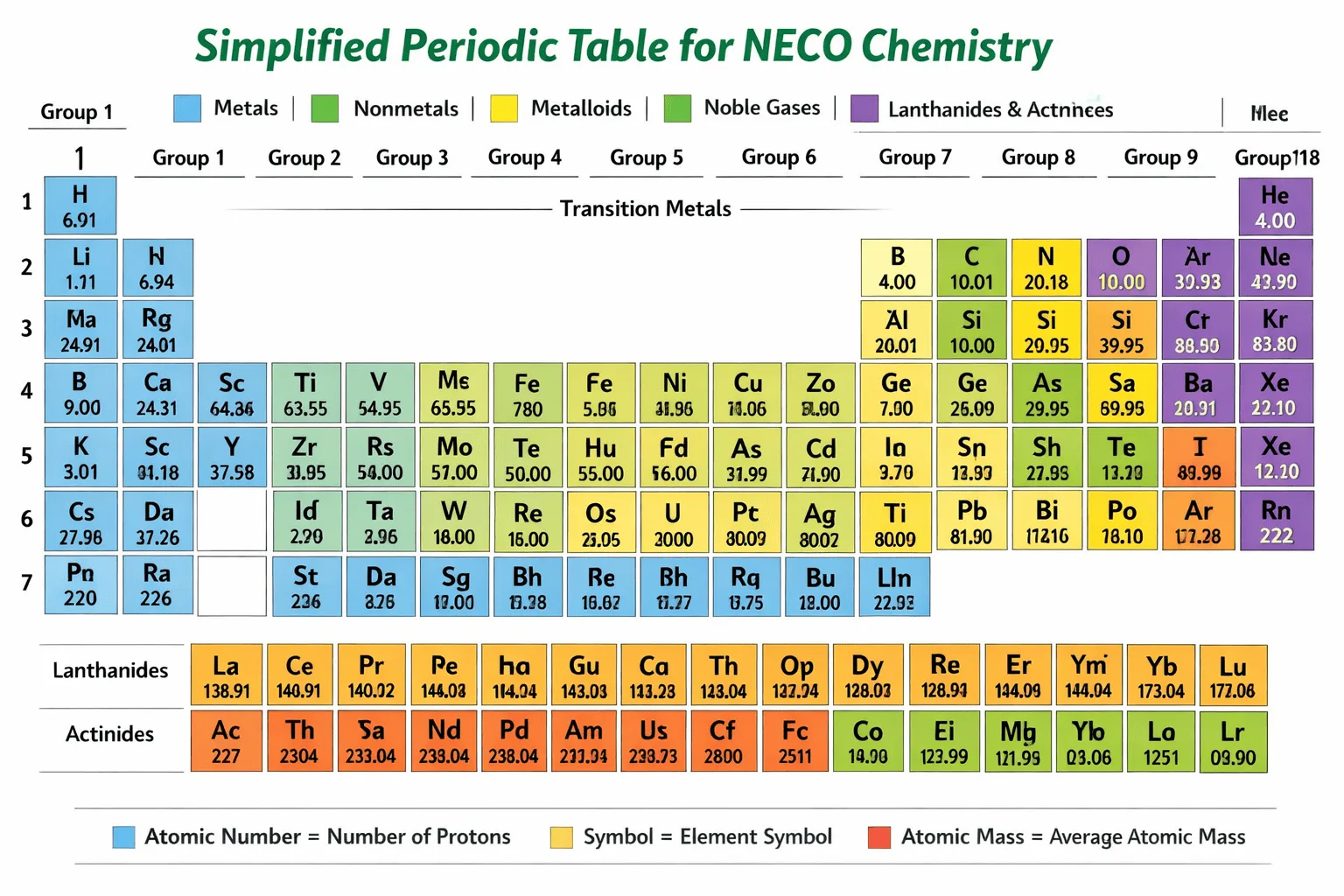
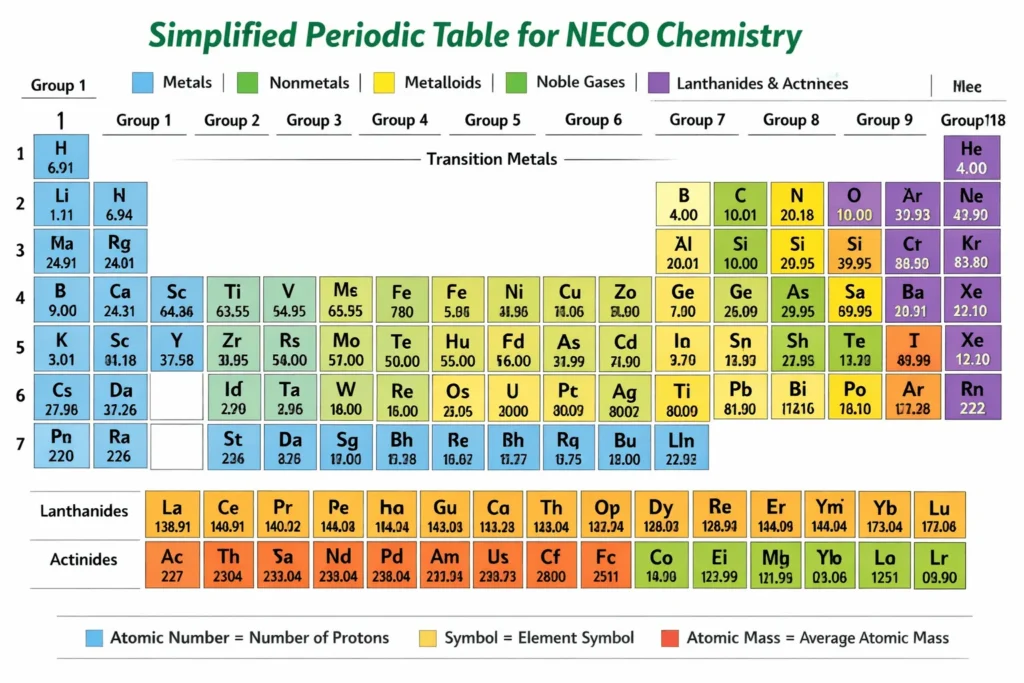
Periodic Table Simplified
The periodic table organizes elements based on atomic number.
Key NECO Focus Areas
- Groups and periods
- Properties of Group 1 and Group 7
- Trends across periods
Extraction of Metals
Methods Based on Reactivity
| Metal | Method |
|---|---|
| Iron | Blast furnace |
| Aluminium | Electrolysis |
| Gold | Physical separation |
Air and Water
Composition of Air
| Gas | Percentage |
|---|---|
| Nitrogen | 78% |
| Oxygen | 21% |
| Others | 1% |
NECO regularly asks about air pollutants and purification methods.
Part Three: Organic Chemistry Simplified (NECO Chemistry Study Notes Simplified (Exam-Focused Guide))
Introduction to Organic Chemistry
Organic chemistry deals with carbon compounds.
Hydrocarbon Types
| Type | Example |
|---|---|
| Alkanes | Methane |
| Alkenes | Ethene |
| Alkynes | Ethyne |
Functional Groups Explained
Functional groups determine chemical behavior.
| Group | Example |
|---|---|
| Alcohol | Ethanol |
| Carboxylic acid | Ethanoic acid |
| Ester | Ethyl ethanoate |
Polymers and Plastics
NECO focuses on uses, advantages, and environmental effects.
Chemistry Practical and Alternative to Practical (NECO Chemistry Study Notes Simplified (Exam-Focused Guide))
Laboratory Safety Rules
- Wear protective equipment
- Avoid tasting chemicals
- Label all substances
Common Laboratory Tests
| Test | Observation |
|---|---|
| Hydrogen | Pops sound |
| Carbon dioxide | Turns limewater milky |
| Oxygen | Rekindles glowing splint |
Common Mistakes NECO Students Make in Chemistry (And How to Avoid Them)
One mistake I see every year, both from my own NECO days and from students I’ve guided, is memorizing chemistry without truly understanding it. Chemistry is not a subject you cram overnight. When you don’t understand why a reaction happens, one small twist in the exam question can throw you off completely.
Another costly error is ignoring practical chemistry. NECO Chemistry rewards students who can visualize experiments, observations, and color changes. I once lost easy marks simply because I treated practicals as theory, never again. That experience changed how I studied.
Many students also misinterpret questions, rushing through without reading command words like state, explain, or calculate. Finally, poor time management silently destroys good preparation. I’ve seen brilliant students leave questions unanswered.
If you want to study smarter, not harder, read my NECO Chemistry Study Notes Simplified (Exam-Focused Guide) and the related posts on my blog, they break these mistakes down and show you exactly how NECO sets its traps.
Expert Study Strategies for NECO Chemistry That Actually Work
NECO Chemistry is not a subject you cram overnight and hope for miracles. It rewards consistency, understanding, and smart practice. When I was preparing for Chemistry myself, I learned very quickly that reading everything at once only created confusion and panic.
Start by studying topic-by-topic. Chemistry builds on itself. If you don’t truly understand atomic structure or chemical equations, topics like stoichiometry and organic chemistry will feel impossible. Break each topic into small, clear goals and master them before moving on.
Make it a habit to practice past questions weekly, not just close to the exam. NECO repeats patterns more than people realize. Each question you solve trains your mind to think the examiner’s way.
Drawing diagrams regularly is underrated. From laboratory setups to molecular structures, drawing helped me remember concepts faster during exams.
Finally, teach someone else, a friend, sibling, or even an imaginary student. If you can explain it simply, you truly understand it.
For deeper guidance, read my related post on NECO Chemistry past questions and examiner patterns, it connects perfectly with these strategies and shows how to apply them in real exam conditions.
Frequently Asked Questions (FAQ) (NECO Chemistry Study Notes Simplified (Exam-Focused Guide))
Is NECO Chemistry difficult?
NECO Chemistry is manageable when studied with simplified and exam-focused notes.
How many questions come from practical?
Practical-related questions appear in both objective and theory papers.
Can I pass NECO Chemistry without calculations?
No. Calculations are essential and frequently tested.
Conclusion: Your Complete NECO Chemistry Success Blueprint
This NECO Chemistry Study Notes Simplified guide was built as a full learning system, not the kind of rushed notes that leave you confused a week to the exam. Every topic follows the NECO syllabus line-by-line, reflects how examiners actually set questions, and explains Chemistry the way students truly understand it, with clear logic, real-life examples, and exam-focused emphasis.
I learned this the hard way. As a student, I once “covered” Chemistry twice yet still struggled in the exam hall because I studied content without understanding how NECO tests it. That experience shaped this guide. It is designed to help you know what to read, why it matters, and how to answer it correctly under exam pressure.
If you study consistently with this guide, practice NECO past questions, and apply the strategies explained, Chemistry stops being intimidating and becomes predictable.
For deeper mastery, read our related post on NECO Chemistry Past Questions Explained on the blog, it shows you exactly how marks are awarded and where students lose easy scores.
Call to Action
Bookmark this page on ExamGuideNG.com, share it with classmates, and make it your daily Chemistry revision companion. For maximum success, combine this guide with NECO past questions and structured weekly study plans available on ExamGuideNG.
Written with academic precision and exam expertise to support Nigerian students worldwide.
References
- National Examinations Council (NECO)
- Nigerian Educational Research and Development Council
- Khan Academy
- British Council Education Resources
Written by Massodih Okon, Senior Exam Preparation Researcher and Academic Education Content Specialist with over 10 years of experience developing high-impact learning resources aligned with Nigerian and international examination standards.
About the Author
Massodih Okon is an experienced educator, researcher, and digital publishing professional with a strong academic and practical background. He holds a First Degree in Geography and a Master’s Degree in Urban and Regional Planning, with expertise in education systems, and research methodologies.
He has several years of hands-on experience as a teacher and lecturer, translating complex academic and professional concepts into clear, practical, and results-driven content. Massodih is also a professional SEO content strategist and writer. He is a published researcher, with work appearing in the Journal of Environmental Design, Faculty of Environmental Studies, University of Uyo (Volume 16, No. 1, 2021), P. 127-134. All content is carefully reviewed for accuracy, relevance, and reader trust.
Related posts
- How To Format a Dissertation a Complete Step by Step Guide
- Research Methodologies Explained for Beginners: A Complete Guide
- What Makes a Good Literature Review a Complete Expert Guide
- Jamb Syllabus Explained Subject by Subject 2026 Complete Guide
- How To Write a Research Abstract for Nigerian Universities
- 10 Top Jamb Exam Tips to Score Above 250+
- Understanding Neco Marking Scheme: A Complete Guide for Candidates
- Fully Funded Scholarships for Nigerian Students 2026 Guide
- Ielts Exam Requirements for Professionals Complete 2026 Guide
- How Admission Is Given in Nigerian Universities: A Complete Step-By-Step Guide