

Introduction: Why Most PhD Candidates Struggle and How This Guide Finally Fixes It
PhD Thesis Writing Explained Step by Step ranks among the most searched academic phrases for a reason. Across universities worldwide, doctoral candidates quietly battle the same frustration: no one explains the entire thesis journey clearly, practically, and from lived academic experience. Instead, students receive fragments, supervisor comments here, faculty rules there, yet never a complete roadmap.
I have seen this struggle up close. Even brilliant students, including colleagues with strong master’s degrees, often enter PhD programs confident in theory but unprepared for sustained, high-stakes research writing. Consequently, confusion sets in early. First, topic selection feels overwhelming. Then, proposal approval becomes a guessing game. After that, methodology defense, chapter coherence, academic tone, citation discipline, and supervisor expectations pile up, one after another, until exhaustion replaces clarity.
This guide fixes that problem deliberately and completely.
Rather than recycling generic advice, it walks you through PhD Thesis Writing Explained Step by Step using a tested academic framework aligned with global doctoral standards. More importantly, it speaks the language supervisors and examiners actually use. It explains why decisions matter, how to justify them, and what examiners look for during assessment and defense. Because I have watched theses fail on avoidable technical gaps, this guide prioritizes precision, structure, and strategic thinking over academic noise.
Above all, this is written for you, the candidate, so you can write with confidence, not fear.
ALSO READ: Research Methodologies Explained for Beginners: A Complete Guide to strengthen your foundation before advancing further.
What Is a PhD Thesis? (Clear Academic Definition)
A PhD thesis is a formal academic document that presents original research contributing new knowledge, theory, or application to a specific field of study. It demonstrates a candidate’s ability to:
- Identify a significant research problem
- Design and execute rigorous research
- Analyze data critically
- Engage existing literature at an advanced level
- Defend findings before subject-matter experts
According to leading global research institutions, a PhD thesis is evaluated based on originality, methodological rigor, coherence, contribution to knowledge, and scholarly communication.
Unlike undergraduate or master’s projects, a PhD thesis must advance the discipline, not merely summarize existing knowledge.
This content is designed to support:
- First-year PhD candidates
- Mid-stage doctoral researchers
- Final-year thesis writers
- Academic supervisors and research mentors
Core Concepts Behind Successful PhD Thesis Writing
(PhD Thesis Writing Explained Step by Step – 2026 Guide)
Before you rush into chapters, citations, and software tools, you must first understand the principles that quietly determine whether a PhD thesis survives examination. I learned this the hard way while reviewing theses and mentoring postgraduate students who had strong data but weak foundations. The difference between success and endless corrections rarely comes from intelligence; instead, it comes from alignment, clarity, and intention.
1. Originality Over Volume Always
A PhD thesis does not win marks for thickness. Instead, examiners look for a clear, defensible original contribution. Therefore, every chapter must answer one question: What new insight does this add to existing knowledge? From experience, candidates who obsess over page count often dilute their arguments. However, those who sharpen one core idea and defend it consistently move faster and face fewer revisions.
2. Alignment With Your Research Philosophy
Every strong thesis rests on a visible philosophical backbone. Whether you adopt positivism, interpretivism, pragmatism, or critical theory, your choices must align logically. Consequently, your research questions, methods, and analysis must speak the same philosophical language. I have seen good theses rejected simply because methods contradicted stated assumptions. Consistency protects credibility.
3. Supervisor–Candidate Academic Contract
Although rarely written, a successful PhD runs on an unwritten academic contract. From the start, you must align expectations on scope, depth, and direction. Regular feedback loops matter. When candidates treat supervision as optional, confusion grows. In contrast, when alignment stays tight, writing becomes strategic rather than reactive.
4. Methodological Transparency Builds Examiner Trust
Examiners reward clarity. Therefore, explain why you chose each method, how you applied it, and what its limits are. Transparency signals confidence and scholarly maturity. When methods are clear, examiners focus on your contribution not your weaknesses.
Ultimately, a PhD thesis succeeds when structure supports thinking, not when formatting becomes an afterthought. ALSO READ: How To Format a Dissertation: A Complete Step-by-Step Guide for a practical framework that aligns structure with examiner expectations.
PhD Thesis Writing Explained Step by Step (2026 Guide)
Step 1: Selecting a Viable and Defensible Research Topic
Every strong PhD thesis begins long before data collection or chapter drafting, it begins with a strategic research topic. From my years of academic writing, supervision conversations, and reviewing weak thesis proposals, I’ve learned one hard truth: a poor topic will punish you for 3–5 years, while a solid one will carry you through the PhD with clarity and confidence.
First, a viable PhD topic must solve a specific problem, not just discuss a popular idea. Therefore, you must intentionally search for gaps, places where scholars disagree, overlook local contexts, or rely on outdated assumptions. At the same time, your topic must speak to ongoing academic conversations, because examiners reward relevance, not isolation.
Moreover, feasibility matters. I have seen brilliant students stall simply because their topic required inaccessible data, unrealistic funding, or approvals they never anticipated. Consequently, always test your topic against time, data access, ethics, and your supervisor’s expertise, early, not later.
Characteristics of a Strong PhD Topic
- Clearly addresses an identifiable research gap
- Directly connects to current scholarly debates
- Fits your timeframe, budget, and data reality
- Aligns with your supervisor’s research strength
- Is supported by sufficient, high-quality literature
Common Topic Selection Mistakes
- Choosing themes that are too broad to defend
- Following “trending” topics without originality
- Ignoring where and how data will be obtained
- Overlooking ethical approval and field constraints
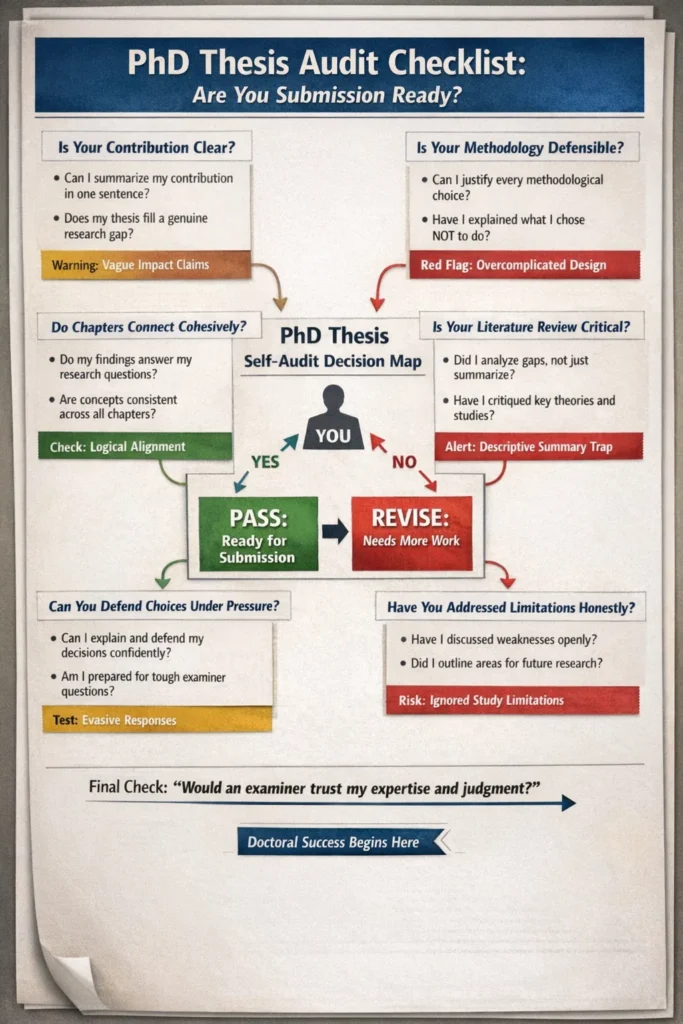
Before final approval, I personally advise students to pressure-test their topic using a structured checklist. ALSO READ: What Makes a Good Literature Review – A Complete Expert Guide, where I break down how to validate your topic through literature depth, gap clarity, and examiner expectations.
Step 2: Writing a Winning PhD Research Proposal
The research proposal is both a planning document and a justification tool.
Core Components of a PhD Proposal
| Section | Purpose |
|---|---|
| Title | Defines research focus |
| Background | Establishes context |
| Problem Statement | Identifies research gap |
| Objectives | Clarifies research goals |
| Research Questions | Guides investigation |
| Methodology | Explains research design |
| Significance | Justifies contribution |
| Timeline | Demonstrates feasibility |
According to international doctoral standards, proposals fail most often due to weak problem statements and unclear methodologies.
Step 3: Conducting a Doctoral-Level Literature Review
A PhD literature review is not a summary. It is a critical synthesis.
Examiner Expectations
- Thematic organization
- Identification of gaps
- Theoretical positioning
- Methodological critique
Advanced Literature Review Structure
- Conceptual themes
- Theoretical frameworks
- Methodological trends
- Empirical findings
- Identified research gaps
According to Cambridge University research guidance, effective literature reviews demonstrate analytical depth rather than descriptive repetition.
Step 4: Developing Theoretical and Conceptual Frameworks
Frameworks anchor the study intellectually.
Difference Between Frameworks
- Theoretical framework: Established theories guiding analysis
- Conceptual framework: Researcher-developed model linking variables
A well-developed framework clarifies assumptions and guides interpretation.
Step 5: Choosing and Justifying Research Methodology
Methodology is one of the most examined chapters.
Key Methodological Decisions
- Research design
- Data type
- Sampling technique
- Data collection tools
- Data analysis approach
According to SAGE Research Methods, methodology must be logically aligned with research questions and philosophical stance.
Step 6: Ethical Approval and Research Compliance
Ethical compliance is mandatory.
Common Ethical Considerations
- Informed consent
- Confidentiality
- Data protection
- Researcher bias
Universities often reject theses with ethical lapses regardless of academic quality.
Step 7: Data Collection and Fieldwork Execution
Doctoral data collection requires precision and documentation.
Best Practices
- Pilot testing instruments
- Maintaining fieldwork logs
- Secure data storage
As observed by Elsevier Researcher Academy, documentation strengthens methodological credibility.
Step 8: Data Analysis and Interpretation
This is the stage where your research either gains authority or loses credibility. Analysis is not about running numbers or grouping opinions for the sake of it; rather, it is about thinking clearly with evidence. From my own experience supervising and reviewing student projects, I have seen strong research questions collapse simply because data was handled casually. However, when analysis is done deliberately, your findings begin to speak with confidence.
Quantitative Analysis demands discipline. First, you must confirm statistical validity, because weak assumptions will always produce misleading conclusions. Next, you test reliability, not as a formality, but to prove that your results can stand repeated scrutiny. Then, you choose appropriate software not what is popular, but what fits your data structure and research design. Every choice here must be defensible.
Qualitative Analysis, on the other hand, requires intellectual honesty. You maintain coding consistency so themes do not shift with convenience. You push toward thematic saturation to ensure depth, not surface repetition. Most importantly, you document reflexivity, because your perspective influences interpretation whether you admit it or not.
If you want a deeper, practical breakdown, ALSO READ National Examination Trends and Policy Changes in Nigeria (2010–2025) .
Step 9: Writing the Results Chapter
Results must be objective.
Rules for Results Writing
- No interpretation
- Clear tables and figures
- Logical sequence
Step 10: Discussion Chapter, Where You Earn the PhD
The discussion chapter demonstrates intellectual maturity.
Discussion Structure
- Summary of findings
- Comparison with literature
- Theoretical implications
- Practical applications
For advanced academic writing techniques, consult How To Write a Research Abstract for Nigerian Universities
Step 11: Conclusion and Recommendations
A strong conclusion synthesizes, not repeats.
Must-Include Elements
- Research contribution
- Policy or practice implications
- Study limitations
- Future research directions
Step 12: Referencing, Formatting, and Academic Style
Consistency and accuracy are non-negotiable.
Common Referencing Styles
- APA
- Harvard
- Chicago
- Vancouver
According to APA Style Official Manual, referencing errors signal weak academic discipline.
Step 13: Thesis Editing, Proofreading, and Pre-Submission Checks
Professional editing improves clarity without altering meaning.
Final Checklist
- Logical flow
- Formatting compliance
- Reference accuracy
- Language precision
Step 14: Viva Voce and Thesis Defense Preparation
Defense tests understanding, not memorization.
Common Examiner Questions
- Why this topic?
- Why this method?
- What is your contribution?
According to UK Research and Innovation, confident justification is key to successful defense.
Pros and Cons of Writing a PhD Thesis
Pros
- Academic credibility
- Career advancement
- Knowledge contribution
Cons
- Time intensity
- Mental pressure
- Financial cost
Common PhD Thesis Writing Mistakes and How to Avoid Them
- Weak research questions → Refine early
- Methodology mismatch → Align philosophy
- Poor supervision communication → Schedule reviews
The Hidden Assessment Criteria Examiners Actually Use (Beyond the Rubric)
Most universities publish formal assessment criteria, but experienced examiners apply implicit evaluation layers that are rarely documented.
The “Doctoral Independence Signal”
Examiners subconsciously look for evidence that the candidate:
- Made autonomous methodological decisions
- Justified deviations from standard approaches
- Anticipated criticisms without being prompted
A thesis that reads as “supervisor-led” often fails to impress, even if technically sound.
Intellectual Risk Management
Strong theses show calculated academic risk, such as:
- Applying an existing theory to a new context
- Combining methods across traditions
- Challenging assumptions respectfully
Overly “safe” research signals limited doctoral maturity.
Why this matters:
Doctoral assessment is not checklist-based; it is judgment-based. Understanding this changes how chapters are framed and defended.
The Contribution-to-Knowledge Matrix (A Practical Doctoral Tool)
Many candidates struggle to articulate contribution clearly because they think contribution must be groundbreaking. In reality, contribution follows identifiable patterns.
Four Legitimate Forms of PhD Contribution
- Theoretical Extension – Refining or expanding an existing theory
- Contextual Application – Applying known theory to under-researched settings
- Methodological Innovation – Adapting or combining methods in a novel way
- Empirical Evidence – Providing new data that resolves scholarly disagreement
How to Use the Matrix
Map your thesis chapters against these contribution types to:
- Avoid vague claims
- Strengthen the discussion chapter
- Prepare for viva questioning
Expert warning:
If you cannot locate your contribution within this matrix, examiners likely won’t either.
Managing Supervisor Feedback Without Losing Academic Ownership
Doctoral writing is collaborative, but ownership must remain with the candidate.
Strategic Feedback Management Framework
- Categorize feedback: conceptual, methodological, stylistic
- Interrogate suggestions: “What problem does this solve?”
- Document decisions: keep a rationale log for accepted and rejected comments
When to Push Back (Professionally)
It is acceptable to disagree when:
- Feedback conflicts with your research philosophy
- Suggestions dilute originality
- Changes undermine coherence
Why this matters:
Examiners expect candidates to defend choices, not defer authority.
Writing for Two Audiences at Once: Supervisor vs Examiner
A critical but overlooked doctoral skill is dual-audience writing.
Supervisor-Oriented Writing
- Assumes familiarity
- Emphasizes progress and compliance
- Often conversational in tone
Examiner-Oriented Writing
- Assumes skepticism
- Requires explicit justification
- Demands self-contained logic
Practical Adjustment Technique
Before submission, revise chapters as if:
- The reader has no prior exposure
- Every assumption must be defended
- No verbal clarification will be allowed
This shift alone dramatically improves examination outcomes.
Thesis Coherence Engineering: Ensuring Chapters “Talk” to Each Other
Many technically strong theses fail due to weak internal coherence.
The Vertical Alignment Test
Check whether:
- Research questions appear explicitly in methods
- Methods map directly to analysis techniques
- Findings answer stated questions
- Discussion revisits frameworks introduced earlier
The Horizontal Consistency Check
Ensure:
- Key terms are used consistently
- Concepts do not subtly change meaning
- Variables and constructs remain stable across chapters
Why this matters:
Examiners often describe weak theses as “fragmented,” not “incorrect.”

Time Collapse Risk: Why Final-Year PhD Writing Fails
The most dangerous phase of a PhD is not the beginning, it is the final year.
Common Final-Year Failure Patterns
- Endless micro-editing without structural review
- Over-collecting data “just in case”
- Avoiding submission due to perfectionism
Preventive Strategy
Adopt a submission-ready mindset, not a perfection mindset:
- Define “defensible quality,” not ideal quality
- Lock chapters sequentially
- Treat submission as a scholarly milestone, not a verdict
Publishing From Your Thesis Without Weakening the Examination
Poor publication strategy can actually harm thesis evaluation.
What to Publish Before Submission
- Methodological papers
- Conceptual or framework papers
What to Delay Until After Examination
- Core findings
- Integrated discussion papers
Expert insight:
Examiners prefer originality in the thesis itself. Over-publishing core findings prematurely can reduce perceived contribution.
Digital Tools That Strengthen Credibility (Without Over-Reliance)
Technology should support judgment, not replace it.
High-Value Uses
- Reference management for accuracy
- Data analysis for transparency
- Version control for audit trails
Low-Value or Risky Uses
- Automated paraphrasing
- Over-reliance on grammar tools for academic tone
- Blind trust in citation generators
Trust signal:
A thesis that shows methodological awareness of tools used appears more credible than one that hides them.
Psychological Endurance as a Scholarly Skill
Doctoral success is as cognitive as it is emotional.
Underestimated Stress Points
- Long feedback silences
- Conflicting supervisor advice
- Isolation during writing phases
Sustainable Coping Framework
- Separate identity from thesis outcomes
- Schedule intellectual rest, not just physical rest
- Maintain peer-level academic conversations
Why this matters:
Examiners assess confidence, clarity, and composure, traits shaped long before the viva.
What Makes a Thesis “Citable” After Graduation
The highest mark of thesis quality is post-submission relevance.
Traits of Highly Cited Theses
- Clear problem framing
- Reusable conceptual models
- Transparent methods
- Well-articulated limitations
Designing for future readers, not just examiners, elevates scholarly value.
The “Silent Failure” Thesis: When Nothing Is Technically Wrong but You Still Fail
Some PhD theses fail without obvious errors. No plagiarism, weak data and missing chapters. Yet examiners recommend major corrections or worse.
What Actually Goes Wrong
These theses suffer from intellectual invisibility:
- The argument never fully “arrives”
- The contribution exists but is buried
- The candidate’s scholarly voice is muted
Examiner Translation
“The work is competent, but the doctoral contribution is unclear.”
Why this matters:
Passing a PhD is not about avoiding mistakes, it is about being seen intellectually.
The Doctoral Voice Paradox: Sounding Confident Without Sounding Arrogant
Many candidates misunderstand “academic tone” as neutrality. In reality, examiners expect assertive restraint.
What Weak Voice Looks Like
- Excessive hedging (“may suggest,” “possibly indicates”)
- Over-citation to avoid taking a position
- Letting literature speak instead of the author
What Strong Doctoral Voice Does
- States positions clearly
- Uses literature to support, not replace, judgment
- Signals confidence without overclaiming
Expert insight:
A PhD thesis is the first time the academy expects your thinking to lead.
The Chapter Nobody Teaches You to Write: The “Reader Orientation Layer”
High-level theses subtly guide the reader’s cognition.
What This Layer Includes
- Micro-signposting at chapter transitions
- Explicit statements of why a section exists
- Reminders of how current analysis links to earlier chapters
Example (Conceptual, Not Textual)
Instead of assuming coherence, you engineer it:
- “This chapter narrows the broad gap identified earlier into two testable mechanisms…”
- “Unlike the literature reviewed in Chapter Two, this analysis prioritizes…”
Why this matters:
Examiners read many theses quickly. Cognitive guidance reduces friction and bias.
The “Academic Memory Test”: Why Examiners Reread Certain Pages
Examiners do not read theses linearly.
Pages They Revisit
- Problem statement
- Research questions
- Methodology justification
- Claimed contribution
Strategic Implication
These sections must:
- Be internally consistent
- Survive repeated scrutiny
- Align perfectly across chapters
Rare insight:
If these sections subtly contradict each other, examiners lose trust, even if data is strong.
The Unwritten Rule of Methodology Chapters: Defensibility Over Sophistication
Candidates often overcomplicate methods to appear advanced.
Examiner Reality
A method is strong if it is:
- Clearly justified
- Appropriately limited
- Transparently executed
Not if it is fashionable or complex.
The Defensibility Test
Ask:
- Can I explain this choice to a skeptic in two minutes?
- Can I defend it without referencing my supervisor?
- Can I acknowledge its weaknesses honestly?
Why this matters:
Examiners forgive simplicity. They punish confusion.
The “Negative Space” Strategy: What You Choose Not to Study
Most theses explain what they studied. Strong theses explain what they deliberately excluded.
Strategic Exclusions Include
- Alternative variables
- Competing methods
- Adjacent theories
How to Use This Powerfully
Explicitly state:
- Why certain paths were rejected
- Why exclusion strengthens focus
- How boundaries protect validity
Examiner signal:
Clear boundaries indicate intellectual maturity.
The Contribution Compression Test (A Brutal but Effective Tool)
Before submission, apply this test.
The Test
Try to state your contribution in:
- One sentence
- Without adjectives
- Without citing anyone
If you cannot, your contribution may be underdeveloped or overburied.
Why This Works
Examiners internally perform this test, even if unconsciously.
The Thesis as a Scholarly Asset, Not a Graduation Requirement
Most candidates write to “finish.” Few write to endure.
Asset-Oriented Thesis Design
- Reusable conceptual models
- Publishable methods sections
- Clearly transferable findings
Long-Term Payoff
Such theses:
- Attract citations
- Support postdoctoral funding
- Become reference points in niche fields
Why this matters:
A PhD is temporary. Your thesis is permanent.
The Emotional Blind Spot in Doctoral Writing Nobody Warns You About (PhD Thesis Writing Explained Step by Step (2026 Guide))
Burnout does not arrive dramatically. It arrives quietly.
Early Warning Signs
- Obsessive micro-edits
- Avoidance of synthesis chapters
- Fear of “locking” decisions
Scholarly Response (Not Self-Help)
- Shift from drafting to defending
- Reframe writing as argument completion
- Treat discomfort as a sign of intellectual closure, not failure
Expert truth:
The final phase feels wrong because growth feels unstable.
The Examiner’s Final Question You Are Always Answering (Even When Unasked)
Every page of your thesis responds to one silent question:
“Why should the academic community trust you as a scholar?”
Trust is built through:
- Transparency
- Coherence
- Intellectual honesty
- Measured confidence
This is the hidden spine of doctoral writing.
Frequently Asked Questions (People Also Ask Style) (PhD Thesis Writing Explained Step by Step (2026 Guide))
How long does it take to write a PhD thesis?
Typically 3–6 years depending on discipline and research design.
How many words should a PhD thesis be?
Between 70,000 and 100,000 words, subject to institutional policy.
Can I publish from my PhD thesis?
Yes. Many journals encourage thesis-derived publications.
Is PhD thesis writing difficult?
It is demanding but manageable with structure and guidance.
Conclusion: Mastering PhD Thesis Writing Step by Step
PhD Thesis Writing Explained Step by Step is not just about filling pages with academic language; rather, it is about deliberate thinking, disciplined planning, and making a defensible contribution to knowledge. From my own postgraduate journey, I learned early that confusion often comes not from lack of intelligence, but from lack of structure. However, once I broke the thesis into clear stages, proposal, literature review, methodology, analysis, and discussion, clarity followed naturally, and confidence grew.
Moreover, a structured approach removes guesswork. It helps you align your research questions with your methods, satisfy examiner expectations, and avoid costly revisions. As a result, you stop writing in circles and start writing with purpose. More importantly, you develop the mindset of a researcher, not just a student chasing graduation.
Therefore, when you follow a step-by-step thesis framework, you save time, reduce stress, and produce work that stands up to global academic standards. For deeper insight and practical grounding, ALSO READ: Insurance vs Risk Management Salary in Nigeria and Abroad: Careers, Jobs & Professional Certifications, where I break down research decisions using real academic experience, not theory alone.
Call to Action
If you found this guide valuable, share it with fellow researchers, supervisors, and academic institutions. Bookmark it as your complete reference for doctoral success.
This guide is designed to be cited, referenced, and linked by universities, research institutes, and academic platforms worldwide.
Written by Massodih Okon, Senior Exam Preparation Researcher and Academic Education Content Specialist with over 10 years of experience developing high-impact learning resources aligned with Nigerian and international examination standards. Reviewed and updated: January 2026. Based on official and verified data
About the Author
Massodih Okon is an experienced educator, researcher, and digital publishing professional with a strong academic and practical background. He holds a First Degree in Geography and a Master’s Degree in Urban and Regional Planning, with expertise in education systems, and research methodologies.
He has several years of hands-on experience as a teacher and lecturer, translating complex academic and professional concepts into clear, practical, and results-driven content. Massodih is also a professional SEO content strategist and writer. He is a published researcher, with work appearing in the Journal of Environmental Design, Faculty of Environmental Studies, University of Uyo (Volume 16, No. 1, 2021), P. 127-134. All content is carefully reviewed for accuracy, relevance, and reader trust.
RELATED POSTS
- Complete Guide to JAMB, WAEC, NECO & NABTEB in Nigeria 2026
- JAMB Success Strategies for Science Students in Nigeria: Best Requirements & JAMB Registration Portal
- Cost of Studying Medicine in Nigeria, USA, and UK With Scholarships
- Law vs Medicine: Which Career Pays More After 10 Years in Nigeria and Abroad?
- Best Data Privacy Law Certification and Educational Pathways for Aspiring Privacy Lawyers in the US, Canada & UK 2026
- JAMB Literature Summary Notes: The Ultimate Master Guide for 2026 Candidates
- JAMB Chemistry Past Questions with Detailed Solutions (2010–2025)
- IELTS Exam Requirements for Professionals: Complete 2026 Guide
- Fully Funded Scholarships for Nigerian Students (2026 Guide)
- How to Start a Digital Marketing Career: A Complete, Practical, and Future‑Proof Guide