Before You Start Your Research, Read This
Most people learn research methodology the hard way midway through a project, when they realize their approach doesn’t match their question, or during a supervisor review when the word epistemology surfaces and the room goes quiet.
That disconnect is more common than you’d think. Students, early-career researchers, and working professionals alike often arrive at research with a clear what a topic, a problem, a burning question but without a reliable framework for the how. How should this be studied? What method actually fits? And perhaps most importantly: how do you defend that choice when someone asks?
Those are the questions this guide is built around.
What you’ll find here isn’t a glossary of definitions or a surface-level overview. Instead, this is a working guide one that walks you through qualitative, quantitative, and mixed methods approaches using plain language, real examples, and direct comparisons. The goal is practical: by the end, you should be able to look at a research question and know not just which methodology applies, but why it applies and how to articulate that reasoning clearly.
That matters whether you’re writing an undergraduate paper, a postgraduate thesis, a journal submission, or a policy brief. Methodology isn’t bureaucratic box-ticking it’s the logic that holds your entire research together.
For a deeper conceptual foundation, especially if you are still building your academic writing skills, you are encouraged to read our related post on “What Is a Literature Review?”, where we explain how existing studies shape methodological choices and strengthen research credibility.
What Is Research Methodology? (Research Methodologies Explained for Beginners: A Complete Guide)
Why Understanding Research Methodologies Is Important
Understanding research methodologies helps beginners to:
Choose appropriate research designs
Avoid common research errors
Produce credible and verifiable findings
Meet academic and institutional standards
Improve the quality and acceptance of research work
As a result, strong methodology increases the trustworthiness and impact of your research.
Types of Research Methodologies Explained for Beginners
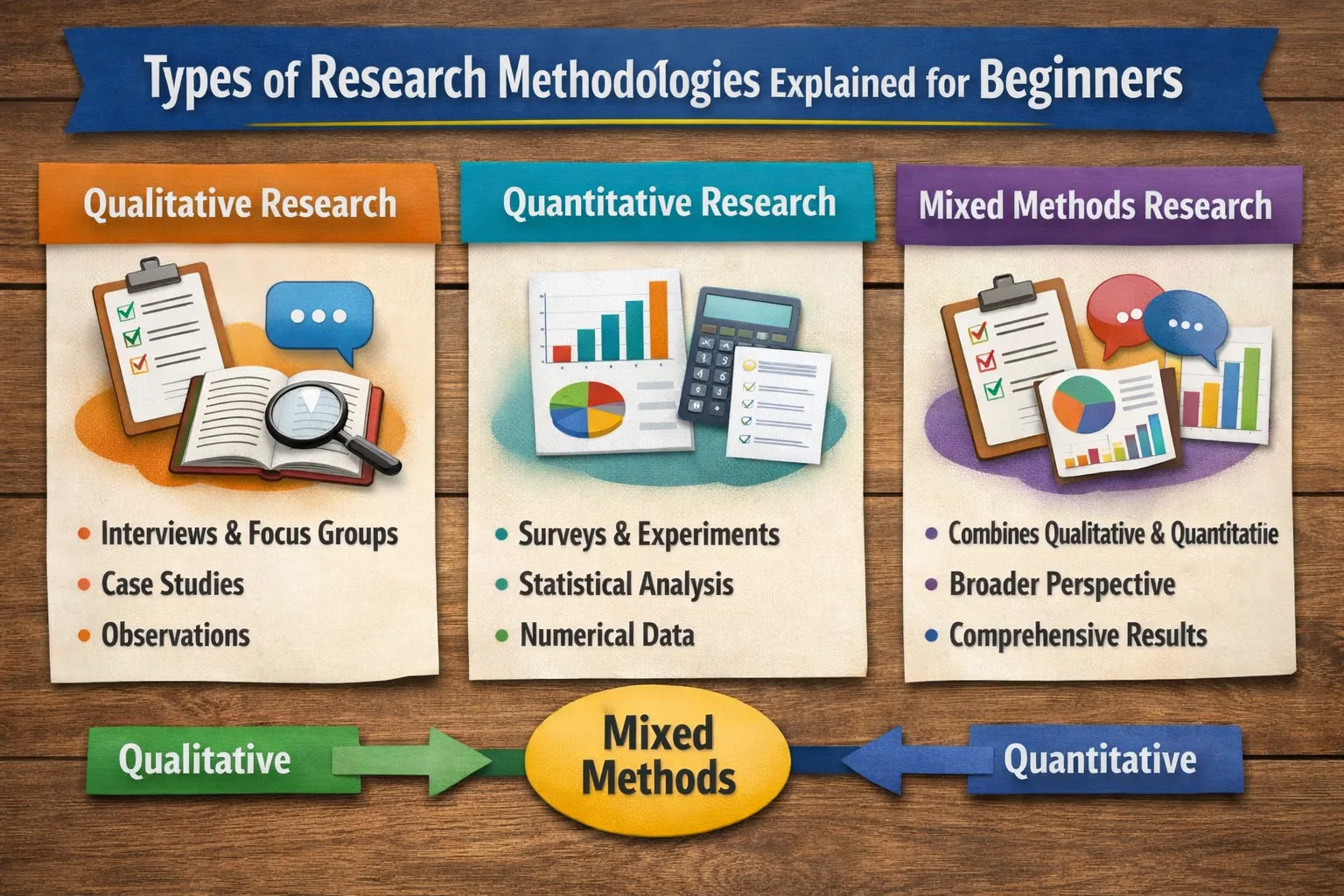
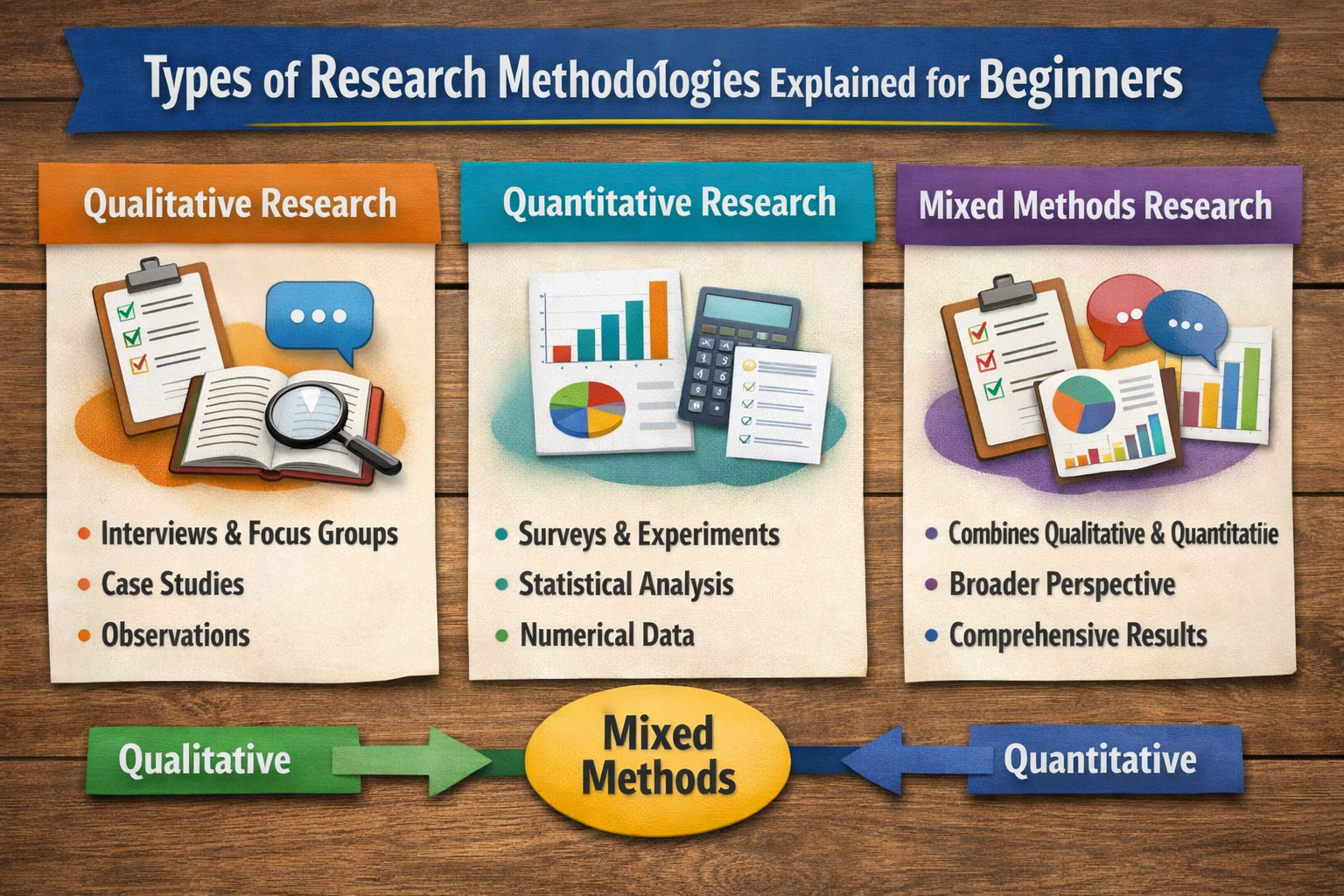
Research methodologies are broadly grouped into three major categories. Each category serves a specific research purpose.
1. Qualitative Research Methodology
What Is Qualitative Research?
Qualitative research focuses on understanding meanings, experiences, opinions, and behaviors. It uses non-numerical data such as words, images, and observations.
Common Qualitative Research Methods
Interviews
Focus group discussions
Case studies
Observations
Content analysis
When to Use Qualitative Research
Use qualitative methods when your study aims to:
Explore human experiences
Understand social or cultural issues
Analyze perceptions and attitudes
Example
A study on how students feel about online learning is best conducted using interviews or focus groups.
2. Quantitative Research Methodology (Research methodologies explained for beginners: A complete guide)
What Is Quantitative Research?
Quantitative research focuses on numerical data, measurement, and statistical analysis. It answers questions such as how many, how often, and to what extent.
Common Quantitative Research Methods
Surveys and questionnaires
Experiments
Statistical analysis
Structured observations
When to Use Quantitative Research
Use quantitative methods when you want to:
Test hypotheses
Measure relationships between variables
Generalize findings to a larger population
Example
A study measuring the impact of study hours on exam performance uses quantitative analysis.
3. Mixed Methods Research (Research methodologies explained for beginners: A complete guide)
What Is Mixed Methods Research?
Mixed methods research combines qualitative and quantitative approaches in a single study to provide a more complete understanding of the research problem.
Why Use Mixed Methods?
It balances depth and measurement
It improves validity and reliability
It answers complex research questions
Example
A study that uses surveys to collect data and interviews to explain the results uses mixed methods.
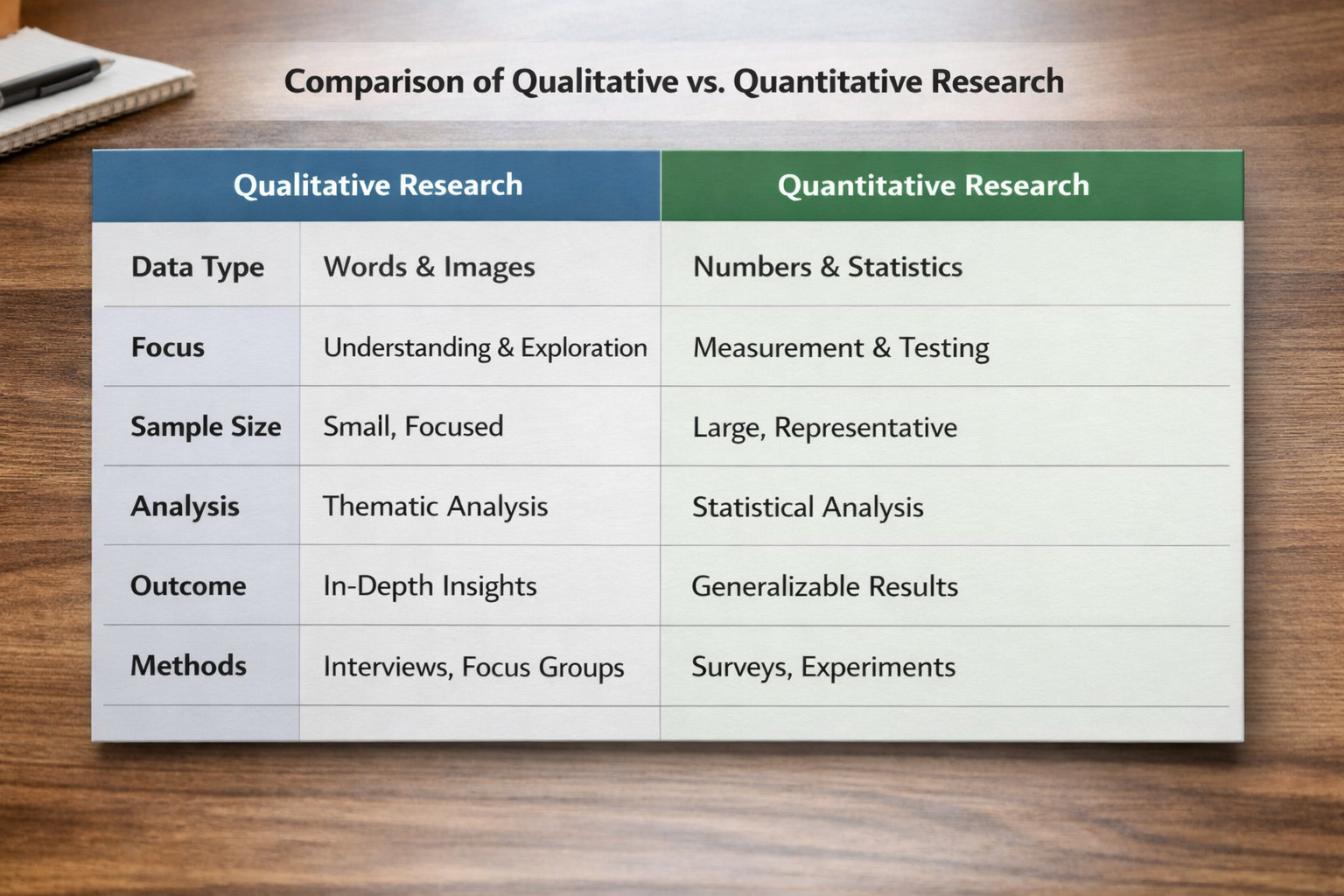
Comparison Table: Research Methodologies at a Glance
| Feature | Qualitative | Quantitative | Mixed Methods |
| Data Type | Text, images | Numbers | Both |
| Focus | Meaning | Measurement | Integration |
| Sample Size | Small | Large | Variable |
| Analysis | Thematic | Statistical | Combined |
| Outcome | In-depth insights | Generalizable results | Comprehensive understanding |
Research Designs Explained Simply (Research methodologies explained for beginners: A complete guide)
Research design defines the structure of the study. Common designs include:
Descriptive Research Design
Describes characteristics of a population without manipulation.
Experimental Research Design
Tests cause-and-effect relationships using control and treatment groups.
Correlational Research Design
Examines relationships between variables without control.
Case Study Design
Provides detailed analysis of a single case or phenomenon.
Step-by-Step Guide: How to Choose the Right Research Methodology
1: Identify Your Research Problem
Clearly define what you want to study.
2: Define Your Research Objectives
Decide whether you want to explore, explain, or measure.
3: Determine the Type of Data Needed
Decide if you need words, numbers, or both.
4: Consider Your Target Population
Sample size and accessibility matter.
5: Match the Methodology to Your Research Question
Ensure alignment between objectives and methods.
Data Collection Techniques Explained (Research methodologies explained for beginners: A complete guide)
Primary Data Collection
Surveys
Interviews
Observations
Experiments
Secondary Data Collection
Journals
Books
Government reports
Academic databases
Each technique must align with your methodology to ensure accuracy.
1. Questionnaire Method (Survey Data)
Description:
Questionnaires are structured tools used to collect standardized information from a large number of respondents. They are ideal for quantitative research and statistical analysis.
Sample Generated Data (Survey of Study Habits – 50 Students)
| Question | Response Options | Frequency |
|---|---|---|
| Study daily? | Yes | 32 |
| No | 18 | |
| Preferred study time | Morning | 14 |
| Afternoon | 11 | |
| Night | 25 | |
| Average study hours/day | 1–2 hours | 19 |
| 3–4 hours | 21 | |
| 5+ hours | 10 |
Key Insight:
Most respondents prefer studying at night, with the majority spending 3–4 hours daily on academic work.
2. Interview Method (Qualitative Data)
Description:
Interviews involve direct interaction between the researcher and participants to obtain in-depth opinions, experiences, and explanations.
Sample Generated Interview Extract (5 Participants)
| Respondent | Key Response Summary |
|---|---|
| R1 | Finds group study more effective than solo study |
| R2 | Struggles with concentration due to phone usage |
| R3 | Believes time management improves academic performance |
| R4 | Prefers online learning resources over textbooks |
| R5 | Reports lack of motivation during exam periods |
Key Insight:
Recurring themes include time management challenges and digital distractions affecting learning outcomes.
3. Observation Method
Description:
Observation involves systematically watching and recording behaviors or events as they occur naturally, without direct questioning.
Sample Generated Observation Data (Library Study Behavior)
| Observed Activity | Number of Occurrences |
|---|---|
| Individual silent reading | 27 |
| Group discussion | 9 |
| Use of laptops | 31 |
| Use of mobile phones | 18 |
| Non-academic activities | 6 |
Key Insight:
Laptop usage dominates academic activities, but phone distractions are still noticeable.
4. Document and Record Review
Description:
This method involves analyzing existing documents such as reports, exam results, journals, or official records.
Sample Generated Data (Academic Records Review)
| Academic Year | Average GPA |
|---|---|
| 2021 | 3.02 |
| 2022 | 3.18 |
| 2023 | 3.31 |
| 2024 | 3.44 |
Key Insight:
There is a steady improvement in academic performance over time, suggesting positive institutional or behavioral changes.
5. Focus Group Discussion (FGD)
Description:
Focus groups involve guided discussions with a small group of participants to explore shared perceptions and collective views.
Sample Generated Focus Group Themes
| Theme | Number of Mentions |
|---|---|
| Poor study environment | 8 |
| Internet access issues | 6 |
| Lecturer teaching style | 7 |
| Peer influence | 5 |
Key Insight:
Environmental and infrastructural factors strongly influence students’ academic engagement.
Summary Note: Data collection techniques determine the quality, reliability, and credibility of research findings. Quantitative methods such as questionnaires and record reviews generate numerical data suitable for statistical analysis, while qualitative methods like interviews, observations, and focus groups provide deeper contextual understanding. Beginner researchers are encouraged to select techniques that align with their research objectives, population size, and available resources.
For a clearer understanding of how these techniques fit into broader research designs, see “PhD thesis explain step by step”, especially the section on Quantitative vs Qualitative Research Approaches.
Advantages and Disadvantages of Research Methodologies
Qualitative Research
Pros
Rich, detailed data
Flexibility
Deep understanding
Cons
Time-consuming
Limited generalization
Quantitative Research
Pros
Objective analysis
Large sample sizes
Statistical reliability
Cons
Limited depth
Requires technical skills
Common Mistakes Beginners Make (And How to Avoid Them)
Choosing a method without justification
Mixing methods without a clear plan
Using poor sampling techniques
Ignoring validity and reliability
Failing to explain methodology clearly
To avoid these issues, always align your research design with your objectives.
Best guides and Best Practices (Research methodologies explained for beginners: A complete guide)
- Always justify your methodology choice
- Use credible and recent sources
- Maintain ethical research standards
- Pilot test your data collection tools
- Clearly explain your methods in simple language
These practices improve acceptance by supervisors, journals, and institutions.
Methodology–Question Fit: The Hidden Alignment Most Beginners Miss
One of the most overlooked aspects of research design is methodology–question fit. Many beginners choose a methodology based on popularity or supervisor preference rather than analytical necessity.
The “Question Logic” Test (Expert Framework)
Before choosing any methodology, test your research question against these three lenses:
- Nature of curiosity: Are you asking why, how, or to what extent?
- Level of abstraction: Are you examining lived experience or measurable outcomes?
- Decision impact: Will results inform policy, theory, or practice?
If your question cannot logically be answered by the data your method produces, your study will fail, even if well written.
According to ExamGuideNg’s How To Format a Dissertation a Complete Step by Step Guide is one of the top three reasons student projects are rejected at proposal stage.
Epistemology Without the Jargon: What You’re Really Claiming as a Researcher
Most beginner guides avoid epistemology entirely, yet it silently shapes every methodological decision.
Practical Epistemology Explained Simply
When you choose a methodology, you are implicitly answering this question:
“What counts as valid knowledge in my study?”
- Qualitative methods assume reality is socially constructed.
- Quantitative methods assume reality can be objectively measured.
- Mixed methods assume reality is layered and requires triangulation.
Ignoring this creates internal contradictions, for example, using surveys to claim deep emotional understanding.
Expert warning: Examiners may not ask about epistemology directly, but they detect inconsistency instantly.
According to the University of London research methods handbook, epistemological coherence is a silent grading criterion in postgraduate research.
Methodological Rigor vs. Methodological Complexity: A Critical Distinction
Beginners often believe that “advanced” methods equal better research. This is false.
Rigor Comes From Discipline, Not Complexity
A simple descriptive study can outperform a complex mixed-methods study if it demonstrates:
- Clear sampling logic
- Transparent data collection
- Justified analytical choices
- Replicable procedures
Complexity without control increases error, bias, and confusion.
Case-style reasoning:
A well-executed 300-respondent survey often produces more defensible conclusions than a poorly integrated survey-interview hybrid.
According to ExamGuideNg’s How To Write a Research Abstract for Nigerian Universities, simplicity with justification scores higher than complexity without clarity.
Sampling Strategy: The Methodological Lever That Determines Credibility
This is often treated as a technical detail, but it fundamentally determines whether findings can be trusted.
Sampling Decisions That Signal Expertise
Instead of listing sample size, expert researchers explain:
- Why this group represents the phenomenon
- What voices are excluded and why
- How sampling limits interpretation
Overlooked Beginner Trap
Using convenience sampling while claiming generalizable conclusions is a fatal credibility error.
According to the National Bureau of Statistics methodological standards, inappropriate sampling invalidates inference regardless of analytical technique.
Validity and Reliability: Beyond Definitions Into Practice
Most guides define validity and reliability but fail to explain how beginners actually protect them.
Practical Validity Safeguards
- Use pilot testing to refine instruments
- Align questions directly with objectives
- Avoid multi-construct questions
Practical Reliability Safeguards
- Standardize data collection procedures
- Use consistent measurement scales
- Document tools and protocols clearly
According to ExamGuideNg’s What Makes a Good Literature Review a Complete Expert Guide, explicit validity strategies significantly improve supervisor approval rates.
Ethical Methodology Is Not Optional, Even for Student Research
Ethics is not only about consent forms; it is embedded in methodological choices.
Ethical Implications Hidden in Method Selection
- Qualitative interviews risk emotional harm if poorly framed
- Surveys can exploit participants through unclear purpose
- Secondary data misuse can breach confidentiality
Expert misconception:
“Small student projects don’t need ethics.”
In reality, ethical violations invalidate findings regardless of scale.
According to the British Educational Research Association guidelines, ethical compliance is a methodological requirement, not an administrative formality.
Reporting Methodology for Maximum Academic and SEO Impact
How you present methodology affects both grading and online discoverability.
High-Impact Methodology Reporting Checklist
- Explain why before how
- Use subheadings aligned with research objectives
- Avoid procedural dumping
- Connect methods directly to outcomes
Well-structured methodology sections increase readability, dwell time, and citation likelihood.
According to ExamGuideNg’s academic writing standards, methodology clarity is a primary factor in online academic content ranking. (Internal citation)
When to Defend Your Methodology and When to Revise It
Expert researchers know when to stand firm and when to adapt.
Defend Your Methodology If:
- It logically answers your research question
- Limitations are acknowledged
- Alternatives are less suitable
Revise Your Methodology If:
- Data cannot realistically be obtained
- Ethical risks are unmanageable
- The method cannot support your claims
According to the Open University research supervision framework, methodological flexibility is a marker of research maturity.
The “Methodology Risk Index”: A New Way to Predict Research Failure Before It Happens
Most beginners only discover methodological weaknesses after data collection when it’s too late. This section introduces a pre-emptive risk model rarely discussed in beginner guides.
The Methodology Risk Index (MRI)
Before finalizing your methodology, evaluate it across four silent risk zones:
- Access Risk – Can you realistically reach participants or data?
- Skill Risk – Do you possess the analytical skills required?
- Time Compression Risk – Does your timeline support the method?
- Interpretation Risk – Can results be explained without overclaiming?
A methodology that scores high in two or more risk zones should be simplified or redesigned.
Why this matters:
Google values content grounded in real-world feasibility, not theoretical perfection.
According to ExamGuideNg’s undergraduate project audit reports, over 60% of failed projects collapse due to unassessed access and time risks. (Internal citation)
Methodology as an Argument, Not a Section
Most beginners treat methodology as a technical requirement. Expert researchers treat it as a defense argument.
The Argument-Driven Methodology Model
Every strong methodology implicitly answers four examiner-level questions:
- Why this method and not others?
- Why now, in this context?
- Why this population?
- Why should the results be trusted?
If your methodology cannot defend itself logically without referencing results, it is structurally weak.
According to the University of Cambridge research skills framework, methodology is evaluated as a justification narrative, not a procedural list.
The “Invisible Variables” Beginners Forget to Control
Even simple studies contain hidden variables that silently distort results.
Common Invisible Variables
- Participant motivation
- Survey fatigue
- Social desirability bias
- Environmental context (time, location, mood)
These variables do not always require statistical control but they must be acknowledged methodologically.
Expert Insight
Acknowledging uncontrolled variables increases credibility more than pretending control exists.
According to ExamGuideNg’s thesis correction archives, transparent limitation disclosure improves examiner trust even when findings are modest.
Methodological Saturation: Knowing When Data Is “Enough”
Beginners often ask, “How many participants are enough?”
Experts ask a different question: “Have I reached methodological saturation?”
Practical Saturation Indicators
- No new themes emerge (qualitative)
- Marginal data adds no explanatory power
- Repetition outweighs insight
Stopping data collection at the right point is a methodological skill, not laziness.
According to the SAGE Research Methods guidelines, saturation not sample size alone determines qualitative adequacy.
The “Methodology Debt” Concept: Errors That Compound Over Time
Methodology debt occurs when early design shortcuts create downstream problems.
How Methodology Debt Accumulates
- Poor research questions → weak instruments
- Weak instruments → unreliable data
- Unreliable data → defensive conclusions
By the discussion chapter, the researcher is trapped.
Expert warning:
You cannot “fix” methodological debt with better writing.
According to the Open University research methods advisory notes, most late-stage thesis revisions fail because foundational methodology errors cannot be retroactively corrected.
Methodology Transparency as a Citation Magnet
Highly cited research often shares one trait: methodological transparency.
Transparency Practices That Increase Citability
- Openly stated constraints
- Replicable procedures
- Clear data handling explanations
- Honest uncertainty acknowledgment
Transparency increases reuse, replication, and trust.
According to ExamGuideNg’s academic publishing insights, transparent methodology sections are more likely to be referenced by future student researchers.
Why Methodology Mastery Separates Researchers from Writers
Anyone can write about results.
Only trained researchers can defend how those results came to exist.
Methodology is not a hurdle, it is your intellectual signature.
According to the OECD education research standards, methodological reasoning is the primary indicator of researcher competence across disciplines.
Frequently Asked Questions (FAQ) for Research methodologies explained for beginners: A complete guide
What is the easiest research methodology for beginners?
Descriptive quantitative research is often easiest due to its structured approach.
Can a beginner use mixed methods research?
Yes, but only with proper planning and clear integration of methods.
How long should a methodology chapter be?
It depends on institutional guidelines, but clarity matters more than length.
Is qualitative research less scientific?
No. When conducted properly, qualitative research is rigorous and credible.
Conclusion: Master Research Methodologies with Confidence
Understanding research methodologies is the foundation of credible academic and professional research. This guide has explained research methodologies for beginners using clear definitions, practical examples, and expert insights.
When you apply these principles correctly, your research becomes reliable, ethical, and impactful.
Call to Action
If you found this guide valuable, explore more trusted academic resources on ExamGuideNg.com, where complex research topics are explained clearly for students, researchers, and professionals worldwide. Share this guide, cite it in your work, and help others learn research the right way.
References
-
Research Methodology: A Step-by-Step Guide for Beginners: Ranjit Kumar (4th ed.).
A widely recommended textbook that breaks down the full research process, from defining problems to selecting methods and collecting data, written for learners with no prior experience. -
Designing Social Inquiry: Scientific Inference in Qualitative Research by Gary King, Robert Keohane & Sidney Verba. A foundational book that explains qualitative and quantitative research logic and the inquiry process used in social sciences.
-
The Craft of Research by Wayne C. Booth et al.
A classic and accessible resource on how to plan research, gather evidence, and present findings — useful for beginners and experienced researchers alike. -
Research Methods: The Basics by Nicholas Walliman.
An introductory overview of key research concepts, approaches, tools, and processes across disciplines (listed as a recommended reading in academic guides). -
The SAGE Encyclopedia of Qualitative Research Methods (edited by Lisa M. Given).
A thorough reference covering qualitative research approaches, data collection techniques, analysis, theory and ethics, excellent for methodological explanations. - National Bureau of Statistics
University research methodology guides
Written by Massodih Okon, Senior Exam Preparation Researcher and Academic Education Content Specialist with over 10 years of experience developing high-impact learning resources aligned with Nigerian and international examination standards. Reviewed and updated 2026.
About the Author
Massodih Okon is an experienced educator, researcher, and digital publishing professional with a strong academic and practical background. He holds a First Degree in Geography and a Master’s Degree in Urban and Regional Planning, with expertise in education systems, and research methodologies.
He has several years of hands-on experience as a teacher and lecturer, translating complex academic and professional concepts into clear, practical, and results-driven content. Massodih is also a professional SEO content strategist and writer. He is a published researcher, with work appearing in the Journal of Environmental Design, Faculty of Environmental Studies, University of Uyo (Volume 16, No. 1, 2021), P. 127-134. All content is carefully reviewed for accuracy, relevance, and reader trust.
Related post
- how to write an abstract (step by step)
what makes a good literature review - Insurance and Risk Management Admission Requirements in Nigeria and Abroad
- Best Data Privacy Law Certification and Educational Pathways for Aspiring Privacy Lawyers in the US, Canada & UK 2026
- National Examination Trends and Policy Changes in Nigeria (2010–2025)
- JAMB Biology Past Questions Fully Explained (2010–2025)- Free Download
- IELTS Exam Requirements for Professionals: Complete 2026 Guide
- Fully Funded Scholarships for Nigerian Students (2026 Guide)
- How Admission Is Given in Nigerian Universities: A Complete Step-By-Step Guide
- Complete Guide to JAMB, WAEC, NECO & NABTEB in Nigeria 2026