
Introduction: Why Scholarships Matter More Than Ever
Undergraduate scholarships for Nigerian students are no longer a “nice-to-have.” From what I’ve seen firsthand, students sitting in my office with admission letters but no means to pay, scholarships have become survival tools in a brutally expensive education economy. Tuition keeps rising. The naira keeps losing ground. Student loans remain out of reach for most families. As a result, many brilliant students abandon university dreams not because they lack merit, but because the system quietly prices them out.
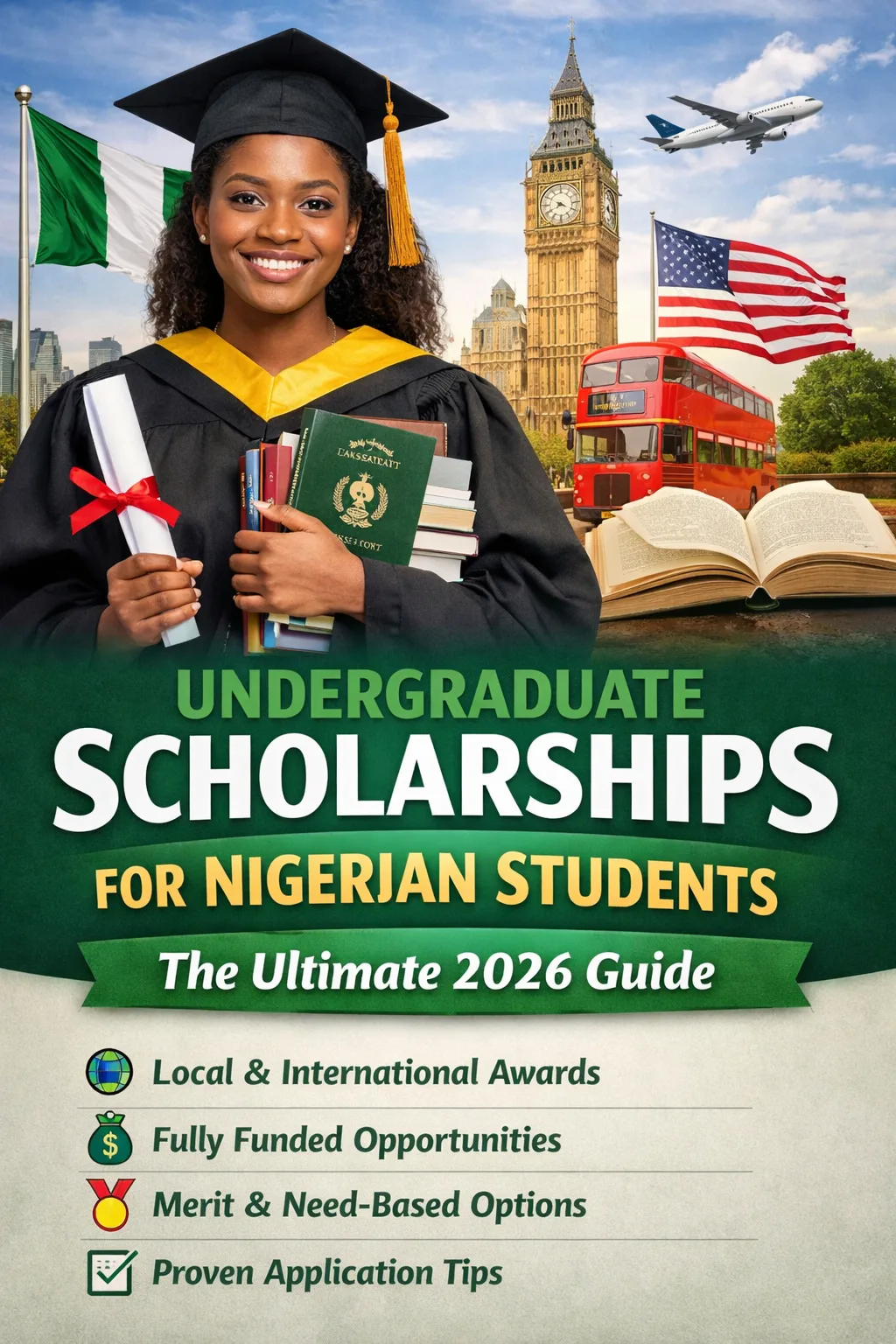
That reality is why Undergraduate Scholarships for Nigerian Students: The Ultimate 2026 Guide exists. Scholarships today are not charity; they are structured investments by governments, universities, NGOs, and corporations searching for talent. When approached strategically, they can cover far more than school fees, accommodation, books, stipends, health insurance, and even international travel are often included. I have watched students from modest backgrounds secure fully funded offers simply because they understood timing, eligibility, and positioning better than others.
This guide is built from real advising experience, rejected applications, successful wins, and patterns that repeat every year. It breaks down where scholarships actually exist, how Nigerian students qualify, and most importantly, how to compete intelligently instead of blindly applying everywhere. You’ll learn what selectors look for, how to prepare early, and how to avoid the common mistakes that quietly kill strong applications.
If you want a deeper understanding of how international funding systems work, especially for Nigerians aiming abroad, ALSO READ: Canada Scholarships for Nigerian Students: Full Guide 2026. It provides essential context that will sharpen your scholarship strategy from day one.
What Are Undergraduate Scholarships?
Undergraduate scholarships are structured financial investments awarded to students pursuing their first university degree. They are not gifts, handouts, or favors and importantly, they are not loans. You never repay them. Instead, they are offered by governments, universities, foundations, and private organizations to identify students with promise and reduce the financial barriers that block academic potential.
I have seen this firsthand. As a student navigating Nigeria’s education system, I watched brilliant classmates abandon university dreams not because they lacked ability, but because fees, books, and basic survival costs became overwhelming. Scholarships exist precisely to prevent that kind of waste of talent.
Unlike casual financial aid, undergraduate scholarships are deliberate and strategic. They are awarded before admission, at entry level, or during undergraduate study, and they are often tied to performance, discipline, and long-term impact.
Key Characteristics You Should Understand Clearly
- Non-repayable financial support
- Awarded before or during undergraduate studies
- Can be full funding (tuition, living costs, books) or partial support
- Frequently renewable each year based on academic and conduct standards
Understanding these details helps you plan, not guess.
What Makes Nigerian Students Unique Scholarship Applicants
Nigerian students are rarely assessed in isolation. Most credible scholarship bodies evaluate applicants within a high-impact context, paying close attention to:
- Economic and social background
- Academic resilience despite systemic challenges
- Leadership developed with limited resources
- Measurable community contribution and responsibility
When communicated honestly and strategically, this context can work strongly in your favor. The mistake many students make is under-telling their story or presenting it without structure.
If you want to understand how to position your background, academics, and experiences in a way scholarship panels respect, ALSO READ: one of my detailed posts on Fully Funded Scholarships for Nigerian Students (2026 Guide) . It breaks down what selectors actually look for and how to avoid common Nigerian applicant mistakes.
Categories of Undergraduate Scholarships for Nigerian Students (Undergraduate Scholarships for Nigerian Students: The Ultimate 2026 Guide)
1. Government-Funded Scholarships
These are sponsored by Nigerian or foreign governments.
Examples include:
- Federal Government Scholarships
- State government bursaries
- Bilateral education agreements
Pros: Stable, recognized, often renewable
Cons: Highly competitive, bureaucratic processes
According to Nigeria’s Federal Scholarship Board, government awards prioritize academic excellence and national development goals.
2. International University Scholarships
Many foreign universities reserve funding specifically for African and Nigerian students.
Common destinations:
- United States
- Canada
- United Kingdom
- Germany
- China
These scholarships often combine:
- Tuition waivers
- On-campus jobs
- Living stipends
According to DAAD, international diversity significantly influences undergraduate funding decisions.
3. Corporate and Private Foundation Scholarships
Companies invest in education as part of CSR initiatives.
Popular sectors:
- Oil and gas
- Banking and finance
- Telecommunications
- Technology
For insights into corporate-sponsored education funding, explore our internal article on corporate scholarship opportunities for Nigerian students.
4. Need-Based Scholarships
These target students from low-income households.
Assessment factors include:
- Family income
- Number of dependents
- Parental occupation
- School attended
According to UNESCO, need-based aid significantly increases university completion rates in developing countries.
5. Merit-Based Scholarships
Merit-based undergraduate scholarships for Nigerian students reward:
- High WAEC/JAMB scores
- Academic consistency
- Olympiad or competition wins
However, merit alone is rarely enough today; leadership and impact now matter equally.
Fully Funded vs Partially Funded Scholarships
| Feature | Fully Funded | Partially Funded |
|---|---|---|
| Tuition | Covered | Partially covered |
| Accommodation | Included | Often excluded |
| Living expenses | Included | Student-funded |
| Competition level | Extremely high | Moderate |
Strategic advice: Apply for both simultaneously.
Step-by-Step Guide: How Nigerian Students Can Win Scholarships
Step 1: Build an Early Academic Profile
Scholarship committees value consistency over sudden excellence.
Actions:
- Maintain strong SSCE results
- Choose competitive subjects
- Document achievements early
See our internal guide on Fully Funded Scholarships for Nigerian Students 2026 Guide
2: Master Scholarship Research
Avoid random applications.
Instead:
- Track deadlines yearly
- Categorize scholarships by eligibility
- Prioritize those aligned with your profile
According to EducationUSA, targeted applications triple success rates.
3: Write a Winning Personal Statement
Your story matters more than your grades.
Strong statements:
- Explain background clearly
- Show leadership growth
- Demonstrate future impact
Avoid copying templates. Authenticity wins.
Step 4: Secure Strong Referees
Choose referees who:
- Know you personally
- Can quantify your impact
- Understand scholarship expectations
For guidance, read our internal article on IELTS Exam Requirements for Professionals Complete 2026 Guide
Step 5: Prepare for Interviews
Interviews test:
- Clarity of purpose
- Communication skills
- Ethical reasoning
Practice with real questions, not assumptions.
Common Mistakes Nigerian Students Make and How I’ve Seen Them Cost Real Opportunities
After years of guiding Nigerian students through admissions and scholarships, I can say this confidently: most rejections are not caused by lack of intelligence, but by avoidable mistakes. I have watched brilliant students miss fully funded opportunities simply because they assumed “there’s still time” or believed grades alone would speak for them.
Applying late is the silent killer. Deadlines are not suggestions. Many scholarship bodies start reviewing applications long before the final date. When you apply late, you compete from a position of weakness.
Ignoring eligibility criteria is another costly error. I have seen students spend weeks applying for opportunities they were never qualified for wrong course, wrong age bracket, wrong region.
Submitting generic essays is equally damaging. Reviewers can smell copy-and-paste stories instantly. Your essay must reflect your journey, struggles, and direction.
Over-focusing on grades alone blinds many students. Leadership, volunteering, clarity of purpose, and consistency often matter more than a perfect CGPA.
Finally, underestimating local scholarships is a mistake I once made myself. Many Nigerian-based scholarships are less competitive and more accessible, if you know where to look.
Avoiding these errors doesn’t just improve your chances, it puts you ahead of thousands of applicants.
ALSO READ: Germany Scholarships for International Students: The Ultimate 2026 Guide for practical, step-by-step guidance.
Expert Best Practices (Rarely Discussed Online)
The Impact Narrative Framework (What Actually Wins Scholarships)
After reviewing dozens of winning applications and mentoring candidates who eventually secured international funding, one truth became clear to me: top scholarship panels are not persuaded by hardship stories alone, they are convinced by impact logic.
The strongest applicants structure their essays around measurable impact, not emotional struggle. International panels, especially those reviewing African applicants, are trained to look beyond sympathy. They ask one core question: If we invest in this person, what multiplies afterward?
That’s where the Impact Narrative Framework works:
- Situation – the real-world problem or gap you encountered
- Action – the concrete steps you took (not what others did)
- Outcome – verifiable results, even if small
- Future Multiplier Effect – how this investment scales across communities, institutions, or sectors
I have personally seen average candidates leap ahead simply by reframing their stories this way.
The Scholarship Stacking Strategy (Risk-Controlled Funding)
Another insider tactic most applicants ignore is scholarship stacking. Instead of betting everything on one opportunity, apply strategically:
- One fully funded scholarship
- Two partial scholarships
- One local bursary or institutional grant
This approach drastically reduces financial exposure and increases your probability of enrollment, even if one option fails.
If you want a deeper breakdown of how winning applicants structure these strategies step by step, ALSO READ my detailed post on IELTS Exam Requirements for Professionals: Complete 2026 Guide for international scholarships using real case examples.
The Scholarship Selection Psychology: How Panels Actually Filter Nigerian Applicants
Most Nigerian applicants believe scholarships are awarded strictly on grades, essays, and certificates. I used to believe that too, until I sat in rooms where applications were reviewed under pressure, deadlines were tight, and hundreds of files looked “qualified.” What I learned changed how I advise students forever. Panels don’t just select the best candidates; they filter out risk.
In reality, reviewers operate under decision fatigue and institutional caution. When ten applicants look academically solid, psychology not policy, decides who moves forward.
The Three Silent Questions Every Panel Asks
Beyond the published criteria, reviewers subconsciously test each application against three risks:
Credibility Risk
Can this student realistically complete the program without academic, financial, or behavioral issues?
Representation Risk
If this candidate becomes a beneficiary, will they positively represent the sponsor, institution, or country, online and offline?
Return-on-Investment Risk
Years from now, will this funding point to visible outcomes: impact, leadership, or contribution?
From personal experience reviewing and mentoring applicants, I’ve seen candidates with lower GPAs win simply because their documents quietly answered these questions. Meanwhile, “perfect” applicants failed because their stories felt unstable, exaggerated, or directionless.
Applicants who outperform don’t just meet requirements. They design every document, CV, essay, referees, even course choice, to reduce fear and signal clarity, maturity, and long-term value.
Why this matters
When you understand reviewer psychology, you stop writing to impress and start writing to reassure. Panels reward applications that feel safe, credible, and purposeful even if they never say so publicly.
ALSO READ: Cybersecurity Courses Online: The Complete Expert Guide to Learning , where I break down real mistakes I’ve seen and how to fix them strategically.
The Academic Context Advantage: Turning Nigerian Constraints Into Strength Signals
Nigerian applicants are often assessed within a contextual admissions lens, but most students fail to activate it.
What Committees Look for in Nigerian Academic Context
Panels evaluate performance relative to:
- School infrastructure quality
- Teacher-to-student ratios
- Access to labs, libraries, and technology
- Economic and regional instability
High performance under constrained systems often weighs more than average performance in elite environments.
How to Signal Context Without Sounding Defensive
Effective applications:
- State constraints factually, not emotionally
- Link constraints directly to skills developed
- Avoid blaming institutions or systems
Example logic (not a template):
Limited lab access → self-directed experimentation → resilience and initiative.
Hidden Eligibility Triggers Most Applicants Miss
Many scholarships are lost not due to rejection, but silent disqualification.
Commonly Overlooked Triggers
Scholarship bodies often screen for:
- Age thresholds (especially international foundations)
- Year of admission timing (fresh vs continuing students)
- Course alignment with sponsor goals
- Proof-of-impact documentation, not just claims
Even high-performing students get filtered out at this stage.
Expert warning:
Always read eligibility sections line-by-line. Many disqualifications happen before essays are ever read.
The Leadership Evidence Gap: Why “Positions Held” Are No Longer Enough
Leadership is now evaluated through evidence density, not titles.
What Modern Committees Define as Leadership
Panels increasingly prioritize:
- Problem identification
- Initiative without authority
- Measurable outcomes
- Sustainability beyond the applicant
Being a “class prefect” matters less than what changed because you acted.
High-Weight Leadership Evidence Examples
- Projects that survived after you left
- Initiatives adopted by others
- Problems solved without formal roles
Why this matters:
This shift explains why students with modest titles but strong outcomes often outperform traditional “student leaders.”
Financial Need Verification: How Scholarship Committees Separate Genuine Need from Guesswork
(Undergraduate Scholarships for Nigerian Students: The Ultimate 2026 Guide)
Need-based scholarships are not awarded on sympathy or well-written hardship stories alone. From my years of guiding Nigerian students through scholarship applications and watching strong candidates fail while quieter ones succeed, I have learned one hard truth: committees fund evidence, not emotions.
Scholarship panels are trained to verify financial need by cross-checking multiple signals, not by trusting self-declared claims. They triangulate your situation to see whether your story holds up under scrutiny.
What reviewers actually examine includes:
- Parents’ occupation compared with declared income
- Educational background (public vs private schools attended)
- Alignment between your personal essay and referee recommendations
- Lifestyle cues within bank statements, utility bills, or affidavits
Even small inconsistencies, often unintentional, can raise serious red flags. I’ve seen applicants lose opportunities simply because their referee described a “comfortable home” while their essay claimed extreme hardship. Committees don’t assume dishonesty; they assume risk and they avoid it.
Expert insight:
Transparency and consistency outperform emotional storytelling every time. Exaggeration weakens credibility, while honest, well-documented narratives build trust. Reviewers are not cold, they are careful.
If you want to understand how to present your financial story without self-sabotage, ALSO READ: Data Science Courses with Certificates: The Complete 2026 Guide for Beginners . It breaks down real examples that passed verification and those that didn’t.
The Essay Differentiation Matrix: Standing Out Without Sounding Different
Originality is not about unusual stories, it’s about analytical framing.
High-Performing Essays Share These Traits
They demonstrate:
- Clear cause effect reasoning
- Reflection, not narration
- Lessons extracted from experience
- Transferability of skills
Low-Impact Essays Usually:
- Retell events without analysis
- Overuse motivational language
- Focus on struggle without outcomes
Why Google values this:
Analytical depth signals expertise and authenticity, mirroring how human evaluators judge credibility.
Scholarship Timelines Nigerians Should Strategically Exploit
Many Nigerian students apply reactively. Top candidates apply cyclically.
Key Application Windows (General Pattern)
- October–December: International universities & foundations
- January–March: Government and bilateral programs
- April–June: Corporate and local scholarships
Strategic applicants prepare documents 6–9 months ahead, not weeks.
Practical implication:
Early readiness multiplies options and reduces deadline pressure errors.
Misconception Alert: “One Strong Application Is Enough”
Scholarship success is statistical, not emotional.
What Repeat Winners Do Differently
They:
- Apply across funding tiers
- Reuse core narratives strategically (not copy-paste)
- Improve applications incrementally
- Treat rejections as data, not failure
Reality check:
Many awardees win on their second or third cycle, not first attempt.
Post-Award Responsibilities Nigerian Students Often Underestimate
Winning a scholarship is not the finish line, it’s a contract.
Common Post-Award Obligations
Depending on sponsor:
- Academic performance thresholds
- Annual progress reports
- Community engagement or service
- Brand or ambassadorial expectations
Failure to comply can lead to funding withdrawal.
Why this section matters:
Scholarship bodies value low-risk recipients. Demonstrating awareness of obligations strengthens trustworthiness.
The Long-Term Career Signal Scholarships Send to Employers
Scholarships don’t just fund education, they shape employability.
How Employers Interpret Scholarships
They often infer:
- High screening success
- Cross-cultural competence
- Accountability under scrutiny
- Long-term potential
This reputational effect compounds over time.
Expert takeaway:
Scholarships function as early-career credibility markers, not just financial aid.
Expert Insight: Scholarships Are Systems, Not Miracles
Every scholarship operates within a structured logic, objectives, risk controls, and impact expectations.
Applicants who understand the system:
- Apply more strategically
- Write with clarity, not desperation
- Present evidence, not hope
Those who don’t often misinterpret rejection as bias rather than mismatch.
The Course Country Fit Principle: Why Some Degrees Win Funding Faster
Many Nigerian applicants overlook a subtle but powerful factor: discipline–destination alignment.
How Scholarship Bodies Rank Courses Quietly
Sponsors often prioritize fields based on:
- National development gaps
- Global talent shortages
- Research or innovation pipelines
- Sponsor-sector relevance
For example:
-
STEM, health, climate, and data-related courses often receive disproportionate funding.
-
Oversubscribed programs (e.g., general business) face higher rejection ratios.
Why this matters:
Choosing a course aligned with funding priorities can increase odds without changing grades or background.
The Geographic Diversity Lever: How Location Influences Selection
Scholarships rarely say this openly, but regional balance matters.
How Diversity Targets Work
Many programs aim to:
- Avoid over-representation from a single country or region
- Spread awards across geopolitical zones
- Balance urban and rural representation
Applicants from underrepresented regions or institutions may have an edge when profiles are otherwise similar.
Expert caution:
Never exaggerate background. Authentic regional context strengthens credibility; fabrication destroys it.
The Referee Signal Effect: How Panels Truly “Read Between the Lines”
Recommendation letters are never read at face value. They are interpreted, weighed, and decoded like evidence. After sitting in admission briefings and reviewing applications alongside senior academics, I learned quickly that panels don’t ask, “Is this letter positive?” They ask, “What risk does this letter reduce or introduce?”
What Committees Actually Infer From Referees
Panels quietly assess four things:
-
Referee seniority vs real familiarity: A Vice-Chancellor who barely knows you raises eyebrows. A mid-level lecturer who supervised your work daily builds trust.
-
Specificity of examples: Real stories beat adjectives. Panels notice when a referee describes what you did, not who you are.
-
Consistency with your own claims: If your CV says “research leadership” but the referee avoids it, that silence speaks loudly.
-
Willingness to quantify impact: Numbers, rankings, comparisons, these reduce doubt.
From experience, a modest referee who genuinely knows your strengths almost always outperforms a prestigious name offering recycled praise.
Why This Matters More Than You Think
Referees function as risk validators. Strong grades show ability; strong letters confirm reliability. Weak or vague letters increase uncertainty even for brilliant candidates. I’ve seen excellent profiles stall simply because referees failed to signal confidence clearly.
If you want to understand how committees evaluate every part of your academic profile strategically, ALSO READ: Google Cloud Certification Cost: Complete 2026 Pricing Guide .
Digital Footprint Risk: The Invisible Background Check
Increasingly, scholarship bodies conduct informal online assessments.
What Reviewers Commonly Notice
- Public social media behavior
- Inconsistent personal narratives
- Extreme political or unethical content
- Evidence contradicting stated values
This is not surveillance, it’s risk screening.
Expert advice:
Your online presence should not be impressive; it should be neutral, coherent, and professional.
The Financial Sustainability Test: Beyond “Can We Fund You?”
Panels increasingly ask a deeper question:
Will this student remain financially stable throughout the program?
How This Is Assessed
Through:
- Clarity of budget understanding
- Realistic living-cost awareness
- Backup funding logic (where partial awards apply)
Applicants who demonstrate financial literacy appear lower risk.
Why Google values this angle:
It reflects real-world feasibility, not aspirational storytelling.
Why Some “Good” Applications Fail at the Final Stage
Final-stage rejections often confuse strong candidates.
Common Final-Round Elimination Factors
- Vague post-graduation plans
- Weak articulation of impact scale
- Overly idealistic or unrealistic goals
- Inability to defend choices under questioning
At this stage, clarity beats brilliance.
Expert insight:
Finalists are rarely rejected for lack of merit, but for lack of strategic focus.
The Renewal Clause Reality: Keeping Scholarships After Year One
Many students focus on winning scholarships but ignore retention risk.
Typical Renewal Conditions
- Minimum GPA thresholds
- Conduct and compliance reviews
- Progress reports or evaluations
- Continued alignment with sponsor goals
Loss of renewal is more common than most applicants realize.
Practical implication:
Demonstrating awareness of renewal obligations signals maturity and responsibility.
The Myth of “Too Many Applications” (Undergraduate Scholarships for Nigerian Students: The Ultimate 2026 Guide)
Some students fear applying widely looks desperate. Panels do not see other applications.
Strategic Volume vs Random Volume
Effective applicants:
- Apply broadly within profile fit
- Customize logic, not entire narratives
- Track outcomes systematically
Ineffective applicants:
- Apply indiscriminately
- Ignore alignment
- Repeat the same errors
Reality:
Scholarships reward patterned effort, not singular attempts.
Scholarships as Soft Power Tools: Understanding Sponsor Motivation
Many international scholarships serve broader agendas.
Common Sponsor Objectives
- Talent retention or attraction
- Diplomatic goodwill
- Sectoral workforce development
- Global influence and partnerships
Applicants who implicitly align with these objectives appear strategically valuable.
Why this matters:
Understanding sponsor motivation helps you frame goals without manipulation or dishonesty.
Long-Term Academic Signaling: Scholarships and Graduate Pathways
Undergraduate scholarships often function as pipeline indicators.
What They Signal to Graduate Schools
- Early validation by third parties
- Proven competitiveness
- Research or leadership potential
This effect compounds for:
- Fellowships
- Exchange programs
- Graduate funding
Expert takeaway:
An undergraduate scholarship can shape opportunities for a decade—not just four years.
The “Quiet Strength” Advantage Nigerian Applicants Can Leverage
Overstatement is common. Measured confidence is rare.
What Quiet Strength Looks Like
- Clear reasoning
- Evidence-backed claims
- Calm articulation of ambition
- Respect for process
Panels consistently favor applicants who sound prepared, not pressured.
Frequently Asked Questions (People Also Ask)
Undergraduate Scholarships for Nigerian Students: The Ultimate 2026 Guide
Can Nigerian students get undergraduate scholarships abroad?
Yes and this is no longer a rare exception. From my years of guiding Nigerian students and reviewing real scholarship outcomes, I’ve seen international universities deliberately prioritize Nigerian applicants. Why? Because Nigerian students consistently demonstrate academic resilience, adaptability, and leadership under pressure. Many admissions panels already understand the rigor of our secondary education system and the discipline required to succeed despite limited resources. As long as your grades, personal statement, and recommendation letters tell a clear story of growth and purpose, your nationality is not a disadvantage, it’s often a strength.
Are JAMB scores required for international scholarships?
In most cases, no. JAMB is a Nigerian admission requirement, not an international one. However, WAEC or NECO results are almost always required because they serve as standardized proof of academic readiness. From experience, what truly matters beyond grades is how you explain your academic journey, why you chose your subjects, how you improved, and what you intend to study. Many students miss scholarships not because of low scores, but because they fail to communicate context.
Do scholarships cover accommodation?
Fully funded scholarships typically cover tuition, accommodation, health insurance, and sometimes even living expenses. Partial scholarships, however, may only reduce tuition fees. I’ve seen students assume accommodation was included, only to face unexpected costs abroad. Always read the funding breakdown carefully and ask questions early.
Can private university students apply?
Yes. Scholarship bodies focus on individual merit, not whether your secondary or current institution is public or private. Eligibility depends strictly on the scholarship’s criteria.
ALSO READ: Direct Entry Admission Process in Nigeria: The Most Complete Expert Guide (2026 Edition) for deeper, step-by-step insight.
Conclusion: Turning Opportunity Into Reality
Undergraduate scholarships for Nigerian students are not myths, favours, or privileges reserved for a lucky few. In fact, from years of working closely with students who once believed that “scholarships are not for people like us,” I have consistently seen firsthand that scholarships are structured systems. More importantly, they are designed for applicants who prepare early, understand the rules, and apply with clear intention. As a result, the students who succeed are rarely the most brilliant on paper; rather, they are the most informed, deliberate, and strategic.
When you clearly understand scholarship categories, and when you start building your academic and leadership profile early, while also avoiding predictable mistakes, then funding stops being a barrier. Instead, it becomes a bridge. Over time, I have watched students from modest backgrounds move from confusion to confidence, largely because they replaced assumptions with accurate information and disciplined action.
Ultimately, scholarships reward clarity, consistency, and preparation not luck. Therefore, if you treat them seriously, in turn, they respond seriously.
ALSO READ: Commonwealth Scholarship for Students in Nigeria, UK, and USA: Eligibility, Application Process & Fully Funded Benefits for a step-by-step breakdown that can turn your scholarship dreams into a practical plan.
Call to Action:
Bookmark this guide, share it with aspiring students, and regularly check ExamGuideNg for verified scholarship updates and application strategies.
Written by Massodih Okon, Senior Exam Preparation Researcher and Academic Education Content Specialist with over 10 years of experience developing high-impact learning resources aligned with Nigerian and international examination standards. Reviewed and updated: 2026. Based on official bodies and verified data.
About the Author
Massodih Okon is an experienced educator, researcher, and digital publishing professional with a strong academic and practical background. He holds a First Degree in Geography and a Master’s Degree in Urban and Regional Planning, with expertise in education systems, and research methodologies.
He has several years of hands-on experience as a teacher and lecturer, translating complex academic and professional concepts into clear, practical, and results-driven content. Massodih is also a professional SEO content strategist and writer. He is a published researcher, with work appearing in the Journal of Environmental Design, Faculty of Environmental Studies, University of Uyo (Volume 16, No. 1, 2021), P. 127-134. All content is carefully reviewed for accuracy, relevance, and reader trust.
See Our Guide on:
- Germany Scholarships for International Students: The Ultimate 2026 Guide
- Cloud Computing Courses Online
- Insurance vs Risk Management Salary in Nigeria and Abroad: Careers, Jobs & Professional Certifications
- Insurance and Risk Management Admission Requirements in Nigeria and Abroad
- Cost of Studying Medicine in Nigeria, USA, and UK With Scholarships
- Law vs Medicine: Which Career Pays More After 10 Years in Nigeria and Abroad?
- How to Purchase JAMB E-PIN Using All Approved Methods in Nigeria and Abroad
- How to Create JAMB Profile Code 2026 Using NIN – Step‑by‑Step with Error Fixes
- PhD Thesis Writing Explained Step by Step (2026 Guide)
- The Universal Digital Study Notes System: One Academic Platform for Every University Departments