
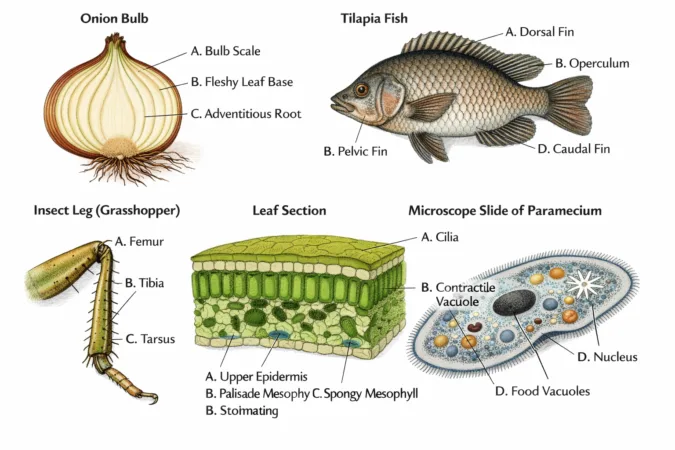
WAEC Biology Practical Marking Scheme 2026: How Examiners Award Marks And How to Score Higher
By Massodih Okon | Updated March 2026
What This Guide Is About
If you are preparing for the WAEC Biology practical exam, one question matters more than almost anything else: how does the examiner decide how many marks your answer deserves?
Most students study hard. They memorize specimens, revise past questions, and practice diagrams. But on the day, they still lose marks they should have kept. Why? Because they never studied the marking scheme the actual logic examiners use.
This guide breaks down that logic clearly. By the end, you will know exactly what earns marks in each section, what language examiners reward, and what common mistakes to avoid. Also read our JAMB Biology Topic Repetition Index (2016–2025): Evidence-Driven Exam Trend Report
What Is the WAEC Biology Practical Exam?
The Biology Practical is not simply a test of how much Biology you know. It is a test of how well you think and communicate like a scientist.
Two candidates can read the same textbook, attend the same classes, and memorize the same facts, yet one scores A1 while the other struggles to pass. The difference is almost always how they present their answers, not what they know.
WAEC’s examiners are looking for evidence of scientific thinking: accurate observation, structured reasoning, and correct use of terminology. Keep that in mind throughout your preparation. Read also our JAMB Chemistry Topic Repetition Index (2016–2025): Data-Driven Exam Trend Analysis
Exam Structure and Mark Allocation
The Biology Practical carries a total of 70 marks, divided across three sections:
| Section | Component | Marks | What Examiners Focus On |
| A | Specimen Identification | 20 | Accuracy of observation |
| B | Biological Drawing | 25 | Scientific diagram quality |
| C | Experimental Analysis | 25 | Reasoning and conclusions |
| Total | 70 | Converted to your WAEC Biology grade |
Your raw score out of 70 is converted by WAEC into a final Biology grade using their standardized scaling. This means strong practical performance can genuinely push your grade up or protect it when your theory result is average.
Section A: Specimen Identification (20 Marks)
This section tests your ability to look at a specimen and accurately describe what you see — not what you assume or remember from a textbook.
| Task | Marks |
| Correct specimen name | 2 |
| Classification | 3 |
| Observable features | 5 |
| Functional explanation | 5 |
| Diagram labeling | 5 |
| Total | 20 |
Where most marks are lost: Candidates usually get the name right but lose marks on observable features. This happens when they write what they expect to see instead of what is actually in front of them. Observe first. Write second.
The word ‘observable’ is important here. Your description must be based on the actual specimen before you, not general Biology knowledge. If the examiner asks you to state two features of a specimen, name two things you can physically see colour, texture, shape, size, arrangement.
Section B: Biological Drawing (25 Marks)
This is the highest-scoring section of the entire exam, and it is also the one most students underestimate.
Biological drawing is not about artistic talent. It is about scientific accuracy. Examiners use your diagram as visual proof that you actually observed the specimen not just guessed at it.
| Criteria | Marks |
| Size | 5 |
| Accuracy | 5 |
| Labeling | 5 |
| Neatness | 5 |
| Proportion | 5 |
| Total | 25 |
Three things directly affect your score in this section:
- Draw large. A bigger diagram lets you show more detail, and more detail earns more marks. Diagrams that take up at least half a page consistently score better.
- Draw with confident, continuous lines. Broken or sketchy lines suggest uncertainty. Examiners notice.
- Label every visible structure. Do not leave anything unlabeled even if you are unsure of the name, a reasonable attempt is better than nothing.
Partial credit exists in this section. Even if your classification is wrong, you can still earn labeling marks. Even if your diagram is not perfect, accurate proportions will earn marks.
Section C: Experimental Analysis (25 Marks)
This section evaluates how well you can think through an experiment from observation all the way to drawing a conclusion.
| Component | Marks |
| Observation | 5 |
| Recording | 5 |
| Interpretation | 5 |
| Conclusion | 5 |
| Accuracy | 5 |
| Total | 25 |
The most common mistake in Section C is jumping straight to a conclusion without properly recording observations first. Examiners award marks for each step independently so even if your conclusion is weak, you can still earn observation and recording marks.
Write your observations before your interpretation. Write your interpretation before your conclusion. A structured, step-by-step answer always scores higher than a rushed summary.
How Examiners Actually Think
Understanding examiner psychology is one of the most underrated preparation strategies. Examiners are not looking to catch you out. They are looking for evidence that you have genuinely done the work.
When reading your script, every examiner is silently asking three questions:
1. Is this candidate actually observing, or guessing?
Examiners can tell the difference immediately. Compare these two answers:
| Type | Example Answer |
| Weak | “The specimen has many parts.” |
| Strong | “The specimen has a segmented body with clearly visible joint lines separating each section.” |
The strong answer describes something specific and visible. The weak answer could apply to almost anything.
2. Is this candidate thinking scientifically?
Scientific thinking shows up through logical sequence, accurate terminology, and consistent reasoning. You do not have to be completely right to earn marks but you do need to show a structured thought process.
| Type | Example Answer |
| Weak | “The leaf loses water.” |
| Strong | “The leaf loses water through transpiration via the stomatal openings on the lower epidermis.” |
3. Is this answer easy to mark?
Examiners mark hundreds of scripts in a sitting. Scripts that are clear, organized, and well-spaced receive more focused attention. This is not about fairness it is about reality. Clear handwriting, proper spacing, and a logical answer flow reduce the effort required to find marks in your script.

The Power of Scientific Language
WAEC marking schemes include keyword triggers, specific terms that unlock marks. When you use the right terminology correctly, the examiner can award marks quickly and confidently.
Here are the main categories of high-value terminology:
- Structural terms: epidermis, cortex, vascular bundle, stomata, mesophyll
- Functional terms: transpiration, respiration, photosynthesis, osmosis, diffusion
- Classification terms: arthropod, vertebrate, monocotyledon, dicotyledon, angiosperm
Terminology only helps when used correctly. Incorrect use of a term for example, writing ‘osmosis’ when you mean ‘diffusion’ reduces examiner confidence and can cost you marks rather than earn them.
Levels of Observation
High-scoring candidates do not just describe what a specimen looks like on the surface. They describe what they see at different levels of depth.
| Level | What It Covers | Example |
| Level 1 | Surface observation | Colour, overall shape, texture |
| Level 2 | Structural observation | Segmentation, attachment points, number of parts |
| Level 3 | Functional interpretation | “The structure enables locomotion” or “The leaf shape maximizes light absorption” |
Most candidates stop at Level 1. Examiners reward Levels 2 and 3 significantly more because they show genuine biological understanding, not just surface description.
Common Mistakes That Cost Marks
| Mistake | Why It Loses Marks |
| Drawing small diagrams | Fewer visible features, less opportunity to earn labeling marks |
| Vague observation language | Fails to trigger keyword marks and signals guessing |
| Skipping experimental steps | Loses marks in recording and interpretation even if the conclusion is correct |
| Incorrect terminology | Undermines examiner confidence in the whole answer |
| Messy or cramped layout | Makes it harder for the examiner to find and award marks |
A Practical Study Plan for A1
| Step | What to Do |
| 1 | Study each common specimen in detail — know its observable features, classification, and function |
| 2 | Practice biological drawing every day. Focus on size, proportion, and clean labeling |
| 3 | Learn classification patterns and how to group organisms scientifically |
| 4 | Build your scientific vocabulary learn and correctly use key terminology |
| 5 | Solve past WAEC Biology Practical questions under timed conditions |
Consistency matters more than intensity. Thirty minutes of focused practical preparation every day for six weeks will produce better results than cramming in the final days before the exam.
Grade Conversion Reference
| Practical Score (out of 70) | Likely Grade Impact |
| 65 – 70 | A1 |
| 60 – 64 | B2 |
| 55 – 59 | B3 |
| 50 – 54 | C4 |
Note: These ranges are indicative. Final grade boundaries are set by WAEC each year and may vary slightly. Always verify with the official WAEC website at www.waecnigeria.org.
Frequently Asked Questions
How many marks is the WAEC Biology Practical?
The practical carries 70 marks in total, split across Sections A, B, and C.
Is biological drawing compulsory?
Yes. Drawing is mandatory and accounts for 25 of the 70 available marks. Skipping it is not an option if you want a strong grade.
Can a weak practical result affect my overall Biology grade?
Yes, significantly. The practical contributes enough to your total Biology score that a weak result can pull your final grade from a distinction down to a credit or below. Treat it as seriously as your theory paper.
Can I still earn marks if my answer is partially wrong?
Yes. WAEC uses a partial credit system. You can earn marks for correct observations even if your conclusion is incomplete, and for accurate diagram labeling even if your classification is wrong. Never leave a section blank.
Final Word
The WAEC Biology Practical is fair it rewards candidates who prepare smartly and present their knowledge clearly. The marking scheme is not a mystery. It is a guide that tells you exactly what earns marks.
Use this guide during your preparation. Practice with it in hand. And when you sit the exam, remember: observe carefully, write clearly, draw large, and always use scientific language.
Good luck. You’ve got this.
Authority References
- West African Examinations Council (WAEC)
- British Council
- Cambridge Assessment International Education
- International Baccalaureate
About the Author
Massodih Okon is the founder of ExamGuideNG.com. He holds a First Degree in Geography and Natural Resources Management and a Master’s Degree in Urban and Regional Planning. He has several years of experience in educational research and academic writing, and his published work includes research in the Journal of Environmental Design (University of Uyo, 2021).
RELATED POST
- How to Score 300+ in JAMB: Proven Nigerian, US, UK & Global Strategies
- JAMB Marking Scheme Explained for 2026 Candidates
- JAMB Chemistry Topic Repetition Index (2016–2025): Data-Driven Exam Trend Analysis
- JAMB Syllabus Explained Subject by Subject (2026 Complete Guide)
- JAMB Literature Summary Notes: The Ultimate Master Guide for 2026 Candidates