
Introduction: Why Many Students Fail WAEC Economics and How You Can Pass with Confidence
Every year, thousands of candidates sit for WAEC Economics with high hopes, yet a shocking number still record low scores. The truth is blunt: most students don’t fail because Economics is difficult, they fail because they prepare the wrong way. If you’re searching for a WAEC Economics Study Guide for Easy Revision, that alone tells me you’re already thinking smarter than the average candidate.
WAEC Economics is not a memory contest. It rewards clear understanding, logical thinking, and the ability to apply concepts to real-life situations, exactly the way WAEC examiners design their questions. Sadly, many students waste precious time reading bulky textbooks from cover to cover, memorising definitions they don’t understand, ignoring examiner reports, and treating past questions as optional. That approach almost always leads to confusion in the exam hall.
If you want to break out of this cycle, you must study strategically, not blindly. To deepen your understanding, I strongly recommend reading my related post on Common WAEC Economics Mistakes Students Make (And How to Avoid Them), as well as my detailed guide on How to Use WAEC Past Questions to Score A1 in Economics. Those insights will completely change how you revise and how you perform on exam day.
This guide solves that problem.
In this WAEC Economics Study Guide for Easy Revision, you will find:
- Clear explanations of every WAEC Economics topic
- Simple examples you can remember in the exam hall
- Step-by-step revision strategies
- Common WAEC mistakes and how to avoid them
- Examiner-tested tips that boost your score
Whether you are a beginner, intermediate learner, or final-stage revision candidate, this guide is designed to help you revise faster, understand better, and score higher.
What Is WAEC Economics? (WAEC Economics Study Guide for Easy Revision)
WAEC Economics is a social science subject that studies how individuals, businesses, and governments make choices about scarce resources to satisfy unlimited wants.
Why WAEC Economics Matters
WAEC Economics:
Tests your understanding of real-life economic issues
Builds analytical and decision-making skills
Is required for courses like Economics, Accounting, Banking, Business Administration, and Political Science
Structure of WAEC Economics Examination
| Paper | Description |
| Paper 1 | Objective (Multiple Choice Questions) |
| Paper 2 | Essay and Structured Questions |
To succeed, you must master definitions, diagrams, calculations, and explanations.
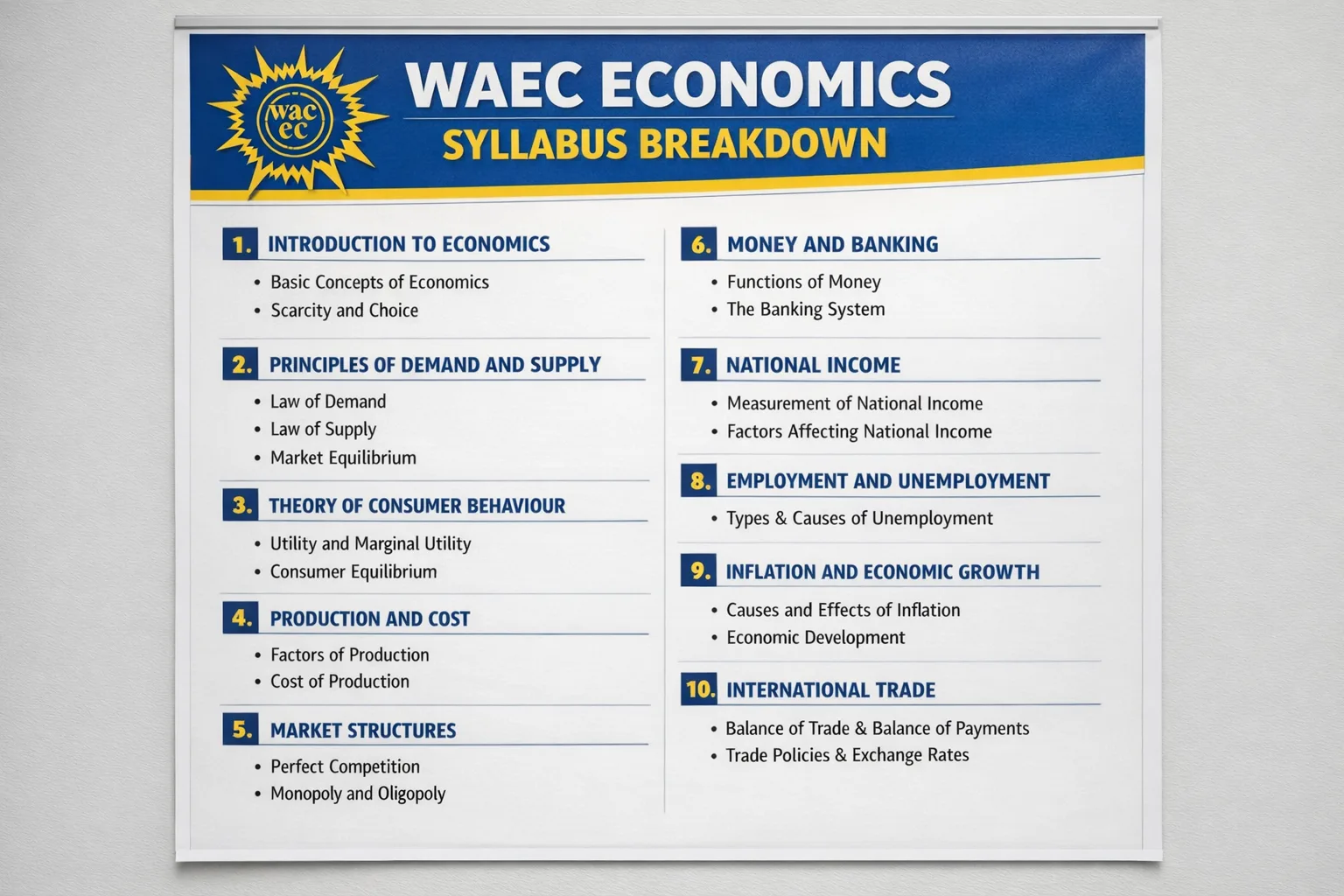
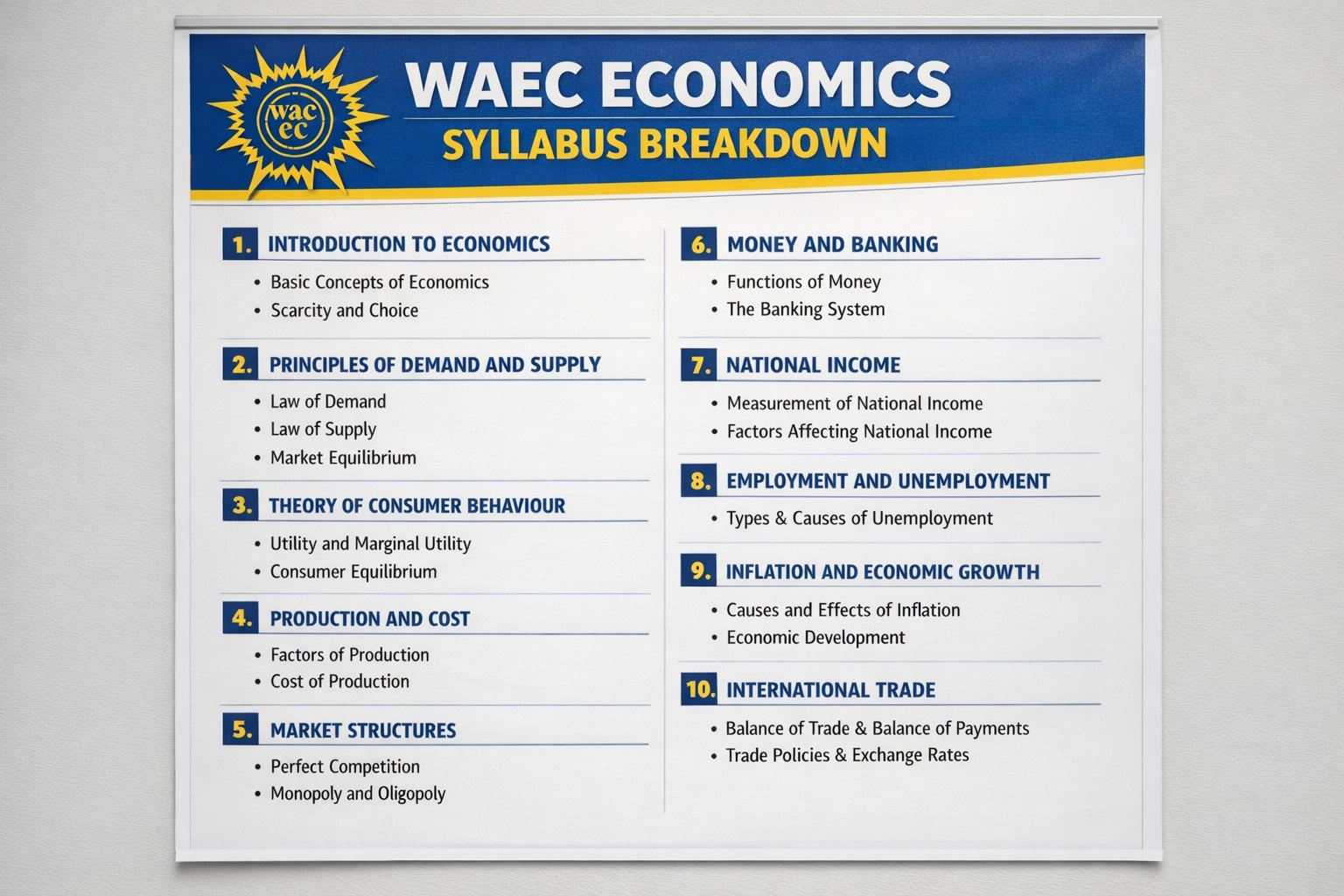
WAEC Economics Syllabus Overview (What You Must Cover)
Understanding the syllabus is the foundation of effective revision. WAEC sets questions strictly from approved topics.
Major Areas in WAEC Economics Syllabus
1. Basic Economic Concepts
2. Economic Systems
3. Production
4. Theory of Demand and Supply
5. Price Determination
6. Elasticity
7. Theory of Consumer Behavior
8. Theory of Production and Costs
9. Market Structures
10. National Income
11. Money and Inflation
12. Public Finance
13. Economic Growth and Development
14. International Trade
15. Economic Problems of West African Countries
This study guide explains each topic in a revision-friendly format.
WAEC Economics Syllabus Overview (What You Must Cover)
| S/N | Syllabus Area | What WAEC Expects You to Understand |
|---|---|---|
| 1 | Basic Economic Concepts | Scarcity, choice, opportunity cost, scale of preference |
| 2 | Economic Systems | Capitalism, socialism, mixed economy, traditional system |
| 3 | Production | Factors of production, division of labour, productivity |
| 4 | Theory of Demand and Supply | Demand and supply curves, laws, exceptions |
| 5 | Price Determination | How prices are fixed under different market conditions |
| 6 | Elasticity | Price, income, and cross elasticity of demand |
| 7 | Theory of Consumer Behaviour | Utility, marginal utility, consumer equilibrium |
| 8 | Theory of Production and Costs | Short-run and long-run production, cost concepts |
| 9 | Market Structures | Perfect competition, monopoly, oligopoly, monopolistic competition |
| 10 | National Income | GDP, GNP, methods of calculating national income |
| 11 | Money and Inflation | Functions of money, inflation causes and effects |
| 12 | Public Finance | Taxation, government revenue and expenditure |
| 13 | Economic Growth and Development | Growth vs development, indicators, challenges |
| 14 | International Trade | Balance of trade, balance of payments, trade barriers |
| 15 | Economic Problems of West African Countries | Poverty, unemployment, inflation, underdevelopment |
Why this matters:
WAEC Economics questions are drawn directly from these areas. Once you master them, you’re no longer guessing you’re revising with purpose.
For deeper understanding and exam-winning strategies, read my related post on How WAEC Sets Economics Questions and How to Answer Them Correctly for more insight.
This guide explains each topic in a revision-friendly and WAEC-aligned format, making your study faster, smarter, and more effective.
Basic Economic Concepts (Foundation for Easy Revision)
Scarcity
Scarcity means resources are limited while human wants are unlimited.
WAEC Guide: Always link scarcity to choice and opportunity cost.
Choice
Choice is the selection among alternatives due to scarcity.
Opportunity Cost
Opportunity cost is the next best alternative forgone.
Example:
If a student chooses Economics instead of Commerce, the opportunity cost is Commerce.
Scale of Preference
A scale of preference is a list of wants arranged in order of importance.
Economic Systems Explained Simply (WAEC Economics Study Guide for Easy Revision)
Types of Economic Systems
- Capitalist Economy
- Socialist Economy
- Mixed Economy
- Traditional Economy
| System | Ownership | Example |
| Capitalist | Private | USA |
| Socialist | Government | Cuba |
| Mixed | Both | Nigeria |
| Traditional | Custom | Rural communities |
Examiner Guide: Always state features, advantages, and disadvantages.
Production: A High-Scoring Topic in WAEC Economics (WAEC Economics Study Guide for Easy Revision)
Factors of Production
1. Land
2. Labour
3. Capital
4. Entrepreneur
Division of Labour
Division of labour means splitting production into different stages.
Advantages
Increased productivity
Specialization
Time-saving
Disadvantages
Monotony
Overdependence
Risk of unemployment
Theory of Demand (WAEC Favourite Topic)
Meaning of Demand
Demand is the willingness and ability to buy a commodity at a given price and time.
Law of Demand
As price falls, quantity demanded increases, and vice versa.
Factors Affecting Demand
Price of the commodity
Income of consumers
Price of substitutes
Population
Diagram Guide: Always label axes correctly in the exam.
Theory of Supply Made Easy :WAEC Economics Study Guide for Fast, Confident Revision
Meaning of Supply
Supply refers to the quantity of goods and services that producers are both willing and able to offer for sale at different prices over a given period.
This definition is important for WAEC because supply is not about desire alone. A poultry farmer may want to sell 1,000 crates of eggs, but if he can only produce 400, his effective supply is 400, not his intention.
In real life, Nigerian traders think this way daily. A garri seller in Aba or Akure checks the market price before deciding how many bags to bring out. If prices are too low, she withholds supply to avoid losses. That decision is supply in action.
Law of Supply
The law of supply states that as the price of a commodity rises, the quantity supplied increases, while a fall in price leads to a decrease in quantity supplied, all other factors remaining constant.
For example, when the price of tomatoes rises sharply in Lagos during the dry season, farmers in the North rush more tomatoes to the market to maximize profit. When prices crash due to oversupply, many farmers reduce production or allow produce to spoil rather than sell at a loss.
WAEC examiners love this law because it explains producer behavior clearly and logically.
Factors Affecting Supply (With Real-Life Insight)
| Factor | Explanation | Real-Life Nigerian Example |
|---|---|---|
| Cost of Production | When production costs rise, supply falls; when costs fall, supply increases | Increase in fuel price raises transport costs, reducing supply of food items |
| Technology | Improved technology increases output and supply | Mechanized farming increases rice supply in Kebbi State |
| Government Policy | Taxes reduce supply; subsidies increase supply | Removal of fertilizer subsidy reduces farm output |
Why This Topic Matters for WAEC
Supply questions often appear as definitions, theory explanations, objectives, and essays. If you understand the logic behind producer decisions, not just the definition, you’ll answer confidently under exam pressure.
Master supply, and you’ve already won half of microeconomics.
Price Determination (Interaction of Demand and Supply)
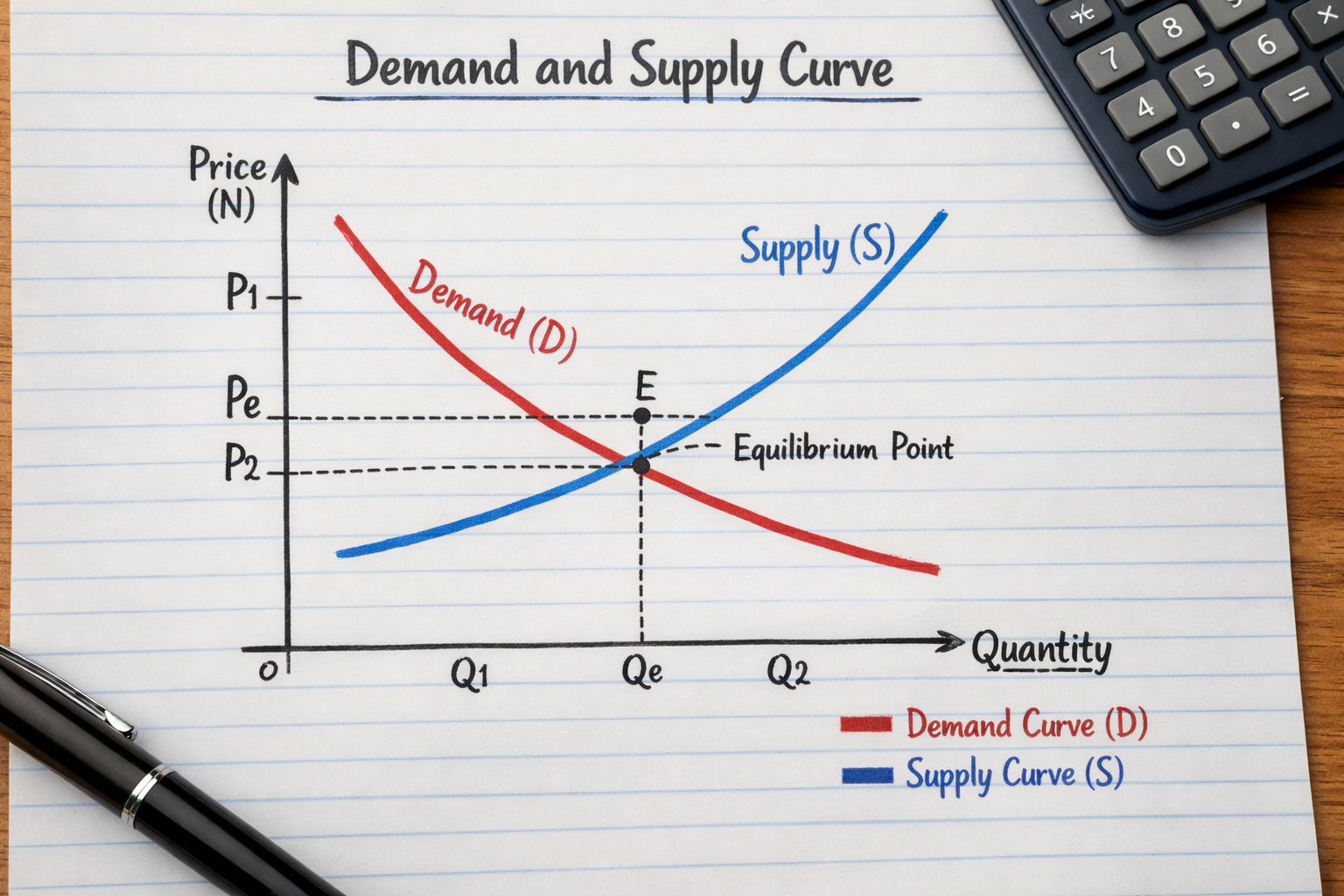
Price is determined at the point where quantity demanded equals quantity supplied, known as the equilibrium price. This is not just a theory, it plays out daily in real markets. Think of what happens in a Nigerian food market when a new harvest of tomatoes arrives. When tomatoes are scarce, buyers compete, prices rise, and sellers take advantage. But once supply increases and every buyer can easily get tomatoes, sellers are forced to reduce prices to avoid losses.
When demand is higher than supply, excess demand occurs. This situation pushes prices upward because consumers are willing to pay more to secure the limited goods. On the other hand, when supply exceeds demand, excess supply occurs. Sellers then reduce prices to attract buyers, prevent spoilage, and clear their stock.
The market continues to adjust through price changes until equilibrium is reached. At the equilibrium price, there is no pressure for price to rise or fall because buyers and sellers are satisfied. This automatic adjustment explains why government price controls often fail, markets naturally seek balance.
For WAEC, students must clearly explain excess demand, excess supply, and equilibrium price, using diagrams or examples where possible.
WAEC-Focused Summary Table: Price Determination
| Concept | Meaning | What Happens to Price | Real-Life Example |
|---|---|---|---|
| Excess Demand | Quantity demanded is greater than quantity supplied | Price rises | Few bags of rice in the market before festive season |
| Excess Supply | Quantity supplied is greater than quantity demanded | Price falls | Overproduction of tomatoes during peak harvest |
| Equilibrium Price | Quantity demanded equals quantity supplied | Price remains stable | Normal market day with balanced buyers and sellers |
WAEC Exam Tip
Always link price changes to market forces and support your explanation with simple examples. Examiners reward answers that show practical understanding, not just definitions.
Elasticity: A High-Yield Topic Smart Students Don’t Joke With
Elasticity is one of those economics topics that separates average students from high-scoring students. In WAEC, NECO, and JAMB essays, examiners don’t just want definitions, they want calculation, interpretation, and real-life application. Over the years, I’ve noticed that students who master elasticity often secure full marks even when their calculations are not perfectly neat, simply because they interpret their answers correctly.
Elasticity measures how responsive demand is to changes in price, income, or the price of related goods. For example, when fuel prices rise in Nigeria, transport fares increase immediately, but demand does not fall sharply because fuel is a necessity. This real-life behavior is exactly what elasticity explains and exactly what examiners expect you to mention.
Many students lose marks by stopping at the formula. In essay answers, interpretation is compulsory. If you calculate an elasticity of 0.5 and fail to explain that demand is inelastic, you have left marks on the table. Smart students always link numbers to economic meaning.
Types of Elasticity (With Exam-Focused Meaning)
| Type of Elasticity | What It Measures | Real-Life Example | Key Exam Tip |
|---|---|---|---|
| Price Elasticity of Demand (PED) | Responsiveness of quantity demanded to price changes | Increase in bread price leads to small change in demand | Always state whether demand is elastic, inelastic, or unitary |
| Income Elasticity | How demand changes with income | Rising income increases demand for cars | Mention normal vs inferior goods |
| Cross Elasticity | Relationship between two goods | Coke price rise increases demand for Pepsi | State substitute, complement, or unrelated |
Formula for Price Elasticity of Demand
Elasticity (PED) = Percentage change in quantity demanded ÷ Percentage change in price
Interpretation (This Is Where Marks Are Won)
| Value of PED | Interpretation | Meaning in Simple Terms |
|---|---|---|
| PED > 1 | Elastic demand | Consumers react strongly to price change |
| PED = 1 | Unitary elastic | Price and quantity change equally |
| PED < 1 | Inelastic demand | Consumers hardly react to price change |
| PED = 0 | Perfectly inelastic | Quantity does not change at all |
| PED = ∞ | Perfectly elastic | Small price change causes huge demand change |
My Scoring Advice
If you want to score high, never write elasticity without interpretation. Even in objective exams, understanding interpretation helps you avoid traps. In essays, interpretation can earn you up to 40% of the total marks on its own. Smart students calculate, explain, and relate answers to real life, every single time.
Theory of Consumer Behaviour (WAEC Economics Study Guide for Easy Revision)
Consumers aim to maximize satisfaction given limited income.
Concepts to Know
– Utility
– Marginal Utility
– Law of Diminishing Marginal Utility
Examiner Warning: Definitions alone are not enough. Add explanations.
Production and Cost Concepts
WAEC Economics Study Guide (Explained with Real-Life Examples)
Understanding production and cost concepts is one of the smartest ways to secure easy marks in WAEC Economics, because examiners love testing them with practical business scenarios. These concepts explain how producers decide what to produce, how much to produce, and at what cost, the same decisions made daily by farmers, shop owners, factories, and even online vendors in Nigeria.
For example, a bread bakery in Uyo pays shop rent whether it sells 10 or 1,000 loaves in a day. At the same time, the cost of flour and yeast rises as more bread is produced. WAEC expects you to understand why these costs behave differently, not just to define them.
Mastering types of cost and the difference between the short run and long run helps you answer both objective and essay questions confidently and with real-world clarity.
Types of Cost (With Clear WAEC-Friendly Examples)
| Type of Cost | Meaning (WAEC Standard) | Real-Life Example (Nigeria) | Key Exam Tip |
|---|---|---|---|
| Fixed Cost | Costs that do not change regardless of output level | Shop rent, generator purchase, business registration fees | Fixed cost exists even when output is zero |
| Variable Cost | Costs that change directly with output | Raw materials, fuel, packaging, wages of casual workers | Increases as production increases |
| Total Cost | The sum of fixed and variable costs | Total cost of running a poultry farm in a month | TC = FC + VC (Always remember this formula) |
Short Run vs Long Run (Made Simple for WAEC)
| Time Period | Meaning | Practical Example | WAEC Focus |
|---|---|---|---|
| Short Run | Some factors are fixed, others variable | A tailor cannot expand shop space immediately | Fixed factors still exist |
| Long Run | All factors are variable | A factory builds a new plant or relocates | No fixed factor in the long run |
WAEC Exam Insight
If you can connect cost concepts to real businesses, like farming, transport, tailoring, or trading, you instantly stand out in essays. WAEC rewards clear explanations with examples, not crammed definitions.
Market Structures Simplified (WAEC Economics Study Guide for Easy Revision)
Types of Market
1. Perfect Competition
2. Monopoly
3. Monopolistic Competition
4. Oligopoly
| Market | Firms | Control |
| Perfect Competition | Many | None |
| Monopoly | One | Full |
| Oligopoly | Few | Partial |
National Income (Frequently Tested)
Methods of Measuring National Income
1. Income Method
2. Expenditure Method
3. Output Method
WAEC Guide:
Mention problems of measurement in developing countries.
Money and Inflation Explained Clearly (WAEC Economics Study Guide for Easy Revision)
Meaning of Money
Money is anything generally accepted as a medium of exchange.
Functions of Money
Medium of exchange
Unit of account
Store of value
Inflation
Inflation is a persistent rise in the general price level.
Causes of Inflation
Demand-pull
Cost-push
Public Finance and Government Revenue
Sources of Government Revenue
Taxation
Fines
Grants
Types of Tax
Direct tax
Indirect tax
Economic Growth vs Economic Development
| Growth | Development |
| Increase in output | Improvement in living standard |
International Trade Made Simple (WAEC Economics Study Guide for Easy Revision)
Meaning of International Trade
Exchange of goods and services between countries.
Balance of Trade vs Balance of Payments
Balance of Trade: Goods only
Balance of Payments: Goods and services
Economic Problems of West African Countries
Common Problems
Unemployment
Inflation
Low capital
Poor infrastructure
Step-by-Step WAEC Economics Revision Strategy
Step 1: Study the Syllabus
Never read blindly.
2: Use Past Questions
WAEC repeats concepts yearly.
3: Practice Diagrams Weekly
Diagrams attract easy marks.
4: Master Definitions
WAEC awards marks for clarity.
Common Mistakes WAEC Candidates Make
Writing vague definitions
Skipping diagrams
Not explaining points
Poor time management
My Guides for Scoring A1 in WAEC Economics
Answer questions directly
Use headings in essays
Give examples
Avoid long stories
WAEC Economics FAQs (People Also Ask)
Is WAEC Economics hard?
No. It becomes easy with proper revision and understanding.
How many hours should I study Economics daily?
At least 1–2 focused hours.
Are past questions enough?
Past questions are essential but must be combined with understanding.
Is Economics compulsory in WAEC?
It depends on your chosen subjects, but it is highly recommended.
Conclusion: Your Roadmap to WAEC Economics Success
This WAEC Economics Study Guide for Easy Revision is more than a reading material, it is a proven roadmap built to help you walk into the exam hall with confidence, clarity, and control. When you study smart, revise with intention, and practice consistently using the strategies shared here, high scores stop being a dream and become a realistic target.
Economics rewards understanding, logical thinking, and structured answers, not cramming. Once you grasp key concepts, master diagrams, and learn how WAEC frames questions, Economics naturally becomes one of your strongest subjects. Purposeful revision transforms confusion into confidence and effort into results.
For deeper mastery, don’t stop here. Read our detailed WAEC Economics syllabus breakdown to know exactly what to focus on, and explore our common
Call to Action
If you found this guide helpful, bookmark ExamGuideNg.com, share it with your classmates, and explore our other WAEC revision resources. Serious students revise smart, start today and stay ahead.
Refences
West African Examinations Council
Nigerian Educational Research and Development Council
British Council Education Resources
Written by Massodih Okon, Senior Exam Preparation Researcher and Academic Education Content Specialist with over 10 years of experience developing high-impact learning resources aligned with Nigerian and international examination standards. Reviewed and updated: 2026.
About the Author
Massodih Okon is an experienced educator, researcher, and digital publishing professional with a strong academic and practical background. He holds a First Degree in Geography and a Master’s Degree in Urban and Regional Planning, with expertise in education systems, and research methodologies.
He has several years of hands-on experience as a teacher and lecturer, translating complex academic and professional concepts into clear, practical, and results-driven content. Massodih is also a professional SEO content strategist and writer. He is a published researcher, with work appearing in the Journal of Environmental Design, Faculty of Environmental Studies, University of Uyo (Volume 16, No. 1, 2021), P. 127-134. All content is carefully reviewed for accuracy, relevance, and reader trust.
Related Posts
- what makes a good literature review a complete expert guide
- jamb syllabus explained subject by subject 2026 complete guide
- how to write a research abstract for nigerian universities
- 10 top jamb exam tips to score above 250+
- understanding neco marking scheme a complete guide for candidates
- JAMB Success Strategies for Science Students in Nigeria: Best Requirements & JAMB Registration Portal
- Law vs Medicine: Which Career Pays More After 10 Years in Nigeria and Abroad?
- JAMB English Language Topic Repetition Index (2016–2025): Data-Driven Examination Trend Analysis
- JAMB Chemistry Topic Repetition Index (2016–2025): Data-Driven Exam Trend Analysis
- JAMB Biology Topic Repetition Index (2016–2025): Evidence-Driven Exam Trend Report
- JAMB Cut-off Marks for All Universities (2026 Guide)
- JAMB Physics Past Questions with Detailed Solutions (2010–2025)