
The Real Reason You are Losing Marks in WAEC English
Let’s start with an uncomfortable truth.
Students fail WAEC English every year not because they can’t write, not because they don’t read, and certainly not because they lack intelligence. They fail because they’re playing a game they don’t fully understand the rules to.
Think about it this way: imagine sitting down to a chess match where your opponent knows every rule, every legal move, every scoring principle and you’re just moving pieces based on instinct and hope. That’s exactly what happens when a candidate walks into the WAEC English hall without understanding how the marking scheme actually works.
Here’s what most candidates believe:
“If I write more, use advanced vocabulary, and sound intelligent I’ll score high.”
Here’s what WAEC examiners are actually trained to do:
Reward specific, predetermined criteria, regardless of how long or impressive your answer sounds.
Long answers don’t earn extra marks. “Big grammar” doesn’t move the needle. What moves the needle is knowing precisely what the examiner’s pen is looking for on each line and then delivering exactly that.
This is why the WAEC English marking scheme isn’t just an examiner’s tool. It’s a candidate’s most powerful weapon, if you know how to use it.
WAEC doesn’t leave marking to personal opinion, mood, or handwriting preference. The West African Examinations Council approves a standardized, structured marking guide that every single examiner follows without deviation. The moment you understand that system, English Language transforms completely. It stops feeling like a subject that randomly rewards the “talented” and starts feeling like a predictable, strategic paper you can deliberately prepare to conquer.
Master the scheme. Master the subject.
In this guide, you will learn:
- How WAEC English is structured and assessed
- How marks are awarded section by section
- What examiners actively look for and what attracts penalties
- Costly mistakes candidates repeat every year
- Practical, examiner-tested strategies to score above average
For a deeper, section-by-section breakdown with real examples, make sure you read the related post: “WAEC English Marking Scheme Explained: How Examiners Award and Deduct Marks.”
What Is the WAEC English Marking Scheme?
The WAEC English marking scheme is the official scoring guide used by WAEC examiners to assess and grade candidates’ answers during the examination. It serves as a benchmark that ensures uniformity, fairness, and accuracy in marking scripts across all examination centres.
This scheme clearly outlines:
- Expected answers for each question
- Allocation of marks per section and sub-question
- Grading criteria examiners must follow
- Penalty rules for spelling, grammar, expression, and content errors
In simple terms, the WAEC English marking scheme answers one critical question every candidate should ask:
“How does WAEC decide whether my answer deserves full marks, partial marks, or zero?”
Understanding this scheme helps you write answers the way examiners expect, not just the way you feel is correct. Many students lose marks not because their ideas are wrong, but because they fail to align with WAEC’s marking expectations.
WAEC English Language is assessed using both objective and subjective methods, depending on the section:
-
Objective (Multiple-Choice) Questions are marked strictly. Each question has one correct option, and no marks are awarded for partially correct answers. (For better performance here, read our detailed post on WAEC English Objective Questions and Common Traps.)
-
Essay Writing, Comprehension, and Summary sections are marked subjectively using detailed rubrics. Examiners assess content relevance, organization, expression, grammar, and vocabulary. Errors such as poor paragraphing, wrong tense usage, or ignoring word limits attract penalties. (You should also see our full guide on WAEC Essay Writing Marking Criteria for higher scores.)
By understanding how WAEC applies its marking scheme, you can avoid common mistakes and structure your answers to maximize marks. This knowledge works hand-in-hand with smart revision techniques and targeted practice. (For a complete strategy, read our WAEC English Study Guide for Easy Revision.)
Overview of the WAEC English Language Exam Structure
Before breaking down the marking scheme, it is important to understand the structure of the WAEC English Language paper.
| Paper | Section | Description |
| Paper 1 | Objective | 60 multiple-choice questions |
| Paper 2 | Essay | Essay, letter, report, article |
| Paper 2 | Comprehension | Passage with questions |
| Paper 2 | Summary | Summary writing |
| Paper 3 | Oral English | Listening, stress, intonation |
Each section has a distinct marking approach, which we will explain in detail.
WAEC English Marking Scheme Explained: Paper 1 (Objective Test)
How WAEC Marks Objective Questions
The objective section consists of 60 multiple-choice questions, each carrying 1 mark.
Total marks: 60
No negative marking
No partial marks
Once your answer is wrong, you score zero for that question.
Topics Covered in the Objective Section
1. Lexis and structure
2. Comprehension
3. Synonyms and antonyms
4. Sentence completion
5. Registers
6. Figures of speech
Scoring Strategy Based on the Marking Scheme
Because every question carries equal marks:
Easy questions deserve full attention
Guessing blindly reduces overall performance
Time management is critical
Expert Guide: Candidates who score 40+ in Paper 1 almost always pass English Language overall.
WAEC English Essay Marking Scheme Explained (Paper 2 – Essay Writing)
Essay writing is where most candidates lose marks. However, WAEC examiners follow a clear marking formula.
Total Marks for Essay Writing
50 marks
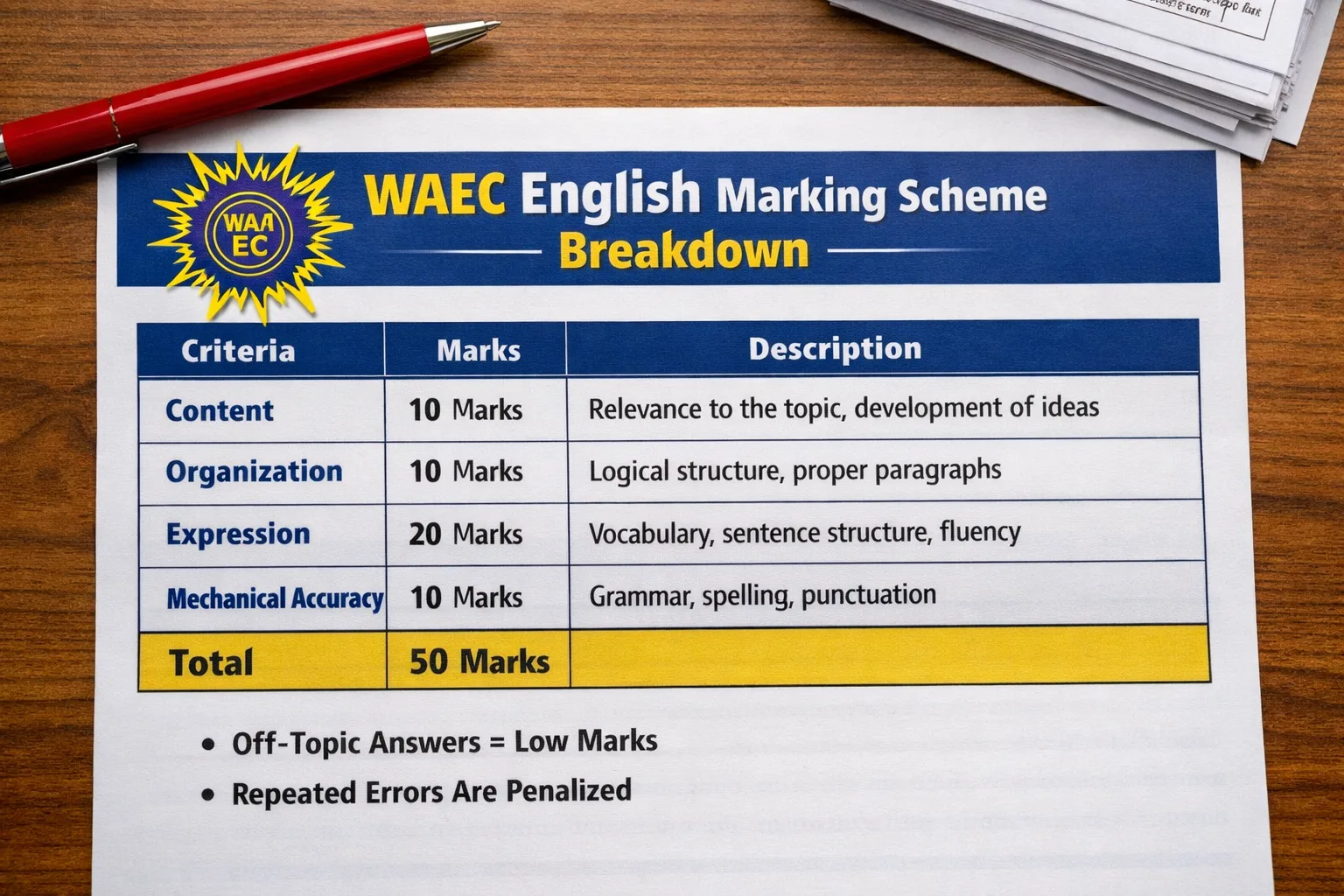
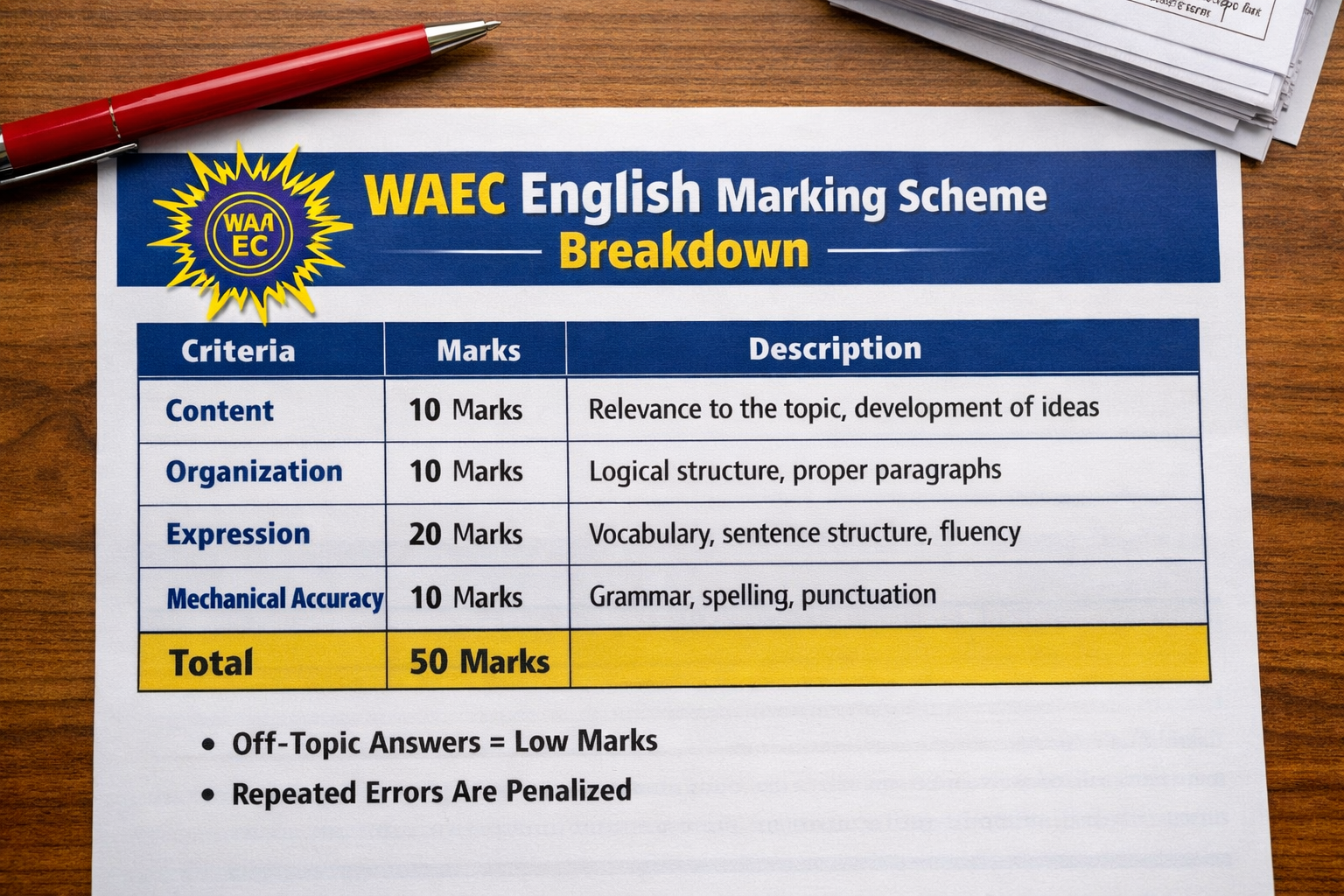
WAEC Essay Marking Breakdown
| Criteria | Marks |
| Content | 10 |
| Organization | 10 |
| Expression | 20 |
| Mechanical Accuracy | 10 |
| Total | 50 |
Content (10 Marks)
WAEC awards marks based on:
Relevance to the topic
Adequate development of ideas
Fulfilling the question’s demand
Common Penalty: Writing off-topic automatically attracts very low content marks.
Organization (10 Marks)
Examiners check:
Logical paragraphing
Clear introduction and conclusion
Flow of ideas
Key Rule: Each paragraph must express one main idea.
Expression (20 Marks)
This is the most heavily weighted area.
Marks are awarded for:
Clear sentence construction
Appropriate vocabulary
Natural flow of language
Penalty Points Include:
Awkward expressions
Repetitive words
Poor sentence structure
Mechanical Accuracy (10 Marks)
This covers:
Grammar
Spelling
Punctuation
Repeated grammatical errors attract cumulative penalties.
WAEC Letter, Article, and Report Writing Marking Scheme
Although formats differ, WAEC uses similar scoring principles.
Additional Format Marks
Formal writing (letters, reports) includes:
Address
Date
Salutation
Title
Missing any of these results in loss of format marks.
WAEC English Comprehension Marking Scheme Explained
Total Marks for Comprehension
40 marks (varies slightly by year)
How WAEC Awards Comprehension Marks
WAEC uses point-based marking.
Each correct idea = 1 mark
Grammar errors reduce marks
Answers must be concise
Important Rule: Lifting long sentences directly from the passage attracts penalties.
Types of Comprehension Questions
Factual questions
Inferential questions
Vocabulary questions
Each has specific marking expectations.
WAEC Summary Writing Marking Scheme Explained
Summary writing is one of the most misunderstood sections.
Total Marks for Summary
30 marks
WAEC Summary Mark Allocation
| Criteria | Marks |
| Content Points | 15 |
| Expression | 10 |
| Grammar | 5 |
Content Points
WAEC provides expected points. Candidates earn:
1 mark per correct point
Zero for irrelevant ideas
Expression and Grammar
Markers penalize:
Over-length summaries
Poor sentence construction
Repetition
WAEC Oral English Marking Scheme Explained
WAEC Oral English is designed to test how well candidates recognize and distinguish spoken English sounds, not how well they can spell or write. It focuses strictly on pronunciation accuracy, sound discrimination, stress placement, and intonation patterns, skills that come only through listening and repeated practice.
Unlike essay or theory questions, Oral English is objectively marked. There is only one correct answer for each question, which means guessing is risky and careless listening leads to avoidable loss of marks. Many students fail this section not because it is difficult, but because they underestimate its importance.
Key Areas WAEC Focuses On
- Vowel Sounds: Ability to differentiate similar vowel sounds such as /ɪ/ and /iː/, or /æ/ and /ɑː/.
- Consonant Sounds: Recognition of consonant contrasts like /f/ vs /v/ or /θ/ vs /t/.
- Stress Patterns: Identifying the correct stressed syllable in words and emphasis in sentences.
- Intonation: Understanding rising and falling tones in questions, statements, and expressions.
Because the marking is strict and automated, consistent listening practice is essential. Regular exposure to standard spoken English, past questions, and audio drills dramatically improves performance.
For deeper mastery, read the related post: “How to Practice WAEC Oral English Effectively Using Past Questions and Audio Tools.”
Common Mistakes Candidates Make According to WAEC Examiners
Every year, WAEC examiners release reports that quietly reveal why many candidates lose easy marks. These mistakes are not about intelligence, they are about exam technique and attention to instructions.
First, writing off-topic essays is one of the biggest reasons candidates fail. Examiners repeatedly complain that many students write impressive answers that completely miss the question. When this happens, marks are lost regardless of grammar or length.
Second, poor paragraphing makes scripts difficult to read and weakens logical flow. WAEC expects clear introduction, body paragraphs, and conclusion. When ideas are lumped together, examiners struggle to award full marks.
Third, excessive grammatical errors reduce clarity and credibility. Even good ideas lose value when sentences are poorly constructed or punctuation is ignored.
Another common issue is copying directly from comprehension passages. WAEC penalizes this because comprehension tests understanding, not memory. Answers should always be in your own words.
Finally, ignoring word limits in summary writing leads to unnecessary penalties. Writing too many or too few words shows poor instruction management.
Avoiding these mistakes alone can significantly improve your score, even without extra studying.
Suggested further reading:
How WAEC Marks Essays and Why Many Candidates Lose Easy Marks, this post explains examiner marking schemes and practical strategies to score higher with the same answers.
Expert Guide to Scoring Higher Using the WAEC Marking Scheme
Understanding the WAEC marking scheme is one of the fastest ways to improve your score, often without studying extra topics. Examiners do not mark by guesswork; they follow strict guidelines that reward precision, clarity, and structure. Students who align their answers with these expectations stand out immediately.
First, always answer exactly what the question demands. WAEC rewards relevance, not volume. If the question asks for two effects, listing five will not earn extra marks. Focus on the command words, define, explain, state, outline and respond accordingly.
Second, write legibly and neatly. Examiners cannot award marks for what they cannot read. Clear handwriting ensures your ideas are fully credited.
Third, avoid slang, abbreviations, and informal expressions. WAEC expects formal academic language.
Fourth, practice past questions alongside official marking guides. This trains you to present answers in the format examiners expect.
Finally, manage your time according to marks. Spend more time on high-mark questions to maximize your total score.
Further reading: How to Use WAEC Past Questions and Examiner Reports to Predict Exam Questions, this guide explains how to spot repeated patterns and examiner-preferred answers.
If you want, I can also turn this into a student-friendly blog post, revision checklist, or shareable WhatsApp note.
WAEC English Marking Scheme Explained: Frequently Asked Questions
How many marks do you need to pass WAEC English?
A score of 50% and above generally translates to a credit pass.
Does WAEC mark spelling mistakes seriously?
Yes. Repeated spelling errors attract cumulative penalties.
Can you score full marks in WAEC essay writing?
Yes, but only when content, organization, expression, and accuracy are excellent.
Does WAEC penalize cancelled answers?
No, as long as your final answer is clear.
Why This Guide Makes ExamGuideNg.com an Authority
This article:
i. Explains WAEC marking transparently
ii. Uses examiner-based insights
iii. Provides practical scoring strategies
iv. Aligns with official WAEC standards
It is designed to be a reference resource, not just another exam blog post.
Conclusion: Master the Marking Scheme, Master the Exam
Understanding the WAEC English Marking Scheme is not optional, it is the secret weapon of candidates who score distinctions year after year. WAEC does not mark by feelings or impressions; it marks by clearly defined rules. Once you understand what earns marks, what loses marks, and what examiners ignore completely, English stops being a gamble and becomes a structured, predictable exam.
When you write essays, comprehension answers, summaries, and even lexis and structure with the examiner’s checklist in mind, you write with purpose. Your grammar becomes more controlled, your points more relevant, and your answers more precise. This is why two students can write similar answers, yet one scores far higher, the difference is awareness of the marking scheme.
If you truly want to boost your score, your revision should go beyond practicing questions. You must also study how WAEC awards marks section by section and align your answers accordingly.
Suggested further reading: WAEC English Language Marking Scheme Explained (Section-by-Section Breakdown with Sample Answers), this related post will help you apply the marking scheme practically and avoid common mistakes that cost candidates easy marks.
Call to Action
If this guide has helped you understand WAEC English better, don’t stop here, small consistent steps make a big difference in exam success.
Bookmark ExamGuideNg.com so you always have trusted revision materials at your fingertips.
Share this article with classmates and friends preparing for WAEC, teaching others reinforces your own understanding.
Explore our WAEC English past questions and detailed marking guides to see exactly how examiners award marks and what they expect in each section.
Remember, WAEC success is not about guessing, it’s about understanding how marks are awarded and writing with intention. Start applying these strategies today, and your confidence in the exam hall will grow.
Your pass doesn’t start in the exam hall. It starts with smart preparation.
References
West African Examinations Council (WAEC)
British Council (English assessment resources)
Cambridge English Assessment
Written by Massodih Okon, Senior Exam Preparation Researcher and Academic Education Content Specialist with over 10 years of experience developing high-impact learning resources aligned with Nigerian and international examination standards. Reviewed and updated: 2026.
About the Author
Massodih Okon is an experienced educator, researcher, and digital publishing professional with a strong academic and practical background. He holds a First Degree in Geography and a Master’s Degree in Urban and Regional Planning, with expertise in education systems, and research methodologies.
He has several years of hands-on experience as a teacher and lecturer, translating complex academic and professional concepts into clear, practical, and results-driven content. Massodih is also a professional SEO content strategist and writer. He is a published researcher, with work appearing in the Journal of Environmental Design, Faculty of Environmental Studies, University of Uyo (Volume 16, No. 1, 2021), P. 127-134. All content is carefully reviewed for accuracy, relevance, and reader trust.
Related posts
- how to format a dissertation a complete step by step guide
- research methodologies explained for beginners a complete guide
- what makes a good literature review a complete expert guide
- jamb syllabus explained subject by subject 2026 complete guide
- how to write a research abstract for nigerian universities
- JAMB Success Strategies for Science Students in Nigeria: Best Requirements & JAMB Registration Portal
- Insurance vs Risk Management Salary in Nigeria and Abroad: Careers, Jobs & Professional Certifications
- Cost of Studying Medicine in Nigeria, USA, and UK With Scholarships
- Law vs Medicine: Which Career Pays More After 10 Years in Nigeria and Abroad?
- Best Data Privacy Law Certification and Educational Pathways for Aspiring Privacy Lawyers in the US, Canada & UK 2026
- How to Start a Digital Marketing Career: A Complete, Practical, and Future‑Proof Guide
- UniUyo Cut-Off Marks for All Courses (2026 Complete Guide)