
What Nobody Tells You Before You Write a Literature Review
Here’s an uncomfortable truth: most literature reviews don’t fail because of bad research. They fail because of bad framing.
Students spend weeks gathering sources, reading papers, taking notes then produce something that reads like an annotated bibliography. Study after study, summarized in sequence, with no thread connecting them. No argument. No voice. Just a long list dressed up in paragraphs.
That is not a literature review. That is a reading log.
The real test of a literature review isn’t how many sources you cite, it’s what you do with them.
Can you show where scholars agree, and why that consensus matters? Or identify the fault lines, where researchers contradict each other, where methods are disputed, where evidence is thin? Can you trace how thinking on a topic has evolved, stalled, or shifted direction? Most importantly: can you make a clear case for why your study needs to exist?
If your review can do those things, it doesn’t matter whether it’s twelve pages or thirty.
Think of it this way. A literature review is less like a history lesson and more like a courtroom argument. You are presenting evidence, yes but always in service of a conclusion. Every source you introduce should be doing a job: supporting a claim, complicating one, revealing a gap, or building toward the research question that anchors your entire study.
Examiners and academic reviewers often decide how seriously to take a piece of research within the first few pages of the literature review. A weak review even attached to solid data collection signals that the researcher hasn’t yet grasped the scholarly conversation they’re entering. A strong one does the opposite. It signals intellectual maturity, critical confidence, and genuine command of the field.
So what separates the two?
Not length. Not the prestige of the journals cited. The difference comes down to three things: purpose, structure, and synthesis. A good literature review knows what argument it is building. It organizes ideas thematically rather than chronologically or randomly. And it weaves sources together into a coherent conversation one where you, the researcher, are the one directing the discussion.
This guide is built around those principles. Whether you are writing an undergraduate project, a postgraduate thesis, or a manuscript for journal submission, what follows will show you concretely and practically how to construct a literature review that meets international academic standards and genuinely strengthens your research.
Common mistakes to avoid, readers are encouraged to explore the related post on my blog: What Makes a Good Literature Review? A Complete Expert Guide.
Definition: What Is a Literature Review?
A literature review is a rigorous, analytical, and well-structured examination of existing research, theories, and authoritative scholarly works relevant to a specific field of study. It goes far beyond a simple summary or catalogue of previous studies. Instead, a strong literature review critically evaluates sources, compares perspectives, identifies patterns, and synthesizes findings to explain what is already established, what remains contested, and where clear knowledge gaps still exist.
By doing this, a literature review demonstrates your mastery of the subject, positions your research within the broader academic conversation, and justifies the need for your study. It shows examiners, supervisors, and readers that your work is not isolated, but thoughtfully grounded in credible evidence and scholarly debate.
👉 For deeper guidance on structuring and writing an examiner-approved review, read our related post on the blog: How to Write a High-Quality Literature Review Step by Step.
Key Elements That Make a Good Literature Review (What Makes a Good Literature Review? A Complete Expert Guide)
1. Clear Focus and Defined Scope
A good literature review begins with a clearly defined topic and scope. It answers:
What is being reviewed?
Why is it relevant?
What time frame or geographical focus applies?
Without focus, the review becomes descriptive and confusing.
Example:
Instead of reviewing education in Nigeria, narrow it to digital learning adoption in Nigerian universities (2015–2024).
2. Strong Organization and Logical Structure
Organization plays a major role in what makes a good literature review. High-quality reviews follow a logical flow such as:
Chronological
Thematic
Methodological
Theoretical
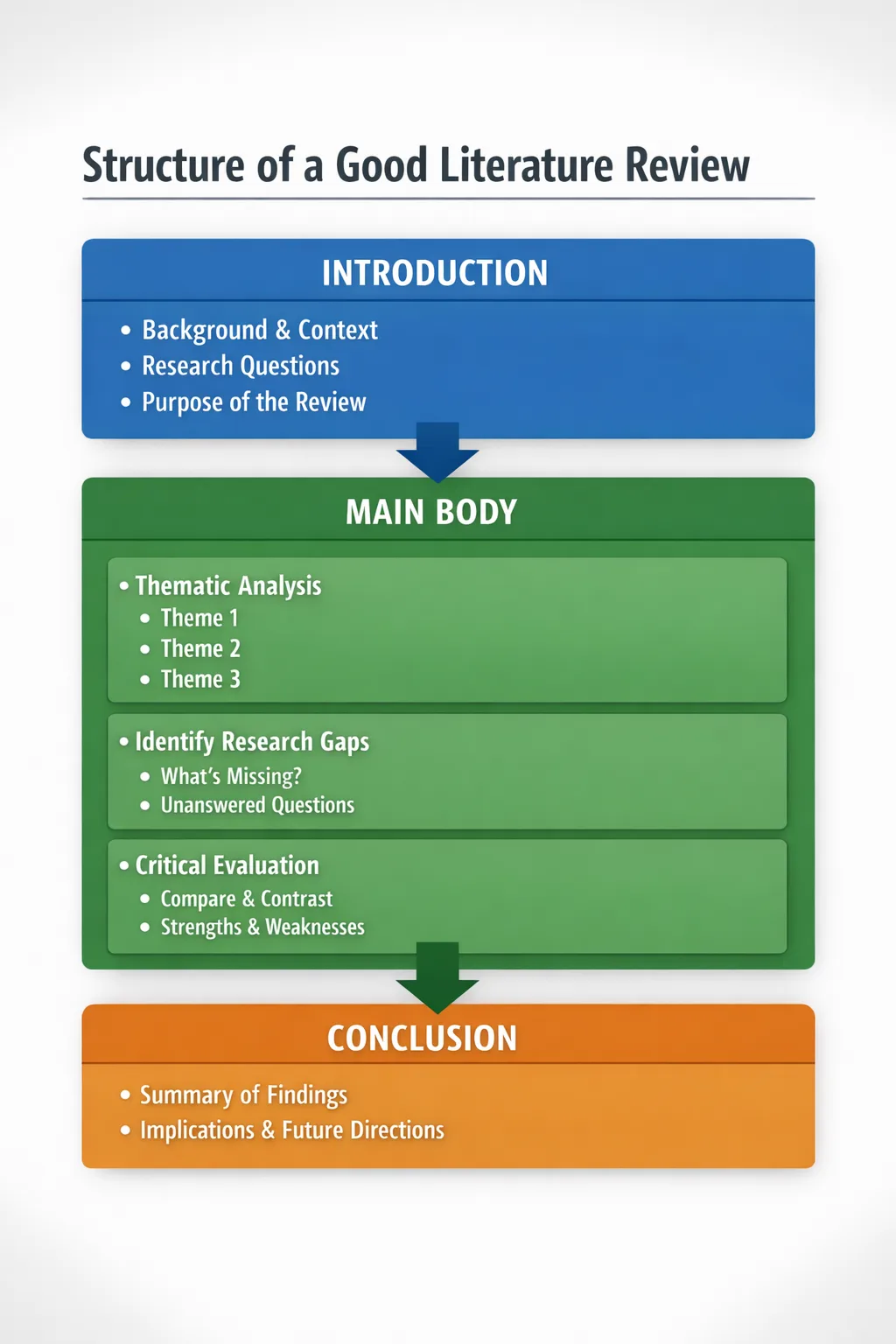
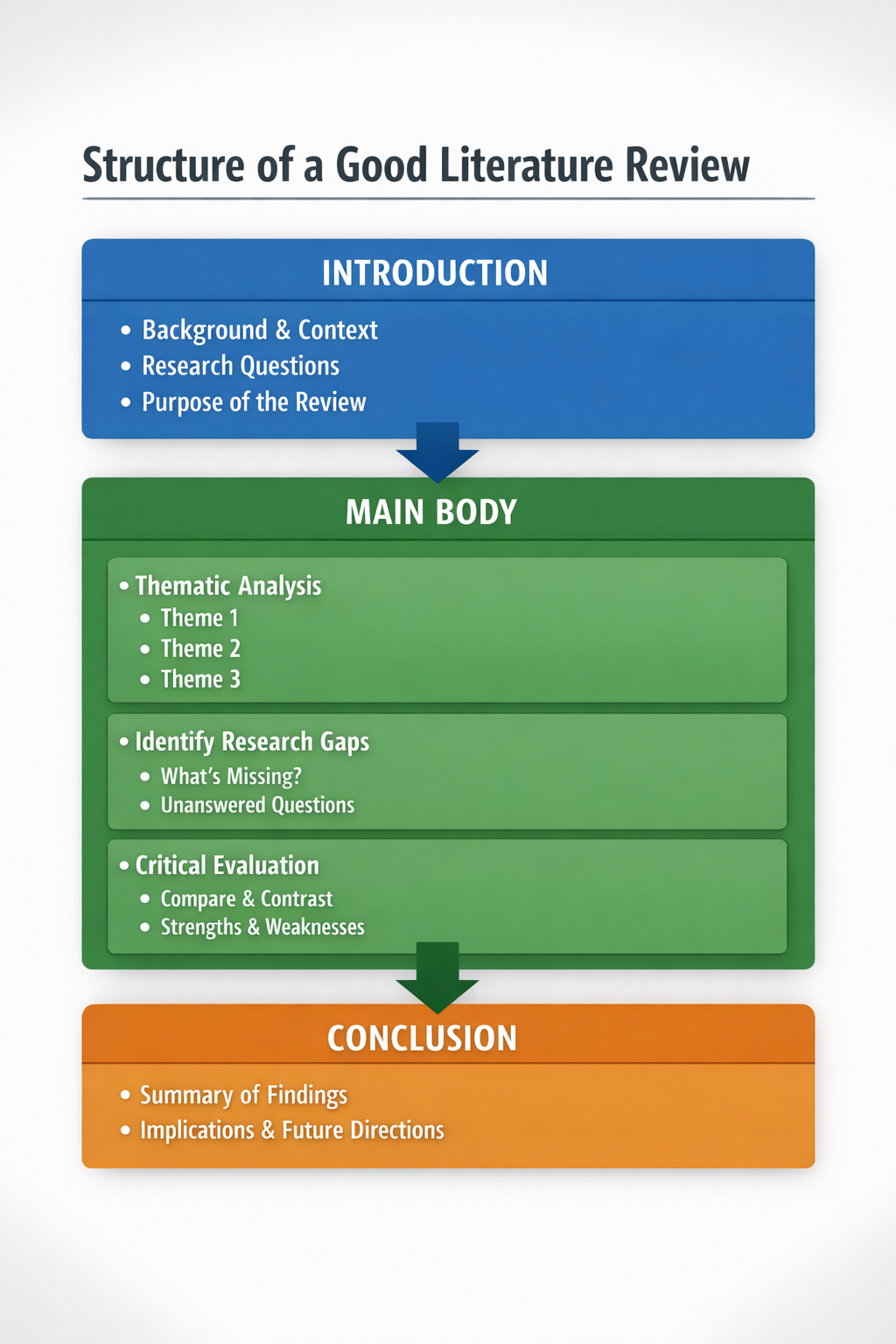
Common Structure
| Section | Purpose |
| Introduction | Context and scope |
| Body | Thematic analysis |
| Gaps | What research missed |
| Conclusion | Summary and relevance |
3. Critical Analysis, Not Summary
One major factor in what makes a good literature review is critical evaluation. You must:
Compare authors’ arguments
Highlight strengths and weaknesses
Identify contradictions and trends
Poor approach:
Author A said X. Author B said Y.
Good approach:
While Author A emphasizes X, Author B challenges this view by arguing Y, suggesting a lack of consensus. What Makes a Good Literature Review? A Complete Expert Guide
4. Use of Credible and Relevant Sources
A good literature review relies on high-quality, verifiable sources, including:
Peer-reviewed journals
Academic books
Government and institutional reports
Recognized research databases
Avoid outdated, opinion-based, or non-academic sources unless clearly justified.
Step-by-Step Guide: How to Write a Good Literature Review
1: Define Your Research Question
Your review must connect directly to your research aim. A clear question keeps the review relevant.
2: Search and Select Literature
Use academic databases and apply inclusion criteria such as:
Publication year
Methodology
Relevance to your topic
3: Read Actively and Take Notes
Focus on:
Key findings
Research methods
Limitations
4: Group Studies into Themes
Thematic organization improves readability and depth.
5: Write with Analysis and Synthesis
Combine findings instead of treating studies separately.
Practical Example: Thematic Literature Review, What Makes a Good Literature Review? A Complete Expert Guide
Topic: Social Media and Academic Performance
Theme 1: Positive Academic Impact
Several studies show that social media supports collaboration and knowledge sharing. What Makes a Good Literature Review? A Complete Expert Guide
Theme 2: Negative Academic Impact
Other researchers report distractions and reduced study time.
Theme 3: Research Gap
Few studies examine long-term academic outcomes, especially in developing countries.
This approach demonstrates analysis, balance, and originality.

Pros and Cons of a Well-Written Literature Review
Advantages
Builds research credibility
Strengthens theoretical foundation
Identifies research gaps
Improves academic writing skills
Limitations
Time-consuming
Requires strong reading skills
Can become outdated if not updated
Common Mistakes That Weaken Literature Reviews (What Makes a Good Literature Review? A Complete Expert Guide)
1. Excessive Summarization
Avoid repeating what authors said without interpretation.
2. Lack of Structure
Disorganized reviews confuse readers and examiners.
3. Weak Source Selection
Using blogs instead of scholarly articles reduces credibility.
4. No Research Gap Identified
A good literature review must justify the need for your study.
Guides and Best Practices
Write in clear, formal, and active voice
Use transition words such as however, therefore, additionally
Maintain consistency in referencing style
Revise for clarity and logical flow
Align every paragraph with your research objective
The Examiner’s Lens: How Literature Reviews Are Actually Judged (Beyond Marking Schemes)
Examiners rarely read literature reviews line by line at first glance. Instead, they scan for intellectual signals that indicate depth and control of the subject. Understanding this hidden evaluation process helps you write with intent, not guesswork.
Experienced examiners subconsciously look for:
- Evidence of selective reading, not indiscriminate citation
- Clear intellectual positioning: where the writer agrees, disagrees, or extends prior work
- Logical progression of ideas rather than chronological dumping
- Awareness of limitations within the field, not blind acceptance of authority
A review that subtly answers “Why should I trust this researcher?” often scores higher than one that simply answers “What have others said?”
The Synthesis Triangle Framework (A Practical Model for Depth)
One underused technique in literature reviews is structured synthesis. The Synthesis Triangle ensures every paragraph adds analytical value.
Each analytical paragraph should connect:
- What the literature agrees on
- Where it disagrees or diverges
- What this tension implies for your research
This approach forces you to move beyond summary and creates natural justification for your study.
Why this matters:
Google and academic reviewers both reward content that resolves complexity rather than repeating information. Synthesis signals expertise and original thinking.
Methodological Blind Spots Most Reviews Ignore
Many literature reviews focus heavily on findings but ignore how those findings were produced. This is a critical missed opportunity.
High-level reviews quietly examine:
- Overreliance on cross-sectional designs
- Small or non-representative samples
- Contextual bias (e.g., Western-centric data applied globally)
- Repeated use of self-reported measures without triangulation
Highlighting methodological concentration does not require attacking authors. It demonstrates maturity and strengthens the rationale for alternative approaches in your study.
Temporal Relevance Analysis: When Old Studies Still Matter
Outdated sources are often dismissed too quickly. The real issue is not age, but intellectual relevance.
Advanced reviews distinguish between:
- Foundational literature (still conceptually valid)
- Context-bound literature (time-sensitive findings)
- Obsolete literature (superseded by new evidence)
Explicitly stating why an older study remains relevant positions you as a critical thinker rather than a passive consumer of recent publications.
Thematic Saturation vs. Artificial Gaps
Not every absence in the literature is a genuine research gap. Some areas are already saturated.
A credible literature review shows awareness of:
- Over-researched themes with diminishing returns
- Superficial gaps created by narrow keyword searches
- Gaps that are methodological, contextual, or theoretical rather than topical
Expert warning:
Claiming a gap where scholars have simply reached consensus can weaken your credibility. Strong reviews justify gaps carefully and conservatively.
Theory as a Lens, Not Decoration
Many literature reviews mention theories only to satisfy academic convention. High-impact reviews use theory as an analytical tool.
Effective theoretical engagement involves:
- Showing how theories explain observed patterns
- Comparing competing theoretical explanations
- Identifying where existing theories fall short in specific contexts
This transforms theory from a background requirement into a justification engine for new inquiry.
Literature Review Coherence Audit (Expert Checklist)
Before final submission, evaluate your review using this internal audit:
- Does each section logically lead to the next?
- Can every paragraph be traced back to the research question?
- Have I compared authors, not just listed them?
- Have I shown awareness of limitations in the field?
- Would a reader understand why my study is necessary after this review?
If any answer is “no,” depth, not length, is still missing.
Why a Strong Literature Review Protects Your Research Long-Term
A well-constructed literature review does more than pass examinations. It:
- Shields your work from reviewer criticism
- Reduces revision demands during defense
- Improves acceptance chances for journals
- Establishes your authority for future publications
In academic publishing and postgraduate assessment, reviewers often forgive minor methodological flaws but rarely forgive weak theoretical grounding. The literature review is where that grounding is proven.
Subtle Signals of Academic Authority Readers Notice Instantly
Without stating it outright, strong reviews signal authority through:
- Confident but measured language
- Balanced treatment of opposing views
- Selective citation of high-impact sources
- Absence of exaggerated claims
These signals influence both human reviewers and search algorithms assessing content trustworthiness and expertise.
Expert Insight: What Separates Good from Exceptional Reviews
Good literature reviews explain the field.
Exceptional literature reviews interpret it.
They do not merely show that you have read widely; they prove that you understand deeply, think independently, and can responsibly contribute to scholarly knowledge.
That intellectual shift is what ultimately defines excellence in academic writing.
The Citation Ecology Concept: How Sources Interact, Not Just Exist
Most literature reviews treat citations as independent units. In reality, scholarly sources form an ecology, they influence, respond to, correct, and sometimes quietly replace one another.
An advanced review pays attention to:
- Which studies are repeatedly cited as anchors
- Which works are cited only to be challenged or corrected
- Which newer studies rely heavily on a narrow group of older authorities
Mapping this citation ecology helps you identify intellectual dominance, weak diversity of perspectives, and areas where the field may be intellectually stagnant rather than progressing.
Negative Findings and Silent Results: The Literature Nobody Talks About
One of the most overlooked weaknesses in literature reviews is publication bias, the tendency for journals to favor positive or significant findings.
High-level reviews deliberately note:
- Areas where results are inconsistent or inconclusive
- Topics with few published null or negative findings
- Research questions that appear “solved” only because contradictory evidence was never published
Why this matters:
Acknowledging silent or missing results signals scholarly honesty and protects your research from overclaiming relevance.
Context Transfer Risk: When Literature Travels Poorly
Many studies are cited across regions, disciplines, and populations without questioning transferability.
An expert literature review evaluates:
- Whether findings from developed economies translate to developing contexts
- Whether institutional settings (universities, hospitals, firms) are comparable
- Whether cultural, legal, or infrastructural differences alter outcomes
Explicitly identifying context transfer risk elevates your review from descriptive to responsibly analytical.
Conceptual Drift: How Key Ideas Quietly Change Over Time
Some concepts retain the same name while their meaning shifts subtly across decades.
A strong review detects:
- Changes in how key variables are operationalized
- Shifts in theoretical interpretation under the same terminology
- Inconsistencies masked by familiar language
This protects your study from building on assumptions that no longer hold the same meaning as earlier research.
The “False Consensus” Problem in Heavily Cited Topics
High citation counts can create the illusion of agreement.
Advanced literature reviews question:
- Whether consensus is real or simply repeated citation of a dominant view
- Whether dissenting studies exist but are under-cited
- Whether methodological similarity explains agreement more than truth
Identifying false consensus positions your research as intellectually cautious and independent.
Research Lineage Tracking: Following Ideas, Not Authors
Instead of organizing literature by author or year, exceptional reviews track idea evolution.
This involves:
- Identifying the original formulation of a concept
- Tracing how it was modified, challenged, or narrowed
- Noting which branches of inquiry were abandoned and why
Research lineage analysis demonstrates deep immersion in the field rather than surface-level reading.
Evidence Density Analysis: Quantity vs. Conviction
Not all sections of a field are supported equally.
A nuanced literature review distinguishes between:
- Areas supported by multiple independent studies
- Claims resting on a small number of heavily cited papers
- Findings derived from narrow datasets reused across studies
This allows you to argue not just what is known, but how confidently it is known.
The Reviewer Anticipation Technique
Exceptional reviews quietly anticipate reviewer objections before they arise.
They do this by:
- Acknowledging likely counterarguments
- Clarifying scope boundaries early
- Explaining why certain literature was excluded
This reduces resistance during defense, peer review, or journal submission.
Intellectual Risk Zones Within the Literature
Every field has areas where conclusions are fragile.
A mature literature review identifies:
- Topics dependent on rapidly changing technology or policy
- Findings sensitive to measurement choices
- Areas where replication is rare or impossible
Flagging these zones shows judgment and protects your study from overgeneralization.
Why Literature Reviews Shape Your Academic Reputation
Beyond a single project, your literature review:
- Signals how responsibly you engage with evidence
- Influences how supervisors and editors perceive your rigor
- Determines whether your future work is trusted without excessive scrutiny
In many cases, scholars are remembered not for their datasets, but for how clearly and fairly they interpreted existing knowledge.
Depth Signal: What Advanced Readers Notice Instantly
Advanced readers notice when a literature review:
- Treats uncertainty as informative, not embarrassing
- Uses restraint instead of exaggeration
- Demonstrates intellectual humility alongside confidence
These qualities cannot be faked with length. They emerge only from genuine analytical engagement, and they are what truly separate routine literature reviews from authoritative ones.
Epistemic Weighting: Not All Evidence Deserves Equal Influence
One of the quiet failures of many literature reviews is evidence flattening, treating all cited studies as if they contribute equally to knowledge.
An expert-level review implicitly applies epistemic weighting by considering:
- Study design robustness (experimental vs. observational)
- Transparency of data and methods
- Replicability potential
- Independence from prior dominant studies
Rather than stating this mechanically, strong reviews reflect it in emphasis: stronger evidence shapes arguments, weaker evidence is contextualized or cautiously framed.
The Absence Signal: What the Literature Avoids Discussing
Fields do not only progress by what they study, but also by what they consistently avoid.
A sophisticated review observes:
- Topics repeatedly framed as “future research” but never pursued
- Variables mentioned in limitations sections but ignored across decades
- Ethical, political, or institutional constraints shaping research silence
This absence signal often reveals structural barriers in knowledge production, not intellectual oversight and can justify your study more powerfully than an obvious gap.
Citation Velocity vs. Citation Longevity
High citation counts can be misleading without temporal interpretation.
Advanced reviews distinguish between:
- High-velocity citations: rapid uptake that fades quickly
- Long-tail citations: steady influence over extended periods
- Citation spikes driven by policy or funding cycles
Understanding citation behavior prevents overvaluing trendy but unstable findings and underestimating slow-burning foundational work.
The Assumption Audit: Hidden Premises in Established Research
Many studies rest on assumptions so widely accepted they are rarely questioned.
A high-impact literature review performs an assumption audit by identifying:
- Unstated baseline conditions
- Normative judgments embedded in “neutral” variables
- Institutional or cultural defaults treated as universal
Surfacing assumptions without attacking authors demonstrates intellectual maturity and opens space for genuinely original inquiry.
Knowledge Compression: When Fields Oversimplify Complexity
As research areas mature, complex findings are often compressed into simplified “accepted truths.”
Expert reviews recognize:
- Where nuance has been lost through repetition
- Where meta-analyses oversimplify heterogeneous contexts
- Where policy summaries distort original academic conclusions
Reintroducing complexity is not weakness, it signals mastery and prevents shallow theoretical framing.
Cross-Disciplinary Leakage: Insights Borrowed Without Adaptation
Many concepts migrate across disciplines without proper recalibration.
A strong literature review identifies:
- The original disciplinary context of borrowed theories
- Conceptual distortions during transfer
- Mismatches between original assumptions and new applications
This guards against theoretical misuse and positions your work as methodologically careful.
Temporal Fragility: Findings That Age Poorly
Some conclusions are structurally fragile over time.
An advanced review highlights:
- Results tied to outdated technology
- Findings dependent on temporary policy regimes
- Conclusions sensitive to short-term social conditions
Flagging temporal fragility demonstrates foresight and strengthens the long-term relevance of your research framing.
Intellectual Gatekeeping Patterns in the Literature
Certain voices dominate not because of superior evidence, but because of institutional visibility.
Expert reviews subtly recognize:
- Overrepresentation of specific regions or institutions
- Editorial preferences shaping research agendas
- Language barriers limiting global knowledge exchange
This awareness adds ethical depth and global sensitivity without politicizing the review.
The Boundary-Setting Function of a Literature Review
Beyond synthesis, a literature review draws boundaries.
It clarifies:
- What the field reasonably knows
- What remains uncertain
- What questions are currently unanswerable
Stating boundaries prevents overclaiming and earns examiner trust by demonstrating judgment rather than ambition alone.
Reviewer Fatigue Prevention: Writing for Tired Experts
Experienced reviewers often read under time pressure.
High-level literature reviews unconsciously help by:
- Prioritizing insight density over citation density
- Structuring sections around ideas, not authors
- Making argumentative direction obvious early
This increases acceptance likelihood without sacrificing rigor.
Unspoken Standard: Intellectual Responsibility
The deepest standard applied to literature reviews is rarely written in guidelines: Has this writer handled existing knowledge responsibly?
Responsibility shows up in restraint, balance, clarity, and honesty about uncertainty. When present, it elevates the review beyond compliance into genuine scholarship and that is the level at which work becomes both academically respected and digitally authoritative.
Frequently Asked Questions (FAQ) (What Makes a Good Literature Review? A Complete Expert Guide)
What makes a good literature review in a thesis?
A good thesis literature review critically evaluates relevant studies, aligns with the research question, and identifies gaps that justify the study.
How long should a literature review be?
Length depends on academic level, but quality matters more than word count. Undergraduate reviews are shorter than dissertations. What Makes a Good Literature Review? A Complete Expert Guide
Can I use online articles in a literature review?
Yes, if they come from reputable academic or institutional sources.
What is the difference between a literature review and an annotated bibliography?
A literature review synthesizes sources, while an annotated bibliography summarizes them individually.
Conclusion: What Truly Makes a Good Literature Review
In summary, what makes a good literature review is focus, structure, critical thinking, and credibility. It does not list studies. Instead, it connects ideas, evaluates evidence, and sets the stage for new research.
When written correctly, a literature review strengthens your academic voice, earns examiner trust, and positions your work as valuable and authoritative.
Call to Action
If you want exam-ready academic guides, research writing tutorials, and educational resources, explore more expert content on ExamGuideNg.com. Share this guide with students, researchers, and educators who want to write better and rank higher academically.
References
Written by Massodih Okon, Senior Exam Preparation Researcher and Academic Education Content Specialist with over 10 years of experience developing high-impact learning resources aligned with Nigerian and international examination standards. Reviewed and updated: 2026.
About the Author
Massodih Okon is an experienced educator, researcher, and digital publishing professional with a strong academic and practical background. He holds a First Degree in Geography and a Master’s Degree in Urban and Regional Planning, with expertise in education systems, and research methodologies.
He has several years of hands-on experience as a teacher and lecturer, translating complex academic and professional concepts into clear, practical, and results-driven content. Massodih is also a professional SEO content strategist and writer. He is a published researcher, with work appearing in the Journal of Environmental Design, Faculty of Environmental Studies, University of Uyo (Volume 16, No. 1, 2021), P. 127-134. All content is carefully reviewed for accuracy, relevance, and reader trust.
Related posts
- how to write a research abstract
research methodology explained - Insurance and Risk Management Admission Requirements in Nigeria and Abroad
- Direct Entry Admission Process in Nigeria: The Most Complete Expert Guide (2026 Edition)
- Undergraduate Scholarships for Nigerian Students: The Ultimate 2026 Guide
- IELTS Exam Requirements for Professionals: Complete 2026 Guide
- Germany Scholarships for International Students: The Ultimate 2026 Guide
- JAMB English Language Topic Repetition Index (2016–2025): Data-Driven Examination Trend Analysis
- Data Science Courses with Certificates: The Complete 2026 Guide for Beginners
- Understanding NECO Marking Scheme: A Complete Guide for Candidates