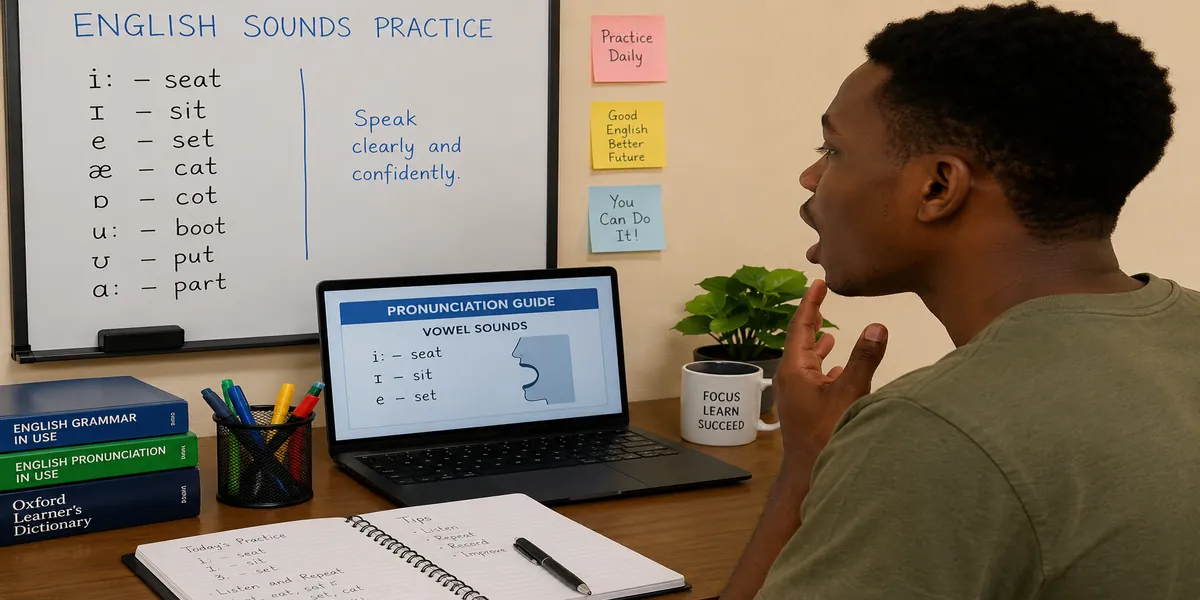
Oral English has always felt like the most confusing part of WAEC, NECO, JAMB, or NABTEB, you are not the only one. Here is the truth: Oral English is not about “speaking with a foreign accent.” It is about recognising English sounds vowels, consonants, stress, and rhyme clearly enough to answer written questions correctly and to speak in a way that people understand easily. This guide breaks it all down simply, from the sounds themselves to real exam-style practice.
In my experience teaching students, I have noticed that Oral English is the section most candidates revise last, or not at all yet it is one of the easiest sections to improve quickly once you understand the patterns. Whether you’re preparing for an exam or simply want to sound clearer at work, in interviews, or in everyday conversation, this guide will help you build that skill from the ground up.
Why Oral English Feels Difficult for Many Nigerians
Many people believe Oral English tests your accent, but that is not correct. It tests whether you can recognise and distinguish English sounds something that becomes harder when your first language uses different sound patterns entirely. This is mother tongue interference in action: Ibibio, Yoruba, Igbo, Hausa, and other Nigerian languages simply don’t contain some English sounds, so our ears and mouths were never trained to notice the difference.
Add to that poor Oral English teaching in many schools where the section is rushed or skipped because it feels “less important” than grammar and essay writing and it’s easy to see why so many Nigerians reach adulthood still unsure about basic stress and sound rules. The good news is that this is one of the fastest areas of English to improve with focused, daily practice.
Part 1: Vowel Sounds: The Foundation
English has more vowel sounds than the five vowel letters (a, e, i, o, u) suggest. From classroom experience, these are the vowel confusions I see most often among Nigerian learners:
Short vs Long Vowel Sounds
| Sound Type | Example Words | Common Mistake |
|---|---|---|
| Short “i” (as in “sit”) | sit, bit, fit | Pronounced the same as long “ee” (seat, beat) |
| Long “ee” (as in “seat”) | seat, beat, meat | Often not distinguished from short “i” words |
| Short “o” (as in “hot”) | hot, pot, lot | Confused with long “oo” (hoot, boot) |
| Schwa sound (as in “about”) | about, sofa, teacher | Often fully pronounced as a strong vowel instead of a soft, quick sound |
Part 2: Consonant Sounds That Trip Up Nigerian Speakers
The “Th” Sound
This is one of the most common English mistakes Nigerians make: replacing “th” with “t” or “d.” Words like “thin,” “this,” “think,” and “that” often become “tin,” “dis,” “tink,” and “dat.” To fix this, gently place your tongue between your teeth and push air out softly practise with “think” and “thick” until it feels natural.
“V” and “F” Confusion
Some Nigerian speakers mix up “v” and “f” sounds, saying “fery” instead of “very,” or “faan” instead of “van.” Practise by noticing that “v” involves a slight vibration in your throat, while “f” does not.
“L” and “R” Sounds
Words like “light” and “right,” or “collect” and “correct,” sometimes get mixed up. Practise saying these word pairs slowly, paying attention to where your tongue touches for “l” (tip of tongue behind top teeth) versus “r” (tongue curled back slightly, not touching the roof of the mouth).
Part 3: Silent Letters: Words That Trick the Eye
Most students were taught this incorrectly, or not taught it at all: many common English words contain letters that are written but never pronounced.
| Word | Silent Letter |
|---|---|
| Comb | b |
| Knee | k |
| Island | s |
| Honest | h |
| Wrist | w |
| Listen | t |
Memory trick: Group silent-letter words by the silent letter itself (all silent “k” words together, all silent “w” words together) this makes them far easier to remember than a random mixed list.
Part 4: Word Stress: Why It Changes Meaning
I have explained this to hundreds of students: in English, stress can completely change a word’s meaning or its grammatical role. This is one of the most overlooked areas in Nigerian English teaching.
| Word | As a Noun (Stress First) | As a Verb (Stress Second) |
|---|---|---|
| Record | REC-ord (a document) | re-CORD (to save) |
| Present | PRES-ent (a gift) | pre-SENT (to give a speech) |
| Object | OB-ject (a thing) | ob-JECT (to disagree) |
| Conduct | CON-duct (behaviour) | con-DUCT (to lead or carry out) |
One simple trick I recommend: Say each word both ways out loud, and notice which stress pattern matches the sentence’s meaning. With practice, this becomes automatic.
Part 5: Rhymes and Sound Recognition
Exam questions often ask you to identify which word does not rhyme with, or does not share the same sound as, the others in a group. From classroom experience, the trick is to say the words quietly to yourself rather than just looking at the spelling, English spelling does not always match pronunciation.
Example: In the group “cough, tough, though, rough” “though” is the odd one out, since it rhymes with “go,” while the others rhyme with “stuff.”
Part 6: Practising Oral English for Exams (WAEC, NECO, JAMB, NABTEB)
Many people believe Oral English can be “crammed” the night before an exam, but that is not correct sound recognition improves with steady, spaced-out practice, not last-minute cramming.
- Practise past Oral English questions from WAEC, NECO, JAMB, and NABTEB the sound patterns tested are very similar across all four exams.
- Read word groups aloud daily, even quietly, rather than only reading silently.
- Keep a short personal list of words you keep getting wrong, and review it weekly.
Part 7: Pronunciation Beyond the Exam Hall
This mistake is extremely common in Nigeria: many people assume Oral English skills are “just for exams” and stop practising after school. But clear pronunciation matters daily in job interviews, in office phone calls, in church announcements, and in everyday conversation.
You are not alone if you feel self-conscious about your accent. The goal is communication, not sounding foreign a Nigerian accent speaking clear, correctly-stressed English is completely acceptable and professional. For more on using this confidently at work, see our English for Jobs and Career Guide, and for broader everyday communication skills, explore our Ultimate English Skills Guide.
A Simple Daily Pronunciation Practice Plan
- Morning (5 minutes): Practise one minimal pair set (e.g., “ship/sheep,” “sit/seat”).
- Afternoon (5 minutes): Read one short paragraph aloud, focusing on word stress.
- Evening (5 minutes): Review your personal “tricky words” list from the week.
Don’t try to memorise everything at once. Focus on understanding before memorising, and small daily practice brings big improvement over just a few weeks.
Frequently Asked Questions
Is Oral English only tested through speaking?
No. In most Nigerian exams (WAEC, NECO, JAMB, NABTEB), Oral English is tested through written multiple-choice questions about sounds, stress, and rhymes not by speaking aloud to an examiner.
Why do I keep confusing certain English sounds?
This is usually due to mother tongue interference some sounds in English simply don’t exist in Nigerian languages, so your ear was never trained to notice the difference. Targeted practice fixes this over time.
Do I need to remove my Nigerian accent to improve my Oral English score?
No. Even advanced English speakers keep their natural accents. What matters for exams and real life is correctly recognising sounds, stress, and pronunciation patterns not sounding like a different nationality.
How long does it take to improve Oral English skills?
With consistent short daily practice, most learners notice real improvement in sound recognition and pronunciation within four to six weeks.
Conclusion: Oral English Is Easier Than You Think
You now understand exactly how English vowels, consonants, silent letters, and stress patterns work, and how to practise them for both exams and everyday communication. This mistake is easier to fix than you think with regular, short daily practice, you will improve steadily and with genuine confidence.
You are not alone if Oral English has confused you until now. Bookmark this page, share it with a friend also preparing for exams, and continue learning with our WAEC English Language Study Guide, our Ultimate English Exam Preparation Guide, or explore more lessons on our homepage.
Reference: British Council- LeranEnglish
Written by Tr. Edidiong Sunday
About Author
Edidiong Sunday is an English educator, communication specialist, and the founder of ExamGuideNG. She holds a Diploma in Mass Communication and a B.Ed. in English Education from the University of Uyo, and is currently pursuing a Master’s degree in English Education. With years of experience teaching English Language, Diction, and Public Speaking in reputable schools in Uyo, she creates practical, accurate, and learner-focused content to help students, job seekers, and professionals improve their English skills. Edidiong also runs a JAMB English tutorial centre in Uyo and has professional experience in journalism, broadcasting, and public speaking. Every article she publishes is guided by a commitment to clarity, accuracy, and helping learners achieve lasting success in academics, examinations, and everyday communication.
