The Business Words That Instantly Make You Sound Professional
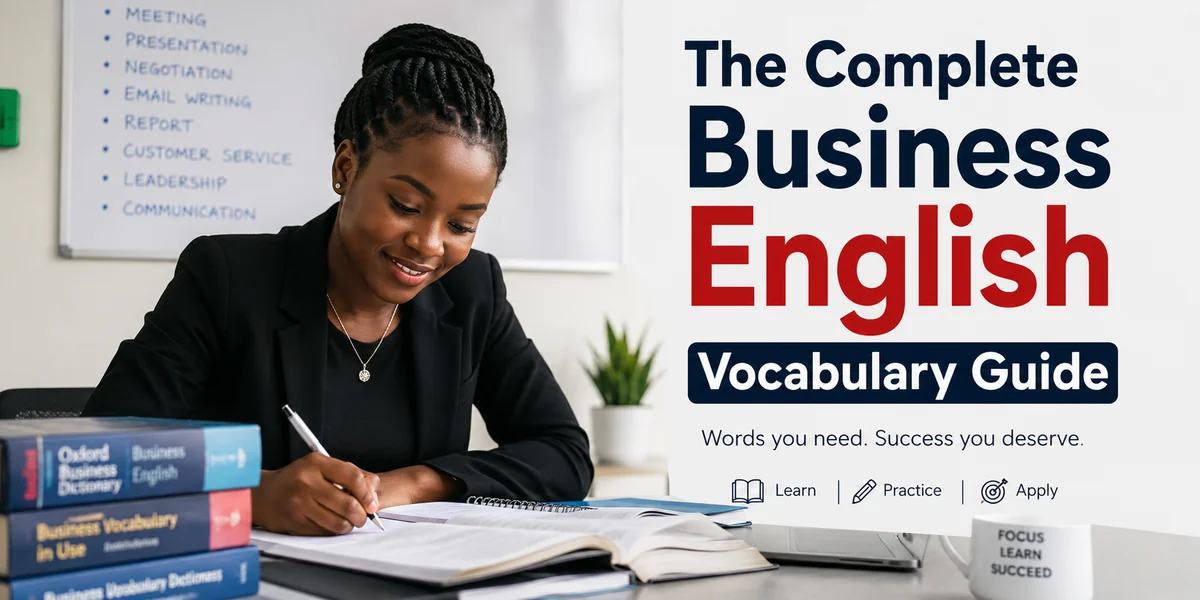
If you’ve ever sat in a meeting and heard a word like “leverage” or “streamline” and quietly wondered what it actually meant, or you’ve written a report using the same five words over and over because you didn’t know better alternatives, this guide solves that problem today. In my experience teaching graduates preparing for the workplace, vocabulary not grammar is usually the real gap between sounding like a student and sounding like a professional. This guide gives you the exact business English words and expressions that Nigerian professionals use daily in offices, meetings, reports, and interviews, explained simply, with real examples you’ll actually use.
Quick Promise: You don’t need 500 new words. You need the right 60. This guide gives you those 60, grouped by where you’ll actually use them.
Why Vocabulary (Not Grammar) Holds Many Nigerians Back at Work
Many Nigerian students struggle with business English not because their grammar is wrong, but because their vocabulary is too “everyday” for a professional setting. This is one of the most common English mistakes Nigerians make using correct but overly casual words in formal situations, such as saying “the boss will look into it” instead of “management will review it.”
The Nigerian Reality Behind This Gap
Mother tongue interference: Some professional concepts don’t have a direct word in local languages, so people either avoid the topic or explain it in a roundabout way.
Limited exposure: If your school or environment didn’t use business vocabulary regularly, you simply never encountered these words this is not a personal failure, just a gap in exposure.
Fear of “big grammar”: Many students avoid business words entirely because they fear mispronouncing them or using them wrongly in front of colleagues.
You are not alone if this sounds like you. The goal of this guide is to close that gap, one section at a time.
Section 1: Vocabulary for Meetings and Discussions
Word/Phrase Meaning Example
Agenda. The list of topics to discuss in a meeting. “Let’s stick to today’s agenda so we finish on time.”
Follow up. To check on something after the first action. “I’ll follow up with the supplier tomorrow.”
Touch base. To make brief contact or check in with someone. “Let’s touch base before the client meeting.”
Circle back. To return to a topic later. “We’ll circle back to the budget after lunch.”
On the same page. To agree or understand something the same way. “Before we proceed, let’s make sure we’re on the same page.”
Memory Trick: Group new words by the situation you’ll use them in meeting words, email words, report words instead of memorising a random list. Your brain remembers context better than a dictionary page.
Section 2: Vocabulary for Reports and Presentations
Meaning Example
Overview: A general summary without too much detail. “Here’s a quick overview of last quarter’s sales.”
Highlight: To draw attention to something important. “I want to highlight the increase in customer complaints.”
Projection: An estimate about the future based on current data. “Our projection shows a 15% growth next year.”
Feasible: Possible and realistic to achieve. “Is it feasible to complete this project by Friday?”
Bottleneck: A point that slows down a whole process. “Slow internet is the main bottleneck in our workflow.”
How to Use These Words in a Sentence Without Sounding Forced
One mistake I see almost every day is students cramming three new “big” words into one sentence to sound impressive this usually backfires. My advice is simple: use one new word per sentence, in a way that feels natural, not performed.
Overdone: “We need to leverage our resources to streamline the bottleneck and optimize our projection.”
Natural: “We need to fix this bottleneck so we can meet our projection for next quarter.”
Section 3: Vocabulary for Negotiation and Decision-Making
Word Meaning Example
Compromise: An agreement where both sides give up something. “Let’s find a compromise both departments can accept.”
Terms: The specific conditions of an agreement. “We need to review the payment terms before signing.”
Finalise: To complete something and make it official. “We’ll finalise the contract by Monday.”
Proposal: A formal suggestion or plan. “I’ve prepared a proposal for the new marketing strategy.”
Non-negotiable: Something that cannot be changed or discussed further. “The delivery date is non-negotiable this time.”
Section 4: Confusing Business Word Pairs (Common Nigerian Mix-Ups)
Many people were taught these incorrectly or never had them explained clearly. Here’s an easy way to remember the difference:
Word Pair Difference Example
Affect vs Effect: “Affect” is usually a verb (to influence); “Effect” is usually a noun (the result). “The delay will affect our timeline.” / “The effect of the delay was a missed deadline.”
Advice vs Advise: “Advice” is the noun; “Advise” is the verb. “He gave me good advice.” / “He advised me to wait.”
Economic vs Economical: “Economic” relates to the economy; “Economical” means cost-saving. “Economic growth improved this year.” / “This is a more economical option.”
Personnel vs Personal: “Personnel” means staff/employees; “Personal” means private/individual. “HR handles all personnel matters.” / “This is a personal decision.”
Section 5: Pronunciation of Common Business Words
Over the years, I have noticed certain business words that are often mispronounced in ways that can affect clarity in meetings:
Colleague: pronounced “KOL-eeg,” not “koh-LEEG”
Entrepreneur: pronounced “on-truh-pruh-NUR” the stress is on the last part
Niche: pronounced “neesh” or “nitch” (both accepted), not “nee-chay”
Data: can be pronounced “DAY-tuh” or “DAH-tuh” both are correct in business English
Section 6: Using Vocabulary in Your CV and Cover Letter
Strong vocabulary can make a simple CV line sound far more professional. Compare these:
Weak CV Phrase Stronger Alternative
“Did sales work” “Managed client relationships and achieved sales targets”
“Helped with reports” “Contributed to the preparation of monthly performance reports”
“Was in charge of the team” “Supervised a team of five staff members”
Practice Exercise: Take one bullet point from your current CV and rewrite it using at least one word from this guide. Do this for every bullet point over the next week.
Section 7: Vocabulary for Everyday Office WhatsApp and Chats
Not every business word needs to sound stiff. On semi-formal platforms like office WhatsApp groups, simpler professional words work best:
“Noted” instead of “Ok I don see am” confirms you’ve read a message professionally.
“Will do” instead of “I go do am” confirms action politely and briefly.
“Kindly confirm” instead of “Abeg confirm” keeps a respectful, formal tone in mixed company.
Quick Revision Summary
Group new vocabulary by situation: meetings, reports, negotiation, CV writing.
Use one new word per sentence don’t overload sentences to sound impressive.
Learn confusing word pairs like affect/effect and advice/advise properly.
Practise pronunciation of common business words, not just their spelling.
Rewrite your CV bullet points using stronger professional vocabulary.
Frequently Asked Questions
Q: How many new business words should I learn per week?
A: Focus on quality over quantity 5 to 7 words per week, used in real sentences, will stick far better than 50 words memorised from a list.
Q: Is it wrong to use simple words instead of “big” business vocabulary?
A: Not at all. Clear communication always beats complicated words. The goal is precision, not impressing people with vocabulary.
Q: How do I remember new vocabulary long-term?
A: Use each new word in a sentence about your own work or life within 24 hours of learning it this connects the word to your memory far better than repetition alone.
Q: What’s the fastest way to build business vocabulary for interviews?
A: Read job descriptions for roles you want and note recurring words (e.g., “manage,” “coordinate,” “implement”) these are the exact words interviewers expect to hear back from you.
Expert Tip: Oxford Learner’s Dictionaries notes that understanding a word’s typical collocations the words it’s normally used with helps learners use vocabulary more naturally than memorising definitions alone. (Source: Oxford Learner’s Dictionaries, oxfordlearnersdictionaries.com
Keep Learning: Related Lessons
Explore more Career English lessons
Browse English Communication Skills lessons
See English for Exams (WAEC, JAMB, NECO)
Return to the ExamGuideNG homepage
- The Ultimate Customer Service English Guide: Speak Professionally and Handle Customers with Confidence
- The Complete Office Communication Guide: Professional English for the Workplace
Final Word: Vocabulary Grows One Sentence at a Time
This mistake, feeling like your vocabulary is “not good enough” for the workplace is easier to fix than you think. Even advanced English speakers keep learning new professional words throughout their careers; nobody arrives at a job already knowing every business term. With regular practice, you will improve, and soon these words will come out naturally in your meetings, emails, and interviews.
Pick three words from this guide today and use each one in a real sentence before the day ends. Bookmark this page, share it with a colleague building their vocabulary, and come back whenever you want to add more professional words to your everyday English.
Written by Tr. Edidiong Sunday
About Author
Edidiong Sunday is an English educator, communication specialist, and the founder of ExamGuideNG. She holds a Diploma in Mass Communication and a B.Ed. in English Education from the University of Uyo, and is currently pursuing a Master’s degree in English Education. With years of experience teaching English Language, Diction, and Public Speaking in reputable schools in Uyo, she creates practical, accurate, and learner-focused content to help students, job seekers, and professionals improve their English skills. Edidiong also runs a JAMB English tutorial centre in Uyo and has professional experience in journalism, broadcasting, and public speaking. Every article she publishes is guided by a commitment to clarity, accuracy, and helping learners achieve lasting success in academics, examinations, and everyday communication.
