How to Stop Shaking and Speak With Power in Front of Any Audience
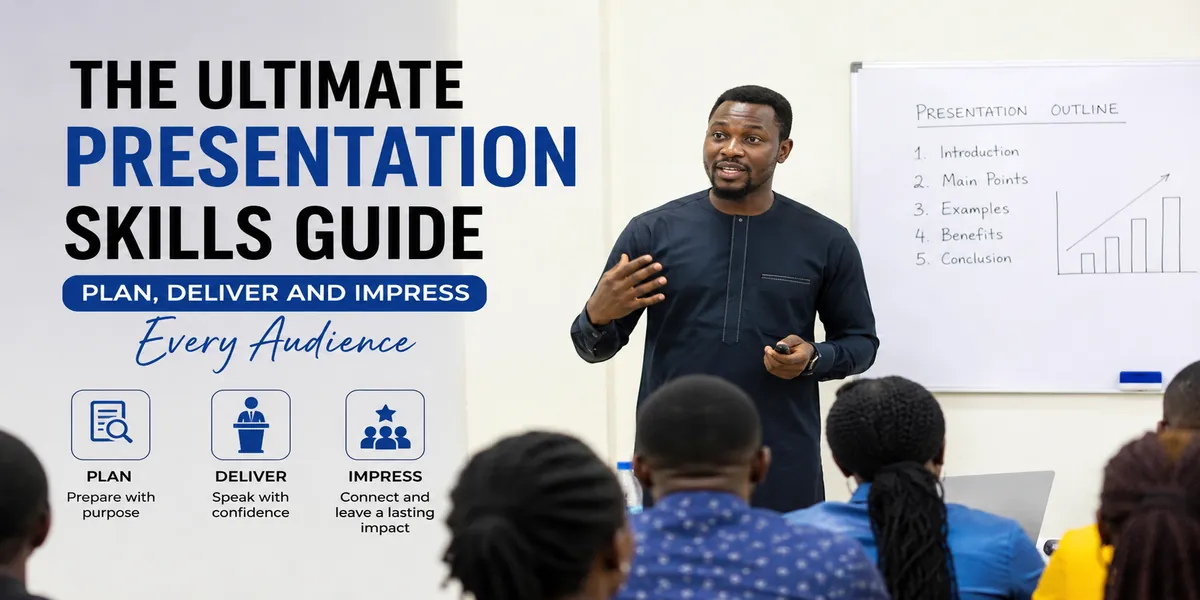
If your hands shake, your voice disappears, or your mind goes blank the moment you stand in front of people to present whether it’s a school project, an NYSC CDS presentation, or a work report to your boss this guide will fix that today. In my experience teaching students and young professionals, presentation fear is rarely about English ability. It’s about not knowing exactly what to say, when to say it, and how to recover when you lose your place. By the end of this guide, you’ll have a simple, repeatable structure for planning any presentation and the exact phrases that make you sound calm and in control, even when your heart is racing.
Quick Promise: You don’t need to be naturally “gifted” at public speaking. You need a structure. This guide gives you one you can reuse for every presentation you’ll ever give.
Why Presentations Feel So Frightening for Nigerians
Many Nigerian students struggle with presentations not because they don’t know their topic, but because of what happens the moment all eyes turn to them. This is one of the most common fears I see in classrooms and offices, and it comes from a mix of real factors.
The Nigerian Reality Behind Presentation Fear
- Exam-style teaching: Many schools focus on writing exams, not speaking, so students reach adulthood having barely practiced standing and speaking in English.
- Fear of mockery: A single bad experience being laughed at for mispronouncing a word in JSS or SS class can create lasting stage fright.
- Mother tongue interference under pressure: Nervousness often makes local language sentence patterns creep back in, even in people who speak good English normally.
- Believing perfection is required: Many people think one grammar mistake will “ruin” the presentation but audiences remember confidence and clarity far more than perfect grammar.
You are not alone if you’ve felt your heart pound before a presentation. Even experienced professionals still feel nervous the difference is they have a structure to hold onto.
Section 1: The Simple 4-Part Presentation Structure
One lesson I always teach my students is this: a presentation is not a performance, it’s a conversation with structure. Use this 4-part formula for almost any presentation a project defense, a work update, an NYSC CDS talk, or a business pitch:
- Open with a question, fact, or short story that grabs attention.
- Tell the audience what you’ll cover: “Today I’ll cover three things: X, Y, and Z.”
- Deliver your main points, one at a time, with clear transitions.
- Summarise your key point and end with a clear closing statement, not a trailing “that’s all.”
Example Opening (Hook + Roadmap)
Weak opening: “Good morning everyone. My name is Chidinma and today I want to talk about small business marketing.”
Strong opening: “Good morning everyone. Did you know that 8 out of 10 small businesses in Nigeria fail within their first five years not because of bad products, but poor marketing? Today, I’ll show you three simple marketing mistakes to avoid, and how to fix each one.”
Memory Trick: Remember your opening as HR-BC: Hook, Roadmap, Body, Close. Write these four words on a sticky note and place it where you’ll see it while preparing.
Section 2: Transition Phrases That Keep You Sounding Smooth
One mistake I see almost every day is presenters going silent or saying “erm…next” between points. Transition phrases fix this instantly:
Situation Phrase to Use
Moving to the next point: “Now, let’s move on to…” / “This brings me to my next point…”
Giving an example: “Let me give you an example.” / “To illustrate this…”
Emphasizing something important: “What’s important to note here is…” / “This is key because…”
Wrapping up a point: “So, in summary…” / “The main takeaway here is…”
Ending the presentation: “To conclude…” / “Before I finish, I want to leave you with this…”
Section 3: Recovering When You Lose Your Place
Over the years, I have noticed this is the single biggest fear presenters have forgetting what to say next in front of an audience. Here’s what to do instead of panicking:
Pause calmly: instead of rushing or saying “sorry” repeatedly. A short silence feels much longer to you than it does to the audience.
Use a bridge phrase: “Let me come back to that point,” or “As I was saying earlier…” this buys you time to recollect your thought.
Glance at your notes calmly. this looks professional, not weak. Even experienced speakers do this.
Confidence Reminder: Even advanced English speakers lose their place sometimes. The goal is communication, not a perfect script. Audiences forgive a pause far more easily than presenters expect.
Section 4: Handling Questions After Your Presentation
Many students freeze during the question-and-answer session more than during the actual presentation. Here are phrases that keep you composed:
If you understand the question: “That’s a great question. From what I found…”
If you need clarification: “Could you clarify what part of X you’d like me to explain further?”
If you don’t know the answer: “That’s a good point I don’t have that data right now, but I’ll find out and follow up.”
Notice the last phrase: saying “I don’t know” alone can feel like failure, but adding “I’ll find out and follow up” turns it into a professional, confident response.
Section 5: Pronunciation and Voice Control Tips
From classroom experience, these are the vocal habits that most affect how confident a presenter sounds:
Speak slightly slower than normal conversation, nervousness naturally speeds up speech, so slowing down deliberately balances this out.
Pause after key points, instead of rushing straight to the next sentence this gives your words weight.
Word stress in key presentation terms: “aNALysis” (stress on second syllable), “PRESentation” (stress on second syllable), “STATistics” (stress on first syllable).
Avoid rising intonation on statements, ending every sentence like a question (a common nervous habit) makes you sound unsure even when you know your facts.
Section 6: Writing Presentation Notes and Slides
Many people were taught to write full sentences on their slides that is not correct for good presentation writing.
Weak Slide Text Better Slide Text
“Our company has experienced significant growth in the last financial year due to improved marketing strategies.” “Growth Driver: Improved Marketing Strategy (+18% Revenue)”
“There are three main challenges facing small businesses in Nigeria today.” “3 Key Challenges Facing Nigerian SMEs”
The correct way is to treat your slide as a headline, not an essay your spoken words carry the full explanation.
Quick Revision Summary
- Use the HR-BC structure: Hook, Roadmap, Body, Close.
- Keep a small list of transition phrases nearby while practising.
- If you lose your place, pause calmly instead of apologising repeatedly.
- Handle “I don’t know” professionally with “I’ll find out and follow up.”
- Write slides as headlines, not full sentences.
Frequently Asked Questions
Q: How do I stop my voice from shaking during a presentation?
A: Practice deep breathing before you start, and speak slightly slower than feels natural a shaking voice is often made worse by rushing, so deliberately slowing down helps steady it.
Q: Is it okay to read from notes during a presentation?
A: Yes, glancing at brief notes is professional. What to avoid is reading full sentences word-for-word without looking up at your audience.
Q: How can I practice presentation English without a group?
A: Record yourself presenting to your phone camera, then watch it back. This shows you exactly where you rush, lose eye contact, or need clearer transitions.
Q: What if my English accent affects how my presentation is understood?
A: Focus on speaking slowly and clearly rather than changing your accent. Clarity and pacing matter far more to audience understanding than accent alone.
Expert Tip: The British Council’s guidance on public speaking notes that pausing briefly before answering a question makes speakers appear more thoughtful and in control, rather than less prepared. (Source: British Council, learnenglish.britishcouncil.org.
Keep Learning: Related Lessons
Explore more Career English lessons
Browse English Communication Skills lessons
See English for Exams (WAEC, JAMB, NECO)
Return to the ExamGuideNG homepage
- The Complete Business English Vocabulary Guide: Essential Words and Expressions for Professionals
- The Ultimate Customer Service English Guide: Speak Professionally and Handle Customers with Confidence
- The Complete Office Communication Guide: Professional English for the Workplace
Finally: Every Confident Speaker Started Nervous
This mistake freezing up or losing your place in front of an audience is easier to fix than you think. Every confident speaker you’ve ever admired once stood exactly where you are now, heart racing, unsure of their words. With regular practice, you will improve, and the HR-BC structure will start to feel automatic rather than something you have to think about.
Practice your next opening line out loud today, even if no presentation is coming up yet. Bookmark this guide, share it with a classmate or colleague preparing for a big presentation, and return here whenever you need to calm your nerves before you speak.
Written by Tr. Edidiong Sunday
About Author
Edidiong Sunday is an English educator, communication specialist, and the founder of ExamGuideNG. She holds a Diploma in Mass Communication and a B.Ed. in English Education from the University of Uyo, and is currently pursuing a Master’s degree in English Education. With years of experience teaching English Language, Diction, and Public Speaking in reputable schools in Uyo, she creates practical, accurate, and learner-focused content to help students, job seekers, and professionals improve their English skills. Edidiong also runs a JAMB English tutorial centre in Uyo and has professional experience in journalism, broadcasting, and public speaking. Every article she publishes is guided by a commitment to clarity, accuracy, and helping learners achieve lasting success in academics, examinations, and everyday communication.
