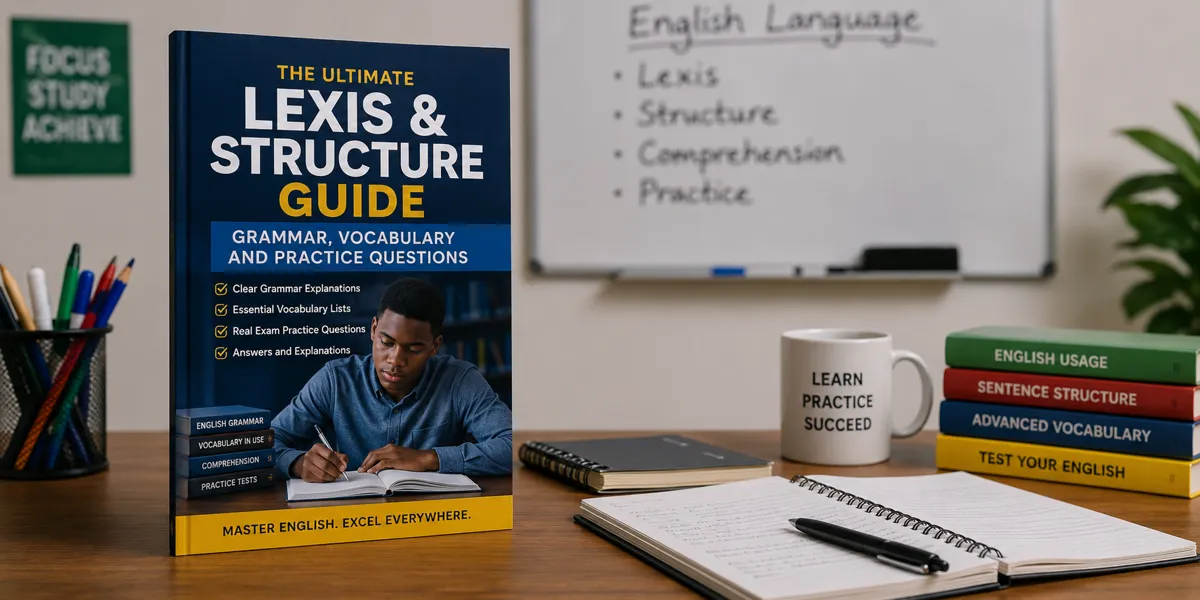
Here’s something different: instead of just explaining grammar rules to you one more time, this guide works like a real practice session. You’ll see actual Lexis and Structure style questions, try to answer them yourself first, then check the answer key with a simple explanation. This is how I train students who want results fast not by reading endless rules, but by testing themselves the same way WAEC, NECO, JAMB, and NABTEB will test them.
Grab a pen and a piece of paper. Every section below has a short question set. Attempt each one honestly before looking at the answers. This single habit testing yourself instead of just reading is one habit that will transform your English faster than anything else in this guide.
Question Set 1: Subject-Verb Agreement
Choose the correct option to complete each sentence.
- Each of the students ______ a form to submit. (A) have (B) has (C) having (D) had
- The committee ______ meeting on Friday. (A) are (B) is (C) were (D) have
- Neither the teacher nor the students ______ ready. (A) is (B) am (C) are (D) be
1. (B) has — “Each” is always singular, even when followed by “of the students.”
2. (B) is — “Committee” is treated as one single unit here, so it takes a singular verb.
3. (C) are — When using “neither…nor,” the verb agrees with the noun closest to it (“students” is plural).
This mistake is extremely common in Nigeria, especially with words like “each,” “everyone,” and “neither,” which look like they refer to many people but are grammatically singular.
Question Set 2: Tense Consistency
Identify the sentence that is correctly written.
- (A) “By the time we arrived, the meeting has already started.”
(B) “By the time we arrived, the meeting had already started.” - (A) “She has finished her assignment before the deadline.”
(B) “She had finished her assignment before the deadline.”
1. (B) — When two past actions happen at different times, the earlier one uses “had” (past perfect).
2. (B) — Same rule: “had finished” shows the action happened before another past point in time.
Memory trick: When one past action happens clearly before another past action, the earlier action almost always takes “had,” not “has” or simple past.
Question Set 3: Preposition Choices
Fill in the correct preposition.
- We will discuss ______ the matter tomorrow. (A) about (B) on (C) [no preposition needed] (D) for
- She is married ______ a banker. (A) with (B) to (C) by (D) for
- I congratulate you ______ your promotion. (A) for (B) with (C) on (D) about
1. (C) — “Discuss” never takes “about.” Simply say “discuss the matter.”
2. (B) — “Married to,” not “married with.”
3. (C) — “Congratulate on,” not “congratulate for.”
Many people believe “discuss about” is correct because it sounds natural in everyday Nigerian speech, but that is not correct in standard written English this single correction alone fixes one of the most common Lexis and Structure errors.
Question Set 4: Word Class and Word Form
Choose the word that correctly completes each sentence.
- Her ______ to the company has been outstanding. (A) contribute (B) contribution (C) contributing (D) contributive
- The manager gave a very ______ speech. (A) persuade (B) persuasion (C) persuasive (D) persuasively
- He answered the question ______. (A) confident (B) confidence (C) confidently (D) confiding
1. (B) contribution — a noun is needed after “Her,” since it’s the subject of the sentence.
2. (C) persuasive — an adjective is needed to describe “speech.”
3. (C) confidently — an adverb is needed to describe how he “answered.”
One lesson I always teach my students is this: identify the gap’s grammatical role first is it describing a noun (adjective), an action (adverb), or naming a thing (noun) before choosing based on how the word “sounds.”
Question Set 5: Cloze-Style Passage
Fill each numbered gap with the most suitable word.
“The young trader had always been (1)______ about starting her own business. After months of saving, she finally (2)______ enough capital to rent a small shop. Her customers described her as (3)______ and always willing to help.”
- (A) passion (B) passionate (C) passionately (D) passions
- (A) accumulate (B) accumulated (C) accumulating (D) accumulation
- (A) friend (B) friendly (C) friendliness (D) friendlier
1. (B) passionate — an adjective describing “she” fits after “had always been.”
2. (B) accumulated — matches the past tense of the surrounding story.
3. (B) friendly — an adjective describing the trader’s personality fits best.
From classroom experience, cloze passages punish guessing based on grammar alone. Always read the full passage first so your word choices match the story’s meaning, not just its grammar structure.
Question Set 6: Vocabulary in Context
Choose the word closest in meaning to the underlined word as used in the sentence.
- The manager remained nonchalant despite the bad news. (A) Angry (B) Calm and unbothered (C) Confused (D) Excited
- The proposal seemed feasible to the board. (A) Expensive (B) Possible to carry out (C) Risky (D) Outdated
- Her explanation was quite ambiguous. (A) Clear (B) Unclear or open to more than one meaning (C) Detailed (D) Short
1. (B) — “Nonchalant” is often misused to mean “careless,” but it actually means calm and unbothered.
2. (B) — “Feasible” means realistically possible to achieve.
3. (B) — “Ambiguous” means unclear, not detailed or short.
Your Score: What It Means
| Score Range (out of 17) | What It Tells You |
|---|---|
| 15–17 | Strong grasp of Lexis and Structure focus on speed and timed practice next. |
| 10–14 | Solid foundation with specific gaps review the sets you missed and repeat them in a week. |
| Below 10 | Don’t worry this is exactly where structured daily practice makes the fastest difference. |
You are not alone if your score wasn’t what you hoped for. With regular practice, you will improve even advanced English speakers get some of these wrong on a first attempt.
Building Your Own Practice Routine
My advice is simple: don’t try to memorise every rule at once. Instead, work through one question set like this per day, mark your own answers honestly, and keep a small notebook of the specific mistakes you repeat. Over two or three weeks, you’ll notice the same three or four error types disappearing from your answers entirely.
For deeper grammar explanations behind these question types, our Ultimate English Skills Guide breaks each rule down further. And if you’re preparing for a specific exam, see our dedicated guides for WAEC, NECO, JAMB, and NABTEB, where Lexis and Structure questions like these appear directly.
Frequently Asked Questions
How is “Lexis and Structure” different from just “grammar”?
Lexis and Structure combines grammar (structure) with vocabulary and word usage (lexis) testing both how a sentence is built and whether the right word is chosen for the context.
Why do I understand grammar rules but still get these questions wrong?
Recognising a rule in explanation is different from applying it quickly under pressure. That’s exactly why timed self-testing, like the sets above, works better than just reading rules.
How often should I practise Lexis and Structure questions?
Short daily practice even 10 to 15 questions a day builds pattern recognition far faster than occasional long study sessions.
Is it normal to keep making the same type of mistake?
Yes, completely normal. This mistake is easier to fix than you think once you notice the pattern most learners repeat just two or three error types until they’re specifically corrected.
Conclusion: Keep Testing Yourself, Not Just Reading
You’ve just completed a real practice session, not just another explanation of rules you may have already heard. This is exactly the approach that helps learners improve fastest test yourself honestly, review your mistakes, and repeat.
The goal is communication, not perfection, and with regular practice, you will improve steadily. Bookmark this page and return to retake these question sets in two weeks you’ll be surprised how much sharper your score becomes. Explore more practical lessons on our homepage, or continue with our English for Jobs and Career Guide to see how these same skills apply at work.
Source consulted:
- ETS (Educational Testing Service) – ets.org
- British Council- LeranEnglish
Written by Tr. Edidiong Sunday
About Author
Edidiong Sunday is an English educator, communication specialist, and the founder of ExamGuideNG. She holds a Diploma in Mass Communication and a B.Ed. in English Education from the University of Uyo, and is currently pursuing a Master’s degree in English Education. With years of experience teaching English Language, Diction, and Public Speaking in reputable schools in Uyo, she creates practical, accurate, and learner-focused content to help students, job seekers, and professionals improve their English skills. Edidiong also runs a JAMB English tutorial centre in Uyo and has professional experience in journalism, broadcasting, and public speaking. Every article she publishes is guided by a commitment to clarity, accuracy, and helping learners achieve lasting success in academics, examinations, and everyday communication.
